Cape Wrath Trail Food: A Resupply-First Nutrition Plan for the 230-Mile Walk
Key points
The Cape Wrath Trail runs 230 miles from Fort William to the Cape Wrath lighthouse on Scotland's far northwest coast. Most thru-hikers complete it in 14 to 21 days. There are 14 named places where you can buy or receive food on or near the route, but no daily shops, no waymarks, and no formal trail. Resupply is the central planning problem, not pack weight or calorie maths.
You will eat at four kinds of place along the trail: village shops, hotel kitchens, posted resupply boxes, and what you carry from the last stop. The choice between posting boxes ahead and buying along the way changes what you eat for three weeks. Most experienced CWT hikers blend the two.
The Knoydart section between Glenfinnan and Kinloch Hourn carries no usable resupply for most hikers and is the section where walks run shortest on food. Plan four days of food out of Glenfinnan, not three.
Daily calorie demand on the Cape Wrath Trail is typically 4,000 to 5,000 calories. Wet days and the Knoydart section sit at the top of that range. Calorie density per gram matters most between resupply points, which can be two to four days apart.
You cannot post gas canisters or batteries through Royal Mail. Plan to buy gas at Fort William, Shiel Bridge, Kinlochewe, or Ullapool.
For broader fuelling principles for multi-week walking, see the Long-Distance Walking Nutrition guide. This page is route-specific.
About this guide
I am James Frost, founder of Flaming Phoenix and creator of Phoenix Bars. For the past two years I have developed, tested, and supplied calorie-dense bars used on Marathon des Sables, on 8000-metre Himalayan peaks, on Atlantic and Pacific Ocean rows, on South Pole ski expeditions at minus 45 degrees Celsius, and on UK long-distance trails including LEJOG, the West Highland Way, and the Cape Wrath Trail.
This guide draws on customer feedback from CWT thru-hikers, the published accounts of experienced CWT walkers (Chris Townsend, Alex Roddie, Andy Wasley, Loz Wong, and the authors of the Cicerone CWT guide), and the specific calorie-density and weight constraints of the route's longest unsupported sections. It is written for hikers planning their first attempt who want a structured food and resupply plan rather than a personal trail diary.
Phoenix Bars are mentioned throughout because they were designed for the constraints this trail imposes: long carries, wet weather, freezing nights, and the kind of accumulated fatigue that closes appetite by day eight. They are not the only option. Wherever I mention them, I have been specific about what they are doing in the food bag and how many to carry.
Last updated: April 2026.
Why Cape Wrath Trail food planning is different from other long-distance walks
Most UK long-distance trails run on a recurring resupply rhythm. The West Highland Way has a town every day. The Pennine Way has a B and B almost every evening. The South West Coast Path has cafes you cannot avoid. You barely need to plan food beyond walking into the next shop.
The Cape Wrath Trail is structurally different. It is unmarked, has no formally defined route, and crosses some of the emptiest terrain in Western Europe. There are stretches where the next building of any kind is 30 miles away. Two of the named resupply points (Inchnadamph in winter, the Cape Wrath Cafe in poor weather) close without notice. Two more (Kinloch Hourn Tea Room, Oykel Bridge Hotel) are roadside meal stops, not shops. The actual list of places where you can do real grocery shopping comes down to four village shops and one famous corner stores at Badcall, plus a handful of post-friendly hotels and B and Bs.
The result: food planning happens at the route-design stage, not on the walk itself. You decide where you will resupply before you set out, you accept that some of those decisions are weather-dependent, and you carry a buffer for the days when the weather turns and you cannot move at planned pace.
The two strategies (and why most experienced hikers blend them)
There are two valid approaches to feeding yourself across the trail.
Buy-as-you-go means you stock up at Fort William before leaving, then resupply at the village shops along the route (Shiel Bridge, Kinlochewe, Ullapool, Kinlochbervie). You buy what is on the shelf, you eat what is available, and you take advantage of pubs and hotel meals where they appear. This is what Chris Townsend describes in his account of the trail. It works well in summer when shops are open and stocked, and a delay of a day rarely costs you a meal. It is lighter on the spreadsheet but heavier on the trail itself, because you cannot pre-select calorie-dense items: you eat what the shop has.
Posting boxes ahead means you pack three or four resupply parcels at home, post them to walker-friendly establishments along the route, and pick them up as you pass. Alex Roddie's winter CWT account is the canonical example. The advantages are real: you eat exactly what you want, you can pre-select calorie-dense and dietary-specific food, and you sidestep the problem of arriving at a closed shop. The trade-offs are postage cost, schedule commitment, the inability to post gas or batteries, and the need to arrive while the receiving establishment's reception is open.
Most experienced CWT hikers do a hybrid: one or two posted boxes for the longest gaps and the dietary-restricted meals, plus shop-bought food for everything else. The hybrid is what I would recommend for a first attempt, with boxes posted to Kinlochewe and Kinlochbervie, and shop resupply at Shiel Bridge and Ullapool.
If you are vegan, gluten-free, or have other dietary requirements, lean toward posting more boxes. Highland village shops carry limited specialist food. Ullapool's Tesco is the only supermarket on or near the route and the safest stop for dietary-restricted resupply. If your itinerary cannot detour to Ullapool, plan to receive a box.
The 14 points where food enters the trail
Working from south to north, here is what is actually available at each resupply point and how to use it.
Fort William is the start and the only place on or near the trail with a full Morrisons, a Tesco, and outdoor shops stocking dehydrated meals (Adventure Food, Expedition Foods, Firepot, Wayfayrer). This is where most thru-hikers do their primary shop. Carry food from Fort William through Glenfinnan to Kinloch Hourn or Shiel Bridge. Buy your starting gas canister here.
Glenfinnan has a small station tearoom but is not a useful grocery resupply. Treat Fort William as your launch supply.
Kinloch Hourn Tea Room sits in a famously remote glen and offers a hot meal and limited overnight options to walkers, but is not a grocery shop. It is a morale stop, not a resupply.
Shiel Bridge has a small shop attached to the campsite and the Kintail Lodge Hotel. Useful for two to three days of basic resupply (bread, cheese, oats, chocolate, instant noodles). Some walkers post boxes to the Shiel Bridge campsite.
Strathcarron has a shop and the hiker-friendly Strathcarron Hotel, which offers cheap camping and showers as well as meals. A useful one-day top-up rather than a primary resupply for most.
Torridon village has a shop and the youth hostel. Limited groceries, but enough for two days if needed.
Kinlochewe is one of the two best mid-trail resupply points. The Whistle Stop Cafe is excellent, the village store stocks Adventure Food dehydrated meals, and several hostels and B and Bs accept posted resupply parcels. Plan to spend a night here. Pick up your first resupply box if you are posting them.
Ullapool requires a seven-mile road walk off-trail (or a bus from Inverlael) but rewards you with a full Tesco supermarket, an outdoor shop selling Expedition Foods, restaurants, and rest. This is the dietary-restricted hiker's safest stop. Many hikers take a rest day here.
Oykel Bridge Hotel sits on the trail and serves walker-friendly hot rolls, cake, tea and coffee even outside meal hours. They will sometimes pack walkers a sandwich and boiled eggs to go. Treat as a meal stop, not a grocery resupply.
Inchnadamph has a hotel that serves meals in summer and a small hostel. In winter and shoulder season, both close. Do not rely on Inchnadamph as a resupply unless you have confirmed it is open.
Rhiconich Hotel accepts posted resupply parcels and serves meals. The hotel is a useful stop; the village itself has no shop.
Kinlochbervie has the Spar shop, which is the last village shop on the trail. Stock up here for the final two days. Some walkers post boxes here too.
Mackay's London Stores at Badcall, four miles north of Kinlochbervie, is a Cape Wrath institution. A small corner shop near the trail, often the last useful purchase before the lighthouse. Bread, cheese, chocolate, oat snacks. Worth the small detour.
Cape Wrath Cafe at the lighthouse serves hot meals to hikers who arrive when it is open. Do not rely on it being open. The owners are wonderful and the Mac n Greens dehydrated meal at the cafe is a celebrated reward, but weather and season can shutter it without notice.
Durness is the finish village (or the gateway home if you are walking south to north). Full village shop and several cafes. Eat as much as you can.
The Knoydart problem
The toughest food-planning section on the entire trail is the stretch from Glenfinnan to either Kinloch Hourn or Shiel Bridge, crossing Knoydart, the most rugged peninsula in Britain. There are no shops, no reliable hot food stops in winter or shoulder season, and the terrain is the kind that turns a planned 18-mile day into a 12-mile day if the weather closes in.
Most CWT planning guides estimate this section at three days. Plan four. Carry four full days of food out of Glenfinnan, which means roughly 16,000 to 20,000 calories per person at 4,000 to 5,000 calories a day. In a calorie-dense format that is around 4 to 5kg of food. In a low-density format (sandwiches, fresh items, regular cereal bars), it is closer to 6 to 7kg.
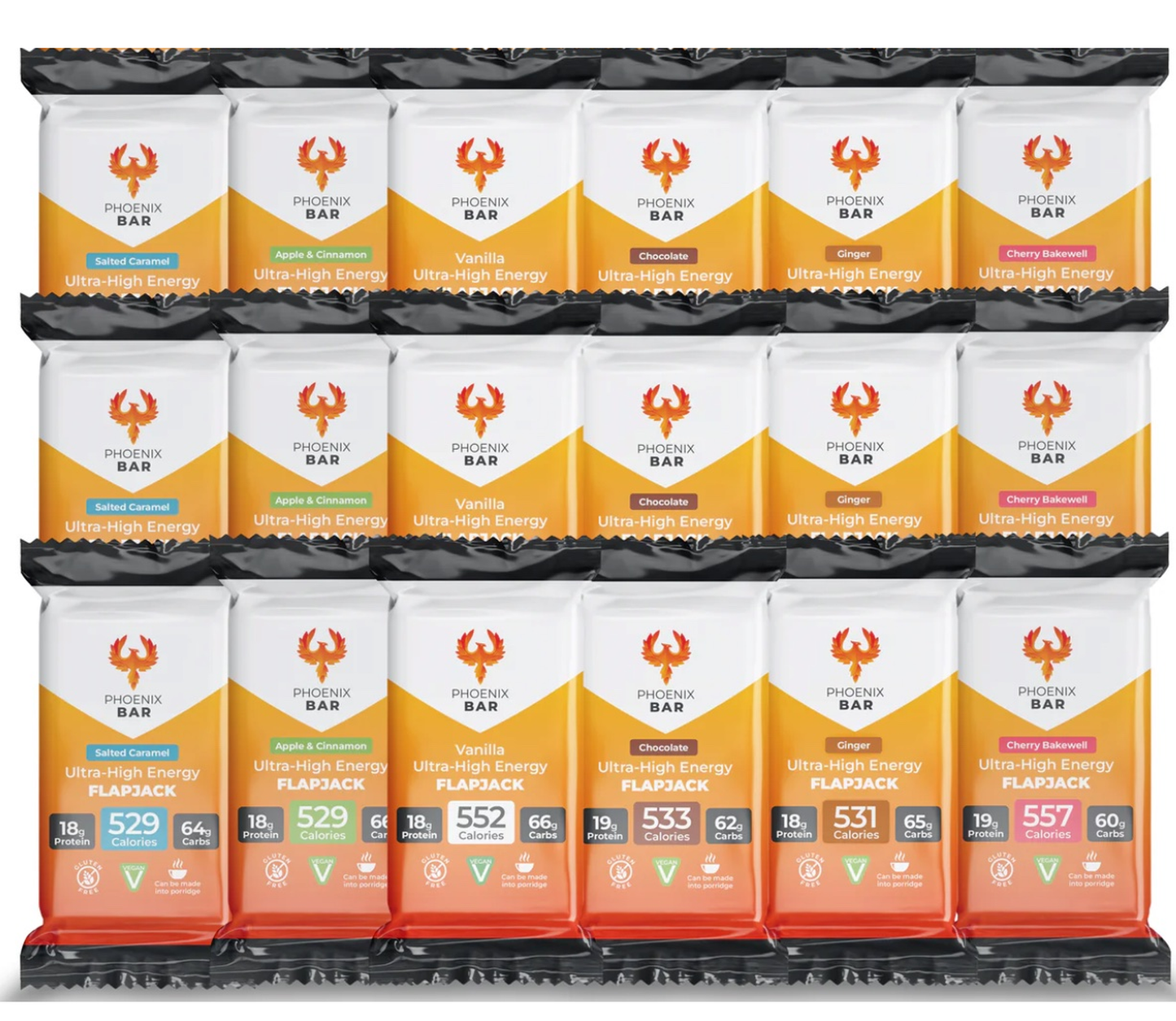
This is the section where calorie density per gram earns its place. One Phoenix Bar at 557 calories in 120g delivers approximately 4.6 calories per gram. Across four days, four bars (480g) provide 2,228 calories of trail snacking, which leaves the rest of your pack space for proper meals at camp. The same calorie load in standard cereal bars would weigh closer to 600 to 700g.
If you carry only three days of food through Knoydart and the weather slows you down, you will arrive at Kinloch Hourn already calorie-deficit, and you will spend the next four days catching up. The cost of the spare day's food is small. The cost of arriving at Shiel Bridge depleted is large.
Hot food without a stove
Two CWT-specific factors make hot food disproportionately important on this trail.
First, the wet. The Cape Wrath Trail crosses some of the wettest country in the UK, and the cold that gets into a hiker is rarely the cold of below-freezing air. It is the cold of wet feet and wet socks at six degrees Celsius after eight hours of bog-walking. A hot meal at lunch is not a luxury here; it is a body-temperature reset.
Second, the bothies. The CWT spends more nights in bothies than almost any other UK trail, partly because tent pitching on saturated ground is genuinely difficult. A bothy is a basic stone shelter with no power, no water supply, no stove, and no kitchen. You carry your own food and your own way to heat it.
For most hikers, this means a JetBoil or similar, with a fuel canister bought at Fort William or Ullapool. But for hikers who want to cut weight and stove time, or who reach a bothy at the end of a long day with nothing left in the tank for cooking, the porridge format becomes useful. A Phoenix Bar crumbled into hot water makes a 557-calorie hot porridge in about a minute. No pot, no washing up, no second course. For the practical method, see How to Use Phoenix Bars.
The same trick works for trailside lunches in driving rain. Boil water once in the morning, fill a flask, and at the worst moment of the day pour hot water over a crumbled bar in your cup. It is the closest thing to a hot meal you can have without taking the stove out in horizontal rain.
This is not unique to Phoenix Bars. Any oat-based bar will do something similar. But the calorie density (557 calories from a 120g bar) means one cup of the resulting porridge is a real meal, not a snack.
Midges and the hot-food window
From mid-June to early September, midges are a CWT planning constraint, not a wildlife footnote. They make stove cooking outside the tent or bothy genuinely unpleasant, and on still summer evenings they can make it impossible. Many summer CWT hikers eat cold dinners during the worst midge weeks, then catch up on hot food at hotel and bothy stops.
The porridge format addresses this directly. A bar plus hot water inside the tent vestibule, before the midges find you, is one of the few hot food options that does not require ten minutes of standing outside.

Phoenix Bars: Up to 557 Calories Per Bar
Soft, easy to eat whole or as a warm porridge. Low volume, two-year shelf life. Rated 5.0/5 from 344 reviews. £4.99 per bar.
How many Phoenix Bars to pack for the Cape Wrath Trail
The base recommendation is one bar per day plus two to three spares. For a 14-day CWT this is 16 to 18 bars; for a 21-day attempt it is 23 to 25 bars.
Most CWT thru-hikers find the Essential Bundle of 18 bars works for a planned 14 to 16 day walk, especially when paired with hotel meals at Kinlochewe, Ullapool and Kinlochbervie. The Complete Bundle of 30 bars is the right size for a slower 18 to 21 day walk, for a winter attempt, or for hikers who plan to use the porridge format as a second hot meal more days than not.
If you are buying-as-you-go and using bars only as trail snacks rather than as a porridge replacement for camp meals, the Starter Bundle of 12 bars is enough for the 14-day version. The Knoydart section is where to concentrate them: four bars across four days through the hardest stretch.
Eat them across the day rather than all in one sitting. A quarter-bar every 90 minutes is roughly the right rhythm. For full guidance on intake mechanics across multi-day walking, see the Long-Distance Walking Nutrition guide.
Cape Wrath Trail food mistakes to avoid
Underestimating Knoydart. Three days of food is not enough if the weather is bad. Four days is the right answer.
Treating Inchnadamph as a guaranteed stop. Outside summer, Inchnadamph is closed. Plan to walk through.
Posting gas. You cannot post gas canisters or batteries through Royal Mail. Buy gas at Fort William, Shiel Bridge, Kinlochewe or Ullapool.
Banking on the Cape Wrath Cafe. The cafe is wonderful when open. It is also weather-dependent and seasonal. Have a meal in your pack for the final approach.
All-sweet trail food. By day five, sugar fatigue is real. Carry savoury options (cheese, crackers, salted nuts, oatcakes, jerky) alongside calorie-dense bars. The Phoenix Bar flavours are deliberately not over-sweet, which helps on the long days, but variety still matters across two weeks.
Underweighting the wet days. A good weather forecast will not save you from a fortnight of Highland weather. The wet days burn more calories. Plan an extra 500 calories per day above your fair-weather estimate.
Skipping the Mackay's stop. Mackay's London Stores at Badcall is famous on the CWT for a reason. The owners are friendly to walkers, the bread is good, and it is the last useful resupply before the lighthouse. Don't pass it.
Related guides
Long-Distance Walking Nutrition covers the broader fuelling framework for multi-week walks: calorie burn, palatability over many days, and the timing rules that prevent the day-three energy collapse.
Hiking and Trekking Nutrition covers calorie demand for shorter walks and weekend hikes.
Wild Camping Food covers food planning for unsupported wild-camping nights, which the CWT involves frequently.
Lightest High Calorie Food for Backpacking ranks foods by calories per gram for hikers optimising pack weight.
Calorie-Dense Foods is the underlying theory of calorie density for anyone unsure why it matters.
How to Use Phoenix Bars covers practical formats including the porridge method.
LEJOG Nutrition is the equivalent guide for end-to-end Britain.
Ultra-Endurance and Expedition Nutrition Guide is the pillar page for multi-day endurance fuelling.
Frequently asked questions
How many calories per day do you burn on the Cape Wrath Trail?
Most CWT thru-hikers burn 4,000 to 5,000 calories per day, depending on body weight, pack weight, terrain, weather, and pace. Wet, cold, and windy days raise the number. Days through Knoydart and across the Fisherfield section sit at the top of the range. Days on easier riverside or road sections sit at the bottom.
How many days does the Cape Wrath Trail take?
Most thru-hikers complete the route in 14 to 21 days. Fast hikers manage 12 to 14 days. Slower hikers and those wanting rest days take 18 to 21. Winter attempts are typically slower because of shorter daylight and weather delays.
What is the toughest food-planning section?
The Glenfinnan to Kinloch Hourn section across Knoydart. There is no useful resupply for most hikers, and the terrain is the slowest on the trail. Plan four days of food, not three.
Can I post gas canisters and batteries to my resupply boxes?
No. Royal Mail prohibits posting both. Buy gas canisters at Fort William, Shiel Bridge, Kinlochewe, or Ullapool. Carry spare batteries from the start or buy them at the same locations.
Are Phoenix Bars suitable for winter Cape Wrath Trail attempts?
Yes. Phoenix Bars stay soft and edible in sub-zero conditions and have been used on polar expeditions at temperatures as low as minus 45 degrees Celsius. Most standard cereal bars freeze solid in winter Highland weather. The same bars also work as a hot porridge with boiling water, which is useful when wet and cold.
How many Phoenix Bars should I pack for a 14-day Cape Wrath Trail walk?
The Essential Bundle of 18 bars covers a 14 to 16 day walk well, providing one bar per day plus two to three spares. The Complete Bundle of 30 bars suits 18 to 21 day attempts or hikers using the porridge format as a regular hot meal. The Starter Bundle of 12 bars is enough if you are using bars only as trail snacks alongside shop-bought food.
Is the Cape Wrath Trail vegan-friendly?
Highland village shops carry limited specialist food, so vegan and gluten-free hikers should plan more posted resupply boxes than buy-as-you-go hikers. Ullapool's Tesco is the safest dietary-restricted resupply. Several hotels along the route are vegan-aware (Loz Wong's 2022 account on the Firepot blog confirms this). Phoenix Bars are vegan and gluten-free, which simplifies the trail snack portion of your food plan.
If you have questions about food planning for a specific Cape Wrath Trail itinerary or season, contact me directly. I am happy to help with quantities, flavour selection, and resupply box content.
James Frost Founder, Flaming Phoenix jfrost@flaming-phoenix.co.uk 07990 519422


Flaming Phoenix