
How to Gain Weight
Gaining weight requires eating more calories than your body burns, consistently, over weeks and months. This guide explains how much you need to eat, why most people fail, and practical strategies that actually work.
In this guide
Why gaining weight is harder than it sounds
How to calculate your calorie target
The calorie surplus you actually need
Why most weight gain attempts fail
Five strategies that work
Where Phoenix Bars fit
Frequently asked questions
About this guide
This guide is for anyone who wants to gain weight: people who are naturally underweight, hard gainers, people with fast metabolisms, people in physically demanding jobs, and anyone trying to build body mass.
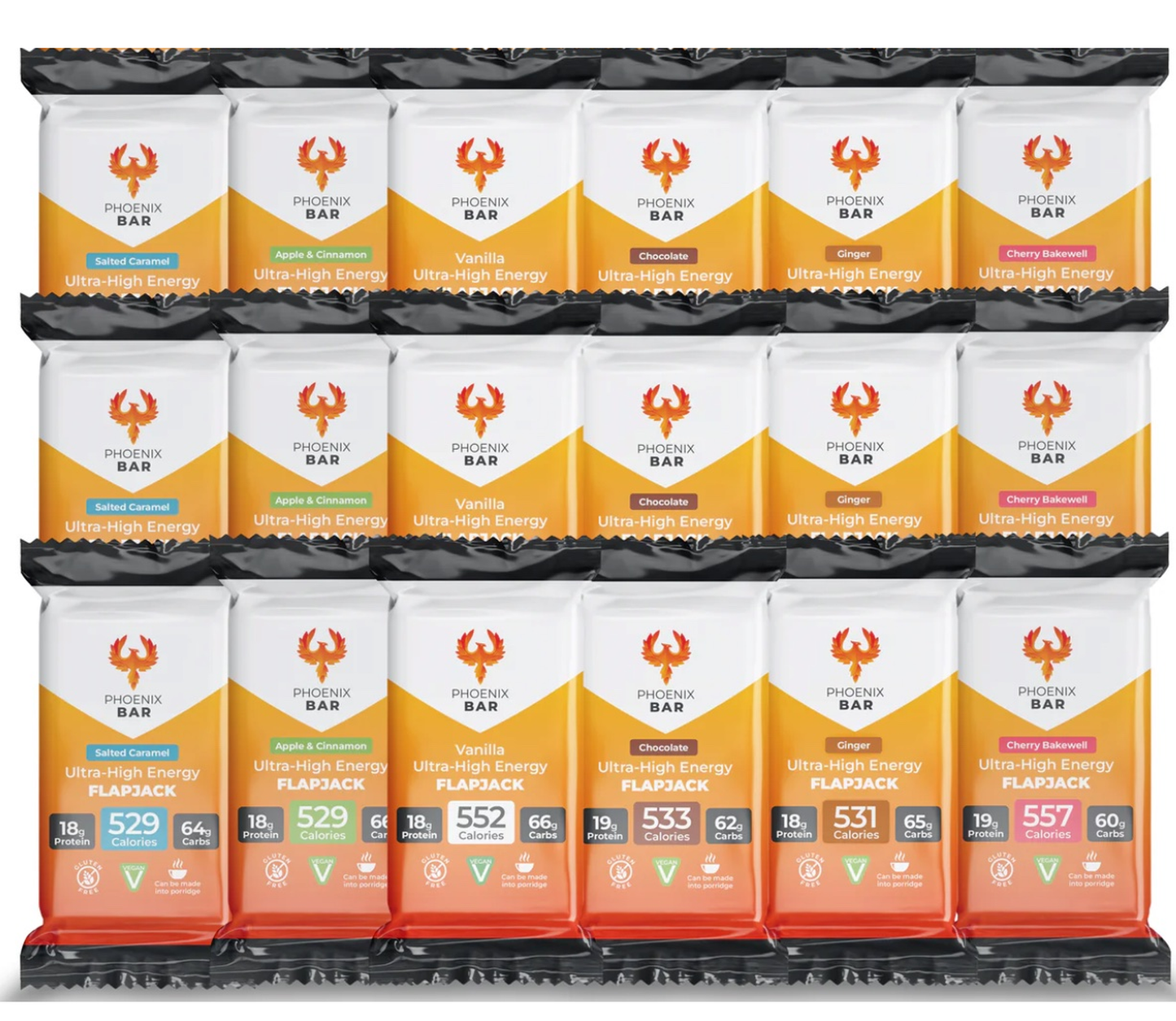
Phoenix Bars are a calorie-dense food product that delivers up to 557 calories per bar. They are food, not a supplement.
Last reviewed: July 2026. Written by James Frost, founder of Flaming Phoenix.
Gaining weight should be simple. Eat more than you burn. The surplus gets stored. Weight goes up.
In practice, it is one of the most frustrating goals in nutrition. People who want to gain weight hear the same advice repeatedly: "just eat more." But for anyone who has actually tried, whether because they are naturally underweight, managing a fast metabolism, building muscle in a bulking phase, or working a physically demanding job that burns more than they can comfortably eat, "eat more" is not helpful advice. The problem is not understanding what to do. The problem is doing it consistently when your appetite, your daily life, and the practicalities of cooking and shopping are all working against you.
This guide focuses on the practical reality of gaining weight: how many extra calories you actually need, why most attempts stall, and specific strategies that make it easier to consistently eat enough without relying on willpower or forcing down huge meals.
How to Calculate Your Calorie Target
Before you can eat in a surplus, you need to know your baseline: how many calories your body burns in a normal day. This is your Total Daily Energy Expenditure (TDEE).
A rough estimate for most adults is 2,000 to 2,500 calories per day for maintenance, depending on age, sex, height, weight, and activity level. Women typically sit toward the lower end, men toward the higher end, and active people above that.
For a more personalised estimate, multiply your body weight in kilograms by 28 to 35 depending on activity level. Someone weighing 55kg with a moderately active lifestyle would estimate a maintenance intake of roughly 1,540 to 1,925 calories per day. Someone weighing 80kg with a physical job or heavy training schedule would estimate 2,800 to 3,200 calories per day.
This is your starting point, not your target. To gain weight, you need to eat above this number consistently. For a fuller walkthrough of the numbers, see how many calories to gain weight.
The Calorie Surplus You Actually Need
A surplus of 300 to 500 calories per day above your maintenance level produces gradual weight gain of roughly 0.25 to 0.5kg per week.
For faster weight gain, a surplus of 500 to 1,000 calories per day can produce 0.5 to 1kg per week. Higher surpluses tend to result in a higher proportion of fat gain rather than muscle gain.
The important word is "consistently." A 500-calorie surplus on Monday followed by a 500-calorie deficit on Tuesday because you forgot to eat lunch results in zero net gain. Weight gain happens over weeks, not individual meals. The strategies that work are the ones you can sustain every day.
In concrete terms: if your maintenance is 2,200 calories, your weight gain target is 2,500 to 2,700 calories per day, every day. That is not an enormous amount of extra food. It is roughly one substantial snack or one additional calorie-dense food item per day.
A single Phoenix Bar delivers up to 557 calories. Adding one bar per day to an otherwise normal diet provides a surplus that is sufficient for steady weight gain without requiring any changes to your existing meals. That is the entire idea behind our high calorie bars for weight gain: one compact addition that covers the whole surplus.
Why Most Weight Gain Attempts Fail
Understanding why weight gain is difficult helps explain which strategies actually work.
Appetite does not match need. People who want to gain weight often have naturally low hunger signals. Their appetite does not push them to eat enough to gain weight. The mechanism that should make it happen is not firing strongly enough.
Large meals feel overwhelming. The standard advice is to eat bigger portions. But for someone who is already finishing normal portions with effort, a larger plate is not motivating. It is demoralising. The food sits there getting cold while the person feels increasingly full and frustrated.
Inconsistency kills progress. Weight gain requires a sustained surplus over weeks. One good eating day followed by two days of under-eating results in no net gain. Life gets in the way: busy mornings, skipped lunches, evenings where cooking feels like too much effort. The surplus evaporates.
The wrong foods are chosen. People trying to gain weight often reach for junk food because it is high in calories. This works briefly but causes energy crashes, poor digestion, and a general feeling of being unwell that makes sustained eating harder. The goal is calorie-dense food that you can eat consistently without feeling terrible.
No strategy for the gaps. Most people can eat reasonable meals. The problem is the hours between meals where no calories go in. Breakfast at 8am, lunch at 1pm, dinner at 7pm. That is three eating events in a 12-hour window. The gaps are where the surplus should come from, but without a plan for those gaps, they remain empty.

Phoenix Bars - Up to 557 Calories
Highly compact, low-volume, calorie-dense bars. Soft, easy to eat whole or as a warm porridge. Vegan, gluten-free and contain up to 66g of carbohydrates, 19g of protein & 8 vitamins & minerals.
Five Strategies That Work
These are not about eating more food. They are about getting more calories from the food you already eat and filling the gaps between meals with calorie-dense options that require minimal effort.
1. Add calories to meals you already eat, without increasing portion size.
Add butter, cream, cheese, olive oil, nut butters, or full-fat dairy to meals you are already eating. A tablespoon of olive oil added to pasta adds 120 calories. Full-fat milk instead of semi-skimmed adds 30 calories per glass. Cheese melted on top of whatever you are eating adds 100+ calories. None of these require eating more volume. They increase the calorie density of the food already on your plate.
2. Eat something calorie-dense between every meal.
The gaps between breakfast, lunch, and dinner are where the surplus comes from. A mid-morning snack, a mid-afternoon snack, and something before bed add three eating events to your day. If each delivers 200 to 300 calories, that is 600 to 900 extra calories per day, enough to drive consistent weight gain. The key is making this effortless: food that requires no cooking, no preparation, and no decision-making. A Phoenix Bar at 11am adds up to 557 calories to your day with zero preparation and zero thought.
3. Front-load calories in the morning.
Most people trying to gain weight eat their smallest meal at the time of day when appetite is lowest (breakfast) and their largest meal when appetite is highest (dinner). This leaves a 12-hour gap where calorie intake is minimal. A high-calorie breakfast sets the day up for success. A Phoenix Bar made into porridge with full-fat milk delivers 700+ calories in two minutes. Starting the day 700 calories ahead makes reaching the daily target significantly easier.
4. Keep calorie-dense food visible and accessible at all times.
If gaining weight requires you to go to the kitchen, decide what to eat, prepare something, and then eat it, most of those eating events will not happen. If there is a Phoenix Bar on your desk, in your bag, on your bedside table, or in your coat pocket, the barrier between "I could eat" and "I am eating" is reduced to unwrapping a packet. Accessibility drives consistency. Consistency drives results.
5. Track your calories for two weeks, then stop.
Most people who are trying to gain weight have no idea how many calories they actually eat. Tracking for a short period (using an app like MyFitnessPal) reveals the gap between what you think you eat and what you actually eat. Once you can see the gap, you can fill it with specific, targeted additions. After two weeks, you will have enough awareness to manage intuitively. Tracking is a diagnostic tool, not a permanent habit.
Where Phoenix Bars Fit
Adding one Phoenix Bar per day to an otherwise normal diet provides a surplus of up to 557 calories. The surplus needed for gradual weight gain is 300 to 500 calories per day. One bar exceeds that threshold without requiring any changes to your existing meals, any cooking, or any willpower beyond unwrapping a packet and eating it.
The format matters. Phoenix Bars require no cooking, no preparation, and no decision-making. They can be eaten as a bar, broken into pieces for grazing across the day, or made into porridge with hot water or milk. They are portable, shelf-stable for two years, and can be kept anywhere you spend time. They do not melt in heat or freeze in cold, so they can live in a car, a desk drawer, a kit bag, or a coat pocket without going off.
For someone whose weight gain attempts have failed because of inconsistency, low appetite, or the effort required to eat more, a single bar that adds up to 557 calories to the day with zero friction is often the difference between a surplus that exists on paper and one that actually happens.
"Perfect as a lunch time snack to get me through the day, keeping energy levels high. Also tastes great."
"I always struggle with finding enough calories when competing at long races. The Phoenix Bar has answered that question. It also tastes delicious."
For a convenient option on days when cooking isn't practical, here is how the highest-calorie bars compareon calories and protein.
Buy Phoenix Bars: £5.25 per bar, up to 557 calories
Related Guides
- Calorie-Dense Foods: What They Are and When They Help
- Soft High-Calorie Foods
- How to Get More Calories Without Eating More Food
- 3,000 Calorie Meal Plan
- High-Calorie Snacks Ranked by Calories Per Bite
Frequently Asked Questions
How many extra calories do I need per day to gain weight?
A surplus of 300 to 500 calories per day above your maintenance level produces gradual weight gain of roughly 0.25 to 0.5kg per week. A single Phoenix Bar provides up to 557 calories, which is sufficient as a daily surplus on its own without changing any other meals.
Why can't I gain weight even though I eat a lot?
Most people who believe they eat a lot are overestimating their intake. Track your calories for one week using an app and you will likely find a gap between what you think you eat and what you actually eat. Other factors include a naturally high metabolic rate or high activity levels. Our guide on why you can't gain weight walks through the usual causes.
On days when a full meal is the barrier, some people use a bar in its place. My meal replacement bars UK comparison covers which type actually carries enough energy to do that job.
What is the fastest way to gain weight?
A surplus of 500 to 1,000 calories per day can produce 0.5 to 1kg per week. Focus on calorie-dense foods, eating between meals, adding fats and dairy to existing meals, and keeping ready-to-eat high-calorie options accessible at all times. Two Phoenix Bars per day delivers over 1,000 calories of surplus on top of normal eating.
Is it better to eat more meals or bigger meals?
More meals. Eating five to six smaller meals and snacks is almost always more effective than trying to eat three larger ones. Large meals are hard to finish when appetite is low and often lead to skipping subsequent meals because you still feel full. Small, frequent, calorie-dense eating events sustained across the day produce better consistency and higher total intake.
Are Phoenix Bars a weight gain supplement?
No. Phoenix Bars are a food product, not a supplement. They are made from oats, coconut oil, and plant-based protein. They are not formulated as a weight gain product, but they deliver up to 557 calories per bar, which makes them one of the most calorie-dense ready-to-eat food options available. Adding one bar per day to a normal diet provides sufficient surplus for steady weight gain.
Can I gain weight without eating junk food?
Yes. Calorie-dense whole foods (nuts, nut butters, full-fat dairy, oils, oats, granola, dried fruit, eggs cooked with butter and cheese) provide the same calories as junk food without the energy crashes and digestive issues. Compact high-calorie food bars made from real ingredients also fit this category. Phoenix Bars are made from gluten-free oats, coconut oil, and plant-based protein, with up to 557 calories per bar.
How long does it take to gain weight noticeably?
At a 500-calorie daily surplus, expect roughly 0.5kg per week, or 2kg per month. Visible body composition changes typically take 8 to 12 weeks of consistent eating. The first few weeks often show fluctuating results because of water retention, glycogen storage, and digestive volume; weight gain becomes more linear once your body adapts.
Buy Phoenix Bars
If you have any questions about using Phoenix Bars as part of a weight gain strategy, contact me directly. I am always happy to help.
James Frost
Founder, Flaming Phoenix
jfrost@flaming-phoenix.co.uk
07990 519422


Flaming Phoenix




Why I built Phoenix Bars
Hi, I'm James.
I started Phoenix Bars at 23 after 150 conversations with ultra endurance athletes, extreme adventurers and people who struggle to eat enough calories.
Every design choice came directly from one of those conversations.
I pack every order from my home in Surrey, and I reply to every email myself, usually the same day.
Made in the UK. Hand-packed by James in Surrey. Used at Marathon des Sables, the South Pole, and in everyday situations where food feels hard.
