
Ultra Marathon Nutrition for Multi-Day Races
UK multi-day ultra races combine sustained endurance with cold, wet, overnight conditions that destroy appetite and make eating one of the hardest parts of the race. This guide covers how to fuel when it matters most.
In this guide
- Why UK ultra races create a specific nutrition problem
- The calorie maths of a multi-day ultra
- Why most runners under-fuel in the second half
- Mandatory kit calorie requirements
- What makes food work in UK race conditions
- How Phoenix Bars can be used
- Practical fuelling strategies by race phase
- Frequently asked questions
About this guide
This guide explains the specific nutrition challenges of UK multi-day ultra races and how to build a fuelling strategy that works in cold, wet, overnight conditions where appetite typically collapses.
For broader guidance on ultra-endurance nutrition across all environments, see the Ultra-Endurance and Expedition Nutrition Guide. For guidance on using Phoenix Bars across different situations, see How To Use Phoenix Bars.
Phoenix Bars are a high-calorie nutrition bar designed for situations where maximum calories in minimum weight and volume is critical.
Last reviewed: 2026
UK multi-day ultra races are among the most nutritionally demanding events in endurance sport. Not because the distances are the longest or the terrain is the most extreme, but because the combination of cold, wet, overnight running, sleep deprivation, and sustained effort over 24 to 100+ hours creates conditions where eating becomes genuinely difficult at the exact moment your body needs calories most.
In a desert ultra, heat suppresses appetite but you can eat at camp. In a mountain ultra in the Alps, you move through villages and can buy food. In a UK winter ultra, you are often moving continuously through the night, in rain and wind, carrying everything you need, with checkpoints that may offer little more than water and a warm room. Your nutrition is almost entirely what you carry and what you packed in your drop bag.
The runners who finish strong are not always the fastest. They are almost always the ones who kept eating when everyone else stopped.
Why UK Ultra Races Create a Specific Nutrition Problem
UK multi-day ultras combine several factors that individually suppress appetite and together make eating one of the hardest aspects of the race.
Cold and wet conditions. UK races typically run through autumn, winter, and early spring. Rain, wind, and temperatures between -5°C and 10°C are standard. Cold increases calorie expenditure (the body burns energy to stay warm) while simultaneously reducing appetite and making food harder to eat. Wet, cold hands make opening wrappers and handling food physically difficult.
Overnight running. Most UK multi-day ultras involve one or more overnight stages. Running through the night disrupts the hormonal signals that drive appetite. Many runners report being unable to face food between midnight and dawn, which is often the longest stretch without a checkpoint.
Sleep deprivation. By the second or third night of a multi-day race, cumulative sleep deprivation compounds the appetite problem. Nausea, cognitive fog, and a general revulsion toward food are common. This is the point where most DNFs happen, and under-fuelling is almost always a contributing factor.
Sustained low-intensity effort. UK ultras typically involve long stretches of walking, power hiking, and moderate-pace running over rough terrain. This steady-state effort burns 400 to 600 calories per hour but does not feel intense enough to trigger the urgency of fuelling that a road marathon does. Runners drift into a calorie deficit without realising it until the consequences hit.
Limited resupply. Unlike European ultras with well-stocked aid stations, many UK races offer basic checkpoints with water, perhaps soup, and limited hot food. Your primary nutrition source is what you carry in your race vest and what you placed in your drop bag.
The result: calorie needs are very high (4,000 to 7,000+ calories per day depending on pace, terrain, and conditions), but the conditions make consuming those calories progressively harder as the race goes on.
The Calorie Maths of a Multi-Day Ultra
Understanding the numbers helps explain why nutrition strategy matters so much.
A runner covering 50 to 80 miles per day over mixed terrain burns roughly 500 to 700 calories per hour of movement, plus a baseline metabolic requirement of around 2,000 calories per day. For a 24-hour stage involving 16 hours of movement, total calorie need is approximately 10,000 to 13,000 calories. Over a multi-day event, the cumulative requirement can exceed 30,000 calories.
Most runners can absorb 200 to 300 calories per hour while moving, meaning on-the-move fuelling covers only about half of hourly expenditure. The rest must come from checkpoint stops, camp meals, and pre-race loading.
The deficit is unavoidable. No one consumes as many calories as they burn in a multi-day ultra. The goal is not to match expenditure. The goal is to minimise the deficit enough that performance does not collapse. The difference between a manageable deficit and a race-ending one is often just a few hundred calories per stage, which is why the calorie density of the food you carry matters so much.
Why Most Runners Under-Fuel in the Second Half
The pattern is predictable and almost universal. Runners eat well in the first 12 to 18 hours. Appetite is present, the novelty of race food has not worn off, and the body is still responding normally to effort.
Somewhere between hours 18 and 30, appetite begins to fade. Sweet foods become repulsive. Gels trigger nausea. The thought of another energy bar is unbearable. This is palate fatigue compounded by physical fatigue, cold, and the onset of sleep deprivation.
From this point, most runners eat less and less even as calorie needs remain constant or increase. The deficit that has been slowly building suddenly accelerates. By the time the consequences appear (sudden weakness, inability to maintain pace on climbs, emotional collapse, shivering that will not stop), the runner is thousands of calories behind and cannot recover the deficit fast enough to continue.
The solution is not willpower. It is strategy: carrying food that remains palatable and easy to eat when everything else has become impossible, and eating proactively before appetite disappears rather than reactively after it has gone.
Mandatory Kit Calorie Requirements
Most UK ultra races include a mandatory kit list that specifies a minimum calorie reserve. This is typically 500kcal of emergency food per runner, though some races require more.
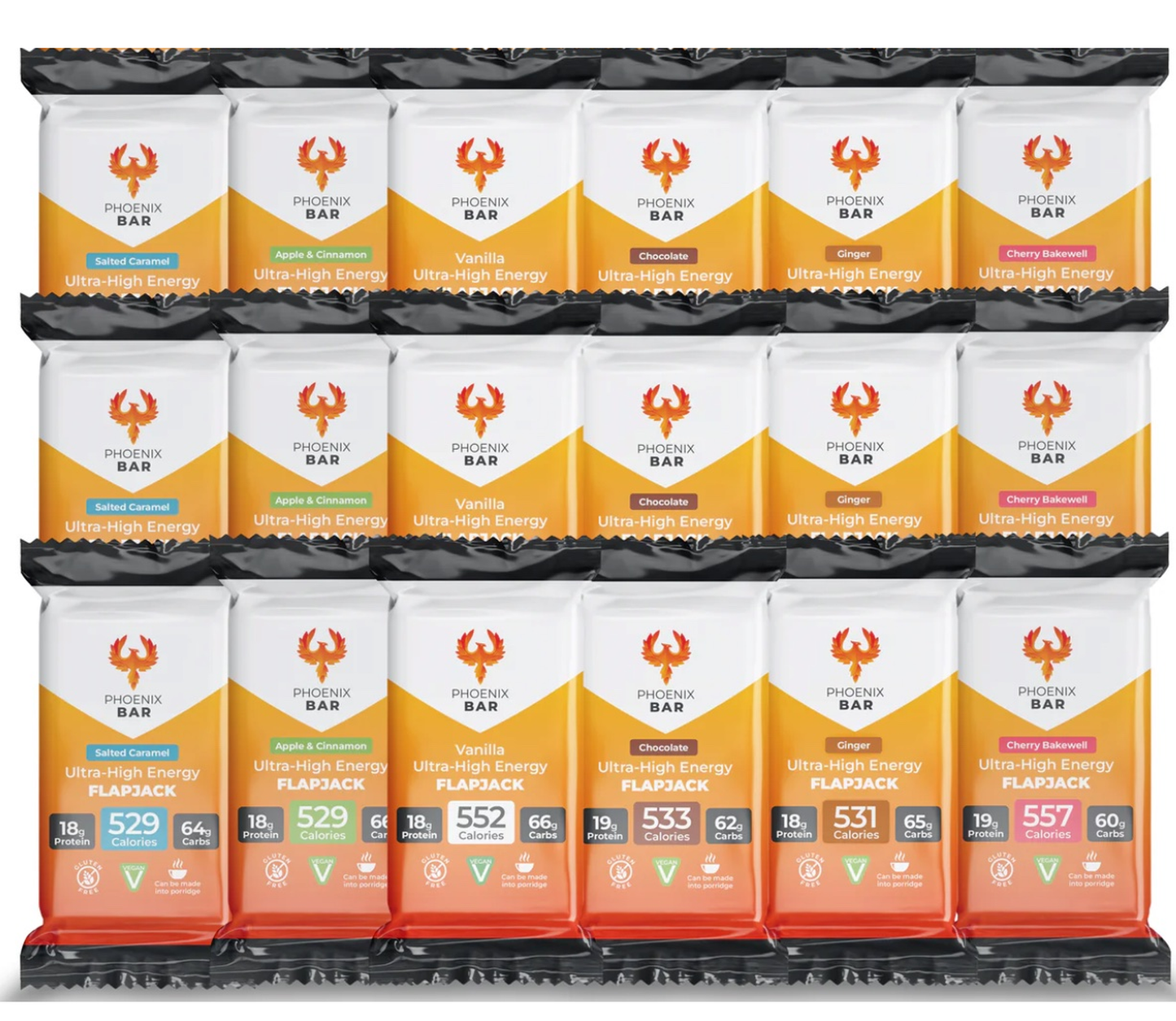
A single Phoenix Bar meets the standard 500kcal mandatory kit requirement in one item (557 calories). For races requiring higher reserves, two bars (1,114 calories) provide substantial emergency food at a total weight of 240g.
This matters for two reasons. First, it simplifies kit preparation: one bar in the race vest satisfies the requirement without needing to combine multiple smaller items. Second, it means your emergency food is something you would actually want to eat in an emergency, not a random collection of gels and sweets assembled to hit a calorie number.

Phoenix Bars: Up to 557 Calories Per Bar
Easy to eat and easy to digest nutrition bars which are specialised for ultra running. Up to 66g of carbs and 19g of protein.
What Makes Food Work in UK Race Conditions
The requirements for race food in a UK winter ultra are specific and unforgiving.
Does not freeze or harden. Many standard energy bars become rock-solid below 5°C. If you cannot bite into it, it is useless. Food for UK winter racing must remain soft and edible in near-freezing conditions.
Does not require dry hands to open or eat. Wet, cold, gloved hands are the norm. Food that requires tearing a small notch on a gel packet or peeling a tight wrapper is impractical in these conditions.
High calories per gram. Pack weight matters when you are carrying everything for 24+ hours. Higher calorie density means fewer grams for the same energy.
Not excessively sweet. Palate fatigue from sweet foods is one of the primary reasons runners stop eating in the second half. Food with milder, more neutral flavours sustains appetite across longer timeframes than gels and sweet bars.
Provides sustained energy, not just sugar spikes. Food combining carbohydrates with fat and protein delivers both fast and slow-release energy, supporting consistent output over hours rather than the spike-and-crash cycle of pure sugar.
Versatile in format. Food that can be eaten as a solid bar when moving, broken into pieces for gradual grazing, or made into porridge with hot water at a checkpoint provides options for different phases of the race and different states of appetite.
How Phoenix Bars Can Be Used
In a UK winter ultra, your nutrition needs to survive rain, cold, mud, and 30+ hours of continuous movement. Phoenix Bars stay soft when the temperature drops below freezing, when most standard bars become solid blocks. They can be broken into pieces and stored in a race vest pocket for continuous on-the-move eating, or mixed with hot water at a checkpoint to make a calorie-dense porridge in a cup. A single bar meets the standard 500kcal mandatory kit emergency calorie requirement in one item.
The six flavours are mild and not excessively sweet, which means they remain palatable deep into multi-day efforts when sugar fatigue has made gels and sweet bars intolerable.
While moving: Break a bar into pieces and eat them gradually from a race vest pocket. A full bar consumed over 90 minutes delivers roughly 370 calories per hour alongside whatever gels or other nutrition you are using.
At checkpoints: Eat a full bar or half bar alongside whatever hot food is available. If the checkpoint has hot water, make a Phoenix Bar porridge in a cup for a 557-calorie hot meal in two minutes. The psychological and physical benefit of hot food during a cold overnight stage is significant.
In drop bags: Pack two to three bars per drop bag. These serve as guaranteed calorie-dense nutrition regardless of what the checkpoint provides. A drop bag with three Phoenix Bars contains 1,671 calories of reliable, ready-to-eat food.
During the overnight collapse window: This is where Phoenix Bars earn their value. Between midnight and dawn, when appetite has disappeared and sweet food triggers nausea, a mild-flavoured, soft bar broken into small pieces can keep calories going in when nothing else works. Even eating half a bar (275 calories) during a four-hour overnight stretch where other eating has stopped can be enough to prevent a total energy crash.
"I successfully used Phoenix Bars as part of my fuelling strategy for the Winter Spine Challenger South. Reliable, easily eaten and most crucially for me, tasty and palatable especially towards the end of the race where you find it hard to eat. I ate the bars slowly by breaking them down into chunks and consumed a couple every 30 minutes. Crucially for this race where the temperature was around or below freezing, the bars remained soft enough to eat unlike some other food that I had that was too hard to eat!"
"I ate 5 Phoenix Bars during the Spine Race and I thought they were very good. I like the fact that they are so calorie-dense and that they don't freeze easily in the cold."
Full nutritional information and ingredient lists for all six flavours are available on the product page.
Practical Fuelling Strategies by Race Phase
Pre-race (24 hours before start). Focus on familiar, carbohydrate-rich meals. Do not try anything new. A Phoenix Bar porridge with milk the morning of the start provides a 600+ calorie breakfast without requiring a large meal.
Hours 0 to 12 (fresh, appetite present). This is when eating is easiest. Establish a rhythm: eat something every 30 to 45 minutes. Use a mix of gels, bars, and real food. Do not rely exclusively on gels even though appetite makes them easy to take. Building a calorie buffer now pays off later.
Hours 12 to 24 (appetite fading, first night). Switch away from pure sugar. This is where Phoenix Bars become more useful than gels. Break a bar into pieces and eat them steadily. At checkpoints, make porridge if hot water is available. Aim to keep eating even as desire to eat fades.
Hours 24+ (deep fatigue, appetite collapsed). Force calories in any form that works. Tiny pieces of a Phoenix Bar, sips of sugary drinks, whatever the checkpoint provides. Do not wait until you feel hungry because the hunger signal may not come. Eat on a schedule: set a timer on your watch if necessary.
Post-race recovery. Your body has a significant calorie deficit to address. A Phoenix Bar porridge with full-fat milk within 30 minutes of finishing provides both carbohydrates and protein for recovery. Follow with normal meals as appetite returns over the following 24 to 48 hours.
Related Guides
- Ultra-Endurance and Expedition Nutrition Guide
- Marathon des Sables Nutrition
- Cycling and Bikepacking Nutrition
- High Altitude Mountaineering Nutrition
- How To Use Phoenix Bars
- Calorie-Dense Foods: What They Are and When They Help
Frequently Asked Questions
How many calories do I need per day in a multi-day ultra?
Most runners need 4,000 to 7,000+ calories per day depending on pace, terrain, conditions, and body weight. You will not consume all of this. The goal is to minimise the deficit enough to maintain performance. A realistic on-the-move intake target is 200 to 300 calories per hour, supplemented by larger amounts at checkpoints and camp.
How many Phoenix Bars should I carry?
For a single 24-hour stage, three to four bars (1,671 to 2,228 calories) provides a substantial calorie base alongside other nutrition. For drop bags, pack two to three bars per bag. A single bar satisfies the standard 500kcal mandatory kit calorie requirement.
Do Phoenix Bars work in cold and wet conditions?
Yes. Phoenix Bars remain soft and edible in sub-zero temperatures. They have been used at -45°C. They do not freeze solid like most standard energy bars and gels. The wrapper can be opened with cold or gloved hands.
What should I eat when I can't face sweet food?
This is the most common reason runners stop eating in the second half of a multi-day race. Phoenix Bars have mild, non-sickly flavours specifically because they are designed for extended use. Savoury checkpoint food (soup, noodles, sandwiches) combined with Phoenix Bar pieces between checkpoints is a reliable strategy when sweet gels and bars have become intolerable.
How does this page differ from the Ultra-Endurance Nutrition Guide?
The Ultra-Endurance and Expedition Nutrition Guide covers general principles of calorie-dense nutrition across all endurance contexts. This page is specifically about the demands of UK multi-day ultra races: cold, wet, overnight conditions, limited checkpoints, mandatory kit requirements, and the late-race appetite collapse that defines these events.
If you have any questions about using Phoenix Bars for UK ultra races, contact me directly. I am always happy to help.
James Frost
Founder, Flaming Phoenix
07990 519422


Flaming Phoenix
High-Calorie Protein Bars for Endurance, Expeditions and Weight Gain




Why I built Phoenix Bars
Hi, I'm James.
I started Phoenix Bars at 23 after 150 conversations with ultra endurance athletes, extreme adventurers and people who struggle to eat enough calories.
Every design choice came directly from one of those conversations.
I pack every order from my home in Surrey, and I reply to every email myself, usually the same day.
Made in the UK. Hand-packed by James in Surrey. Used at Marathon des Sables, the South Pole, and in everyday situations where food feels hard.
