
Pennine Way Food: Fuelling England's Toughest National Trai
Eat for the Pennine Way as if it were harder than its mileage suggests, because it is. England's oldest and toughest National Trail runs 268 miles from Edale to the Scottish border, and its peat bogs, constant climbing and exposed tops make you burn far more energy than the same distance on a gentler path. Most of the route is served well enough that you can resupply every day or two, but two stretches are different: the crossing of Cross Fell in the high North Pennines, and the long Cheviots finale to Kirk Yetholm, both run for many miles with no shop, no café and sometimes only a bothy for shelter. Across those you carry everything you eat. Add cold, wet, windy weather that raises your energy needs further, and a grind of 16 to 19 days, and the fuelling problem is real. This guide covers all of it.
About this guide
I am James Frost, founder of Flaming Phoenix. We make Phoenix Bars, a 120g vegan, gluten-free bar that packs a lot of easily digested energy into a small, low-volume package, and which can be made into a warm porridge with hot water. I am not a guide, so where this gets practical I draw on what walkers report on the trail and on the fundamentals of fuelling long, hard days on foot. This page is one part of our wider ultra-endurance and expedition nutrition guide. Last reviewed June 2026.
Key points
- The Pennine Way punishes you beyond its mileage: peat bog, near-constant climbing and exposed tops burn far more energy than the distance suggests.
- Two stretches have effectively no resupply, the Cross Fell crossing and the Cheviots finale to Kirk Yetholm, so you carry everything you eat across them.
- Cold, wet, windy Pennine weather raises your energy needs and makes warm food and a hot flask genuinely worth their weight.
- At 268 miles over 16 to 19 days, the cumulative load is the real test, and fading in the third week is an under-fuelling problem as much as a fitness one.
- How you walk it changes how you eat: self-sufficient and wild camping means carrying more, while inn-to-inn with bag transfer means only day food.
- The same route hosts the Spine Race, one of the world's hardest endurance events, which is the extreme version of the same fuelling problem.
Contents
- Why the Pennine Way costs more energy than the map says
- The two stretches with no shop: Cross Fell and the Cheviots
- Cold, wet and high: the case for warm food
- The long grind: fuelling 16 to 19 days
- Two ways to walk it, two ways to eat
- The Spine Race: the Pennine Way at its most extreme
- Where Phoenix Bars fit
- Frequently asked questions
1. Why the Pennine Way costs more energy than the map says
The single biggest fuelling mistake on the Pennine Way is treating it like a normal long-distance walk and planning your food by the mileage. The ground itself works against you. Long stretches cross deep peat bog, where every step sinks and has to be hauled back out, and the famous boggy moors near the start, Kinder Scout, Bleaklow and Black Hill, set the tone early.
On top of that comes the climbing. The route is one ascent after another across the spine of England, with a huge cumulative amount of uphill over its length, and exposed high ground where the wind never lets up. The result is that your energy cost per mile is meaningfully higher than on a flat, firm path, so the calories that would see you through a gentle trail leave you flat here.
The practical takeaway is to fuel for the effort, not the distance. Plan to eat more than the map suggests, especially on the boggy and high sections, and graze steadily rather than rationing. The fundamentals of fuelling hard days on foot are covered in our hiking and trekking guide and long-distance walking guide, and the case for energy-dense food in our calorie-dense foods guide.
2. The two stretches with no shop: Cross Fell and the Cheviots
For most of the Pennine Way you can resupply every day or two in the villages and the odd remote pub, including Tan Hill Inn, the highest pub in Britain. Two stretches break that pattern completely, and they are where carrying your own food stops being optional.
The first is Cross Fell, the highest point of the Pennines at 893 metres and the most exposed ground on the route. The long crossing from Dufton over the summit and down toward Garrigill and Alston has no services, only the shelter of Greg's Hut bothy near the top, and it is notorious for the Helm Wind that tears down the escarpment. You carry your day's food and water across it, and you carry enough spare in case the weather turns and slows you down.
The second is the finale through the Cheviots. The roughly 27 miles from Byrness to Kirk Yetholm is long, remote and committing, with only two mountain refuge huts for shelter and no shop, café or reliable water along the tops. Many walkers split it over two days using the huts, which means carrying food for the whole stretch with no chance to top up. It is often the hardest part of the entire trail, and the part where running short on fuel hurts most. The principles for these self-sufficient stretches are the same ones in our backpacking nutrition guide and wild camping food guide.
3. Cold, wet and high: the case for warm food
The Pennine Way is a high, wet, windswept route, and the weather shapes how you should eat as much as the terrain does. You can get all four seasons in a day, and the exposed sections offer little shelter, so cold and damp are constant companions even in summer.
That matters for fuelling in two ways. Keeping your core warm in the wind and rain raises your energy demand on its own, so you burn more simply staying comfortable. And cold blunts appetite and makes fiddly, chilled food a chore, so the calories you planned to eat often do not get eaten.
This is where warm food earns its place. A flask of hot water, or a quick brew at a break, turns instant porridge, soup or a broken-up bar into something that lifts both your core temperature and your morale far more than the same food eaten cold. On a grim afternoon off Cross Fell, that hot bite is worth more than its weight. Our high calorie porridge guideand how to use Phoenix Bars guide both cover the hot-food approach.
4. The long grind: fuelling 16 to 19 days
The Pennine Way is not won or lost in a single day. At 268 miles taken over a typical 16 to 19 days, it is one of the longest sustained efforts of any National Trail, and the real test is whether you can keep going strong into the third week.
This is where a quiet, cumulative energy deficit does its damage. Walk hard day after day while eating a little less than you burn, which is easy to do on a route this demanding, and it shows up not on day three but on day fourteen, as deepening tiredness, low mood and slower miles. Around 15,000 people walk the Pennine Way each year, but only about 3,500 complete the full route, and under-fuelling across the back half is part of why so many stop short.
The fix is to eat properly from the start, not to wait until you feel depleted, and to keep your daily intake up even when appetite lags late in the walk. The logic of sustaining energy over many consecutive hard days is covered in our multi-day ultra running nutrition guide, which applies directly to a long trail like this.

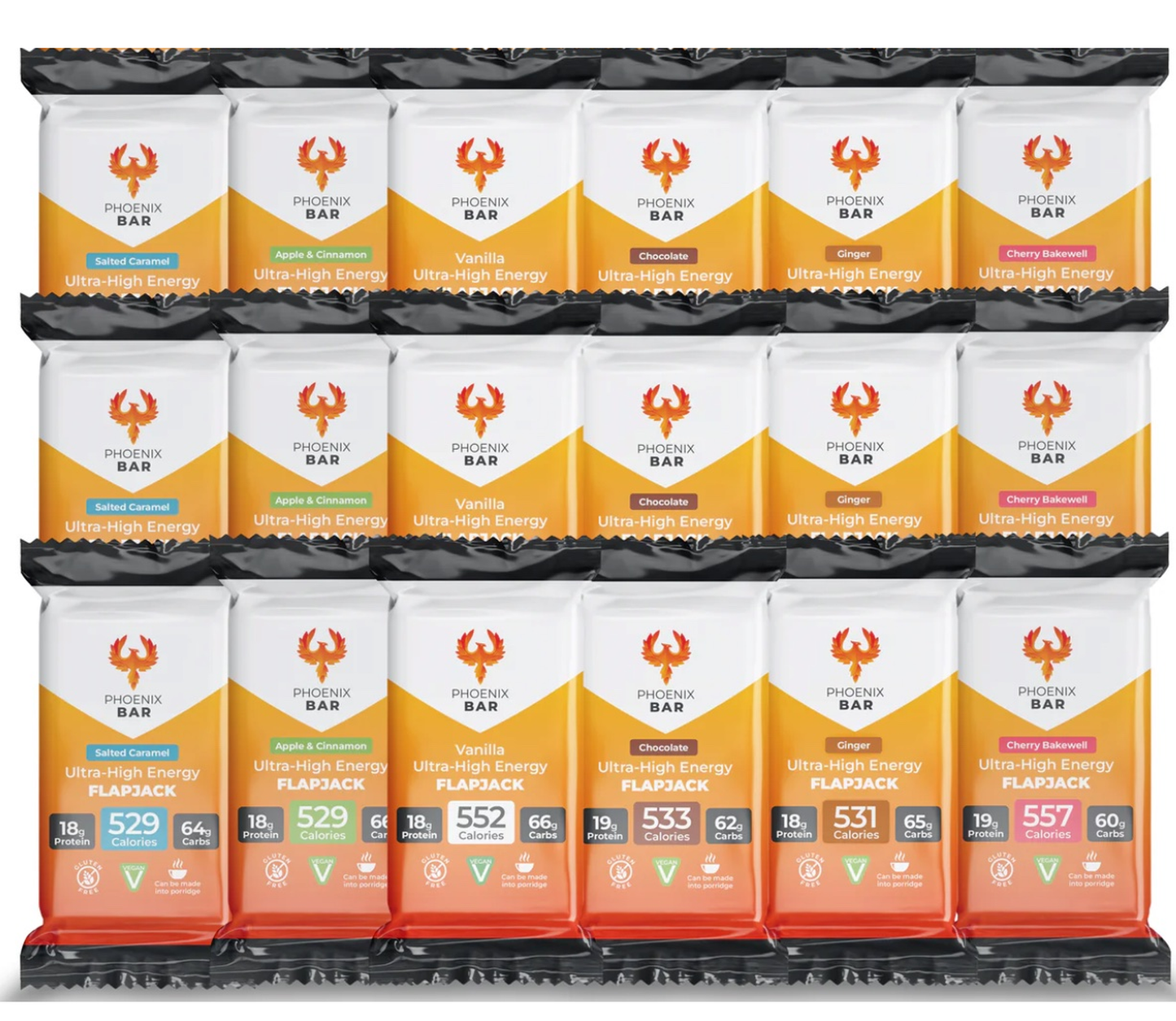
Phoenix Bars: Up to 557 Calories Per Bar
Soft, easy to eat whole or as a warm porridge. Low volume, two-year shelf life.
5. Two ways to walk it, two ways to eat
How you fuel the Pennine Way depends heavily on which of the two common styles you choose, and it is worth deciding early, because they call for different food.
The self-sufficient style means wild camping or using bothies and bunkhouses, carrying your shelter, and being responsible for your own food between the resupply points. Here food is a weight-and-bulk problem: you are carrying days of meals on a route that already punishes every extra kilo, so compact, calorie-dense, no-prep food that does not add bulk is genuinely valuable, and you lean on it hardest across the Cross Fell and Cheviots stretches.
The inn-to-inn style means booking accommodation each night, often with a baggage-transfer service carrying your main pack between stops, so you walk with a light daypack. Here you only need to carry the day's food and snacks, you eat a proper breakfast and pub dinner at each end, and the job is simply bridging the hours and the two no-shop stretches in between.
Most walkers land somewhere between the two, and the right food kit follows from where you sit on that spectrum. Either way, the two remote crossings demand carried food, so even comfortable inn-to-inn walkers need a plan for those days. Our wild camping food guide covers the self-sufficient end in more depth.
6. The Spine Race: the Pennine Way at its most extreme
It is worth knowing that the Pennine Way is also the course for the Spine Race, widely regarded as one of the hardest endurance events in the world. Run in the depths of January, it sends competitors along the full 268 miles in a single continuous push through snow, bog and darkness, and finishing it at all is a serious achievement.
For the ultra-minded, the Spine Race is the extreme version of everything on this page. Racers eat almost constantly to stay ahead of a deficit they can never fully close, carry dense, easy-to-eat calories between widely spaced checkpoints, and rely on hot food to fight the winter cold. The same principles that get a walker through the Cheviots, carry energy-dense food, eat steadily, prioritise warmth, simply get turned up to their limit.
If you are approaching the Pennine Way as a fast or continuous effort rather than a multi-week walk, the fuelling moves toward race nutrition, covered in our trail running nutrition guide and fastpacking nutrition guide. The route rewards the same compact, high-calorie approach whether you take three weeks or three days.
7. Where Phoenix Bars fit
Our bars fit the Pennine Way precisely where it is hardest, which is the honest way to put it. You will not need them for the served village days, when a shop lunch and a pub dinner cover you. Where they earn their place is the two no-shop crossings, the cold, and the long grind.
Across Cross Fell and the Cheviots, where there is nothing open for many miles, a Phoenix Bar delivers up to 557 calories in a 120g package the size of a phone, so a couple of bars carry serious energy for very little weight or bulk on a route that punishes both. On the cold, exposed sections they can be made into a warm porridge with hot water, matching the hot-food approach that works best here. And over 16 to 19 days the six flavours, Apple and Cinnamon, Cherry Bakewell, Chocolate, Vanilla, Salted Caramel and Ginger, help fight the monotony that sets in on any long walk.
The honest limits: much of the Pennine Way is supplied, so these are for the remote crossings, the cold and the cumulative grind, not for every mile. At £5.25 a bar they are a premium product, and what you pay for is the calorie density, the low bulk, the no-prep convenience and the warm option. A practical way to take them is the starter bundleof 12 bars for a section, or the essential and complete bundles for the full route or a camping trip. You can see the range in the Phoenix Bars collection and the bundles collection.
8. Frequently asked questions
Why is the Pennine Way so hard?
It combines the most demanding terrain of any National Trail, deep peat bog, near-constant climbing and high exposed ground, with serious length and famously bad weather. The bogs and ascents make you burn far more energy than the mileage suggests, and the remoteness of Cross Fell and the Cheviots means long stretches with no support.
Do you need to carry food on the Pennine Way?
For most of the route you can resupply every day or two, but two stretches have no shops or cafés: the Cross Fell crossing in the North Pennines and the Cheviots finale from Byrness to Kirk Yetholm. Across those you carry everything you eat and drink, plus a little spare in case the weather slows you down.
How many calories do you burn on the Pennine Way?
More than the distance implies, because boggy ground and constant climbing raise the energy cost of every mile, and cold weather adds more on top. A hard Pennine day can run well beyond what the same miles would cost on a flat trail, so fuel for the effort rather than the distance.
What is the hardest section of the Pennine Way?
The Cheviots finale and the Cross Fell crossing are the two that test people most: both are remote, exposed and committing, with no resupply and limited shelter. The Cheviots stretch in particular is long and often saved for last, when you are already tired.
How many days does the Pennine Way take?
Most walkers take 16 to 19 days for the full 268 miles, with fitter and faster walkers doing it in less. At the extreme end, Spine Race competitors cover the whole route non-stop in a matter of days.
What should you eat on a long, cold, boggy trail like this?
Carry compact, calorie-dense, no-prep food that survives a pack and can be eaten one-handed: nuts, dried fruit, oatcakes, flapjack and high-calorie bars. On cold, exposed days, add something you can heat with a flask, like porridge or soup, because warm food does more for your core temperature and morale than the same food cold.
Related guides
Closest companions: our West Highland Way food guide and Cape Wrath Trail guide for other tough northern routes, our Lands End to John O'Groats guide for the long-haul end of British walking, and our wild camping food and backpacking nutrition guides for self-sufficient walking. For the faster and racing approach, see our trail running and multi-day ultra running guides. This page sits within our wider ultra-endurance and expedition nutrition guide.


Flaming Phoenix



Contact Us
Declare withdrawal
Please fill out the following form to declare your withdrawal from the contract.

