
Vegan Flapjacks: Easy 4-Ingredient Recipe
Vegan flapjacks need four ingredients: oats, a vegan baking block, soft brown sugar and golden syrup. Melt 150 g of block with 100 g of sugar and 120 g of syrup, stir in 300 g of oats, press into a 20 cm tin and bake at 180C (160C fan) for 22 to 25 minutes. Cut into 12, each bar is about 245 kcal.
Written by James Frost, founder of Flaming Phoenix and the maker of Phoenix Bars. Updated October 2026.
Vegan flapjacks recipe (makes 12 bars)
Prep takes 10 minutes and baking takes 22 to 25 minutes. Allow an hour to cool before cutting.
Ingredients
- 300 g porridge oats
- 150 g vegan baking block (the foil-wrapped kind, not a soft tub spread)
- 100 g soft light brown sugar
- 120 g golden syrup (about 6 tablespoons)
- A pinch of salt (optional)
Method
- Heat the oven to 180C (160C fan, gas mark 4). Line a 20 cm square tin with baking paper, leaving some overhanging so you can lift the slab out.
- Melt the block, sugar and syrup in a large pan over a low heat. Stir until the sugar has dissolved, but do not let it boil.
- Take the pan off the heat and stir in the oats and salt until every oat is coated.
- Tip into the tin and press down hard with the back of a spoon, right into the corners. This is the step that stops them crumbling.
- Bake for 22 to 25 minutes, until the edges are golden and the middle is still pale.
- Score into 12 bars while warm, then leave in the tin until completely cold before cutting through.
Per bar (one twelfth of the tray): about 245 kcal, 31 g carbohydrate, 12 g fat and 3 g protein. These figures are calculated from typical UK pack values, so yours will vary a little with the brands you use.
Can you make vegan flapjacks with coconut oil or oil instead of a block?
Yes. Use 120 g of coconut oil plus 2 tablespoons of plant milk in place of the 150 g of baking block. A baking block is roughly 75 to 80% fat and the rest is mostly water, while coconut oil is almost pure fat, so a straight swap gives a greasy flapjack that struggles to hold together. Cutting the fat by a fifth and adding the liquid back keeps the recipe in balance.
Refined coconut oil tastes neutral. Virgin coconut oil adds a light coconut flavour. A liquid oil such as rapeseed also works at 110 g plus 2 tablespoons of plant milk, but the bars set softer, so press them firmly and chill the tin for an hour before cutting.
Some people prefer flapjacks without a buttery taste at all. One of my customers, a long-distance runner, put it this way in a review of my own bars: “I love the fact they’re made with coconut oil as the buttery taste of usual flapjacks sets my ultra-nausea into hyperdrive.” (Jodi B., November 2024)
What makes vegan flapjacks chewy or crunchy?
Bake time decides most of it. Take the tin out at 22 minutes, when only the edges have coloured, for a soft and chewy bar. Leave it for 28 to 30 minutes, until the whole surface is golden, for a crunchy one.
Three other things move the texture:
- Syrup against sugar. More syrup gives chew, more sugar gives snap. This recipe leans towards syrup.
- Oat size. Porridge oats pack tightly and give a dense, chewy bar. Jumbo oats give a looser, more rustic texture. A half and half mix sits in between.
- How hard you press. A firmly pressed slab bakes chewy and cuts cleanly. A loosely filled tin bakes crisp and crumbly.

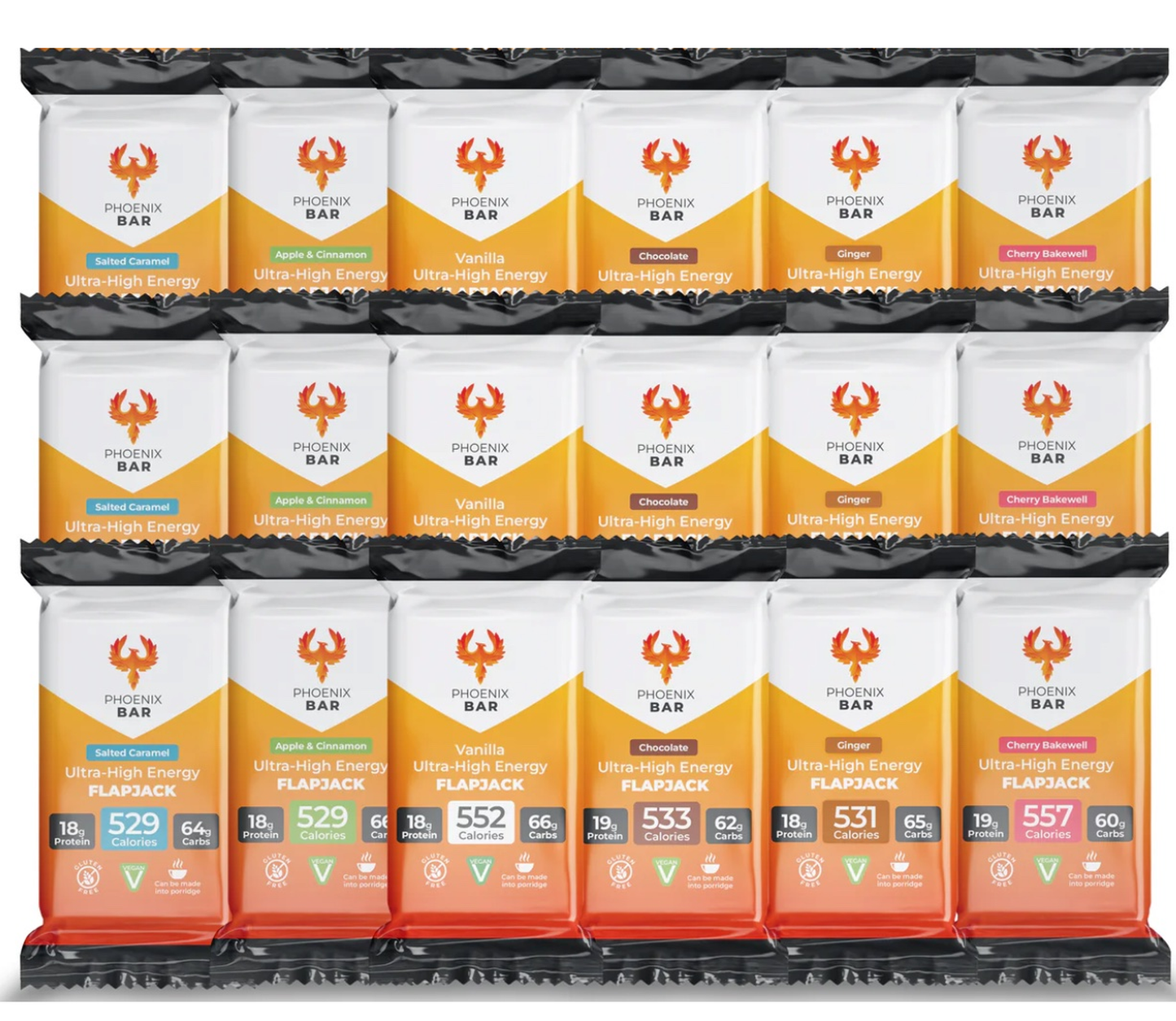
Phoenix Bars: Up to 557 Calories Per Bar
Highly compact, low-volume, calorie-dense bars. Soft, easy to eat whole or as a warm porridge. Vegan, gluten-free and contain up to 66g of carbohydrates, 19g of protein & 8 vitamins & minerals.
Why do vegan flapjacks fall apart?
Vegan flapjacks fall apart for five common reasons, and none of them is the lack of butter.
- The mixture was not pressed down firmly. Lean on it. The oats should look compacted, with no loose flakes on top.
- They were cut while warm. The sugar and syrup only set as they cool. Score warm, cut cold.
- A soft tub spread was used. Tub spreads carry more water than a block, and the water turns to steam and loosens the bake.
- The sugar or syrup was reduced. They are the glue. Cut them by more than about a fifth and nothing holds the oats together.
- Only jumbo oats were used. Swap half for porridge oats.
Are flapjacks vegan?
Traditional flapjacks are not vegan, because they are made with butter. Shop-bought ones can also contain honey, milk chocolate, yoghurt coatings or whey protein. Oats, sugar and golden syrup contain no animal ingredients, so swapping the butter is the only change a basic recipe needs.
One labelling point is worth knowing. “Vegan” describes the ingredients, not allergy safety. A flapjack can be vegan and still carry a “may contain milk” or “may contain egg” warning if it is made in a bakery that handles them. If you avoid milk or egg because of an allergy, read the allergen statement and not only the vegan claim.
How many calories are in a vegan flapjack?
A homemade vegan flapjack has about 460 kcal per 100 g, which is around 245 kcal for a 53 g bar from this recipe. Protein is low, at roughly 5 g per 100 g, because nearly all of it comes from the oats.
Shop-bought bakery flapjacks land in the same place. Oatopia’s Original Flapjack, for example, lists 453 kcal and 6.6 g of protein per 100 g on its product page (checked 12 October 2026).
My own Phoenix Bars work out at 439 to 464 kcal per 100 g depending on flavour. So they are no more calorie-dense than a good homemade flapjack, and I would rather say that plainly. The differences are elsewhere: each bar is 120 g, so one bar is 527 to 557 kcal, it has about 18 g of protein from soy and pea, and it keeps for up to two years in its wrapper.
Which vegan flapjacks can you buy?
I make one of the options below, so read this section as the maker’s view and compare for yourself.
For a soft bakery treat. Oatopia’s Original Flapjack is labelled suitable for vegans and costs £3.50. Flapjackery marks several of its flavours as vegan and sells a vegan box. Both are baked the traditional way. Oatopia says its flapjacks stay soft for at least a month while sealed.
For long days and big appetites. Phoenix Bars are the high calorie bars I make for endurance events, expeditions and people who struggle to eat enough. Each is a 120 g vegan oat flapjack made with gluten free oats and coconut oil, with 527 to 557 kcal, 60 to 66 g of carbohydrate and about 18 g of protein. They cost £5.25 a bar.
Across 397 published reviews the bars average 4.9 out of 5, and 12 of those reviews mention that the bars are vegan. “It’s so difficult to get the proper nutrition if you are a vegan,” wrote Jim P. after carrying two on a half marathon in August 2026. Oliver H., who races long distance, wrote: “Being vegan it’s difficult to find good products.”
They are not for everyone, and the reviews say so. Phoenix Bars are drier and less sticky than a tray-baked flapjack. Eleven of the 397 reviews give three stars or fewer, and most of those say the bar was too dry to enjoy on its own. One was blunt: “Very dry, nothing like a flapjack at all.” (Rachel, September 2025). Others like exactly that. Martha U. found the texture “a little drier than some bars, but I actually liked that and was really impressed by the way they almost melt in the mouth.” If you want the soft, buttery chew of a bakery flapjack, bake the recipe above. If you want a compact bar that survives a rucksack, a sip of water with each bite helps with the dryness, and 55 reviews mention turning the bar into porridge instead.
Allergen note: Phoenix Bars contain soy, the Cherry Bakewell flavour contains almonds, and some flavours contain sulphites. They are made in a facility that also handles milk, egg, nuts, peanuts and sesame, so the label carries a “may contain” warning.
If your goal is hill days or racing, my guides to the best energy bars for hiking and the best energy bars for ultra running compare more options. People with small appetites also use Phoenix Bars as high calorie bars for weight gain, and I have written a separate guide on how to gain weight on a vegan diet.
How do you store and freeze vegan flapjacks?
Keep homemade vegan flapjacks in an airtight tin at room temperature for up to a week. Layer them with baking paper so they do not weld together. They freeze well for up to three months: wrap the bars individually, then thaw at room temperature for an hour or two.
Frequently asked questions
Are vegan flapjacks gluten free?
Not automatically. Oats are often contaminated with wheat, barley or rye during farming and milling, so a flapjack is only gluten free if it is made with oats labelled gluten free. This recipe works with them unchanged. My guide to gluten free flapjacks covers what to check.
Is golden syrup vegan?
Yes. Golden syrup is refined from sugar and contains no animal ingredients. Check the label on flavoured or own-brand syrups.
Can you make vegan flapjacks without sugar or syrup?
You can replace them with mashed banana or blended dates, but expect a different result. Sugar and syrup are what set a flapjack, so a fruit-only version bakes into a soft oat square that is closer to baked porridge. It is pleasant, but it will not snap or travel well.
How do you add protein to vegan flapjacks?
Stir 40 to 50 g of unflavoured pea or soy protein into the oats and add 2 to 3 extra tablespoons of plant milk to the pan, because the powder soaks up moisture. Peanut butter is the simpler route: swap 50 g of the baking block for 75 g of peanut butter.
What is the highest calorie vegan flapjack?
Size matters more than recipe. Most flapjacks, homemade or shop-bought, sit between 430 and 480 kcal per 100 g, so a bigger bar means more calories. For a richer bake, see my high-calorie flapjack recipe, which reaches about 490 kcal a square and can be made vegan. For ready-made options, I compare the highest calorie bars in the UK in a separate guide.
Related guides
- Flapjack bars: what to buy and how to make them
- Vegan endurance nutrition
- High calorie porridge
- High calorie protein bars from Flaming Phoenix
Nutrition figures for other brands are taken from their own product pages on the date shown. Recipes change, so check the pack.


Flaming Phoenix



Contact Us
Soumettre une demande de rétractation
Veuillez remplir le formulaire suivant pour soumettre votre demande de rétractation.

