Aconcagua Nutrition: Personal Snacks & Summit Day Food
By James Frost, Founder of Flaming Phoenix. Phoenix Bars have been used on Aconcagua expeditions, Marathon des Sables, polar crossings, and ocean rows. They've been carried to the summit of Everest.
Last updated: May 2026
The short answer
Your operator will feed you at Plaza de Mulas or Plaza Argentina base camp. Personal snacks for the 11 climbing days, the carries, the high camps, and the summit push are 100% your responsibility. This is where most Aconcagua attempts fail nutritionally, not at base camp.
You'll burn 4,000 to 6,000 calories on a normal climbing day and 8,000 to 10,000 on summit day, while your appetite is suppressed by altitude, your taste perception is dulled, and most snacks freeze solid above 5,500m. The personal-pack list needs to solve all four problems at once.
This guide breaks down nutrition by expedition phase, shows you exactly what to pack for summit day, and gives you a provisioning maths spreadsheet for the full 18 to 21 day climb.
Why Aconcagua is harder to fuel than people expect
Aconcagua sits at 6,962m, the highest peak outside the Himalayas, and the standard Normal Route ascent takes 18 to 21 days from Mendoza. The combination of altitude, duration, and exertion produces a calorie demand most climbers seriously underestimate.
Calorie demand by phase: approach trek to base camp (3,500 to 4,500 cal/day), base camp acclimatisation (3,500 to 4,500 cal/day at rest), carries between camps (4,000 to 6,000 cal/day), high camp days (4,500 to 6,000 cal/day with reduced appetite), summit day (8,000 to 10,000 cal/day on a 12-hour push).
Calorie intake reality: most climbers consume 50 to 70% of their burn above 5,000m. The deficit accumulates day by day, which is why climbers commonly lose 5 to 10kg over an Aconcagua expedition. Some weight loss is unavoidable. But the climbers who summit are the ones who close the gap most aggressively.
Why eating gets harder as you climb: hypoxia suppresses appetite via leptin and cholecystokinin pathways, slowed gastric emptying makes meals feel heavy, dulled taste perception kills enthusiasm for food, and sub-zero temperatures freeze most snacks solid. Full mechanism breakdown at High Altitude Mountaineering.
The personal pack vs operator meals split
Almost every Aconcagua climber goes with an operator (Inka, Aconcagua Mountain Guides, Grajales, Ian Taylor Trekking, Alpine Ascents, AMG). Operators provide cooked meals at the two base camps and sometimes at higher camps if you pay for the upgrade. They do not provide personal snacks.
Your personal pack covers:
Climbing day snacks, eaten on the move during carries between camps and on summit day. This is roughly 8 to 11 climbing days depending on itinerary and weather windows.
High camp food, when operator catering ends or when bad weather pins you in your tent. Above Camp 1 you're typically self-sufficient, melting snow on your own stove and eating what you brought.
Emergency reserve, for storm days, extended stays, or summit retreats. A 2 to 3 day reserve above your itinerary is the unwritten rule.
Comfort food, for morale management on a 21-day expedition. Boring food kills more summit attempts than altitude does.
Phase-by-phase nutrition strategy
Approach trek to base camp (days 1 to 3)
You'll trek roughly 40km from Horcones (or Punta de Vacas for the Polish route) to base camp at 4,300m, gaining 1,500m of altitude over 2 to 3 days. Mules carry the heavy gear. You carry your day pack with personal snacks, water, and layers.
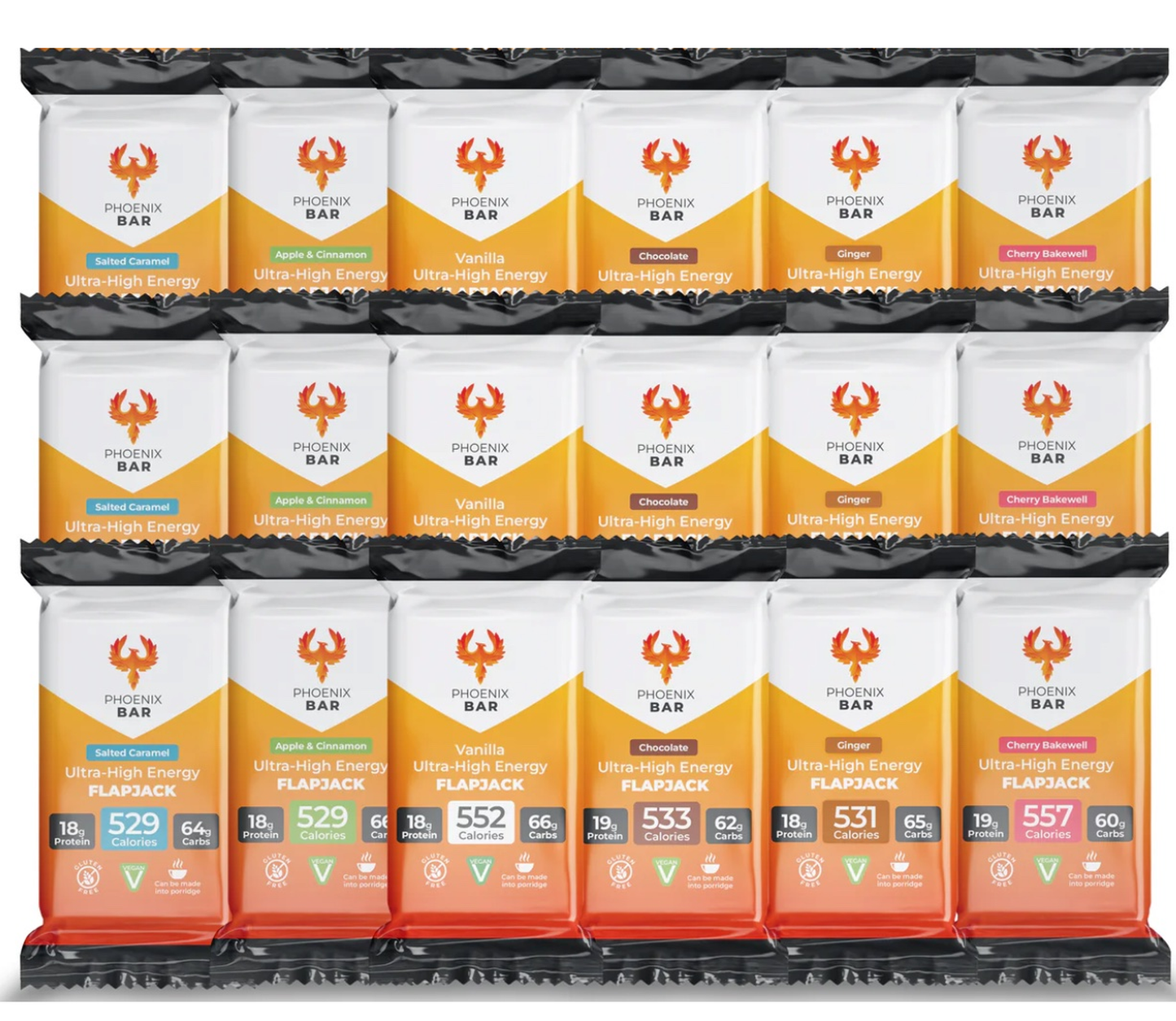
This is the easiest eating phase. Appetite is still relatively normal. Eat aggressively. Build calorie reserves while you can. One Phoenix Bar per day on the trek delivers 557 calories of compact backup fuel that you can eat without stopping. Operators provide trekking lunches, but they're rarely enough on the long Plaza Argentina approach.
Base camp acclimatisation (days 4 to 6)
Base camp sits at 4,200 to 4,300m. You'll spend 2 to 3 nights here acclimatising before starting carries to higher camps. Operators provide three meals a day, typically Argentinian-style: meat-and-pasta dinners, eggs and bread for breakfast, packed sandwiches for the day.
What operators don't provide is the constant grazing food that keeps you eating between meals. Acclimatisation depends on calorie intake. The climbers who acclimatise fastest are the ones who eat almost continuously. A Phoenix Bar between meals plus the occasional High Calorie Porridge made by adding hot water to a Phoenix Bar gives you 1,000 to 1,500 extra calories per rest day with zero cooking effort.
Carries to high camps (days 6 to 9)
Carries between Camp 1 (Canada, 5,050m), Camp 2 (Nido de Cóndores, 5,560m), and Camp 3 (Berlin or Cólera, 6,000m) involve hauling 15 to 20kg loads up steep, exposed terrain for 4 to 6 hours per day. Calorie burn is 5,000 to 6,000 per carry day.
This is where personal snacks earn their place. You won't stop for a proper lunch. You'll snack continuously from your jacket pocket. The food needs to: be eaten with gloves on, not freeze in sub-zero conditions, deliver maximum calories per gram of pack weight, and survive being crushed in a pack with crampons.
A Phoenix Bar in each jacket pocket plus 3 to 4 in the top of your pack covers a full carry day. 557 calories per bar means three bars cover 1,671 calories of climbing fuel without slowing you down. For more on what makes a snack work mid-effort at altitude, see Ultra High Carb Solid Foods.
High camp days (days 9 to 11)
You'll typically spend 2 to 4 nights between Camp 1, Camp 2, and Camp 3 before the summit attempt. Above Camp 1 you're self-sufficient on cooking. Most climbers carry freeze-dried dinners (Real Turmat, Mountain House, Firepot) plus oats for breakfast.
Two practical issues at high camp: appetite drops sharply above 5,500m, and cooking becomes a fuel-and-time tax. Anything that doesn't require cooking is gold. Phoenix Bars eaten cold count as a meal. A Phoenix Bar mixed with hot water becomes a 557-calorie porridge in 2 minutes with no cooking. Both options work when you can't face another bag of dehydrated stew.
Summit day (day 11 or 12)
This is the make-or-break day. Most teams leave Camp 3 between 4 and 5am for a 12 to 14 hour round trip, gaining 1,000 to 1,200m of altitude to the 6,962m summit. Calorie burn is 8,000 to 10,000. Realistic intake is 1,500 to 3,000. The deficit is enormous and unavoidable.
The summit day pack list is the single most important nutrition decision of the expedition. Detail in the next section.
Descent (days 12 to 14)
After summiting you descend to base camp over 1 to 2 days, then trek out to Horcones over another day. Appetite returns rapidly below 4,500m. Eat aggressively. Recovery starts here. Operators provide proper meals at base camp on the descent.

Phoenix Bars: Up to 557 Calories Per Bar
Soft, easy to eat whole or as a warm porridge. Low volume, up to 2-year shelf life. Rated 4.9/5 from nearly 400 reviews. £5.25 per bar.
Summit day pack list: what actually works at 6,962m
Summit day is 12 to 14 hours of climbing in temperatures from minus 20°C at the start to minus 30 to 35°C in the upper Canaleta with windchill. Most snacks fail. Here's what works.
Calorie target: 2,000 to 3,000 calories from your personal pack, knowing you'll likely consume 1,500 to 2,500 of them. Pack more than you'll eat.
Three Phoenix Bars in inner jacket pockets, kept warm against the body to prevent freezing. 1,671 calories total. Break them into 6 pieces each the night before so you can eat one piece at every rest stop without removing gloves. Phoenix Bars stay soft at sub-zero temperatures, which is why they keep getting carried to high altitudes when other bars freeze solid.
One thermos of warm sugary tea or hot chocolate (500 to 700 calories depending on what you mix in). Drinking matters as much as eating on summit day. Cold water freezes; thermos drinks stay liquid.
Two energy gels for the final summit push when chewing is too much effort. Gels work for the last 90 minutes when solid food is intolerable. For why gels fail before then and why bars beat them earlier in the day, see Energy Gel Alternatives.
Glucose tablets or boiled sweets for the descent. Sugar emergencies happen on the way down when blood glucose crashes after the summit adrenaline fades. The most dangerous nutrition moment of the climb.
What to leave at Camp 3: anything chocolate-coated (freezes solid), dried fruit (turns to ice rocks), nuts (frostbite-cold to chew), conventional energy bars (freeze rock-hard above 5,500m). Bring them up, leave them at camp for the post-summit return.
What freezes at 6,962m and what doesn't
Almost every snack that works at sea level fails above 5,500m. Here's the practical reality of what you can actually eat with gloves on at minus 25°C.
Freezes solid (avoid for summit day): chocolate bars, conventional energy bars (Clif, Power Bar, most supermarket options), dried fruit, fresh fruit, jerky, hard cheese, frozen sandwiches, anything water-based.
Stays edible at sub-zero: Phoenix Bars (formulated to stay soft), gels (kept against the body), Stroopwafels (just about), boiled sweets, glucose tablets, soft pre-cut chocolate eaten quickly.
Becomes hot food (the secret weapon): anything mixed with boiling water from a thermos. Phoenix Bars become porridge. Couscous becomes a meal. Hot chocolate becomes calories. The thermos is the most underrated piece of summit-day nutrition kit.
Provisioning maths for an 18 to 21 day expedition
Here's the practical maths for a personal-pack provisioning list, assuming an 18 to 21 day expedition with operator-provided meals at base camp.
Approach trek (3 days): 1 Phoenix Bar per day plus operator-provided trekking lunches. Total: 3 bars.
Base camp acclimatisation and rest days (across the expedition, roughly 6 to 8 days): 1 Phoenix Bar per day for between-meal grazing, plus 2 days using a bar as porridge breakfast. Total: 8 to 10 bars.
Carry days (roughly 4 to 5 days): 3 Phoenix Bars per day in jacket and pack. Total: 12 to 15 bars.
High camp days (roughly 3 to 4 days): 2 Phoenix Bars per day, including 1 used as porridge. Total: 6 to 8 bars.
Summit day: 3 Phoenix Bars in jacket pockets. Total: 3 bars.
Storm and emergency reserve: 5 to 7 bars for buffer days, retreat days, or extended summit waits.
Total recommended provisioning: 38 to 46 Phoenix Bars for an 18 to 21 day expedition.
The 30-bar Complete Bundle covers most of this. Most climbers add an additional 12-bar Starter Bundle for full coverage with reserve. For bulk expedition provisioning above 50 bars, contact me directly for expedition pricing.
How Phoenix Bars work on Aconcagua
Phoenix Bars sit in the gap between a snack bar and a meal: 557 calories per compact 120g bar, 66g of carbohydrate, 4.6 cal/gram (among the highest in any portable solid), soft texture edible at sub-zero temperatures, two-year shelf life so you can buy them months ahead and ship them with your duffel, and six flavours including Salted Caramel and Ginger to manage the flavour fatigue that hits after 10+ days at altitude.
What makes them specifically good for Aconcagua: the soft texture means they don't freeze in jacket pockets even at minus 25°C, the 66g of carbohydrate per bar aligns with the body's preference for carb metabolism at altitude (carbs require less oxygen than fat to convert to energy), and the optional porridge format gives you a hot meal on summit night when nothing else is tolerable.
For practical guidance on using Phoenix Bars across an expedition, including the porridge method, see How To Use Phoenix Bars.
Frequently asked questions
How many calories do I need on Aconcagua? 4,000 to 6,000 calories per day on normal climbing days, 8,000 to 10,000 on summit day. Most climbers consume 50 to 70% of their burn above 5,000m, which is why weight loss of 5 to 10kg over the expedition is normal.
What is the best food for summit day on Aconcagua? Calorie-dense solids that don't freeze, kept against the body for warmth. Three Phoenix Bars broken into pieces, a thermos of warm sugary drink, two gels for the final push, and boiled sweets for the descent. Total target: 2,000 to 3,000 calories from your personal pack.
Will my snacks freeze at high camp? Most will. Above 5,500m, chocolate bars, conventional energy bars, dried fruit, and most snacks turn rock-hard or freeze solid. Phoenix Bars are formulated to stay soft at sub-zero temperatures, which is why they get carried to high altitudes when other bars don't.
How many Phoenix Bars do I need for an Aconcagua expedition? Roughly 38 to 46 bars for an 18 to 21 day expedition, depending on how many days you spend at high camps and how much emergency reserve you carry. The 30-bar Complete Bundle plus a 12-bar Starter covers most climbers.
Can I eat at altitude if I lose my appetite? Eating becomes a deliberate, scheduled act above 5,000m, not a response to hunger. Set a timer. Eat something every 90 minutes regardless of appetite. Soft, calorie-dense, slightly salted foods tolerate best. Strong sweet flavours often trigger nausea above 5,500m.
Should I do a porridge breakfast at high camp? Yes. Warm semi-liquid foods are the most tolerable at altitude when solid breakfast feels impossible. Mixing a Phoenix Bar with hot water gives you a 557-calorie porridge in 2 minutes with no cooking required. This is one of the highest-leverage nutrition tactics on the mountain.
What about hydration on Aconcagua? 3 to 5 litres of fluid per day, with electrolyte tablets in at least half of it. Water above Camp 1 comes from melting snow, which has no minerals, so electrolyte supplementation is essential. Dehydration accelerates altitude sickness more than any other factor.
Are operator meals enough on Aconcagua? At base camp, yes. Above base camp, your personal pack and self-cooked meals do most of the work. Even with the best operator service, you'll need 30 to 50 personal snacks across the expedition.
Related guides
High Altitude Mountaineering | Ultra-Endurance and Expedition Nutrition Guide | Ultra High Carb Solid Foods | Energy Gel Alternatives | Calorie-Dense Foods | High Calorie Porridge | How To Use Phoenix Bars


Flaming Phoenix