
High Calorie Low Volume Foods (Least Filling)
High calorie low volume foods are foods that hold a lot of calories in a small amount, so they take up less room and fill you up less. They are mostly foods high in fat or low in water, such as oils, nuts, nut butters, seeds, dried fruit, cheese and chocolate. They are useful when you fill up fast, or find a big plate hard to manage, because a small serving still carries plenty. For the wider list of dense foods, see calorie-dense foods.
The idea is simple. Some foods take up a lot of space in your stomach for very little, and others do the opposite. If getting through a large amount of food is difficult, the answer is not to eat more of it, it is to choose foods where a small amount goes a long way.
What makes a food high calorie but low volume?
It comes down to energy density, meaning how many calories a food holds for its size. Two foods of the same weight can be worlds apart: a bowl of salad and a small handful of nuts weigh similar amounts, but the nuts carry many times the calories.
The difference is water, fibre and fat. Foods high in water and fibre, like vegetables, fruit and soup, are bulky and filling for very few calories. Foods high in fat and low in water, like oils, nuts and cheese, are the reverse, because fat carries more than twice the calories of the same weight of carbohydrate or protein. So the least filling, most calorie-dense foods are the dry, fatty ones.
The least filling, most calorie-dense foods
These are the foods that give you the most for the smallest amount, roughly from the most concentrated down.
Oils and fats are the most concentrated of all, so a small drizzle of olive or rapeseed oil, or a little butter stirred through food, adds a lot in almost no space.
Nuts, seeds and their butters are next. A small handful of nuts, or a spoon of peanut butter or tahini, is compact and rich, and easy to add to other food.
Dried fruit shrinks fruit down by removing the water, so a small handful of dates, raisins or apricots is far more concentrated than the fresh version.
Cheese and full-fat dairy are dense and easy to add, with a small piece of cheese, a spoon of cream, or full-fat yoghurt all carrying a lot in a little.
Chocolate, coconut and nut-based snacks round it out, along with compact bars, all of which pack plenty into a small size.
When a big plate is a struggle
If you fill up quickly, or a large meal feels like too much, the aim is not to push more food down. It is to make what you can manage count for more.
A few gentle things help. Choose small portions of the dense foods above rather than a big plate of lighter food. Spread eating across the day in smaller amounts, since several small moments are often easier than one large meal. Drink some of it, because a milkshake or a smoothie tends to go down more easily than a plate of food, and takes up less room while it does. And start with the richer part of a meal, while you have the most appetite. For more on this, see what to eat when your appetite is low and high calorie drinks and smoothies.
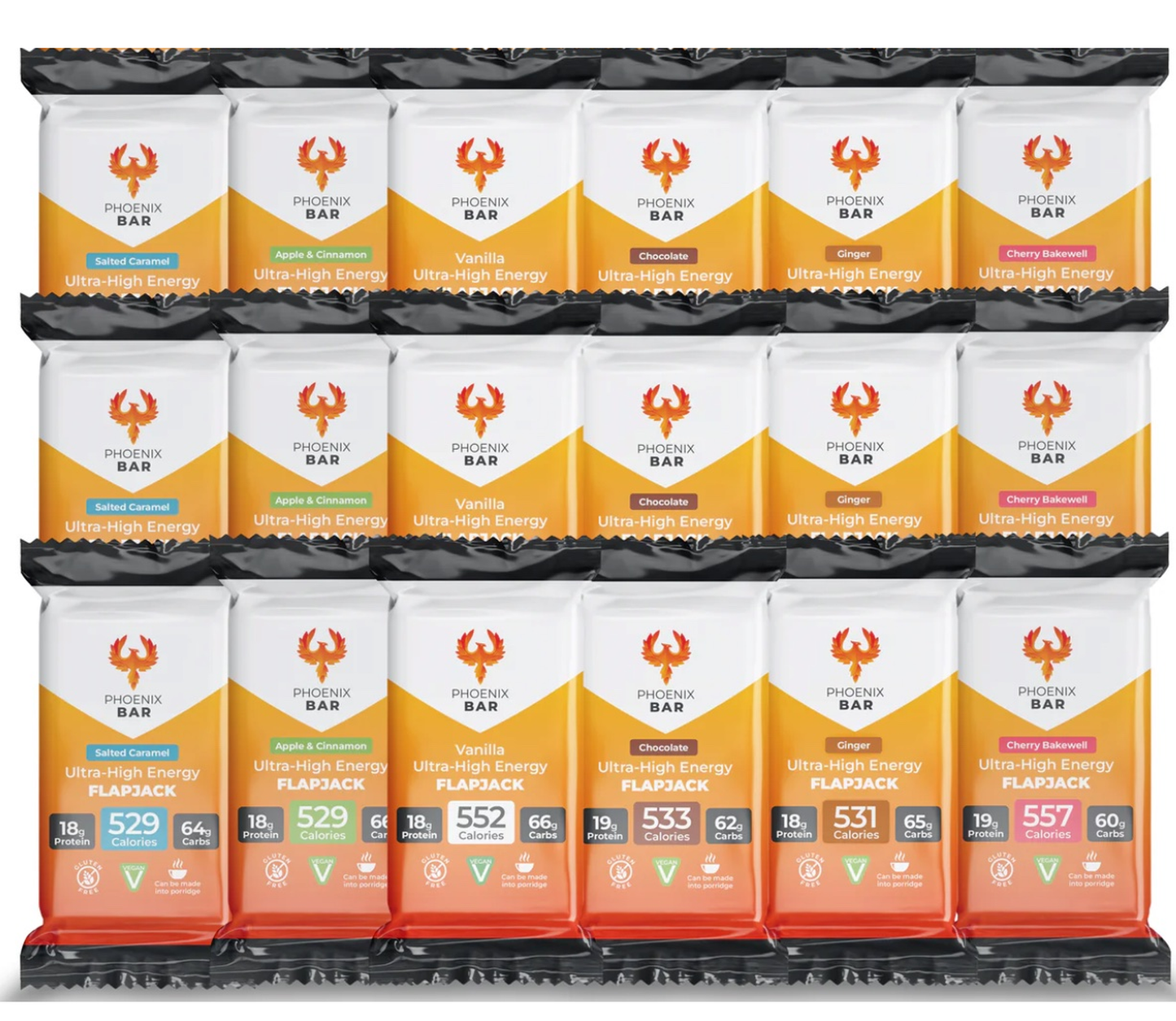
Bars are the most portable food in this category, and purpose-built high calorie bars like Phoenix Bars sit near the top of it at 4.6 kcal per gram, a meal's worth of energy in something smaller than your phone.

Phoenix Bars: Up to 557 Calories Per Bar
Highly compact, low-volume, calorie-dense bars. Soft, easy to eat whole or as a warm porridge. Vegan, gluten-free and contain up to 66g of carbohydrates, 19g of protein & 8 vitamins & minerals.
A compact option for when you want something simple
Everything above takes a little assembly, and sometimes you just want something small and ready.
That is what the product is built to be. Each of our high calorie bars holds a lot of calories in a small 120g bar, so it stays easy to manage when a full meal is not. It needs no preparation, is vegan and gluten-free, comes in six flavours, and can be stirred into hot milk to make a soft porridge if that is easier than eating it as a bar. You can see the full range of high calorie bars on the homepage.
Frequently asked questions
What are high calorie low volume foods?
They are foods that carry a lot of calories in a small amount, so they take up less room and are less filling. Most are high in fat or low in water, such as oils, nuts, nut butters, seeds, dried fruit, cheese and chocolate. A small serving of these goes a long way.
What foods are least filling for their calories?
Dry, fatty foods are the least filling, because they hold little water or fibre. Oils, nuts, seeds, nut butters, dried fruit and cheese give you a lot in a small, low-volume form, unlike watery, high-fibre foods such as vegetables, fruit and soup, which fill you up for far fewer calories.
How can I get more calories without feeling full?
Lean on calorie-dense, low-volume foods, keep portions small but rich, spread eating across the day, and drink some of your intake, since drinks tend to be less filling than solid food. Adding a little fat, such as oil, nut butter or cheese, lifts a small serving without adding much bulk.
What can I eat when a big meal feels like too much?
Choose small amounts of dense foods rather than a large plate of lighter food, have a milkshake or smoothie in place of a full meal when that is easier, and eat the richest part first while your appetite is freshest. Smaller, more frequent portions are often easier to manage than one big meal.
Related guides
For the full list of dense foods, see calorie-dense foods. For low-appetite situations, see what to eat when your appetite is low. For drinks, which are less filling than solid food, see high calorie drinks and smoothies. For smaller options, see high calorie snacks. For the porridge method, see how to use Phoenix Bars.
Written by James Frost, Founder of Flaming Phoenix. James started Flaming Phoenix in 2024 and has spent the years since working out how to get the most calories into the least food, building and testing compact, calorie-dense recipes. He can be reached at jfrost@flaming-phoenix.co.uk. Last reviewed: June 2026.


Flaming Phoenix



Contact Us
Declare withdrawal
Please fill out the following form to declare your withdrawal from the contract.

