Adventure Nutrition: How to Plan Food for Multi-Day Trips and Expeditions
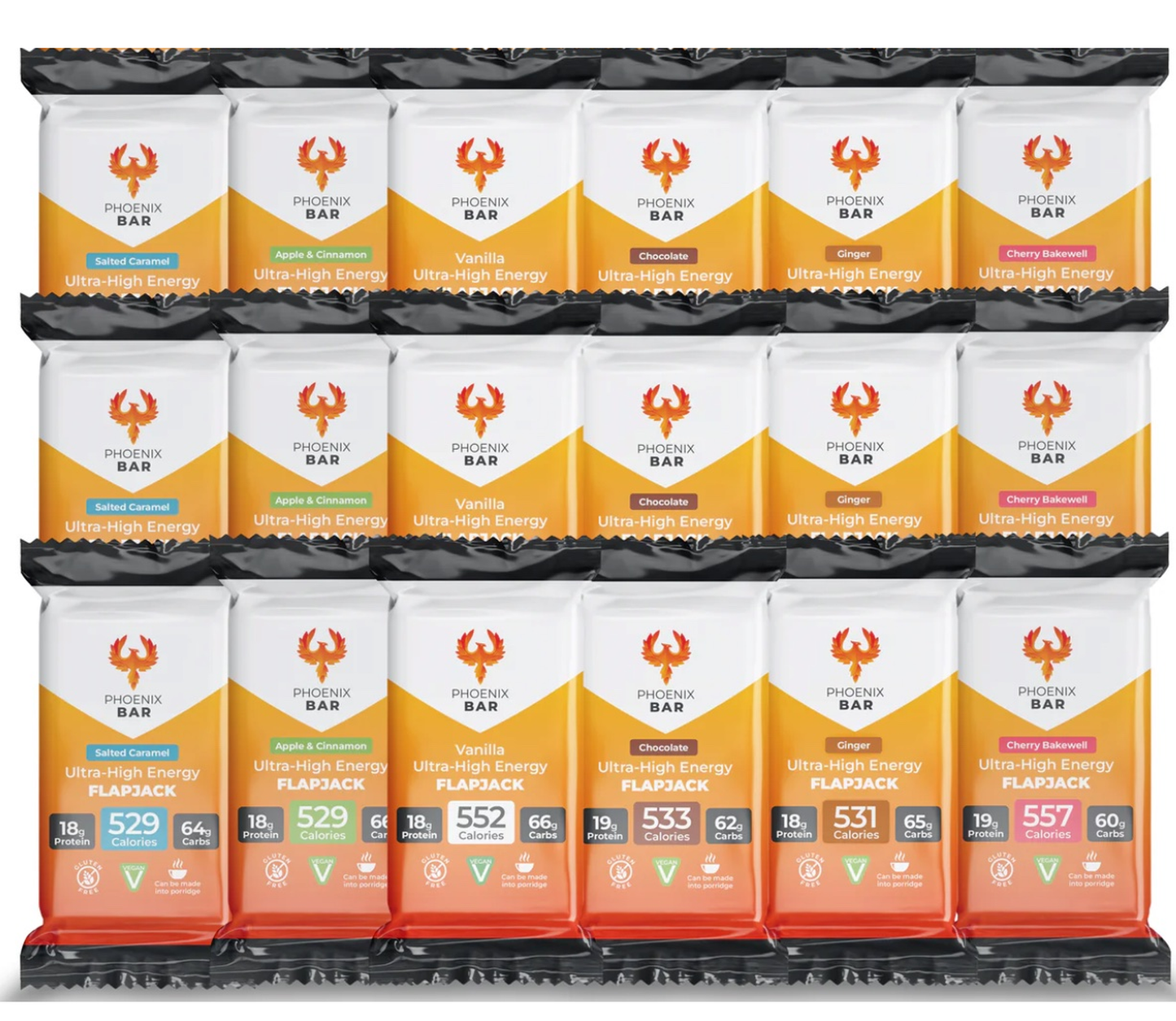
Quick answer: Adventure food planning is a weight problem disguised as a nutrition problem. Whether you are wild camping for a long weekend, walking the Tour du Mont Blanc, cycling LEJOG, or trekking to Everest Base Camp, every gram you carry has to deliver calories. The defining number is calorie density: aim for 4 calories per gram or higher for the bulk of your food. The defining choice is between food that survives your specific environment (heat, freezing, rain, no cooking) and food that does not. The single biggest mistake is planning for the appetite you have at home rather than the appetite you will have on day three or day fourteen, when fatigue and palate fatigue have set in. Phoenix Bars at 557 calories per 120g were built specifically for this. For the underlying principle, see calorie-dense foods.
Who This Guide Is For
This guide is for anyone planning a self-supported trip where food has to be carried for at least one full day. That includes weekend wild camping, multi-day hikes and treks, long-distance walks (LEJOG, Cape Wrath, the Pennine Way), bikepacking and audax cycling, hut-to-hut trekking, organised challenges (Three Peaks, Bob Graham Round, Tour du Mont Blanc), Duke of Edinburgh expeditions, and the more extreme end of the spectrum: high-altitude mountaineering, polar trekking, ocean rowing, desert ultras.
It is not a guide to running an ultramarathon, a cycling event, or any race-format challenge. For those the demands are different (drop bags, checkpoints, hourly fuelling). See the Ultra Endurance and Expedition Nutrition Guide for race-format principles, long-distance cycling nutrition for road events specifically, and bikepacking nutrition for off-road multi-day rides.
This page is about the broader adventure space where you carry your own food, you plan your own meals, and the trip lasts longer than the food in your day-pack.
Why Adventure Food Is a Different Problem from Daily Eating
Daily eating happens in a kitchen with a fridge, hot water, no time pressure, and a normal appetite. None of those conditions apply on a multi-day adventure.
You cannot store fresh food for more than a day or two without refrigeration. You probably cannot cook beyond boiling water on a small stove. The food you carry has to survive whatever weather, temperature, and rough handling the trip throws at it. Your appetite will be unpredictable: high at first, often suppressed by day three, sometimes elevated again, often nonexistent at the worst moment.
Three things compound these problems on multi-day trips specifically.
The first is the storage problem. Food on multi-day trips has to survive heat, cold, rain, repeated freeze-thaw cycles, and being squashed at the bottom of a pack for days. Most commercial energy bars freeze rock-solid below 5°C and become inedible. Many become rancid in tropical heat within days. Choosing food that survives your conditions is not optional, it is a precondition.
The second is the palate problem. Eating the same food every day for three to fourteen days creates aversion. Sweet foods become repulsive. Strong flavours become unbearable. The food that worked perfectly on day one can be physically impossible to swallow by day five. Variety matters, but variety has a weight cost.
The third is the appetite problem. Cold, fatigue, sleep deprivation, altitude (where relevant), heat, and the simple novelty of being outside all suppress appetite for many people. By day two or three of most trips, eating becomes harder than not eating. Plans built around hitting calorie targets at home assume an appetite that may not survive contact with the trail. See low appetite and difficulty eating enough calories for more on this dynamic.
The Adventure Food Equation
Most adventure food planning fails because it starts with recipes rather than constraints. Better to start with the equation:
Days × calories per day × grams per calorie = pack weight
This single formula determines whether your trip is feasible. Let it guide every food choice.
A 3-day wild camping trip at moderate pace burns roughly 3,500 to 4,500 calories per day. At a calorie density of 3.5 calories per gram (typical of bread, conventional energy bars, dehydrated meals), that is around 1,150g of food per day, or 3.5kg total. Manageable for a weekend.
A 5-day Tour du Mont Blanc circuit burns 4,000 to 5,500 calories per day. At 3.5 cal/g that is 1,400g per day, 7kg total. Heavy when you are also carrying camping gear, water, and clothing.
A 10-day unsupported trek burns 4,000 to 6,000 per day. At 3.5 cal/g you would carry 14 to 17kg of food alone. At 4.5 cal/g you would carry 9 to 13kg. The 4kg saving is the difference between a trip that is enjoyable and a trip that is grim.
A 21-day polar pulk expedition burns 6,000 to 8,000 per day. At 4.5 cal/g that is 28 to 37kg of food. Below that calorie density the maths simply does not work.
The lesson scales across the spectrum. For a weekend, calorie density matters slightly. For a week, it matters a lot. For multi-week trips, it determines whether the journey is even physically possible. This is why understanding calorie density is more important than understanding macronutrient ratios for any adventure longer than a weekend.
The Adventure Spectrum: From Weekend to Multi-Week
Different lengths of trip impose different priorities. Knowing where your trip sits helps you decide what to pack.
Weekend trips (1 to 3 days) prioritise variety and morale over weight. You can carry a few luxuries (a chocolate bar, a small bottle of olive oil, fresh cheese), bring real-flavour food, and treat the trip as a chance to enjoy good outdoor cooking. Calorie density still matters, but you have margin.
Short multi-day trips (4 to 7 days) are where the planning starts to bite. Variety competes with weight. Real food gives way to dehydrated dinners. You start needing reliable backup snacks for when appetite fades. This is where most people first encounter palate fatigue.
Long multi-day trips (8 to 14 days) are where calorie density becomes the dominant constraint. You cannot afford bulky low-density food. Most of your supply must hit 4+ cal/g. You need a small number of highly tolerable items rather than wide variety. You need a backup food specifically for the days when appetite collapses.
Multi-week trips (15+ days) are expedition territory. Storage conditions matter as much as nutrition. Your menu must include both an acclimatisation phase (when you can eat well) and an effort phase (when you cannot). You need at least one mild-flavoured option saved for the second half. Resupply planning becomes a separate problem on top of food planning.
The principles are the same across all four. The intensity of each constraint scales with the length of the trip. Phoenix Bars work across all four because the things that make them useful (calorie density, soft texture, mild flavour, edible without preparation) become more valuable as the trip gets harder, not less.
Environment Affects Everything
The single biggest determinant of what to pack is where you are going. Each environment imposes different constraints and rewards different food choices. The principles below apply whether you are out for a long weekend or a multi-week trip.
Cold and Sub-Zero Environments
The defining problem is freezing. Most commercial bars become inedible below 5°C. Wrappers must open with mittened hands. Snacks must be eaten quickly during brief breaks because exposed skin loses heat fast.
Cold environments also burn more calories than equivalent effort in temperate conditions, partly from the work of moving in extra clothing and partly from the body's heat generation. UK winter trips, ski touring, polar expeditions, and high-altitude mountaineering all share this problem.
The food category that wins cold conditions is calorie-dense bars that stay soft below freezing, dehydrated meals reconstituted with hot water, nut butters in squeeze packs, and chocolate (which freezes but remains chewable). Phoenix Bars have been used at sub-zero temperatures including South Pole expeditions and remain edible at temperatures well below anything most adventures encounter. For environment-specific guidance see polar expedition nutrition and ski touring nutrition.
High-Altitude Environments
The defining problem is appetite suppression. Above 4,000m, the hormones that drive hunger become unreliable. Above 6,000m, most climbers report active food aversion. Multiple academic reviews of high-altitude physiology note that climbers at altitude typically consume 30 to 50% fewer calories than they burn, and weight loss is a defining feature of long altitude trips.
The countermeasure is food that remains palatable when nothing else is. Mild flavours, soft textures, easy to break into small pieces, possible to consume in small amounts spread across an hour rather than as a single meal. For altitude-specific guidance see mountaineering nutrition, Everest Base Camp nutrition, and Kilimanjaro food planning.
Hot and Desert Environments
The defining problem is the combination of heat, water rationing, and salt loss. Calorie needs are still high but appetite is suppressed by heat and dehydration. Water carrying capacity often dictates pace and rest schedule.
Hot environments favour foods that do not melt (chocolate fails), foods that do not require water to prepare or rehydrate (you cannot afford the water), and foods that can be eaten in small amounts because heat suppresses the desire for large meals. Salt content matters more than in any other environment. For desert ultra and expedition specifics, see Marathon des Sables nutrition.

Phoenix Bars: Up to 557 Calories Per Bar
Soft, easy to eat whole or as a warm porridge. Low volume, two-year shelf life. Rated 5.0/5 from 344 reviews. £4.99 per bar.
Ocean and Marine Environments
The defining problem is salt water exposure plus the mental challenge of eating while seasick. Ocean rowers and sea kayakers regularly need 5,000 to 8,000 calories per day, often eaten in small amounts every 30 to 60 minutes between shifts.
Food must survive being soaked in salt water (most packaging fails), be eatable one-handed and with cold wet hands, and be tolerable when seasickness reduces appetite to zero. Phoenix Bars have been carried on Atlantic Ocean rowing crossings. For specific guidance see ocean rowing nutrition and sea kayaking nutrition.
Temperate Mountain and Long-Distance Trekking
The defining problem is sustained moderate effort over many days, with the food supply mostly carried but occasionally resupplied at huts, villages, or drop points. Calorie needs are 3,500 to 5,000 per day, lower than extreme environments but accumulated over longer durations.
Variety becomes more important here because the timeframe is long enough that palate fatigue is the primary risk. The best strategy combines lightweight dehydrated dinners with calorie-dense lunch and snack food, using resupply points to refresh fresh items where possible.
For specific UK and European long-distance routes, see Tour du Mont Blanc food, Cape Wrath Trail food, Three Peaks Challenge food, LEJOG nutrition, and the broader hiking and trekking nutrition guide. For UK wild camping, see wild camping food. For load-carrying, see rucking nutrition. For the lightest options when pack weight matters most, see the lightest high-calorie food for backpacking. For walking specifically, see long-distance walking nutrition.
Resupply Windows: How Often Can You Restock?
The other variable that determines everything is how often you can replenish. This is the question that separates fully unsupported adventures from the rest, and it is the question most people get wrong on their first multi-day trip.
A fully supported trip (huts with meals, organised expeditions with porters or vehicle support) can carry small amounts of food at any time and replenish frequently. Variety is high. Pack weight is low.
A semi-supported trip (Alpine hut tours, trans-Alpine traverses with village stops, Lake District tours through populated valleys) carries 2 to 4 days of food and resupplies at predictable intervals.
A fully unsupported trip carries everything from the start. Pack weight is the constraint. Food choices must be optimised for calorie density and shelf life. Variety has to be planned in deliberately because there are no chances to add it later.
Most adventure food problems come from underestimating the unsupported segments of partially supported trips. A trip with two long unsupported sections can require almost as much food planning as a fully unsupported trip, but planners often underweight the unsupported segments because they think of the trip as "supported overall."
Plan for the longest unsupported window, not the average.
Acclimatisation Phase vs Effort Phase
Most adventure guides treat the trip as a single fuelling problem. In practice, almost every multi-day trip has at least two distinct nutrition phases that need different planning.
The acclimatisation phase covers the first 1 to 5 days, depending on environment. Your body is adapting to new conditions: cold, heat, daily mileage, sleeping on the ground. Appetite is usually present (or even elevated) in this phase, and you have surplus mental capacity to prepare and eat real food.
The effort phase is everything after that. Appetite is often suppressed. Cooking takes more energy than it returns. Eating becomes a chore. The food that worked in days one to three may now be intolerable.
The implication for packing: do not plan a single menu for the trip. Plan two. The early days can include foods that take effort or have strong flavours. The later days need foods that work when you cannot face cooking, when nothing tastes good, when you are too tired to make decisions. Your most reliable, most palatable, easiest-to-eat food should be saved for the second half. Most people get this backwards and eat their best food first.
What Adventure Food Must Do (the Six Tests)
Run every candidate food through these six tests before it goes in the pack.
It must survive your environment. If it freezes solid below 5°C and you are going somewhere cold, it fails. If it melts above 30°C and you are going somewhere hot, it fails. Test in conditions, not in your kitchen.
It must be edible without preparation. There will be days when you cannot or will not cook. Food that requires cooking is fine for evening meals in good conditions, but you also need food that delivers calories with zero preparation.
It must be calorie-dense enough for your trip length. Below 3.5 cal/g it is too heavy for trips longer than a few days. Aim for 4+ cal/g for the bulk of your supply on anything beyond a long weekend.
It must be tolerable for the duration. If you cannot stand the thought of eating it on day five, do not pack five days of it.
It must be physically possible to eat in your conditions. Wrappers must open with cold or wet hands. Bars must not require teeth-tearing through frozen blocks. Pouches must not explode under pressure changes at altitude.
It must include at least one mild option for when palate fatigue hits. Sweet foods will become unbearable. Spicy foods will become unbearable. Strong-flavoured foods will become unbearable. Have something deliberately neutral as your fallback. This is the gap that mild-flavoured calorie-dense bars are designed to fill.
Where Phoenix Bars Fit
Phoenix Bars at 557 calories in 120g (4.5 cal/g) sit specifically in the "reliable backup food" category described above. High calorie density, mild flavour, soft enough to eat at sub-zero temperatures, packaged to open with cold hands, eatable without preparation, and tolerable across multi-day timeframes precisely because they are deliberately not too sweet.
For a weekend wild camping trip, one or two bars work as backup snacks alongside whatever else you carry. For a 5-day trek, three to five bars cover the moments when other food has stopped working. For longer expeditions, the count scales but the role stays the same: not the only food carried, but the food you can rely on when other food has failed.
Phoenix Bars have been used on UK long-distance trails, on multi-day hill walks, on audaxes and LEJOG, on Marathon des Sables in the Sahara, on Atlantic Ocean rowing crossings, on South Pole expeditions, and on Everest and other 8,000m peaks. The pattern across all these is consistent: they are reliably the food that still works when other food has stopped working.
For practical guidance on different ways to use them, including the porridge method that works at altitude camps and on cold mornings, see how to use Phoenix Bars.
Common Mistakes
Planning for the home appetite. The biggest single error in adventure food planning. Build menus assuming day-five you, not day-zero you. The food you choose must work when appetite has faded.
Underestimating calorie burn. Most amateur planners pack for 2,500 to 3,000 calories per day. Most multi-day adventures burn 3,500 to 6,000. The deficit catches up at the worst moment.
Ignoring storage conditions. Food chosen for "lightness" without considering whether it will freeze, melt, or rot in your specific environment is wasted weight. Test in actual conditions or as close as you can simulate.
Packing too much variety. Some variety is essential. Excessive variety adds weight and cognitive load. Pick a small number of items that work and double down, rather than carrying many small different items.
Saving the best food for last by accident. Most people eat their preferred food first because it is more appealing on day one. The result is that they are eating their least preferred food in the second half when their tolerance for unpreferred food is lowest. Plan ration timing in reverse.
Not testing at home. Every food in your kit should have been eaten in your kitchen first, ideally after a long training day to test it against fatigue. The trip is not the place to discover something is inedible.
Underestimating water requirements for prep. Freeze-dried meals need significant water. In environments where water is scarce or has to be melted from snow, the water cost of preparing food can be larger than the water cost of drinking.
Frequently Asked Questions
How many calories per day do I need on a multi-day adventure? Depends on intensity, environment, body weight. Typically 3,500 to 5,000 per day for temperate trekking, 4,000 to 6,000 for harder mountain or cold-weather trips, 5,000 to 8,000 for polar or high-altitude expeditions. Plan for the upper end of your estimate to build margin.
What is the most calorie-dense adventure food? Pure fats (oils, butter, ghee) at 9 cal/g. Nut butters at 6 to 6.5 cal/g. Nuts at 5.5 to 6.5 cal/g. Calorie-dense bars at 4 to 5 cal/g. Chocolate at 5 to 5.5 cal/g. Most freeze-dried meals are 3.5 to 4.5 cal/g before water is added. See the calorie-dense foods guide.
Is calorie density really that important on a weekend trip? Less so. For 1 to 3 days, you can afford lower-density real food because total weight is small. From 4 days upwards, calorie density starts to matter. Beyond a week, it becomes the single most important food choice.
How do I avoid palate fatigue? Build in deliberate variety, especially across the savoury-sweet axis. Save your most reliable mild-flavoured food for the second half. Include occasional luxuries (a chocolate pudding, a sachet of soup, a tea bag) at planned intervals to provide morale boosts.
Will I lose weight on an adventure? Probably yes on any trip over a few days. Most multi-day trips involve some weight loss, primarily from inability to consume enough calories. Multi-week expeditions commonly involve 5 to 15kg of weight loss. The goal is to minimise this, not eliminate it.
Can I take Phoenix Bars on a cold-weather adventure? Yes. They remain soft and edible at sub-zero temperatures. They have been used at -45°C. The wrapper opens with cold hands or gloves.
How much food weight per day should I plan? At 4 cal/g and a 4,000 calorie target, that is 1,000g per day. Most adventure planners aim for 800 to 1,500g per person per day depending on intensity and environment. Below 800g per day usually means insufficient calories. Above 1,500g per day usually means insufficient calorie density.
How is this different from race nutrition? Race nutrition is hour-by-hour fuelling with aid station support. Adventure nutrition is day-by-day and week-by-week provisioning where you carry everything. The principles overlap but the constraints are different. For race-format multi-day endurance principles, see the Ultra Endurance and Expedition Nutrition Guide.
Related Guides
For the underlying calorie density principle: Calorie-Dense Foods Explained.
For practical Phoenix Bar usage including the porridge method: How to Use Phoenix Bars.
For race-format multi-day endurance nutrition: Ultra Endurance and Expedition Nutrition Guide.
For environment-specific deep dives: polar expedition nutrition, mountaineering nutrition, Everest Base Camp nutrition, Kilimanjaro food, Marathon des Sables nutrition, ocean rowing nutrition, sea kayaking nutrition, ski touring nutrition.
For UK long-distance routes and challenges: LEJOG nutrition, Cape Wrath Trail food, Tour du Mont Blanc food, Three Peaks Challenge food, hiking and trekking nutrition, long-distance walking.
For load-carrying and military: rucking nutrition, military field nutrition, the lightest high-calorie food for backpacking.
For multi-day cycling: bikepacking nutrition, long-distance cycling nutrition.
For UK wild camping: wild camping food.
For low appetite during long efforts: loss of appetite, feeling full after a few bites.
Written by James Frost, Founder of Flaming Phoenix. James developed Phoenix Bars after 150+ pre-development conversations with people who struggle to eat enough, ultra-endurance athletes, and adventurers. Phoenix Bars have since been carried on UK long-distance trails and audaxes, on Tour du Mont Blanc and other multi-day mountain trips, on Marathon des Sables in the Sahara, on Atlantic Ocean rowing crossings, on South Pole expeditions, and on Everest and other 8,000m peaks. He can be reached at jfrost@flaming-phoenix.co.uk.
Last reviewed: May 2026.


Flaming Phoenix