Fastpacking Nutrition: How to Fuel Multi-Day Runs When Every Gram Counts
Fastpacking sits between trail running and ultralight backpacking. You move on foot for multiple days, you carry your shelter, your sleep system, and all your food, and you cover ground at a pace closer to running than walking. That combination creates a nutrition problem that no other endurance discipline shares. You need to consume thousands of calories a day, you cannot carry the weight that backpackers carry, and you cannot stop and cook three meals like a thru-hiker. This guide explains how to fuel a fastpack properly. It covers daily calorie targets, why calorie density per gram is the defining metric, what foods earn their place in the pack, how to think about hot meals versus cold food, and how to manage the late-trip appetite collapse that ends most multi-day attempts. Phoenix Bars are a high-calorie nutrition bar designed for situations where maximum calories in minimum weight and volume is critical. For broader principles across all multi-day disciplines, see the Ultra-Endurance and Expedition Nutrition Guide.
What fastpacking actually is, and why nutrition is harder than people think
Fastpacking is multi-day, self-supported movement on foot, lighter than backpacking and longer than trail running. A typical setup is a 25 to 35 litre pack containing a tarp or bivvy, a quilt or light sleeping bag, a sleeping pad, a stove or no stove at all, water filtration, spare layers, and food. Total base weight (everything but food and water) sits between 3kg and 6kg. Add food and water and most fastpackers are running with 7kg to 9kg on their back for an overnighter, more for longer trips.
This is not the same problem as a trail run where you fuel for a few hours and return to a kitchen. It is not the same as bikepacking where you can carry 4kg of food in frame bags without it affecting your stride. It is not the same as long-distance walking where you have time to stop, cook, and rest properly between sections. Fastpacking compresses the calorie demand of an ultra into days rather than hours, while restricting the food carrying capacity to roughly half what a backpacker would tolerate.
That compression is the entire problem. You are burning thru-hiker calories on a runner's food carrying capacity.
The fastpacking calorie problem
A 70kg fastpacker covering 25 to 35 miles a day on UK terrain (mixed, undulating, with several thousand feet of elevation) burns somewhere between 3,500 and 5,500 calories per day. The exact number depends on body weight, pack weight, terrain, gradient, weather, and pace. Cold and wet conditions push the figure higher because thermoregulation costs energy. Big climbing days push it higher still.
Compare that to the standard recommended daily intake of 2,000 to 2,500 calories. A fastpacker is sustaining roughly double a normal day's energy burn, often for three, five, or ten days in a row. Almost nobody hits this target from food. The typical food bag for a multi-day trip contains energy bars, trail mix, dried fruit, jerky, and a couple of dehydrated meals. The accumulated calorie deficit grows by 1,000 to 2,000 calories per day, compounding into real performance decline by day three.
This is not a fitness problem. It is a calorie density problem. The food carried is not energetic enough per gram to fit the volume your body actually needs. For a deeper breakdown of how to think about fuelling for sustained, multi-day output, see the guide to calorie-dense foods.
Calorie density: why it is the defining metric
Calorie density is the number of calories a food provides per gram. On a fastpack, where every gram is carried up every climb and across every river crossing, density determines two things at once: how much energy your food provides and how much weight you carry to get it.
An apple weighs around 180g and delivers roughly 95 calories. That is 0.5 calories per gram. A standard cereal bar weighs 25 to 35g and delivers 90 to 130 calories, working out at 3.0 to 3.5 calories per gram. A Phoenix Bar weighs 120g and delivers up to 557 calories, which is 4.6 calories per gram. Olive oil sits at 8.8 calories per gram (the practical ceiling for any food humans actually eat in volume), but you cannot live on it.
To put that into pack-weight terms: if you target 5,000 calories on day two of a fastpack, you would need to carry roughly 50 apples (9kg), roughly 38 cereal bars (1.3kg), or fewer than 9 Phoenix Bars (1.08kg). The differences compound across multi-day trips. Over five days at 5,000 kcal/day, the gap between cereal bar density and Phoenix Bar density is about 1kg of pack weight. That is the difference between running comfortably and walking with a sore back.
The widely cited threshold in the fastpacking and ultralight community is 4 calories per gram. Anything below that earns its place only as flavour relief or psychological reward. Anything above it is doing real work. For a ranked breakdown of foods by calorie density, see high-calorie snacks ranked by calories per gram and the deeper lightest high-calorie food for backpacking guide, which covers backpacking-specific trade-offs that also apply to fastpacking.

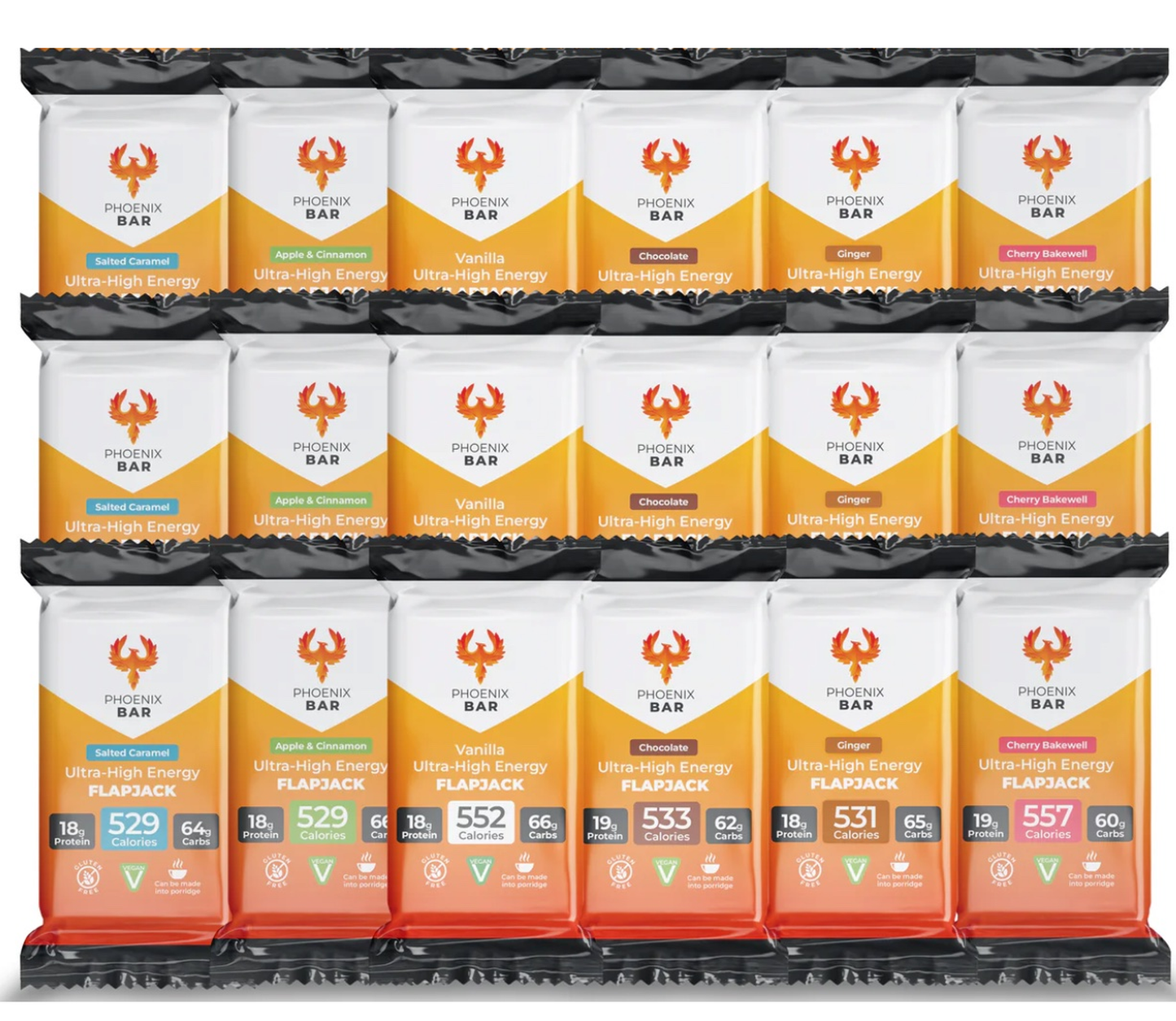
Phoenix Bars: Up to 557 Calories Per Bar
Soft, easy to eat whole or as a warm porridge. Low volume, up to 2-year shelf life. Rated 4.9/5 from nearly 400 reviews. £5.25 per bar.
What to actually eat: the working categories
A practical fastpacking food bag has four to six categories of food, each playing a specific role. Relying on one category leads to flavour fatigue and gut rebellion by day three.
Calorie-anchor foods. These are your calorie backbone. They sit above 4.5 calories per gram, do not require preparation, and can be eaten on the move. Phoenix Bars (4.4 to 4.6 kcal/g, 533 to 557 kcal per compact 120g bar), nut butters in sachets (5.5 to 6.5 kcal/g), and macadamia nuts (7.2 kcal/g) are the densest practical options. One or two anchor foods per trip should provide 50 to 60% of your total calories.
Trail snack variety. Mixed nuts, dried fruit (mango, banana, apricot), seeds, hard cheese, salami, jerky, and biltong cover the salty-savoury cravings that calorie-anchor foods do not. These foods sit at 3 to 6 calories per gram and provide the textural variety that keeps you eating across multi-day efforts.
Hot meal options. Dehydrated backpacking meals (Firepot, Summit to Eat, Mountain House) deliver 600 to 800 calories per pouch at roughly 4 calories per gram once dry. They require water and either a stove or a long cold-soak. One per evening is the standard fastpacking template.
Cold-soak alternatives. If you skip the stove, instant noodles, couscous, and porridge oats can be cold-soaked. Phoenix Bars can be crumbled into cold or hot water to make a thick porridge in two minutes (see How To Use Phoenix Bars for the full method). This eliminates 250 to 350g of stove, fuel canister, and pot weight from your kit.
Sweets and morale food. A small bag of jelly babies, a square of dark chocolate, or a packet of biscuits is not efficient by calorie density, but late on day three it can be the difference between finishing and bailing. Plan for 100 to 200 calories per day of pure morale food.
Hot food versus cold food: stove or no stove
The stove decision is the biggest weight call on a fastpack. A canister stove (110g), a 100g gas canister (200g full), and a small pot (90g) is roughly 400g of weight before any food. Across a 3-day fastpack, that is 130g of additional weight per day for the privilege of hot food.
There are three working models.
The full-stove approach makes sense for cold-weather fastpacks (autumn, winter, high altitude) where hot food is psychologically important and snow melt is needed for water. Use it for trips longer than three days where one hot evening meal is the only thing keeping you sane.
The no-stove approach uses cold-soaked oats, instant noodles softened in cold water, ready-to-eat bars, and nut butter sachets. Phoenix Bars work in this model whether eaten whole or crumbled into cold water as a thick, soft porridge. Save 400g, eat well, sleep cold.
The hybrid approach carries a 25g titanium alcohol stove and a 100ml fuel bottle. Boils water for one hot drink and one porridge bowl per day. Keeps weight to 150g instead of 400g while preserving the hot-food morale boost.
For most UK overnighters and 2 to 3 day trips, the no-stove approach wins on weight and hassle. For trips above three days or in cold conditions, a hybrid setup earns its weight.
Trail eating versus camp eating
The two food contexts on a fastpack have different rules.
On the move, you eat small amounts frequently. The body absorbs roughly 200 to 300 calories per hour during sustained aerobic effort, and any more than that often triggers GI distress. Food has to be accessible without stopping (in a vest pocket, in a hip belt pocket), easy to eat in 15 seconds, and tolerable to your stomach under exertion. Bars, gels, gummies, dates, and small handfuls of trail mix all work. Heavy, fatty, or fibrous foods (full sandwiches, jerky, hard cheese) are better saved for breaks and camp.
At camp, you eat for recovery and tomorrow's reserves. This is where the high-fat, high-calorie hit lives: a hot meal, a fortified porridge, nut butter on a wrap, the morale chocolate. Aim for 1,000 to 1,500 calories at camp from one main meal plus ancillary food. Pre-trip breakfast follows the same logic; see the high-calorie breakfast guide for fortifying strategies.
A Phoenix Bar crumbled into hot water with a tablespoon of nut butter and a banana (where available) hits roughly 750 calories in two minutes of preparation, with no chopping, no draining, and one bowl to clean.
Calorie targets by trip length
Trip length changes the calorie target because the body's ability to maintain a deficit shifts as the days accumulate.
For an overnighter (one night out, two days of effort), aim for 3,500 to 4,500 calories per day. Total trip food: roughly 7,500 to 9,000 calories, around 1.7 to 2kg in pack weight at proper density.
For a 2 to 3 day push, aim for 4,000 to 5,000 calories per day. Total trip food: 12,000 to 15,000 calories. This is the sweet spot for fastpacking and the trip length most UK fastpackers actually run.
For a 5+ day expedition, aim for 4,500 to 6,000 calories per day, with at least one resupply mid-trip. Carrying 30,000+ calories at once is not viable on a fastpack. Plan a shop stop, a posted drop bag, or a hut stop to break the supply chain.
These targets assume mixed UK terrain at 25 to 35 miles per day. Bigger climbing days, colder weather, or higher pace push the targets up by 500 to 1,000 calories per day. For more on multi-day calorie planning across longer events, see the UK ultra running nutrition guide, which covers similar deficit dynamics over 50K to multi-day races.
UK fastpacking: route-specific notes
UK fastpacking has its own quirks. Distances are shorter than US thru-hikes, but resupply gaps can be surprisingly long and weather is rarely on your side.
The South Downs Way (100 miles) has frequent villages and pubs and supports a "carry less, buy more" strategy for any fastpacker comfortable with daily shop stops. The West Highland Way (96 miles) has good resupply at Drymen, Crianlarich, Tyndrum, and Kinlochleven, but a long stretch through Rannoch Moor demands a full day's food on you. The Pennine Way (268 miles, the route of the Spine Race) has multi-day gaps between proper shops and rewards careful drop bag planning. The Cape Wrath Trail in northwest Scotland is the UK's most committing route and effectively demands full self-supply for stretches of 4 to 6 days, putting it at the upper end of fastpacking-feasible without external support.
For shorter route-specific options, the Bob Graham Round (a 24-hour fell-running classic that some attempt as a slower self-supported fastpack) is covered in the dedicated Bob Graham Round nutrition guide. The Welsh 3000s, the Cumbria Way, and the Southern Upland Way all sit comfortably in fastpacking territory and reward the same calorie-density principles.
Resupply strategy in the UK is shaped by one fact: small shops in remote areas (post office shops, petrol stations, village stores) carry limited high-calorie options. Plan to top up on flapjacks, peanuts, and chocolate. Plan not to find proper trail food. Build your calorie anchors before the trip and treat resupply as a flavour break, not a calorie source.
The day-three appetite collapse
By day three of a fastpack, most people stop being hungry. Cumulative fatigue, sleep debt, and prolonged sympathetic nervous system activation suppress appetite. Sweet food becomes intolerable. The body still needs the calories. The mouth refuses to accept them.
This is the single biggest failure mode on multi-day trips. Every fastpacker has experienced sitting in front of a flapjack on day three, knowing they need to eat it, and being physically unable to. The cumulative deficit that follows is what ends multi-day pushes.
Three things help. First, variety: rotating sweet, salty, savoury, and bitter flavours prevents the palate fatigue that kills appetite faster than physical fatigue. Second, soft texture: when chewing feels like work, soft food gets eaten when chewy food does not. Third, calorie density: if you can only manage 200g of food on day three, those 200g need to deliver 900 to 1,000 calories.
This is the situation Phoenix Bars are specifically designed for. The bars can be broken into small pieces and eaten gradually over an hour, or crumbled into hot water with a splash of milk to make a soft porridge that requires no chewing. Several Spine Race finishers and Marathon des Sables veterans use the porridge format precisely because chewable food becomes intolerable in the back half of multi-day events.
How Phoenix Bars fit into a fastpack
Phoenix Bars deliver up to 557 calories in a compact bar of only 120g (4.6 calories per gram for the Cherry Bakewell flavour, 4.4 to 4.6 for the others). They are vegan, gluten-free, freeze-resistant down to sub-zero temperatures, melt-resistant in heat, and have a two-year shelf life. The bars come in six flavours (Apple & Cinnamon, Cherry Bakewell, Chocolate, Vanilla, Salted Caramel, Ginger), which directly addresses the flavour fatigue problem on multi-day trips.
The format flexibility is what sets them apart for fastpacking. A bar can be eaten whole on the move, broken into quarters and eaten gradually during a hard climb, or crumbled into hot or cold water to make a soft, calorie-dense porridge in two minutes. That last format is the late-trip appetite hack: when chewing fails, porridge keeps the calories going in.
For a 3-day fastpack at 4,500 calories per day, four to five Phoenix Bars (roughly 480g to 600g of pack weight) cover 50% of total calories before you add any other food. The Essential Bundle of 18 bars covers a full multi-day trip plus training, and the Complete Bundle of 30 bars covers an extended push or a season of training plus events.
A worked 3-day fastpack food plan
A practical 3-day, 4,500 kcal/day fastpack food bag at roughly 1.6kg total weight:
Day one starts with a Phoenix Bar porridge breakfast (557 kcal) made with hot water and a sachet of nut butter (180 kcal). On the move: one Phoenix Bar broken across the morning (557 kcal), a 100g bag of mixed nuts (600 kcal), a 50g bag of dried mango (140 kcal), and 50g of jerky (140 kcal). Camp meal: dehydrated meal at 800 kcal, a square of dark chocolate at 150 kcal, a spoonful of nut butter at 100 kcal, and the second half of a Phoenix Bar at 280 kcal. Daily total: roughly 4,500 kcal at 600g of food weight.
Day two follows the same pattern with flavour rotation (different bar flavour, salami instead of jerky, dates instead of mango). Day three lighter on volume because the appetite has dropped, heavier on bars in porridge format because chewing is harder.
Total food weight: 1.6 to 1.8kg for 13,500 kcal. That is the calorie density target you cannot hit with cereal bars and trail mix alone.
Frequently asked questions
How many calories per day do you need for fastpacking? A 70kg fastpacker covering 25 to 35 miles per day on UK terrain typically burns 3,500 to 5,500 calories. Aim to consume 80 to 90% of that figure (3,000 to 5,000 calories per day) to manage the deficit without sacrificing performance. Cold weather, big climbing days, and bigger body weights all push the figure higher.
What is the best food for fastpacking? The best fastpacking foods sit above 4 calories per gram, require no refrigeration, and survive being packed all day. Calorie-dense bars (4.4 to 4.6 kcal/g), nut butters (5.5 to 6.5 kcal/g), mixed nuts (5.5 to 7 kcal/g), hard cheese (3.5 to 4 kcal/g), jerky and biltong (3 to 4 kcal/g), dried fruit (3 to 3.5 kcal/g), and dehydrated meals (4 kcal/g once dry) cover the categories you need.
How heavy should fastpacking food be per day? Aim for 600 to 800g of food per day at proper calorie density. That delivers 3,500 to 5,000 calories at densities between 4.5 and 6 calories per gram. Carrying more than 800g per day is usually a sign that food density is too low.
Do you need a stove for fastpacking? No. Cold-soaking, ready-to-eat bars, and nut butters can deliver full calorie targets without a stove. Removing the stove, fuel, and pot saves 250 to 400g of base weight. For trips longer than three days or in cold conditions, a hybrid setup with a small alcohol stove is often the better trade-off.
What food does not melt or freeze on a fastpack? Most chocolate-based bars melt in summer heat and turn rock-solid in sub-zero conditions. Phoenix Bars are formulated to remain edible across a temperature range from below freezing to summer heat. Dried fruit, jerky, hard cheese (in cold weather), and nut butters in sachets all hold up across UK conditions.
Is fastpacking food the same as backpacking food? No. Backpacking food can include heavier, lower-density options because pack weight is less critical and pace is slower. Fastpacking demands food above 4 calories per gram, no-refrigeration storage, and packaging that survives being run with. Most backpacking food lists include items (canned food, fresh produce, heavy meals) that fail on a fastpack.
What is the best UK fastpacking bar? A bar earns its place on a UK fastpack on three criteria: calorie density above 4 calories per gram, palatability across multi-day use, and durability across UK conditions (rain, freeze-thaw, summer heat). Phoenix Bars deliver 533 to 557 calories at 4.4 to 4.6 calories per gram, six flavours to manage palate fatigue, and freeze-resistant and melt-resistant formulation. They can also be crumbled into water for a no-chew porridge when late-trip appetite collapses.
About this guide
Written by James Frost, founder of Flaming Phoenix and creator of Phoenix Bars. James developed Phoenix Bars after 150+ pre-launch conversations with ultra-endurance athletes, expedition teams, and self-supported racers. Phoenix Bars are now used by Spine Race finishers, Marathon des Sables athletes, and customers on multi-day fastpacks across the UK and internationally. For broader principles across all multi-day disciplines, the Ultra-Endurance and Expedition Nutrition Guide is the primary cluster pillar. For shorter-format running guides, see trail running nutrition and UK ultra running nutrition. For day hike and weekend trip planning, hiking and trekking nutrition covers the broader category.
If you have any questions about using Phoenix Bars on a specific fastpack or trail, contact James directly at jfrost@flaming-phoenix.co.uk.


Flaming Phoenix