

Mountaineering Nutrition: How to Fuel When Altitude Kills Your Appetite
In this guide

About This Guide
Altitude changes everything about eating. As you climb higher, appetite drops, digestion slows, calorie expenditure increases, and the weight of every item in your pack becomes more punishing. The result is a persistent calorie gap that can compromise performance, recovery, and safety.
At elevations above 2,500m, most climbers and trekkers experience some degree of altitude-induced appetite loss. Above 5,000m, appetite suppression can be severe, yet the body's calorie demands at this elevation are 2–3 times higher than at sea level due to the increased effort of movement, thermoregulation in cold conditions, and the metabolic cost of acclimatisation.
This guide focuses specifically on practical approaches to maintaining calorie intake at altitude when appetite is suppressed, conditions are extreme, and pack weight is limited.
It covers:
- why altitude suppresses appetite and increases calorie demands simultaneously
- why the weight-to-calorie ratio of your food matters more in the mountains than anywhere else
- what food characteristics are most practical at high altitude
- how compact, calorie-dense foods can close the gap when full meals are not realistic
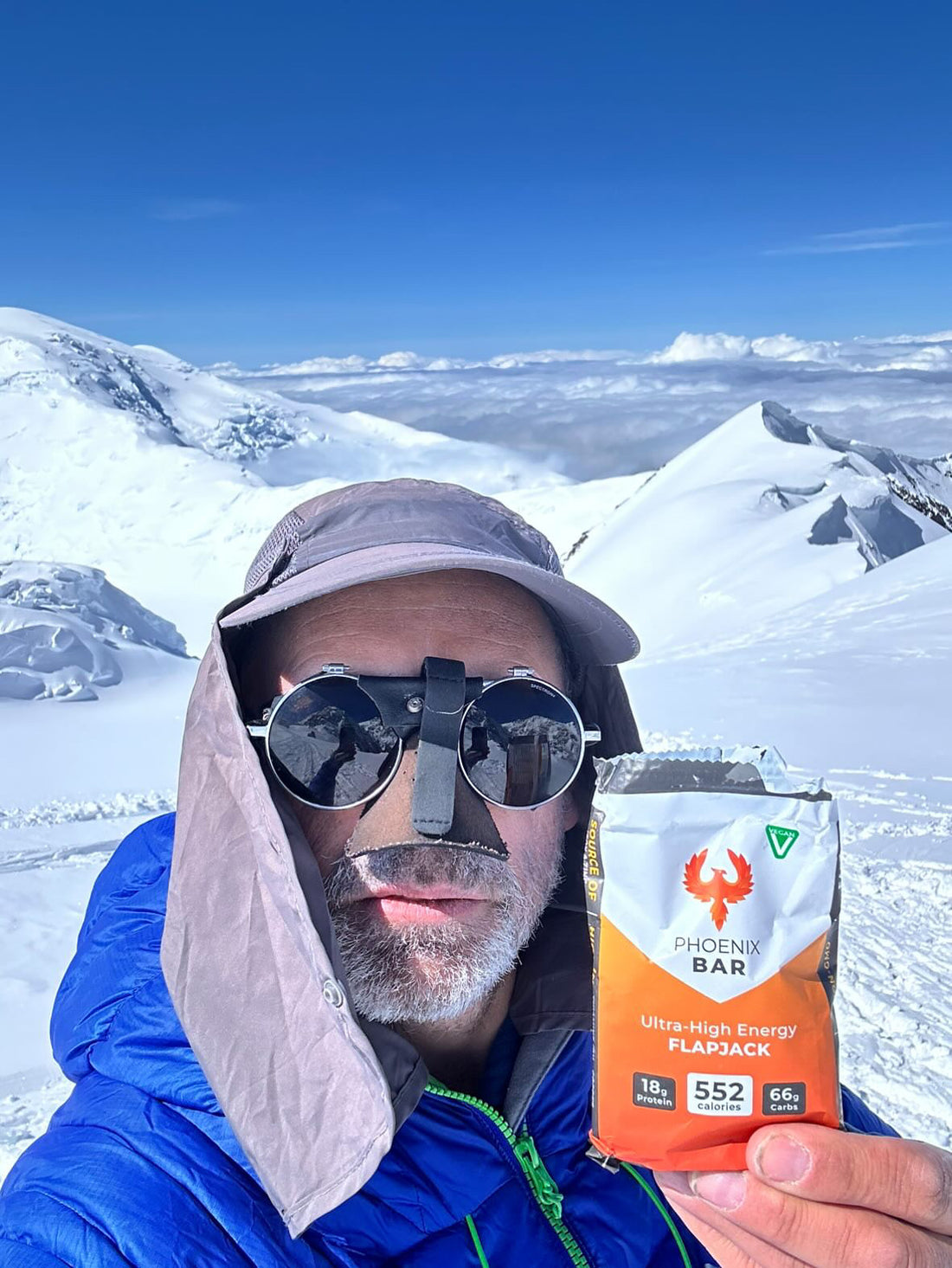
It also explains how mountaineers and high-altitude trekkers use Phoenix Bars, compact high calorie bars (up to 557 calories each) that won't freeze or melt, as part of their expedition nutrition.
This guide is informational and should not replace medical advice about altitude acclimatisation or nutrition for specific expeditions. Consult your expedition doctor or a sports dietitian for personalised guidance.
Written by James Frost, Founder of Flaming Phoenix. Phoenix Bars have been carried to the summit of Everest and used on expeditions from the Sahara to the Arctic.
Last updated: March 2026
Key points: Altitude suppresses appetite while increasing calorie demands by 2–3x. Most climbers eat 50–70% of what they need above 5,000m. Every gram of food must justify its place in your pack: calorie density per gram is the critical metric. Food must not freeze in sub-zero conditions or melt in direct sun. Phoenix Bars deliver up to 557 calories per compact 120g bar, won't freeze or melt, and are a source of iron, which contributes to normal oxygen transport in the body.
Free download
Free: the Ultra & Expedition Fuelling Checklist
A printable 2-page plan with your hourly carb targets, race-week plan and pack-weight maths. Free, sent straight to your inbox.
Free. Unsubscribe anytime. Privacy policy
Contents
- Why altitude changes everything about eating
- The calorie gap at high altitude
- Common eating challenges in the mountains
- What makes food work at altitude
- Practical strategies to maintain calorie intake
- Why calorie density matters more in the mountains
- How Phoenix Bars are used at altitude
- Practical suggestions for expeditions
- Frequently asked questions
- Related guides
Why Altitude Changes Everything About Eating
High altitude affects eating through multiple overlapping mechanisms.
Appetite suppression. As altitude increases, the body produces hormones including leptin and cholecystokinin that suppress hunger signals. At the same time, hypoxia (reduced oxygen availability) dampens the desire to eat. Above 5,000m, many climbers report virtually no appetite, even when they know they need to eat.
Increased calorie expenditure. Moving at altitude requires significantly more effort than at sea level. The body works harder to breathe, harder to thermoregulate in cold conditions, and harder to perform any physical task with reduced oxygen. A day of climbing above 5,000m can burn 4,000–6,000+ calories depending on conditions and intensity.
Impaired digestion. Altitude slows gastric emptying: food sits in the stomach longer, creating a feeling of fullness and discomfort. Rich, fatty, or heavy meals can feel particularly difficult to digest. Many climbers experience nausea, bloating, and general digestive discomfort at altitude.
Dehydration. The body loses fluid faster at altitude through increased respiration and the dry air. Dehydration further suppresses appetite and impairs digestion.
Cold conditions. At high altitude, sub-zero temperatures are common, even on tropical mountains. Cold suppresses appetite independently of altitude, and the energy cost of maintaining body temperature adds to calorie demands.
Pack weight constraints. On technical mountaineering routes and high-altitude expeditions, every gram matters. Food competes with safety equipment, climbing gear, shelter, and fuel for weight and space in the pack. This creates a direct tension between carrying enough food and carrying a pack light enough to climb safely.
The combined effect is a severe mismatch: the body needs far more calories than normal, but appetite, digestion, conditions, and weight constraints all work against adequate eating. Research consistently shows that most high-altitude climbers consume only 50–70% of their calorie needs above 5,000m.
The Calorie Gap at High Altitude
The calorie deficit at altitude accumulates rapidly.
At sea level, a moderately active adult might need 2,000–2,500 calories per day. A climber above 5,000m carrying a pack and moving through technical terrain in cold conditions may need 4,000–6,000 calories per day, yet typically consumes only 2,000–3,500.
This deficit has direct consequences: weight loss and muscle wasting that accelerate with altitude and duration, fatigue that compounds daily and reduces climbing performance, impaired cognitive function that increases the risk of poor decision-making, slower acclimatisation as the body lacks the energy to adapt, and weakened immune response that increases vulnerability to illness.
On a multi-day expedition, cumulative calorie deficit is one of the most significant performance and safety risks. Climbers who maintain better calorie intake consistently perform better, acclimatise faster, and recover more effectively between climbing days. Soldiers on demanding exercises face a similar calorie gap, covered in our guide to military field nutrition.
Common Eating Challenges in the Mountains
No appetite. The single biggest barrier. At altitude, the desire to eat can be completely absent for hours or even days. Eating becomes a deliberate, conscious act rather than a response to hunger.
Nausea. Altitude sickness, dehydration, and exertion can all cause nausea that makes eating feel impossible. Rich or heavy foods are particularly likely to trigger it.
Frozen food. At sub-zero temperatures, many foods freeze solid: bars become rock-hard, bread becomes inedible, fruit becomes an ice block. Foods that don't freeze remain edible when others fail. Staying soft in the cold is one of the main tests in our ranking of the best energy bars for expeditions.
Melting food. On sun-exposed approaches and at lower altitudes in tropical mountain environments, chocolate, many energy bars, and soft snacks melt into an unusable mess.
Limited cooking. Above certain altitudes, cooking becomes impractical: fuel is heavy, water needs to be melted from snow, and the energy to prepare a meal may not be available. Ready-to-eat foods become essential.
Taste changes. Altitude can dull taste perception. Bland foods become even less appealing. Subtle, not-too-sweet flavours tend to be tolerated better than either very bland or very sweet options.
Dry mouth and throat. The dry air at altitude, combined with mouth breathing during exertion, makes dry or crumbly foods very difficult to eat without significant water, which itself is a precious and heavy resource.
What Makes Food Work at Altitude
Food for high-altitude mountaineering and expeditions needs to be:
- Calorie-dense: maximum energy per gram of pack weight
- Won't freeze: remains soft and edible in sub-zero conditions
- Won't melt: remains intact in direct sun and warm approaches
- Lightweight and compact: every gram counts in the pack
- Ready to eat or minimal preparation: conserving fuel and energy
- Easy to eat with minimal chewing: manageable when exhausted, hypoxic, and wearing gloves
- Not sickly sweet: tolerable when appetite is suppressed and taste perception is altered
- High in carbohydrates: carbs are the most efficiently metabolised energy source at altitude, requiring less oxygen to convert to energy than fat
- Robust packaging: survives being compressed in a pack, exposed to moisture, and handled with gloves
- Contains useful vitamins and minerals: iron contributes to normal oxygen transport in the body, thiamine contributes to normal energy-yielding metabolism, and vitamin E contributes to the protection of cells from oxidative stress
Practical Strategies to Maintain Calorie Intake
Eat by the clock, not by appetite. Hunger signals are unreliable at altitude. Set a schedule: eat something every 2 hours, regardless of whether you feel hungry. Small, frequent calorie-dense snacks maintain energy without overwhelming a suppressed appetite.
Front-load calories at lower altitudes. Eat aggressively at base camp and during approach days when appetite is stronger. Building calorie reserves before going high provides a buffer for the days when eating becomes hardest.
Carry ready-to-eat, high-calorie snacks for climbing days. Anything that requires cooking, heating, or preparation with utensils will not get eaten on a climbing day above 5,000m. Pack food that can be eaten from a pocket with gloves on.
Choose carbohydrate-rich foods. At altitude, the body metabolises carbohydrates more efficiently than fat: carbs require less oxygen to convert to energy. High-carb, calorie-dense foods are the most practical fuel source for climbing days.
Test everything at altitude before committing. Foods that work perfectly at sea level may be intolerable at altitude due to taste changes, nausea, or texture aversion. Test your planned nutrition during acclimatisation days or training at altitude.
Porridge and liquid calories for acclimatisation days. Warm, semi-liquid foods are often the most tolerable at altitude. A calorie-dense porridge, soup, or hot drink with added calories can deliver meaningful energy when solid food feels impossible. For instructions on making a 557-calorie porridge from a Phoenix Bar, see how to use Phoenix Bars.
Keep food accessible. Store snacks in jacket pockets, hip belt pockets, or the top of your pack, not buried at the bottom. The easier it is to reach food without stopping, the more likely you are to eat consistently.
Why Calorie Density Matters More in the Mountains
Calorie density (calories per gram) is the single most important food selection criterion for mountaineering.
Every gram of food in your pack must be carried uphill, at altitude, in conditions where every additional gram of weight increases fatigue and reduces climbing performance. The food that delivers the most calories in the least weight is the food that lets you climb faster, lighter, and with more energy.
A standard energy gel delivers approximately 100 kcal at 30g. A standard energy bar delivers approximately 150–250 kcal at 40–60g. A Phoenix Bar delivers up to 557 kcal at 120g, roughly 464 kcal per 100g. That's among the highest calorie-to-weight ratios available in a ready-to-eat, no-preparation format.
For a five-day alpine push where you're carrying all your food, the weight difference between lower-density and higher-density options can be 1–2kg, weight that translates directly to speed, safety, and available energy.
How Phoenix Bars Are Used at Altitude
Phoenix Bars were designed for extreme conditions. Several characteristics make them particularly suited to mountaineering and high-altitude expeditions.
Won't freeze. Phoenix Bars remain soft and edible in sub-zero temperatures. While many bars and snacks freeze solid above 5,000m, Phoenix Bars maintain their texture, meaning they can be eaten with gloves on, in any temperature.
Won't melt. Equally important on sun-exposed approaches and in warm base camp conditions. Phoenix Bars are heat-stable above 50°C.
High calorie density. 557 calories per compact 120g bar. Carried in a jacket pocket, this represents a full snack meal available at any moment during a climbing day.
66g of carbohydrates per bar. Carbohydrate-rich, which aligns with the body's preference for carb metabolism at altitude where oxygen is limited.
A source of key vitamins and minerals. Phoenix Bars contain naturally occurring iron (3.2mg per bar, 23% RI), vitamin E (5.2mg, 43% RI), vitamin B1 (0.4mg, 36% RI) and vitamin B7 (9.9µg, 20% RI). Iron contributes to normal oxygen transport in the body, thiamine and biotin contribute to normal energy-yielding metabolism, and vitamin E contributes to the protection of cells from oxidative stress.
Soft texture even in extreme cold. Can be eaten with minimal chewing when exhaustion and hypoxia make the physical act of eating effortful. Can be broken into pieces and eaten one piece at a time during rest stops.
Can be made into porridge. Adding hot water creates a warm, calorie-dense porridge, ideal for base camp meals, acclimatisation days, or summit night when solid food is intolerable.
Robust packaging. Water-resistant packaging that won't crush or tear in a climbing pack.
Shelf life of up to two years. Can be purchased months before an expedition with no risk of expiry during the trip.
Phoenix Bars have been carried to the summit of Everest.
"I took Phoenix Bars with me on Mt Teide and during my Aconcagua expedition."
"Packing a solid amount of calories and carbs into such a small product that's easy to carry and eat while out on the trails is brilliant and changed the game for me."
Practical Suggestions for Expeditions
Base camp and approach: Eat Phoenix Bars as calorie-dense snacks between meals to build calorie reserves while appetite is still relatively strong. Make porridge for breakfast by mixing a bar with hot water or milk powder.
Climbing days: Carry 2–3 bars in jacket or hip belt pockets. Break into pieces before the day starts. Eat one piece every 30–45 minutes regardless of hunger. Three bars provide 1,671 calories of easy-to-access, no-preparation climbing fuel.
Summit push: Keep a bar in an inner pocket close to your body to prevent freezing in extreme conditions. The soft texture means it can be eaten at altitude with minimal effort. On an 8,000m summit push, even a few bites provide meaningful calories when other food is impossible.
Rest days and acclimatisation: Use the porridge format for warm, comforting, calorie-dense meals. Add milk powder, nut butter, or honey for extra calories.
Emergency/storm days: Phoenix Bars require no cooking, no water, and no preparation. They function as a reliable emergency food that is always available regardless of conditions.
Provisioning: For a 2-week expedition, 2–3 bars per day = 28–42 bars. For a month-long expedition, 60–90 bars. The 24-bar Signature Bundle is the most practical provisioning option. Contact me directly for bulk expedition orders.
Frequently Asked Questions
Why does appetite drop at altitude?
Altitude triggers hormonal changes (increased leptin and cholecystokinin) that suppress hunger signals. Hypoxia, dehydration, nausea, and cold all contribute further. Above 5,000m, most climbers have very little natural appetite.
How many calories do I need at high altitude?
Depends on altitude, activity, temperature, and individual metabolism, but 4,000–6,000 calories per day is typical for active climbing above 5,000m. Most climbers consume only 50–70% of this, creating a progressive calorie deficit.
Will Phoenix Bars freeze at altitude?
No. Phoenix Bars remain soft and edible in sub-zero temperatures. This is one of their key advantages over standard energy bars which typically freeze solid above 5,000m.
Are Phoenix Bars good for altitude because of the nutrients?
Phoenix Bars contain naturally occurring iron, vitamin E, B1, and B7, all of which support oxygen delivery and energy metabolism at altitude. They are also high in carbohydrates (66g per bar), which the body metabolises more efficiently at altitude than fat.
Can I make Phoenix Bar porridge at altitude?
Yes. Adding hot water to a Phoenix Bar creates a warm, calorie-dense porridge. This is particularly useful at base camp and during acclimatisation when solid food is hard to face but warm meals are comforting and practical.
Related Guides
- Ultra-Endurance & Expedition Nutrition Guide: broader expedition nutrition principles
- Marathon Des Sables Nutrition: extreme heat conditions nutrition
- Ocean Rowing Nutrition: similar calorie-density challenges at sea
- Calorie-Dense Foods: full explanation of calorie density
- How To Use Phoenix Bars: practical guidance including porridge method
James Frost,
Founder, Flaming Phoenix
jfrost@flaming-phoenix.co.uk | 07990 519422
Big calories. Small bar.
Up to 557 calories in a compact, lightweight bar of only 120g, with up to 66g of carbs and 19g of protein. Eat it whole, break it into pieces over a few hours, or stir it into hot water or milk for porridge.
Easy to eat, easy to digest and not sickly sweet. Phoenix Bars do not melt in heat or freeze in sub-zero temperatures and have an up to 2-year shelf life, so they work on a mountain, on a night shift, or at home on days when eating enough feels hard. Vegan and gluten-free too.
- 557 calories in one compact 120g bar (529 to 557 by flavour)
- 4.6 calories per gram
- 66g carbs per bar (up to)
- 19g protein per bar (up to)
