
Obstacle Race Nutrition: How to Fuel OCR
The short version: obstacle racing and Hyrox sit between two worlds, so neither the marathon playbook nor the gym playbook fits on its own. You are asking your body to run hard and to produce near-maximal force at the stations, over and over, which burns through stored carbohydrate fast. The biggest fueling wins happen across your training block and in recovery, not on race day itself. For most short events, a Spartan Sprint or a sub-90-minute Hyrox, your breakfast and your carb stores already cover you, and the job during the race is simply to stay hydrated. The longer formats, a Spartan Beast, an Ultra, or a 24-hour event, are where carried food matters, and where the rule flips toward eating real, durable calories at every chance you get. This guide walks through all of it, from daily training fuel to race-morning timing to what actually works when you are caked in mud.
About this guide
I'm James Frost, founder of Flaming Phoenix. We make Phoenix Bars: a 120g vegan, gluten-free bar built to pack a lot of easily digested energy into a small package, which is exactly what a hard training block and a fast recovery call for. I am not a coach, so where this gets technical I lean on published sports-nutrition guidance and on what experienced OCR and Hyrox athletes actually do. This page is one spoke of our wider ultra-endurance and expedition nutrition guide. Always test your fueling in training before you trust it on race day. Last reviewed June 2026.
Key points
- OCR and Hyrox are hybrid events: you fuel for running and strength at the same time, so carbohydrate is the priority and protein needs run higher than for pure runners, around 1.6 to 2.4g per kg of bodyweight a day.
- Most of the real fueling happens in the training block, not on race day. Under-eating carbs across a hard 8 to 12 week build is the most common mistake.
- For events under about 90 minutes (most Hyrox races, a Spartan Sprint), you usually do not need to eat mid-race. Hydration is the bigger lever, and 40 to 50% of athletes start already dehydrated.
- For long events (a Spartan Beast, an Ultra, a 24-hour format) carry durable, easy-to-eat real food and eat at every chance, because gels alone rarely hold up.
- Carb-load to roughly 6 to 8g per kg in the 24 to 48 hours before, and work your race-morning meals back from your start time.
- Recovery within 30 to 60 minutes, carbs plus protein, is the most neglected lever, and it is what lets you train hard again two days later.
Contents
- Why OCR and Hyrox fueling is different
- How much energy these events actually demand
- Fuelling the training block
- Race week and race morning
- During the race: do you need to eat?
- Hyrox: fuelling a hybrid event
- Recovery: the most underrated lever
- Where Phoenix Bars fit
- Frequently asked questions
1. Why OCR and Hyrox fueling is different
Obstacle racing and Hyrox are hybrid events, and that single fact changes everything about how you fuel. You are combining sustained aerobic running with repeated bursts of near-maximal strength: dragging sleds, carrying sandbags, climbing walls, hauling yourself over obstacles. Most advice you will find online is borrowed wholesale from marathon content or from bodybuilding content, and neither one fits a sport that demands both at once.
The practical consequence is that carbohydrate matters more than people expect, and it matters in a different way. Pure strength training can get away with moderate carbs. A hybrid event cannot, because the running volume and the high-intensity stations both run on glycogen, your stored carbohydrate, and you deplete it fast.
At the same time your protein needs sit higher than a marathoner's, in the region of 1.6 to 2.4g per kg of bodyweight a day, because the sled pushes, wall balls and carries cause real muscular damage that has to be repaired. This is the genuine difference: you are fueling an engine and a set of muscles at the same time, and you have to feed both.
If you are coming to this from a pure running background, our trail running nutrition guide covers the endurance side, and the principles here add the strength layer on top.
2. How much energy these events actually demand
Obstacle racing burns more energy than steady running of the same distance, because every obstacle spikes your heart rate. The repeated surges mean you are rarely in a comfortable aerobic rhythm, and at hard efforts some estimates put the burn as high as 700 calories an hour, well above an easy run.
The total depends almost entirely on how long you are out there, which varies hugely by format. A Spartan Sprint of around 5km takes most people one to one and a half hours. A Super of around 10km runs to roughly two hours, a Beast of around 21km to three to five and a half hours, and the Ultra and 24-hour formats like the World's Toughest Mudder go far beyond that.
Hyrox is shorter and more intense: eight 1km runs broken up by eight functional stations, finished in around 55 minutes by elites, just under 90 minutes by the average competitor, and up to three hours at the back. Measured heart rates during Hyrox sit very high, around 96% of maximum for some athletes, which puts the metabolic strain on a par with a half marathon or a sprint triathlon.
So the fueling answer is not one number. A 70-minute event and a six-hour event are different problems, and you fuel them differently, which is what the next sections cover. For the broadest energy demands across multi-hour formats, our multi-day ultra running nutrition guide and calorie-dense foods guide go deeper on closing a big calorie gap.

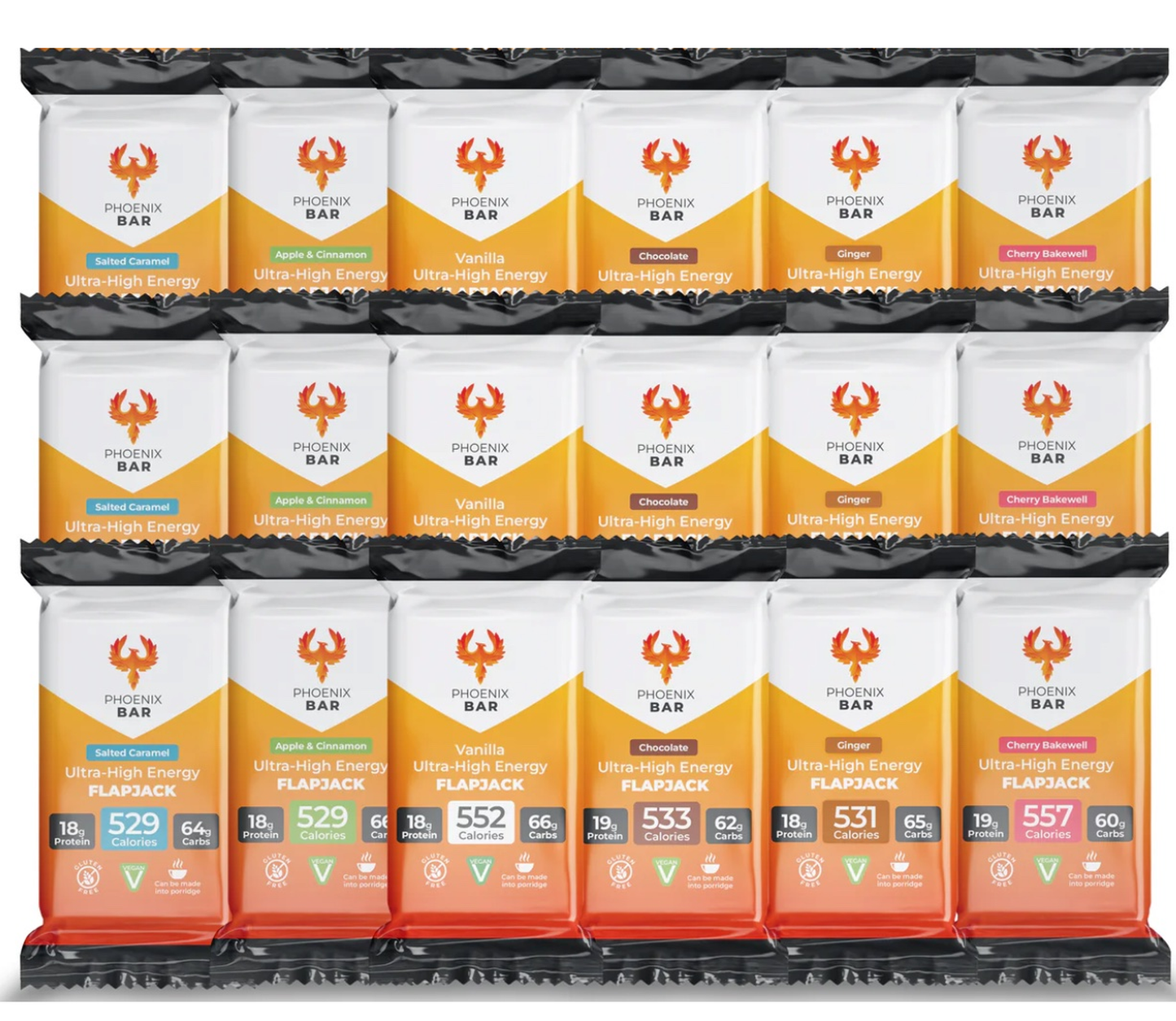
Phoenix Bars: Up to 557 Calories Per Bar
Soft, easy to eat whole or as a warm porridge. Low volume, two-year shelf life.
3. Fuelling the training block
Here is the part most race-day articles skip: the majority of your fueling happens in the weeks of training, not in the hour of the race. An 8 to 12 week OCR or Hyrox build stacks running volume on top of strength work, and the single most common mistake is under-eating carbohydrate as that load climbs.
The reason it happens is simple. People taper their food when they should be holding it, or they bring a fat-loss mindset to a performance sport, and then they wonder why they are dragging through the sled push. Research on hybrid and functional-fitness athletes repeatedly finds they under-consume carbs relative to their training load. The fix is to keep carbohydrate in the 4 to 7g per kg range on training days, with the higher end on your hardest sessions.
This is the everyday job that a high-calorie, easy-to-digest food does well. When you are training twice some days and your appetite cannot keep up with your energy output, getting a concentrated dose of carbohydrate in quickly matters. A Phoenix Bar packs up to 557 calories into 120g, so it is a practical way to top up around a hard session without a full meal, and it can be made into a warm porridge if you would rather eat it as a proper pre-session breakfast.
For structuring daily intake across a heavy block, our 3,000 calorie meal plan and high calorie snacks guide are the two most useful companions to this page. The Essential bundle of 18 bars is a sensible block to fuel a few weeks of training from.
4. Race week and race morning
Race week is about topping off the tank, not last-minute heroics. In the 24 to 48 hours before, lift your carbohydrate to roughly 6 to 8g per kg of bodyweight while your training volume drops, which fills muscle and liver glycogen so you start full. For a 70kg athlete that is around 420 to 560g of carbohydrate a day, from familiar, low-fibre sources like rice, pasta, potatoes, bread and oats.
Two rules matter more than the numbers. Do not try anything new in the final 24 hours, and do not strip all fibre or overload on plain water. The aim is a full tank and a settled stomach on the start line.
On race morning, work backwards from your start time. Eat a high-carb, low-fibre, low-fat meal two to four hours before, something like porridge with banana and honey, a bagel with jam, or eggs on toast. Then take a smaller carb snack 60 to 90 minutes out, and another small top-up around 30 minutes before if it suits you.
Oats are the classic OCR and Hyrox race-morning breakfast because they release energy steadily and sit well. A Phoenix Bar made into porridge with hot water is an easy, packable version of that breakfast for the morning of an away race, and our how to use Phoenix Bars guide shows the porridge method. For more race-morning options, see our high calorie breakfast and high calorie porridge guides.
5. During the race: do you need to eat?
For most obstacle races and Hyrox events, the honest answer is no. If you are finishing inside about 90 minutes, your breakfast and your topped-up glycogen will carry you, and the priority during the event is hydration, not food. Aim to drink steadily, roughly 150 to 250ml every 15 to 20 minutes, because a large share of athletes start events already mildly dehydrated and pay for it in the second half.
The picture changes once you go past two hours. On a Spartan Beast, an Ultra, or a lapped 24-hour event, you have to eat, and this is where the realities of the sport bite. Gels are awkward when you are crawling through mud and water: you have to take the whole pack at once, often with water, and they get lost or ruined. Many racers find chews easier to partition, and on the longest events they switch to real food entirely, because by hour six the stomach wants rice, a sandwich, or something savoury, not another sweet gel.
What works mid-race on a long event is durable, easy-to-eat, calorie-dense food you can manage one-handed and that survives a water obstacle in your pocket or vest. If gels do not sit well with you, our energy gel alternatives guidecovers the real-food options in detail, and the lapped-course formats are closest to the demands in our backyard ultras guide, where you refuel at a base between laps.
One clarification worth making: obstacle racing is not the same as adventure racing. If you are looking at multi-day, multi-discipline expedition events with navigation, biking and paddling, our adventure racing nutrition guide is the right page for that, and it treats food as multi-day logistics rather than single-event fuel.
6. Hyrox: fuelling a hybrid event
Hyrox deserves its own approach because its demand profile is so specific: eight 1km runs paired with eight strength stations, almost all of it at very high intensity, almost all of it finished inside 90 minutes. The mistake nearly everyone makes is fueling it like a marathon or like a gym session. It is neither.
Because most Hyrox races are short and intense, you do not carb-load like a marathoner and you rarely eat during the race. A practical 36 to 48 hour carb emphasis is enough to top off glycogen, and during the race itself the Roxzone transitions are for drinking, not eating, unless you are over 90 minutes, in which case 30 to 60g of carbs across the second half can help.
Where Hyrox fueling actually gets won is the training block and recovery, for the same reasons as OCR. You are running hard and lifting hard several times a week, your carbohydrate needs are high (4 to 7g per kg on training days), and your protein needs sit at 1.6 to 2.4g per kg to recover from the sleds, lunges and wall balls. Caffeine has the strongest evidence of any legal aid here, around 3 to 6mg per kg taken 30 to 60 minutes before, particularly for the neuromuscular punch on the sled push.
The takeaway: for Hyrox, treat your daily fueling and your recovery as the performance levers, and treat race day as simple execution of a breakfast you have already rehearsed. Because Hyrox now has enough of its own following to be a topic in its own right, this section is a summary, and a fuller standalone Hyrox guide is worth building next.
7. Recovery: the most underrated lever
Recovery is where hybrid athletes leave the most on the table. The hard part of OCR and Hyrox training is not any single session, it is being able to repeat hard sessions through a long block, and that depends almost entirely on how well you refuel afterwards.
The window that matters is the 30 to 60 minutes after a hard session or a race. Your muscles are primed to absorb carbohydrate and protein then, so getting both in quickly speeds glycogen replacement and kick-starts the muscle repair you need after sleds and carries. A rough target is a solid dose of carbs alongside 20 to 30g of protein.
This is a genuine use case for a packable, high-calorie food. When you finish a session away from your kitchen, having something dense and easy to eat in your bag means you actually hit the window instead of waiting two hours for a meal. A Phoenix Bar, eaten cold or as porridge, covers the carbohydrate side of that recovery snack in a format that travels in a gym bag.
8. Where Phoenix Bars fit
Let me be straight about where our bars help and where they do not, because the honesty is the point. Phoenix Bars are not a mid-race gel for a 60-minute Hyrox, and for a short Spartan Sprint you will not eat one on course. If that is all you do, you do not need them during the event.
Where they earn their place is the rest of the picture. Across a hard training block they are a fast way to hit high daily carbohydrate when your appetite lags. On race morning they make a packable porridge breakfast. In the recovery window they cover the carbohydrate side of refuelling in a format you can carry. And on the long events, a Beast, an Ultra, or a lapped 24-hour race, they are durable, calorie-dense carried fuel that holds up better than a soft snack.
The practical case is density and convenience. Each bar delivers up to 557 calories in 120g, it is vegan and gluten-free so it suits a mixed training group, and it comes in six flavours (Apple and Cinnamon, Cherry Bakewell, Chocolate, Vanilla, Salted Caramel and Ginger) so you are not sick of one taste by week ten of a build. They are a premium product at £5.25 a bar, and what you pay for is the calorie density and the format, not a cheaper supermarket alternative.
A good way to test them across a training block is the Starter bundle of 12 bars, or step up to the Essential and Complete bundles for a full build. You can see the full range in the Phoenix Bars collection and the bundles collection.
9. Frequently asked questions
What should I eat before an obstacle race or Spartan race?
Eat a high-carb, low-fibre, low-fat meal two to four hours before the start, such as porridge with banana and honey, a bagel with jam, or eggs on toast. Add a small carb snack 60 to 90 minutes before. Keep it familiar and tested, and do not try anything new on race day.
Do you need to eat during a Hyrox or obstacle race?
For most events under about 90 minutes, including a typical Hyrox or a Spartan Sprint, you do not need mid-race food, and hydration is the bigger priority. For events over two hours, like a Spartan Beast or a 24-hour format, you should eat regularly, favouring durable, easy-to-eat food over gels alone.
How many calories does an obstacle race burn?
It depends almost entirely on duration, but the burn is higher than steady running because obstacles spike your heart rate, with some estimates reaching around 700 calories an hour at hard efforts. A short Sprint might be 600 to 900 calories, while a multi-hour Beast can run into several thousand.
What is the best food to carry during a long obstacle race?
Durable, calorie-dense food you can eat one-handed and that survives mud and water: dense bars, chews, and real food like rice or sandwiches on the longest events. Gels are easy to lose or ruin in water obstacles, so most long-event racers carry a mix and lean on real food later in the race.
What should I eat to recover after an OCR or Hyrox race?
Aim for carbohydrate plus around 20 to 30g of protein within 30 to 60 minutes of finishing, then a full balanced meal within a couple of hours. The early carb-and-protein hit speeds glycogen replacement and muscle repair, which matters most when you are training hard repeatedly.
How is Hyrox nutrition different from marathon nutrition?
Hyrox is shorter, more intense, and hybrid, so it needs a smaller, 36 to 48 hour carb emphasis rather than full marathon-style loading, and higher daily protein (1.6 to 2.4g per kg) to recover from the strength stations. You also rarely eat during a Hyrox, whereas a marathon usually requires steady mid-race fuelling.
What is the best vegan fuel for obstacle racing?
Oats, bananas, rice, dried fruit and plant-based bars all work well across training, race morning and recovery without any animal products. A vegan, gluten-free high-calorie bar is a simple way to fuel a mixed training group where some people have dietary restrictions.
Related guides
If obstacle racing is one part of a wider training life, these cover the neighbouring demands: trail running nutrition for the run portion, rucking nutrition for weighted carries and hybrid load, multi-day ultra running nutrition for the long formats, and the energy gel alternatives guide if gels do not agree with you. This page sits within our wider ultra-endurance and expedition nutrition guide.


Flaming Phoenix



Contact Us
Declare withdrawal
Please fill out the following form to declare your withdrawal from the contract.

