

Land's End to John o'Groats Nutrition: The Three Failures That Break End-to-Enders
In this guide

Most people who attempt Land's End to John o'Groats finish it. The ones who do not, or who arrive at John o'Groats looking significantly older than when they left Cornwall, almost always fail on the same three problems. None of them are fitness. All three are nutrition.
This is a guide for cyclists, runners, and walkers taking on the full 874 to 1,200 mile length of Britain. It is not a training guide. It assumes you have trained. It is the guide for the other variable that will determine whether you arrive at John o'Groats strong, whether you grind the last three days in a fog of cumulative fatigue, or whether you abandon somewhere north of Glasgow in a damp petrol station forecourt. Nutrition is the variable most end-to-enders underinvest in, and the one most likely to stop them.
About this guide
This guide covers Land's End to John o'Groats (LEJOG) and John o'Groats to Land's End (JOGLE) across the three most common travel modes: cycling (10 to 14 days), running (9 to 20 days), and walking (6 to 12 weeks). It is written around the three failure modes that stop end-to-enders. For mode-specific mechanics beyond the LEJOG context, see the Cycling and Bikepacking Nutrition guide, the UK Ultra Race Nutrition guide, and the Long-Distance Walking guide.
Phoenix Bars are referenced throughout because end-to-enders use them specifically for the failure moments covered below. These high calorie bars carry up to 557 calories in a compact, flapjack-textured format that survives being sat on for days in a pannier, a running vest, or a rucksack.
Written by James Frost, Founder of Flaming Phoenix. Last updated: April 2026.
Part one: The three nutrition failures of LEJOG
Failure 1: The Day 3 gut shutdown
By Day 3, most end-to-enders have done more consecutive hours of exercise than they did in any single training week. The digestive system is not trained for this. Symptoms appear around Day 2 afternoon or Day 3 morning: a slow, queasy fullness that does not clear, loss of appetite in the afternoons, mild nausea on climbs, and an uncomfortable relationship with anything sweet or acidic.
This is a common early-stage gut shutdown. It is driven by blood shunting away from digestion toward working muscles, compounded by the sheer volume of food being pushed through the gut for the first time at that scale.
The fix is mechanical. Shift away from gels, isotonic drinks, and sweet bars toward real food with lower simple sugar content. Savoury over sweet. Cheese, salted nuts, cold sausage rolls, pork pies, oatcakes, porridge. The aim is to take the pressure off the gut while keeping calories going in. Calorie-dense savoury options matter here because you need to maintain intake while reducing total food volume.
Phoenix Bars work in this window because the flapjack format is closer to real food than gels or protein bars, the flavours are mild rather than aggressively sweet, and up to 557 calories per bar means fewer bites to reach your daily target when the gut is not in the mood.
If you can get through Day 3 without losing significant calories, the gut usually adapts by Day 4 or Day 5. If you cannot, you start Day 4 already in deficit, which feeds directly into the second failure.
Failure 2: The Day 7 appetite wall
Around Day 6 or Day 7, something different happens. The gut has adapted. But appetite drops away. Food looks unappealing. Meals take effort. You sit down to a pub dinner you would have demolished at home and push half of it around the plate.
This is partly neurological and partly the result of cumulative low-grade inflammation and cortisol from consecutive hard days. It is real, it is well-documented in ultra-endurance research, and it is one of the main reasons end-to-enders arrive at John o'Groats underweight and cooked.
The fix is to eat by the clock, not by appetite, exactly like on an ultra-endurance expedition. Set a schedule. Something every 60 to 90 minutes during activity, a planned pub lunch, a planned mid-afternoon top-up, a substantial dinner whether you want it or not. If appetite will not cooperate, switch to liquid calories: milkshakes, smoothies, high-calorie drinks, or a Phoenix Bar stirred into warm milk as a drinkable porridge. See the low appetite guide for the broader framework on eating when hunger has left the building.
Most riders and runners who successfully cross the Day 7 wall do so because they plan their eating in advance, not because they wait for the urge.
Failure 3: The cumulative-deficit finish
The third failure is the most insidious. You get past Day 3. You push through the Day 7 wall. You feel like you are coping. But you are coping at 3,500 calories a day when you are burning 5,000. The deficit compounds across ten days. By Day 11 or Day 12, your legs have lost power you cannot explain, your mood has flattened, and climbs that should be routine feel disproportionate.
This is cumulative under-fuelling. On any single day of LEJOG, a 1,500 calorie deficit is invisible. Across eleven days, it is a 16,500 calorie debt. That is roughly 2kg of body weight, most of which your body is reluctant to give up as fat, so it comes off muscle. Lost muscle at the north end of Britain is the reason so many riders describe the last three days as "grinding."
The fix is discipline from Day 1, not from Day 8 when the signs appear. Eat more than you think you need in the first three days while appetite is intact. Log calories for the first week (mental ledger, not spreadsheet) so you know whether you are really hitting target. Build fat into every meal: butter, cheese, olive oil, peanut butter, full-fat milk. See how to gain weight for the underlying arithmetic of calorie surplus.
Most end-to-enders do not realise how significant the cumulative deficit problem is until they finish. The people who finish strong are the ones who took it seriously in Cornwall.
The numbers: daily calorie demand by mode
Cyclists (10 to 14 days, 70 to 120 miles per day). Typically 3,500 to 5,500 calories per day; our cycling calorie calculator gives your own figure from your weight and speed. Faster riders on flatter sections sit lower; loaded tourers on Highland days sit higher. Pub dinners and B&B breakfasts usually cover 2,000 to 2,500; the remaining 1,500 to 3,000 comes from in-saddle snacks and cafe stops.
Runners (9 to 20 days, 30 to 50 miles per day). Typically 4,500 to 6,500 calories per day. Running burns more per mile than cycling and the recovery demand is higher. This is the mode most vulnerable to the Day 3 gut shutdown because of the repeated impact and the higher baseline effort intensity.
Walkers (6 to 12 weeks, 15 to 25 miles per day). Typically 3,500 to 5,000 calories per day. The slower pace is deceptive: walkers carry more, cover more total ground (the walking route is roughly 1,200 miles, not 874), and are out for longer in all weathers. Walkers dominate the Failure 3 category because the deficit compounds over weeks rather than days.
In all three cases, most of the daily intake has to come from what Britain sells at the roadside.
Fuelling from what Britain actually sells
Most of your LEJOG calories will come from a rotation of pub meals, Co-op sandwiches, Greggs, petrol station raids, Tesco Express, village shops, and the occasional farm shop. Nobody puts this in training guides because it sounds unsophisticated. It is also the reality.
Pubs. Where most of your dinners will come from. Pie and chips, steak and ale pie, gammon and egg, Sunday roasts on Sundays. Target 1,200 to 1,800 calories per evening meal. Carb-heavy, protein-substantial, salt-dense. Pubs are also the best option for breakfast on rest-day mornings if your B&B does not do early cooked breakfasts.
B&B and hotel breakfasts. The full English is engineered for this exact use case. Eat all of it, every morning, and ask for extra toast. 900 to 1,200 calories before you leave the table.
Co-op and Tesco Express. The standard resupply. Meal deals (sandwich, crisps, drink) at 800 to 1,000 calories, plus bananas, flapjacks, sausage rolls, and Mini Cheddars for the bike or pack. Both chains are reliably stocked on main routes.
Petrol station forecourts. The default option in Scotland north of Inverness and in rural stretches of Wales and Cornwall. Pasties, pork pies, chocolate, crisps, and if you are lucky, a hot food counter with sausage rolls. Calorie-dense, fat-heavy, not glamorous, works.
Greggs. Underrated. A steak bake and a yum yum is roughly 700 calories, warm, served fast. Most medium-sized towns have one.
Village shops in rural stretches. Variable. Some are well stocked, some sell four types of biscuit and little else. Never assume. If you see a proper shop on a rural day, stock up whether you need to or not.
Farm shops and cafes. Morale food. Scones, cakes, coffee. Use for the mid-morning mood reset, not for calorie load.
The practical consequence: every morning you should have a rough plan for where tonight's dinner is coming from, where tomorrow's lunch is likely, and what your pack or panniers contain as backup in case of shop failure.
Mode-specific notes
For cyclists
Most of your in-saddle fuelling happens from jersey pockets, top-tube bags, or a handlebar roll, and our comparison of the best energy bars for long distance cycling covers what to fill them with. The cycling and bikepacking guide covers the mechanics. LEJOG-specific adjustments: budget for more stopping than audax-style events because the route is rarely direct and the days are long, plan your pub dinner by 6pm at the latest (rural kitchens close early), and carry a reserve bar for the Highlands where the gap between shops can reach 30 miles.
For runners
LEJOG running is closer to a stage ultra than a single race. The primary nutrition risk is Failure 1 (the Day 3 gut shutdown) because of impact load on digestion. Ease the gut from Day 1 with savoury over sweet, avoid loading gels in the first three days, and treat every breakfast as a 1,000-calorie event. For mechanics of running-specific intake, the UK Ultra Race Nutrition guide covers the intra-effort framework.
For walkers
You are carrying everything you eat between resupply points, or at least everything for a day. Calories per gram and per pack litre matter. See the long-distance walking guide for the pack weight framework. Failure 3 (cumulative deficit) is your defining risk because the trip is measured in weeks. Build rest days with aggressive calorie loading every 6 to 8 days to top up reserves.
Regional fuelling realities
The character of the trip changes with the geography, and so does the food supply.
Cornwall and Devon (Days 1 to 3 northbound). Hills are deceptive. You will burn more than expected. Villages are frequent but small, many shops shut by 5pm, and the pasty is both culturally appropriate and nutritionally effective.
Somerset, Wiltshire, Cotswolds (Days 3 to 5). Densely populated by LEJOG standards. Pubs and farm shops everywhere. This is where most riders first feel strong. Do not mistake that for not needing to eat.
Midlands and Welsh borders (Days 5 to 7). Often the psychological low point of the trip. Failure 2 (the Day 7 wall) typically appears here. Eat on schedule, not appetite. Double down on protein at dinner.
Lake District and Yorkshire Dales (Days 7 to 9). Terrain steepens significantly. Daily calorie burn jumps. Resupply is good in the market towns but sparse between. Plan pub dinners in advance; kitchens book up in peak season.
Scottish Lowlands (Days 9 to 11). Fuelling remains straightforward. This is where cumulative deficit begins to bite. Check in on how you actually feel versus how you felt in Devon. If there is a large gap, you are under-eating.
Highlands (Days 11 to 14). Resupply thins sharply. Between Inverness and Wick, petrol stations become your primary food source. Carry more than you think you need. Weather adds thermoregulation load, which adds calories on top of effort. This is the stretch where carrying two or three Phoenix Bars as a buffer is most valuable.
The one-bag emergency kit
Regardless of mode, a small reserve kit closes the gap when pubs are shut, shops are stripped, and the next town is 25 miles away. Target 2,000 to 3,000 calories, no-cook, shelf-stable, volume-efficient.
A practical kit: three Phoenix Bars (up to 1,671 calories), a 200g bag of salted nuts (roughly 1,200 calories), two nut butter sachets (320 calories), a small hard cheese or jerky portion (300 calories). Total roughly 3,500 calories, fits in a jersey pocket, a running vest bladder sleeve, or the top pocket of a walking rucksack.
This is the kit that saves Day 11 in the Highlands when the only shop in the village is closed for an unscheduled family wedding. End-to-enders tell that story more often than seems statistically reasonable.
Where Phoenix Bars fit in a LEJOG kit
The specific case for Phoenix Bars across all three modes is the same: up to 557 calories in only 120g (roughly 4.6 calories per gram), up to 66g of carbohydrate and 19g of protein, a flapjack texture that is closer to real food than gel or bar, mild flavour that survives repeated use across ten-plus days, and no cooking required. Each bar delivers the calorie equivalent of a full pub main for the weight of a banana.
A practical provisioning rule for end-to-enders: two to three bars per day for cyclists and walkers (one as porridge breakfast, one or two in-motion), three to four per day for runners (higher mechanical intake demand). For a 12-day cycling LEJOG, that is 24 to 36 bars. For a 7-week walking LEJOG, that is 100 to 150 bars, which most walkers split into resupply packages posted ahead to B&Bs or pre-booked accommodation.
The porridge format matters for LEJOG specifically because B&B hosts will sometimes let you use the kitchen kettle but not the hob. A bar plus boiling water equals a hot breakfast of up to 557 calories with one cup and no cooking, which is a quiet advantage when you have an early start and the host is not yet up. For the method, see How to Use Phoenix Bars.
Related guides
- Cycling and Bikepacking Nutrition: the full framework for in-saddle eating
- UK Ultra Race Nutrition: running-specific intake mechanics
- Long-Distance Walking: walker-specific pack weight and resupply
- Ultra-Endurance and Expedition Nutrition Guide: the eat-by-the-clock framework for multi-day efforts
- Low Appetite and Difficulty Eating Enough Calories: what to do when Failure 2 hits
- How to Use Phoenix Bars: formats including the porridge method
Frequently asked questions
How many calories do I need per day on LEJOG? Cyclists: 3,500 to 5,500. Runners: 4,500 to 6,500. Walkers: 3,500 to 5,000. These are totals including baseline metabolism. Most end-to-enders under-eat by 800 to 1,500 a day and only realise on the final stretch.
Is it better to stop in pubs or carry everything? Pubs every night for dinner is the most popular pattern and the easiest on your legs. Self-catering is cheaper but adds cooking time at the end of a long day. Most finishers do a mix: pubs for dinners, shops for lunches and snacks, pack reserve for emergencies.
What should I eat when I stop wanting food on Day 7? Switch to liquid calories and real food over sugary bars and gels. Milkshakes, smoothies, full-fat milk, Phoenix Bar porridge, cheese and biscuits, cold cuts. Eat on a 90-minute schedule regardless of appetite. Appetite usually returns by Day 10 to 11, but only if you keep eating through the window.
Do Phoenix Bars survive in a pannier or running vest for two weeks? Customers say they travel well. Rick Wilton has used them cycling Land's End to John O'Groats as well as on Everest and Denali, and Adam Eustace found they didn't break up in his bag bikepacking across Vancouver Island. With a shelf life of up to two years (12 months for Cherry Bakewell), you can provision the whole trip in advance.
How do I eat while running LEJOG? Broadly the same framework as any stage ultra. Small, frequent intake while moving; substantial meals at stops; aggressive breakfast and dinner. See the UK Ultra Race Nutrition guide for the detailed mechanics.
Is north-to-south (JOGLE) harder for fuelling than south-to-north? Slightly. You hit the Highlands resupply desert on fresh legs rather than tired legs, but the weather is less predictable and the first week is mentally harder because the pretty bits come later. Calorie demand and resupply patterns are otherwise identical.
Can I do LEJOG cheaply and still eat enough? Yes, but it requires more planning. Co-op meal deals, shop pasties, and self-catered breakfasts keep costs down. Budget roughly £25 to £40 per day for food alone at the low end, £50 to £80 if you want pub dinners most nights. Carrying Phoenix Bars or similar calorie-dense bars is significantly cheaper per calorie than equivalent pub or cafe food.
Questions about fuelling for your end-to-end
If you are planning LEJOG or JOGLE and want to talk through provisioning, drop me a line. I am always happy to help.
James Frost Founder, Flaming Phoenix jfrost@flaming-phoenix.co.uk 07990 519422
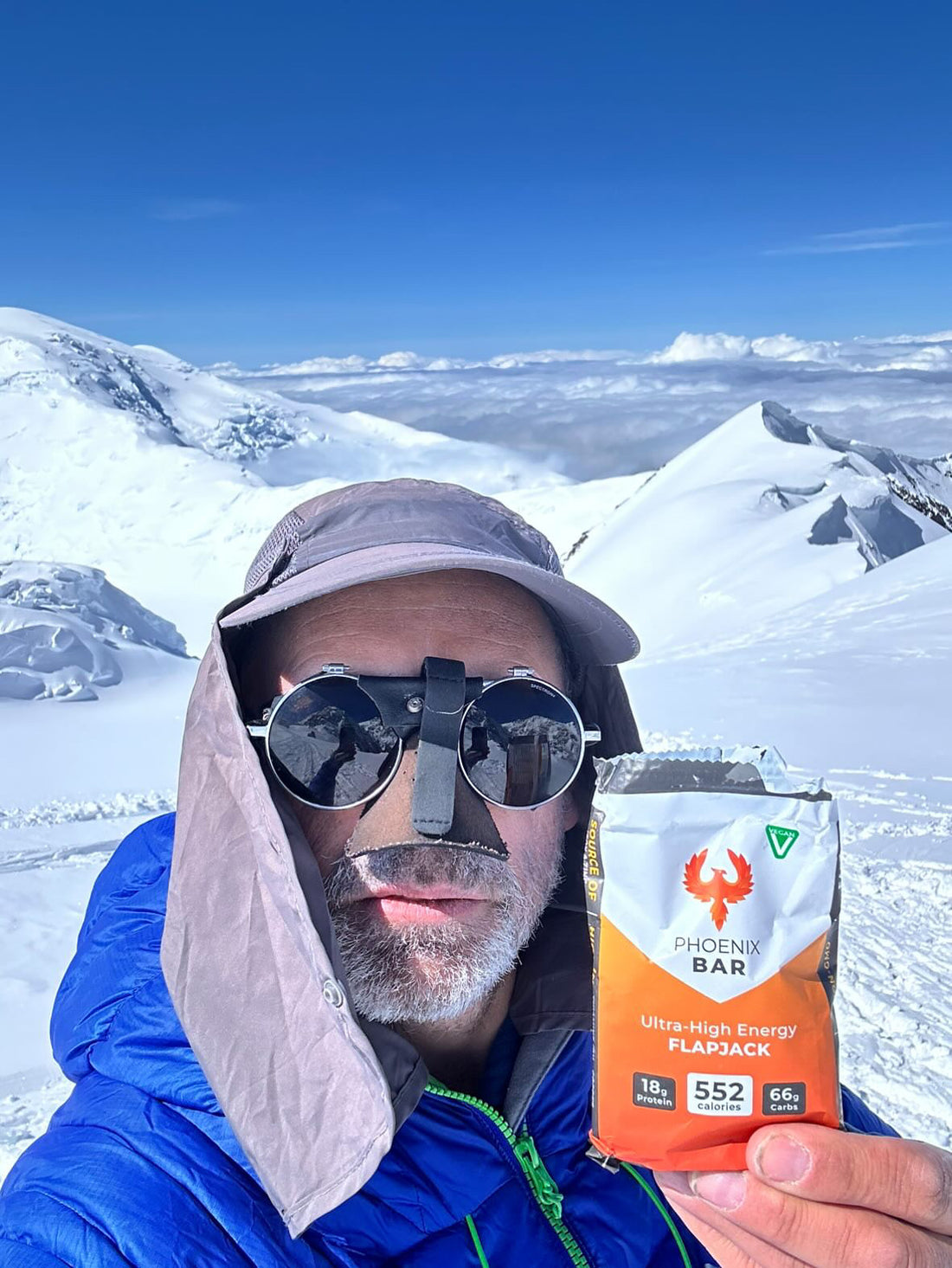
Big calories. Small bar.
Up to 557 calories in a compact, lightweight bar of only 120g, with up to 66g of carbs and 19g of protein. Eat it whole, break it into pieces over a few hours, or stir it into hot water or warm milk for porridge.
Easy to eat, easy to digest and not sickly sweet. Customers have eaten them at -45°C and through the heat of the Marathon des Sables, and they keep for up to 2 years, so they work on a mountain, on a night shift, or at home on days when eating enough feels hard.
- 557 calories in only 120g (529 to 557 by flavour)
- 4.6 calories per gram
- 66g carbs per bar (up to)
- 19g protein per bar (up to)
