

West Highland Way Food: What to Eat and Carry
In this guide

The short version: the West Highland Way is well supplied for most of its 96 miles, with shops, cafés and pubs in the villages, so the real skill is spotting the two stretches where that support disappears and carrying enough to get through them. The east shore of Loch Lomond and the long remote crossing past Rannoch Moor toward Kinlochleven both run for hours with little or nothing open, so you need to be self-sufficient for the day across them. If you are wild camping rather than staying in inns, you are self-sufficient more of the time, and Scottish weather adds its own twist: it is often cold and wet, which makes a warm meal worth far more than the same calories eaten cold. The fix is simple. Resupply in the towns, then carry compact, calorie-dense food for the gaps and the camp: nuts, flapjack and high calorie bars. This guide walks the route and shows you where each of those applies.
About this guide
I am James Frost, founder of Flaming Phoenix. We make Phoenix Bars, a 120g vegan, gluten-free bar built to pack a lot of easily digested energy into a small, light package, and one that can be turned into a warm porridge, which counts for a lot on a cold Scottish hill. I am not a guide, so where this gets practical I draw on the realities walkers report on the Way and on the basics of fuelling long days on foot. This page is one part of our wider ultra-endurance and expedition nutrition guide. Last reviewed June 2026.
Key points
- The West Highland Way is mostly well supplied, so the job is not carrying everything, it is covering the two remote stretches where nothing is open.
- The east shore of Loch Lomond, and the long crossing from Tyndrum past Rannoch Moor to Kinlochleven, are the gaps where you must be self-sufficient for the day.
- The walk is 96 miles with over 3,000 metres of ascent, usually done in 5 to 10 days, so the cumulative load builds week on week.
- Wild camping is legal in Scotland under the access code, but the Loch Lomond shore has a permit-only camping zone from March to September.
- Scotland is often cold and wet, so pack a flask or small stove: hot porridge or soup at a wet lunch stop beats the same food eaten cold.
- Midges reward grab-and-go food. The less you have to stop and faff in still, damp conditions, the happier you are.
Contents
- The food question on the West Highland Way
- How much the Way demands
- Resupply along the Way, south to north
- Wild camping and going self-sufficient
- Scottish weather, the cold and the midges
- What to carry and keep light
- Where Phoenix Bars fit
- Frequently asked questions
1. The food question on the West Highland Way
Compared with a true wilderness trail, the West Highland Way is friendly. You pass through or near villages most days, and you are rarely far from a shop, a café or a pub, which is part of what makes it one of the most accessible long-distance walks in Britain. So the honest starting point is that you do not need to carry days of food.
What you do need is to recognise the exceptions, because the Way has two of them and they matter. The east shore of Loch Lomond, and the long remote stretch from Tyndrum across the edge of Rannoch Moor toward Kinlochleven, both go for hours with little or nothing open. On those sections you have to be self-sufficient for the day, and walkers who do not plan for them end up rationing a flapjack across a hard afternoon.
Cover those two gaps, eat well in the towns, and you rarely need more than a day or two of food on your back. Most of this guide is about spotting where the support is and where it is not, so you carry exactly what you need and no more.
2. How much the Way demands
The West Highland Way is a real physical undertaking, even though it is graded moderate. It runs 96 miles from Milngavie, just north of Glasgow, to Fort William at the foot of Ben Nevis, with over 3,000 metres of total ascent, and around 36,000 people walk the full route each year, with well over 100,000 using parts of it.
Most walkers take 5 to 10 days, which works out at anything from a gentle 9 or 10 miles a day up to a hard 16 miles a day on the fastest sensible schedules. The terrain is mixed and often rough: the rocky, root-strewn east shore of Loch Lomond is slow and tiring, and the climbs over Conic Hill, the Devil's Staircase and out of Kinlochleven all add up.
The cumulative effect is the thing to plan for. One long day is manageable on yesterday's dinner, but a week of hill miles with a pack adds up day after day, and the second half is where tired legs and under-fuelling tell. The fundamentals of fuelling long consecutive days on foot are covered in our hiking and trekking guide and long-distance walking guide. The same route also hosts the West Highland Way Race, a 96-mile ultramarathon run in a single push, so if you are tackling it at pace the demands move toward those in our trail running nutrition guide and multi-day ultra running guidance.
3. Resupply along the Way, south to north
Walking the Way from south to north, the support comes and goes in a predictable pattern. Here is where to stock up and, more importantly, where not to count on anything.
Milngavie to Drymen. An easy first day through farmland. Milngavie has a large supermarket and outdoor shops, so it is the place to buy your first day or two of snacks. Drymen has a shop and pubs at the end.
Drymen to Rowardennan. Over Conic Hill to Balmaha, which has a shop, a café and the Oak Tree Inn, then along the loch to Rowardennan, where services thin out to a hotel. This is your last reliable resupply before the first gap, so top up at Balmaha.
The east shore of Loch Lomond, the first gap. From Rowardennan the path turns rocky and rooty along the wooded shore to Inversnaid and on to Inverarnan. There is very little open along here, and the going is slow, so carry enough food and water for the whole stretch rather than expecting to buy anything. A few charming honesty boxes appear in places, stocked with flapjacks and drinks, but treat those as a bonus, not a plan.
Inverarnan to Tyndrum. Services return. Beinglas Farm near Inverarnan has a shop and bar, and Tyndrum is one of the best resupply points on the whole route, with a well-stocked shop, the famous Green Welly Stop, and the Real Food Café, which is unusually good for gluten-free and vegan walkers. Stock up properly here, because the next gap is the big one.
Tyndrum to Kinlochleven, the second gap. This is the long, remote, exposed heart of the Way: Bridge of Orchy, then across the edge of Rannoch Moor, the wildest section, past Kingshouse and over the Devil's Staircase before the descent to Kinlochleven. There are a couple of hotels where you can get a hot meal if timings work, but nowhere to do a proper shop, and Rannoch Moor itself is open, roadless and brutal in bad weather. Leave Tyndrum carrying everything you will eat across this stretch.
Kinlochleven to Fort William. Kinlochleven has a Co-op open from early until late, ideal for grabbing the next day's food. The final stage climbs steeply out of town and crosses the exposed Lairig Mor, a long, lonely section with only ruins for company, before descending through Glen Nevis into Fort William, which has full supermarkets and plenty to eat to celebrate. Carry lunch and snacks for that last crossing, because there is nothing on it.
4. Wild camping and going self-sufficient
Many walkers camp the Way rather than staying in inns, and Scotland makes this easy. Wild camping is legal under the Land Reform Act and the Scottish Outdoor Access Code, as long as you camp responsibly and leave no trace, which gives you huge freedom to stop where you like across most of the route.
There is one important exception. The shores of Loch Lomond fall under a camping management zone where, from 1 March to 30 September, you must either use a permit or stay at an official campsite rather than camping wild. Plan that section around a permit or a booked pitch so you are not caught out.
If you are camping and cooking for yourself, everything you buy in a town is weight on your back until you eat it. The priorities shift toward compact, light, high-energy food and anything you can rehydrate or heat quickly, the same logic that governs our wild camping food guide and backpacking nutrition guide. You still resupply in the towns, but you carry more between them than an inn-to-inn walker does, so calories per gram start to count. Our guide to the lightest high calorie food for backpacking compares the usual trail foods on that measure.
5. Scottish weather, the cold and the midges
Scotland will give you sunshine, wind, rain and chill, sometimes in a single day, and the exposed sections like Rannoch Moor and the Lairig Mor feel it most. This changes what good trail food looks like compared with a warm-weather walk.
When you are cold and wet, a warm meal does far more for you than the same calories eaten cold, both for morale and for keeping your core temperature up. A flask of hot water or a quick stove brew turns instant porridge, soup or a broken-up bar into something that lifts you on a grim afternoon, which is why anything you can heat is worth its small weight. Our high calorie porridge guide and how to use Phoenix Bars guide both cover the hot-food approach.
Then there are the midges. From June to August, in damp, still conditions, these tiny biting insects can make stopping miserable, especially at camp morning and evening. So favour food you can eat on the move without unpacking and faffing, because the longer you stand still in a midge cloud, the worse your day gets. Grab-and-go beats sit-down whenever the midges are out. They bother you far less while you are walking and on breezy days, and they ease off in spring and early autumn.
6. What to carry and keep light
The art on the Way is carrying little but choosing dense, because you restock every day or two but still have to cross those two gaps self-sufficient. A heavy bag of snacks slows you on the rough Loch Lomond shore and the climbs, so concentrated energy beats bulk every time.
The reliable carried foods are the usual dense, durable ones: nuts, dried fruit, oatcakes, flapjack and compact bars give the most calories for the least weight and space. For shop-bought bars, see our guide to the best energy bars for hiking. Chocolate works in cool Scottish weather better than it does on a hot trail, though it still softens on a warm day.
A sensible default is to carry a breakfast option for early starts, lunch and snacks for whichever gap is coming up, and a little spare in case of a long day or bad weather, then replenish in the next town. Our calorie-dense foods guide and high calorie snacks guide go deeper on getting maximum energy from minimum pack weight.
7. Where Phoenix Bars fit
The honest case for our bars on the West Highland Way is specific, and it is strongest exactly where the trail is hardest. You will not need them for the village days, when a café lunch and a pub dinner have you covered. Where they help is the two remote gaps, the camp, and the cold.
Across the east shore of Loch Lomond and the Rannoch Moor crossing, a Phoenix Bar delivers up to 557 calories in a compact package of only 120g the size of a phone, so a couple of bars carry a lot of energy for very little weight through the stretches where nothing is open. If you are wild camping, they cover breakfast before you have packed the stove, or top up a day's eating without adding bulk. And because they stir into hot water as a warm porridge, they give you a hot breakfast or lunch on the cold, wet days.
They are vegan and gluten-free, which is useful insurance for the rare rural day when a small shop has little to offer, even though the Way is generally well catered in its towns. They come in six flavours, Apple and Cinnamon, Cherry Bakewell, Chocolate, Vanilla, Salted Caramel and Ginger, so they hold up over a week of walking without becoming monotonous.
The honest limits: the Way is supplied enough that these are for the gaps and the camp, not for stocking a wilderness expedition, and the café culture along the route is part of the fun and worth enjoying. At £5.25 a bar they are a premium product, and what you are paying for is the calorie density, the no-prep convenience, and the option of a hot meal when you need one. The starter bundle of 12 bars suits a shorter section walk, and the essential and complete bundles suit the full route or a camping trip. You can see the range in the Phoenix Bars collection and the bundles collection.
8. Frequently asked questions
Do you need to carry food on the West Highland Way?
For most of the route, no, because you pass shops, cafés and pubs in the villages and can resupply every day or two. The exceptions are the east shore of Loch Lomond and the long crossing from Tyndrum past Rannoch Moor to Kinlochleven, where little or nothing is open and you should carry food and water for the whole day.
How many calories do you burn on the West Highland Way?
A full day of 12 to 16 miles over Highland terrain with a pack burns well beyond 2,500 calories for most walkers, more on the big climbs and in cold or wet weather. Across the 5 to 10 days of the route the cumulative demand is significant, so eat steadily from the first day; the second half is where under-fuelling shows.
Where can you resupply on the West Highland Way?
The best resupply points walking south to north are Milngavie at the start, Balmaha, Tyndrum, Kinlochleven and Fort William, with smaller shops at Drymen and Beinglas. Tyndrum and Kinlochleven are the key ones to stock up at before the two remote stretches.
Can you wild camp on the West Highland Way?
Yes, wild camping is legal in Scotland under the Outdoor Access Code if done responsibly and leaving no trace. The exception is the Loch Lomond shore, which has a permit-only camping zone from 1 March to 30 September, so plan that section around a permit or an official campsite.
What food should you carry for the remote sections?
Carry compact, calorie-dense, no-prep food that survives a pack: nuts, dried fruit, oatcakes, flapjack and high-calorie bars give the most energy for the least weight. On cold days, something you can heat with a flask or stove, like porridge or soup, is worth the small extra effort.
Are midges a problem when eating on the trail?
From June to August, in damp and still conditions, midges can make stopping unpleasant, so it helps to favour food you can eat while walking rather than sitting down to unpack a meal. They bother you far less on the move and on breezy days, and they ease off in spring and early autumn.
Related guides
Closest companions: our hiking and trekking guide and long-distance walking guide for the fundamentals, our wild camping food guide and backpacking nutrition guide for self-sufficient walking, and the named long-route guides for the Cape Wrath Trail, the Camino de Santiago and the Lands End to John O'Groats walk. If you are running the route, see our trail running nutrition guide. This page sits within our wider ultra-endurance and expedition nutrition guide.
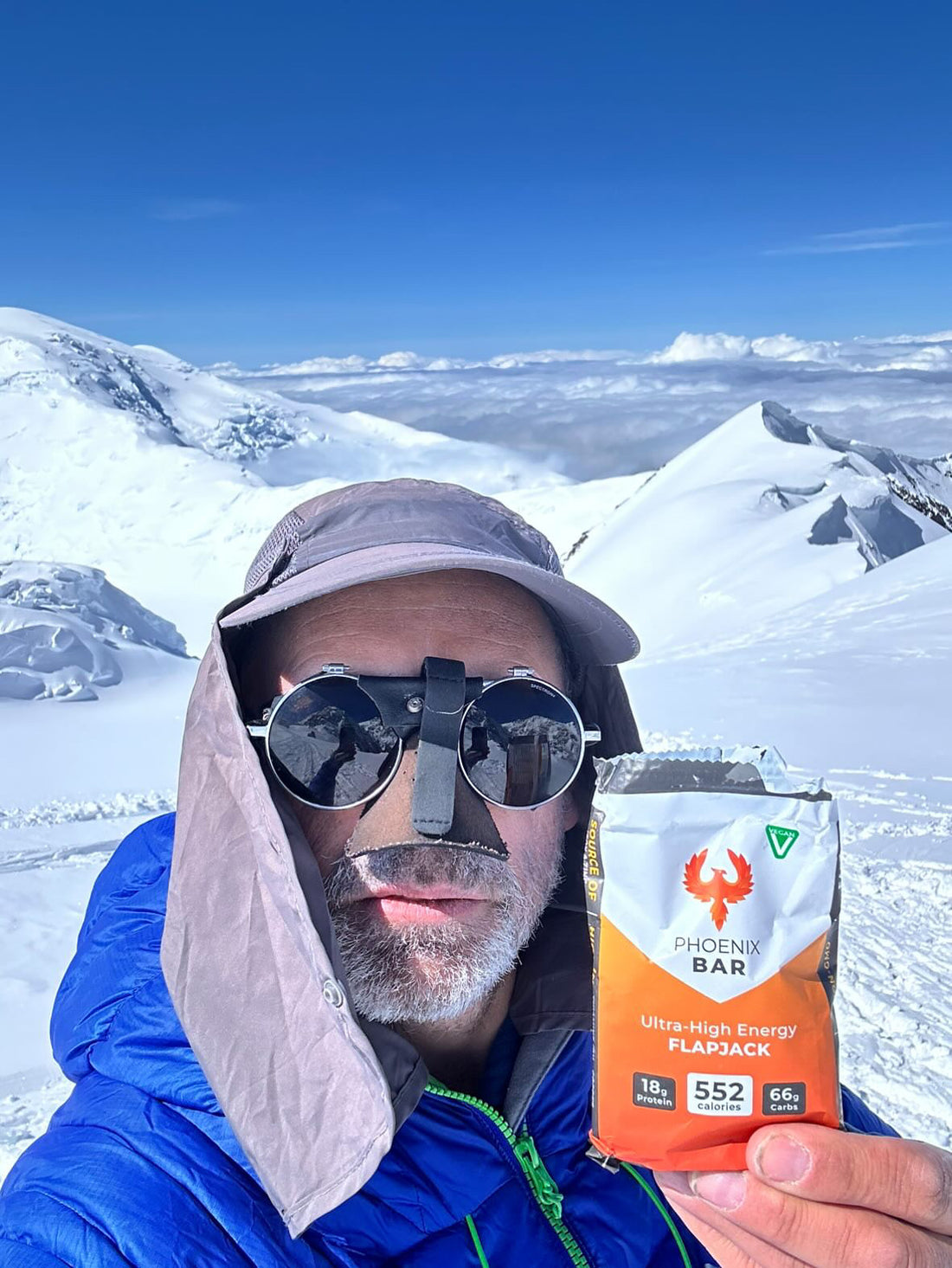
Big calories. Small bar.
Up to 557 calories in a compact, lightweight bar of only 120g, with up to 66g of carbs and 19g of protein. Eat it whole, break it into pieces over a few hours, or stir it into hot water or warm milk for porridge.
Easy to eat, easy to digest and not sickly sweet. Customers have eaten them at -45°C and through the heat of the Marathon des Sables, and they keep for up to 2 years, so they work on a mountain, on a night shift, or at home on days when eating enough feels hard.
- 557 calories in only 120g (529 to 557 by flavour)
- 4.6 calories per gram
- 66g carbs per bar (up to)
- 19g protein per bar (up to)
Declare withdrawal
Please fill out the following form to declare your withdrawal from the contract.

