
How Many Calories to Gain Weight: Working Out Your Number
To gain weight you need to eat more calories than you burn. The way to find how many is to work out your maintenance calories, the amount that keeps your weight steady, then add a surplus of around 300 to 500 a day on top. For a lot of adults that puts the daily target somewhere around 2,500 to 3,200 calories, but the only figure that matters is your own, and the surest way to find it is to start with an estimate and let the scales correct it.
That last point is the part most pages skip. There is no calculator that knows exactly how many calories you burn, because it varies with your activity, your build and your metabolism. So the honest method is not to trust a number to four decimal places. It is to get a sensible starting figure, eat to it for a few weeks, and adjust based on what actually happens. For the mechanism behind all of this, see how to eat in a calorie surplus.
How many calories do you need to gain weight?
Your maintenance calories plus a surplus of roughly 300 to 500 a day. Maintenance is the number that holds your weight steady, so anything consistently above it is what adds weight over time.
As a rough idea of where maintenance sits, many adult women land somewhere around 1,800 to 2,400 calories a day and many adult men around 2,200 to 3,000, depending heavily on size and activity. Add the surplus on top and a typical gaining intake is often in the region of 2,300 to 3,200, sometimes more for very active people. Treat those as starting brackets, not your answer.
How to work out your maintenance calories
Two ways, and the second is more reliable than the first.
The quick estimate. As a starting point, take your bodyweight in pounds and multiply by roughly 14 to 16, using the lower end if you are mostly sedentary and the higher end if you are active. That gives you a ballpark maintenance figure to begin with. It is an estimate, nothing more.
The better method. Eat as you normally would for a week or two and track it honestly, while weighing yourself a few times a week. Whatever intake keeps your weight roughly steady is your real maintenance, measured rather than guessed. This beats any formula, because it is based on your actual body rather than an average one. You do not have to track forever, just long enough to find your number.
Once you have maintenance, add 300 to 500 calories and that is your gaining target.
How big should the surplus be?
For steady weight gain, 300 to 500 calories a day above maintenance is the usual recommendation, and it is the figure the NHS suggests too. It is enough to make progress and small enough to keep up.
A larger surplus of 700 to 1,000 a day adds weight faster, but more of it tends to come on as body fat and it is harder to sustain. For most people the moderate surplus is the better long-term choice. The behaviour side of holding a surplus, the consistency that actually makes it work, is covered in the calorie surplus guide.

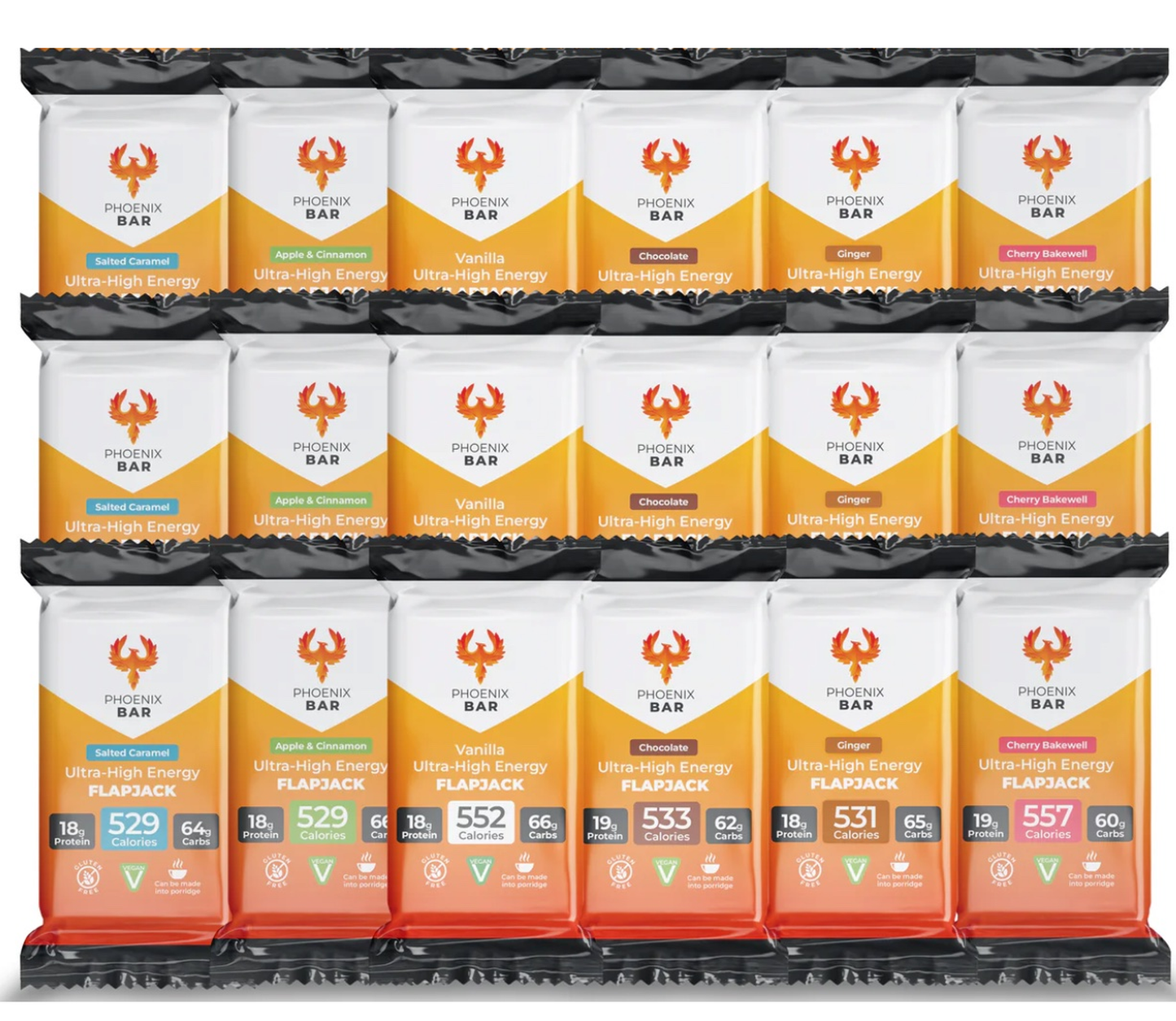
Phoenix Bars: Up to 557 Calories Per Bar
Highly compact, low-volume, calorie-dense bars. Soft, easy to eat whole or as a warm porridge. Vegan, gluten-free and contain up to 66g of carbohydrates, 19g of protein & 8 vitamins & minerals.
Why a calculator probably won't give you the right number
Every calculator is an estimate built on averages. It cannot see how much you fidget, how hard you train, or how your particular metabolism runs. Two people of the same age, height and weight can have maintenance figures hundreds of calories apart.
So treat any number, including the ones above, as a hypothesis to test, not a fact. The real measurement is what the scales do over two to three weeks. If the number was a good guess, your weight moves gently. If it was off, you adjust. The calculator gets you to the starting line, the feedback does the rest.
How to adjust your number
Give any target two to three weeks before judging it, because weight bounces around daily with water and food in the gut and a single weigh-in tells you nothing. Look at the trend, not the day.
If your weight has not moved after a few weeks, add another 200 to 300 calories a day and reassess. If it is climbing faster than you want, ease back by a similar amount. Your number is a dial you turn based on results, not a fixed value you set once.
A known number makes hitting your target easier
The practical hard part is not the maths, it is reliably eating the extra calories every day. It is much easier when some of those calories come in a fixed, known amount rather than a guess.
That is one place the product is useful. Each of our high calorie bars is up to 557 calories in a 120g bar, a known figure you can add to your day to close the gap to your target without weighing or working anything out. It is vegan and gluten-free, needs no preparation, and can be stirred into hot milk to make porridge. You can see the full range of high calorie bars on the homepage. For more ways to add calories without much effort, see easy ways to eat more calories.
Once you know your target, a structured plan can make it concrete. See the 3,000 calorie meal plan if that is near your number.
Once you know your surplus number, high calorie bars for weight gain are one of the easiest ways to close the gap, since a single Phoenix Bar covers up to 557 kcal of it without adding another full meal.
Frequently asked questions
How many calories do I need to eat to gain weight?
Your maintenance calories plus a surplus of around 300 to 500 a day. Maintenance is the amount that keeps your weight steady, which depends on your size, age and activity. Estimate it, add the surplus, then adjust based on what the scales do over a few weeks.
How do I work out my maintenance calories?
Either estimate, by multiplying your bodyweight in pounds by roughly 14 to 16, or measure, by tracking your normal intake for a week or two and seeing what keeps your weight steady. The tracked figure is more accurate because it is based on your actual body rather than an average.
How many calories should I eat to gain weight fast?
A larger surplus of around 700 to 1,000 calories a day above maintenance gains weight faster, but more of it comes on as body fat and it is harder to keep up. For most people a steadier 300 to 500 surplus is the better long-term approach.
How many calories does it take to gain a pound?
Weight gain comes from a sustained surplus over weeks rather than a single fixed number. Instead of aiming at a figure per pound, set a daily surplus of around 300 to 500 calories and let the scales over a few weeks tell you whether to eat a little more or less.
Do I need a calorie calculator to gain weight?
No. A calculator gives a starting estimate, but it cannot know your exact needs. You can get the same starting point from a simple bodyweight estimate, and the real adjustment comes from tracking your weight over a few weeks and changing your intake based on the result.
Related guides
For the mechanism, see how to eat in a calorie surplus and how to gain weight. For hitting your number, see easy ways to eat more calories and the 3,000 calorie meal plan. For the porridge method, see how to use Phoenix Bars.
Written by James Frost, Founder of Flaming Phoenix. James started Flaming Phoenix in 2024 and has spent the years since working out how to get the most calories into the least food, building and testing compact, calorie-dense recipes. He can be reached at jfrost@flaming-phoenix.co.uk. Last reviewed: June 2026.


Flaming Phoenix



Contact Us
Declare withdrawal
Please fill out the following form to declare your withdrawal from the contract.

