
High Calorie Gluten Free Foods (and How Not to Eat Less)
High calorie gluten free foods are the naturally gluten-free foods that are concentrated in calories: nuts, oils, nut butters, seeds, avocado and dried fruit, plus gluten-free staples like rice, potatoes, gluten-free oats and quinoa, and full-fat dairy. The catch with eating gluten-free is that it removes a lot of the easy calorie-dense foods most people rely on, bread, pasta, cereal and baked goods, so it is easy to eat fewer calories without noticing. The fix is to build your calories from naturally gluten-free whole foods rather than expensive gluten-free replacement products. For the full picture across all foods, see calorie-dense foods.
Most advice on this treats gluten-free as a problem to work around. It is simpler than that. A handful of whole foods that never contained gluten in the first place carry more calories than most of the packaged gluten-free versions, and cost less too.
Why can going gluten-free lower your calories?
Because so many everyday calorie sources are wheat-based. Bread, pasta, cereal, wraps, pastries and baked goods are the foods a lot of people lean on for easy calories, and cutting them out leaves a gap that is easy to under-fill.
People often replace them with vegetables, fruit and salad, which are filling but light on calories, and end up eating less overall without meaning to. The gap is real, but it closes quickly once you swap in gluten-free foods that are actually calorie-dense.
The gluten-free product trap
Here is the part worth knowing before you spend money. It is tempting to assume that reaching for gluten-free bread, pasta and snacks solves the problem. Often it does not.
Research comparing gluten-free packaged products with their standard versions has found they tend to cost more while frequently being higher in sugar and lower in fibre and protein, and not reliably more calorie-dense in any useful way. In other words, a gluten-free label does not mean a food is a good calorie source. The dependable calories are in naturally gluten-free whole foods, not the processed replacements. Lean on those and use gluten-free versions of bread and pasta as a convenience, not as your main calorie strategy.
Naturally gluten-free calorie-dense foods
None of these has ever contained gluten, and all of them are concentrated in calories.
Oils are the densest food there is, at about 120 calories a tablespoon and pure fat, so a drizzle adds a lot without bulk.
Nuts, seeds and their butters come next. A 30g handful of almonds or cashews is around 180 calories, two tablespoons of peanut butter about 190, and a tablespoon of tahini roughly 90.
Avocado and coconut are rich in fat, with half an avocado about 150 calories and 100ml of full-fat coconut milk around 180.
Dried fruit packs sugar into a small space, at 85 to 90 calories per 30g of dates, raisins or apricots.
Gluten-free grains and starches give you a base. A 50g serving of gluten-free oats is about 185 calories, cooked quinoa around 220 a portion, and rice, potatoes and sweet potatoes all deliver solid calories. Note that oats are naturally gluten-free but often processed alongside wheat, so choose ones labelled gluten-free.
Full-fat dairy is dense and versatile, with 30g of cheese about 125 calories, a pot of full-fat Greek yoghurt around 150, and whole milk about 195 for 300ml.
Dark chocolate is worth a mention at around 130 calories per 25g, and most is gluten-free.
How to add calories on a gluten-free diet
You do not need new meals, just denser versions built on gluten-free bases. Use rice, potatoes, gluten-free oats or gluten-free pasta as the foundation, then add fat.
Drizzle oil over cooked dishes, stir nut butter into oats or a smoothie, add cheese or full-fat dairy, drop in half an avocado, and scatter nuts, seeds or dried fruit over breakfast and salads. Each of these adds 100 to 200 calories with almost no extra volume. If you fill up quickly, eat the dense part of the meal first, and lean on drinks, since a smoothie of milk, gluten-free oats, peanut butter and banana can carry 600 calories in a glass. See high calorie drinks and smoothies for recipes.
Gluten-free foods for gaining weight
If your goal is to gain weight, the foods above are the tools, but the thing that does it is a steady calorie surplus, eating a bit more than you burn. Going gluten-free only makes that harder by removing easy staples, which the approach above puts back.
Work out the number you are aiming for with how many calories to gain weight, and if you are eating plenty but not gaining, see why can't I gain weight, which usually comes down to appetite and density rather than effort.

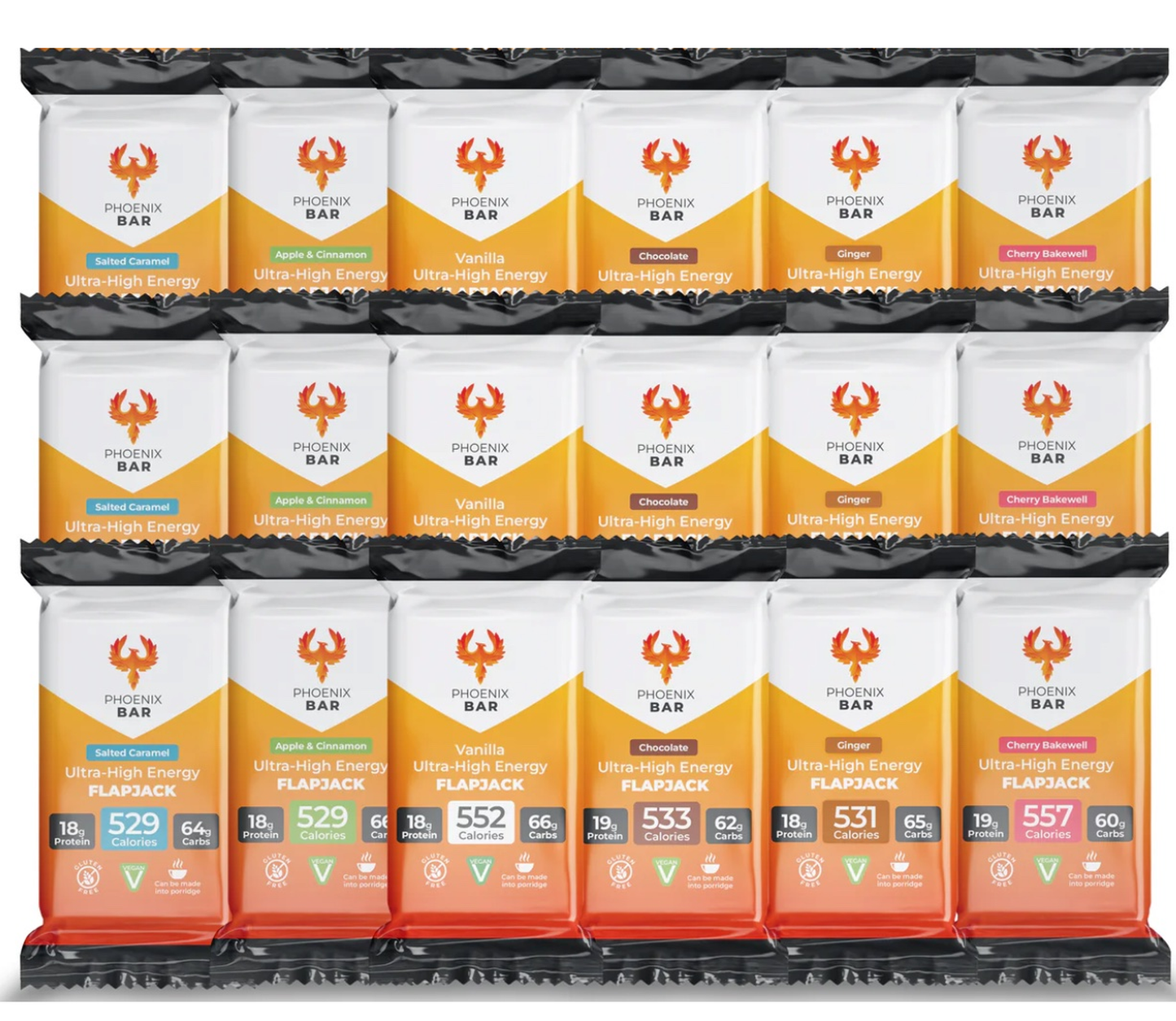
Phoenix Bars: Up to 557 Calories Per Bar
Highly compact, low-volume, calorie-dense bars. Soft, easy to eat whole or as a warm porridge. Vegan, gluten-free and contain up to 66g of carbohydrates, 19g of protein & 8 vitamins & minerals.
A gluten-free option with no label-checking
The tedious part of eating gluten-free is reading every label. Having a fixed option you already know is safe takes that off your plate.
Each of our high calorie bars is up to 557 calories in a 120g bar, and it is both gluten-free and vegan, so there is nothing to check. It needs no preparation, comes in six flavours, and can be stirred into hot milk to make porridge. It is a simple way to add a known amount of calories in a compact, gluten-free form on the days a full meal is too much. You can see the full range of high calorie bars on the homepage.
Frequently asked questions
What are the best high calorie gluten free foods?
The most calorie-dense are naturally gluten-free whole foods: oils, nuts, nut butters, seeds, avocado, coconut and dried fruit, plus gluten-free grains like rice, gluten-free oats and quinoa, potatoes and full-fat dairy. These carry far more reliable calories than most packaged gluten-free replacement products.
Why do I eat fewer calories on a gluten-free diet?
Because a lot of everyday calorie sources are wheat-based, bread, pasta, cereal and baked goods, and cutting them leaves a gap that often gets filled with lighter foods like vegetables and fruit. Swapping in naturally gluten-free calorie-dense foods closes that gap.
Are gluten-free products high in calories?
Not reliably. Research has found gluten-free packaged products often cost more and can be higher in sugar but lower in fibre and protein, without being dependably more calorie-dense. It is better to build calories from naturally gluten-free whole foods and treat gluten-free bread and pasta as a convenience.
What are high calorie gluten free snacks?
Nuts, nut butter on rice cakes or oatcakes made from gluten-free oats, trail mix with dried fruit and dark chocolate, full-fat yoghurt with gluten-free granola, cheese, or a compact gluten-free bar. The best options are high in fat or dried, packing a lot of calories into a small amount.
Which gluten-free grains are highest in calories?
Rice, gluten-free oats, quinoa, buckwheat and corn-based products all provide solid calories, with quinoa also higher in protein. Cooking them in milk rather than water, and adding oil, butter or cheese, lifts their calories further without adding much volume.
Related guides
For all calorie-dense foods, not just gluten-free, see calorie-dense foods. For the plant-based version, see high calorie vegan foods. For drinks, see high calorie drinks and smoothies. For gaining weight, see how many calories to gain weight. For the porridge method, see how to use Phoenix Bars.
Written by James Frost, Founder of Flaming Phoenix. James started Flaming Phoenix in 2024 and has spent the years since working out how to get the most calories into the least food, building and testing compact, calorie-dense recipes. He can be reached at jfrost@flaming-phoenix.co.uk. Last reviewed: June 2026.


Flaming Phoenix



Contact Us
Declare withdrawal
Please fill out the following form to declare your withdrawal from the contract.

