

Trail Running Nutrition - Fuelling for UK Trails and Fell Races
In this guide

Trail running burns more calories than road running: the uneven terrain, elevation gain, slower pace, and longer time on feet all push energy demands higher. Yet most trail running nutrition advice is written for road runners and simply adds the word "trail" on top. The reality is that trail races create specific fuelling challenges that road running does not: longer durations, variable intensity, remote locations with limited resupply, changeable UK weather, and the physical difficulty of eating while climbing, descending, or scrambling over rough ground.
This guide covers practical nutrition for trail runners in the UK, from short fell races and trail 10kms through to 50km and 50-mile events. If you are racing multi-day ultras of 100 miles or more, see our dedicated guide to UK multi-day ultra race nutrition, which covers the specific challenges of overnight running, sleep deprivation, and multi-day calorie deficit. For the hourly-loop, last-runner-standing format, see our guide to backyard ultras in the UK.
Why Trail Running Is Harder to Fuel Than Road Running
Three factors make trail running nutrition more demanding than fuelling a road race over the same distance.
You are out longer for the same distance. A runner who completes a road marathon in 4 hours might take 5–6 hours to cover the same distance on trails, depending on terrain and elevation. That extra time means more calories burned, more glycogen depleted, and a greater need for on-the-move fuelling. A 50km trail race could take anywhere from 5 to 10 hours, a window where nutrition moves from helpful to essential.
Intensity is more variable. Road running is relatively steady-state. Trail running alternates between high-intensity climbing, moderate running on flats, and technical descending. This variability affects digestion: your gut tolerates food differently when you are power-hiking up a steep climb at low heart rate versus running hard on a flat section. Many trail runners find they can eat on climbs but not on descents. Learning your own pattern is part of the process.
Resupply is limited. UK trail races (particularly fell races and lower-key events) often have minimal aid stations. Some offer nothing more than water. Unlike a city marathon with gels and bananas every few miles, a trail race in the Lake District, Brecon Beacons, or Scottish Highlands may leave you entirely self-sufficient for food across the full distance. What you carry is what you eat.
How Much to Eat: A Practical Framework
The standard sports nutrition recommendation is 30–60g of carbohydrates per hour for events lasting 1–2.5 hours, rising to 60–90g per hour for longer events. This is a reasonable starting point, but translating grams of carbohydrates into actual food on a muddy Welsh hillside requires practical thinking, not a spreadsheet.
Here is a more useful framework for UK trail runners:
Runs under 90 minutes. You probably do not need to eat during the run if you have eaten a proper meal 2–3 hours before. Carry water and perhaps a single emergency snack. Focus your nutrition effort on pre-run fuelling.
Runs of 90 minutes to 3 hours. Start eating early (within the first 45–60 minutes) and eat a small amount every 20–30 minutes. This is the zone where most trail runners under-fuel because the effort does not feel long enough to warrant eating. It is. If you are racing, start fuelling before you feel you need it. A gel, a few pieces of flapjack, a handful of dried fruit: the specific food matters less than the consistency of intake.
Runs of 3–6 hours. This is where nutrition becomes a genuine performance factor. You need a reliable system: food you have tested, portioned, and made easily accessible in your race vest. Aim for 200–350 calories per hour from a mix of sources. Pure gels become harder to tolerate beyond 3–4 hours for most runners. This is when real food and high calorie bars become more important. For more on choosing calorie-dense food for longer efforts, see our guide to calorie-dense foods.
Runs of 6+ hours. You are now in ultra territory. Palate fatigue with sweet foods is likely, which is why flavour matters so much when picking the best energy bars for ultra running. Appetite may start to drop. The principles from this guide still apply, but for detailed strategies on fuelling very long events, see our ultra-endurance and expedition nutrition guide.
The Calorie Density Advantage on Trails
Every gram you carry in your race vest affects how you move. Trail runners are acutely aware of pack weight: it determines vest comfort, shoulder fatigue, and how freely you can move on technical terrain. This is why the calorie density of the food you carry matters more on trails than on roads.
Calorie density is simply the number of calories a food delivers per gram of weight. The higher the number, the more energy you get for less weight carried.
Energy gels deliver approximately 2.5–3.0 calories per gram. A standard cereal bar provides around 3.5–4.0 calories per gram. Nuts deliver 5.5–6.5 calories per gram but are slow to digest during running. Phoenix Bars provide approximately 4.5 calories per gram, delivering up to 557 calories and 66g of carbohydrates in a single, compact 120g bar.
To put this in practical terms: carrying four gels and two cereal bars for a 4-hour trail race gives you roughly 700–900 calories at 250–300g. A single Phoenix Bar delivers up to 557 calories at 120g. Two Phoenix Bars and two gels would deliver approximately 1,300 calories at 310g, significantly more fuel for similar weight.
This matters most on longer trail races and fell races where you are self-sufficient. When every gram competes with waterproofs, a map, and a headtorch, the food that delivers the most energy for the least weight wins.
Gels vs Real Food: When Each Works Best
One of the most common questions in trail running nutrition is whether to use gels or real food. The honest answer is that both have a role, and the best approach for most trail runners is a combination.
Gels work well for: quick energy during intense efforts, the first 2–3 hours of a race before palate fatigue sets in, technical sections where you need one-handed fuelling with minimal chewing, and as an emergency boost when you feel energy dropping suddenly.
Real food works well for: longer events where gel fatigue becomes a problem, lower-intensity climbing phases where digestion is easier, providing variety and psychological satisfaction on long days, and delivering a broader mix of carbohydrates, fat, and protein for sustained energy rather than pure sugar spikes.
The tipping point is usually around 3–4 hours. Before that, gels and simple carbohydrate products are convenient, effective, and well tolerated by most runners. After that, the sweetness becomes oppressive, the stomach starts to rebel, and real food (something you can actually chew, that tastes like food rather than sugar syrup) becomes increasingly important.
The runners who fuel best over long trail races are typically the ones who start with gels and transition toward real food as the hours pass. A gel every 30 minutes for the first 3 hours, then switching to pieces of flapjack, a calorie-dense bar, some salted nuts, or whatever savoury options the checkpoints provide. For more on food that works when sweet products fail, see our guide to high-calorie snacks.
What to Eat Before a Trail Race
Pre-race nutrition for trail running follows the same principles as road running, with one important caveat: trail race starts are often earlier and in more remote locations, which can make the pre-race meal logistically harder.
The night before. Eat a familiar, carbohydrate-rich meal. Pasta, rice, or potato-based dishes are all fine. The key word is familiar: do not experiment with new foods the night before a race.
3–4 hours before the start. Eat a substantial breakfast: porridge with honey and banana, toast with nut butter, or cereal with milk. This is your main glycogen-loading opportunity.
60–90 minutes before the start. A smaller carbohydrate-rich snack tops up glycogen without sitting heavy. A banana, a flapjack, or a calorie-dense bar works well. For early-morning starts where cooking is impractical, a compact high-calorie option you can eat in the car or at the start line is valuable: something that delivers 400–550 calories without requiring preparation.
15–30 minutes before the start. Optional: some runners take a final small carbohydrate hit, others prefer to start with an empty-feeling stomach. Test during training.
Recovery Nutrition After Trail Running
Trail running is harder on the body than road running: the eccentric loading on descents, the ankle and foot stress on uneven terrain, and the full-body effort of scrambling and climbing all create greater muscle damage and inflammation.
Recovery nutrition should begin within 30–60 minutes of finishing, focusing on carbohydrates to replenish glycogen and protein to support muscle repair. A ratio of roughly 3:1 carbohydrates to protein is commonly recommended. Practical options include a recovery shake, a bowl of porridge, a sandwich, or a calorie-dense bar with a drink.
If appetite is suppressed after a hard effort, which is common, choose something easy to eat and calorie-dense rather than waiting for a full meal to become appealing. Getting calories in quickly after finishing is more important than the specific food format. For strategies on eating when appetite is low, see our guide on low appetite and difficulty eating enough calories.
Where Phoenix Bars Fit for Trail Runners
Phoenix Bars are used by trail runners across distances from trail marathons to multi-day ultras. Each bar delivers up to 557 calories and 66g of carbohydrates (more than most runners consume in two hours of gels) in a single compact bar that fits in a race vest pocket.
They can be broken into pieces and eaten gradually over 60–90 minutes while running, eaten as a pre-race breakfast when a full meal is impractical, or crumbled into hot water at a checkpoint to make a calorie-dense porridge. The six flavours are mild and not excessively sweet, which means they remain palatable in the later stages of long races when gels and sweet bars have become intolerable. For the full range of ways to use them, see How to Use Phoenix Bars.
Phoenix Bars also meet the standard 500kcal mandatory kit emergency calorie requirement in a single item, simplifying kit preparation for races that require minimum calorie reserves.
How Trail Runners Use Phoenix Bars
"I have one open in my pocket and just nibble away at it like a mouse as they are so calorie-dense. I will definitely be ordering more for the events I have coming up."
"As an ultra runner I'm always on the lookout for new ways to fuel. These are great. Ideal for when you want something more than a gel but don't want something that will sit heavy in your belly. Mild tasting so go down easily too."
"Phoenix Bars are the best bars that I've used for long-distance races. I've used other branded bars and they just don't hit as well. Being vegan it's difficult to find good products. These are great."
"I ate 3 Phoenix Bars during the Spine Sprint and they helped fuel me to a 7th place finish. I normally struggle to eat solids during races but I found Phoenix Bars so easy to get down on the move and to digest."
"Used Phoenix Bars during Rat Race's Coast To Coast event, involving 100 miles of running, cycling and kayaking. They taste great and being packed full of calories they helped carry me to the finish line."
Frequently Asked Questions
What should I eat before a trail run? A carbohydrate-rich meal 3–4 hours before (porridge, toast with nut butter, cereal), followed by a smaller carbohydrate snack 60–90 minutes before the start. Avoid high-fibre and high-fat foods close to the run as they take longer to digest.
How often should I eat during a trail run? For runs over 90 minutes, aim to eat something every 20–30 minutes. Start eating within the first 45–60 minutes: do not wait until you feel hungry, because by that point you are already in deficit.
What is better for trail running: gels or real food? Both have a role. Gels are convenient and effective for the first 2–3 hours. Beyond that, most runners benefit from transitioning to real food (bars, flapjacks, nuts, savoury snacks) to avoid palate fatigue and provide sustained energy. The best approach for most trail runners is a combination.
How many calories do I need per hour on a trail run? A practical target is 200–350 calories per hour for runs over 90 minutes. You will not replace all the calories you burn: the goal is to minimise the deficit enough to maintain performance. The British Nutrition Foundation provides general guidance on energy requirements for active individuals.
Why do I feel sick eating during trail races? GI distress during running is common and usually caused by eating too much at once, eating high-fibre or high-fat foods during intense effort, or introducing unfamiliar foods on race day. The solution is to eat small amounts frequently, test everything in training, and choose foods that are easy to digest. Many runners find that climbing phases (lower intensity) are easier for eating than flat or downhill sections.
This guide is part of our series on nutrition for endurance activities. For longer events, see our guides to UK multi-day ultra race nutrition and ultra-endurance and expedition nutrition. For related reading, see calorie-dense foods and How to Use Phoenix Bars.
Written by James Frost, Founder of Flaming Phoenix. James developed Phoenix Bars following over 150 conversations with ultra-endurance athletes, expedition teams, and people experiencing difficulty eating. Last updated: March 2026.
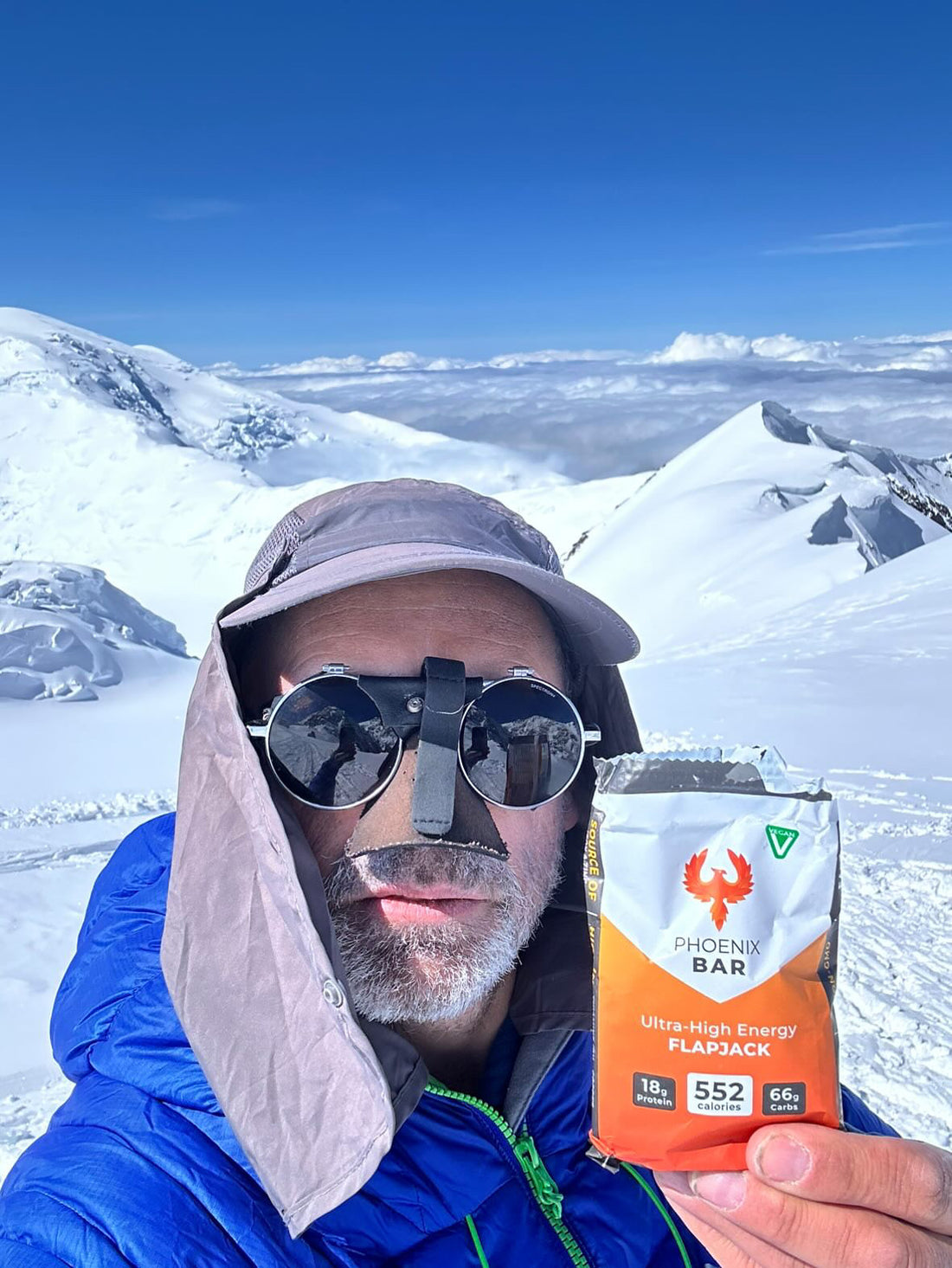
Big calories. Small bar.
Up to 557 calories in a compact, lightweight bar of only 120g, with up to 66g of carbs and 19g of protein. Eat it whole, break it into pieces over a few hours, or stir it into hot water or milk for porridge.
Easy to eat, easy to digest and not sickly sweet. Phoenix Bars do not melt in heat or freeze in sub-zero temperatures and have an up to 2-year shelf life, so they work on a mountain, on a night shift, or at home on days when eating enough feels hard. Vegan and gluten-free too.
- 557 calories in one compact 120g bar (529 to 557 by flavour)
- 4.6 calories per gram
- 66g carbs per bar (up to)
- 19g protein per bar (up to)
