
High energy snacks for active days: what to eat before, during and after
Dans ce guide

 Written by James Frost, founder of Flaming Phoenix. Updated October 2026.
High energy snacks are snacks that pack a useful amount of calories and carbohydrate into a portion you can carry and eat on the move. Choose by timing: a low-fat, carbohydrate-rich snack two to three hours before, quick sugars such as jelly babies (20g carbohydrate in 25g) during harder efforts, then carbohydrate with some protein afterwards.
This page is about snacks for active and long days: hill walks, rides, runs, long shifts and travel. Every snack below comes with its calories, carbohydrate, protein and a rough price, taken from Tesco's own product pages on 22 October 2026 (standard shelf prices, not Clubcard prices), so you can build a bag that adds up. If you are trying to gain weight, my high calorie snacks guide ranks snacks by calories per bite instead.
What makes a snack high energy?
On a food label, energy simply means calories. UK labels show it in kJ and kcal, and the law fixes the sums: 4 kcal for each gram of carbohydrate or protein and 9 kcal for each gram of fat, under Annex XIV of the food information regulation.
So a snack can be high in calories for two different reasons, and on a long day out the reason matters. The table compares common snack foods per 100g, using McCance and Widdowson's Composition of Foods, the UK government's food tables. These are averages, so a branded label can differ by a few grams. On a label, those calories sit under “Energy”; my high energy foods guide explains why.
| Food (per 100g) | Calories | Carbohydrate | Fat | Protein |
|---|---|---|---|---|
| Peanuts, roasted and salted | 602 | 7.1g | 53.0g | 24.7g |
| Milk chocolate | 519 | 56.0g | 31.1g | 7.3g |
| Flapjack, shop-bought | 434 | 55.7g | 22.8g | 5.1g |
| Cheddar | 416 | 0.1g | 34.9g | 25.4g |
| Fruit gums and jellies | 324 | 79.5g | 0g | 6.5g |
| Bagel, plain | 273 | 57.8g | 1.8g | 10.0g |
| Raisins | 256 | 62.6g | 1.0g | 3.0g |
| Banana, flesh only | 81 | 20.3g | 0.1g | 1.2g |
Salted peanuts have nearly twice the calories of jelly sweets (602 against 324 per 100g) but under a tenth of the carbohydrate (7.1g against 79.5g). The reason is fat: 53g of fat at 9 kcal a gram is 477 kcal, so about 80% of a peanut's calories come from fat. That makes peanuts very good for carrying a lot of calories in a light bag, and a poor choice for a quick hit of carbohydrate halfway up a climb. Jelly sweets are the reverse. Most long days want some of each.
Which snacks digest quickly, and which slowly?
Snacks that are mostly sugar or white starch, with little fat, fibre or protein, are the quick ones. The British Dietetic Association suggests a low-fat, high-carbohydrate snack or light meal two to three hours before exercise, and a 2014 review by the sports scientist Asker Jeukendrup lists drinks, gels and low-fat, low-protein, low-fibre bars as the ways to take carbohydrate during exercise. Food with fat and protein in it stays in the stomach longer: the International Society of Sports Nutrition notes that mixed meals delay gastric emptying.
In practice, jelly babies, malt loaf, fig rolls, bananas and gels are your quick snacks. Nuts, cheese, pork pies and chocolate are slow ones, better on a steady walk or at a lunch stop than just before a hard climb or a fast run.
What should you eat before a long day or a workout?
Eat a low-fat, carbohydrate-rich snack or light meal two to three hours before you start, which is the British Dietetic Association's advice for exercise. Its sport fact sheet lists foods that each give about 50g of carbohydrate, including one bagel, two medium-large bananas and two oat-based cereal bars (50g).
A New York Bakery Co plain bagel with a tablespoon of Tesco jam gives 53.1g (43.8g from the bagel and 9.3g from the jam), so the BDA's yardstick holds up. The table shows that snack and three others, per portion, with Tesco label values and prices.
| Snack and portion | Calories | Carbs | Protein | Rough price | Best for |
|---|---|---|---|---|---|
| New York Bakery Co plain bagel with 1 tablespoon (15g) of jam | 263 | 53.1g | 8.0g | 43p | Two to three hours before a long run or ride |
| Ambrosia rice pudding, 150g pot | 147 | 24.6g | 4.8g | £1.00 | Soft and easy if breakfast is hard to face |
| Two Soreen malt lunchbox loaves (60g) | 176 | 36.0g | 5.0g | 72p | An early start; eat it on the way |
| One typical banana (150g, Tesco's figure) | 135 | 30.5g | 1.8g | 16p | A small top-up when you are short of time |
If you start within an hour of eating, keep it small: a banana or a single malt loaf, not a bagel and a pot of rice pudding, and try it on a training day first.
What should you eat during exercise?
For about an hour or less you need little carbohydrate, if any: Jeukendrup's review found that large amounts of carbohydrate are not necessary for exercise lasting about 30 minutes to an hour. Past that, the International Society of Sports Nutrition advises about 30 to 60g of carbohydrate an hour for hard sessions of more than an hour, and Jeukendrup puts it at up to about 60g an hour for two to three hours and about 90g an hour, from a mix of sugar types, for ultra-endurance events.
Those numbers are for trained athletes working hard. The same review says people working at a lower intensity should adjust them downwards, which covers most hill walks and easy rides.
Quick snacks for runs, rides and harder efforts
These are mostly sugar or white starch, low in fat, and easy to eat on the move. Values are per portion, from Tesco labels.
| Snack and portion | Calories | Carbs | Protein | Rough price | Best for |
|---|---|---|---|---|---|
| Tesco jelly babies, 25g | 86 | 20.1g | 1.3g | 14p | Runs and rides; the quickest to eat |
| SiS GO Isotonic gel, 60ml | 87 | 22.0g | 0g | £1.65 | Race pace, when you are breathing too hard to chew |
| One Soreen malt lunchbox loaf (30g) | 88 | 18.0g | 2.5g | 36p | Rides and long runs |
| Three Bolands fig rolls | 195 | 37.2g | 2.4g | 48p | Long rides; more carbohydrate per stop |
| Two 14g boxes of Tesco raisins | 80 | 18.4g | 0.6g | 22p | Walks and rides; small enough for a hip pocket |
SiS says up to three of its gels an hour, which is 66g of carbohydrate (3 x 22g) for £4.95. Three 25g portions of jelly babies give 60.3g for about 41p. Gels are still easier at race pace; if you want to move away from them, my guide to real-food alternatives to gels goes further.
Slower snacks for long walks and easy days
On a hill walk, an easy ride or a long day on your feet, you can eat food with more fat and protein, which packs more calories into the same weight and feels more like a meal.
| Snack and portion | Calories | Carbs | Protein | Rough price | Best for |
|---|---|---|---|---|---|
| Tesco peanuts and raisins, 50g | 242 | 22.0g | 8.0g | 43p | Walks; a handful at every stop |
| Two McVitie's Hobnobs oaty flapjacks | 254 | 36.2g | 3.4g | 60p | Easy rides and walks |
| Tesco snack Melton Mowbray pork pie (75g) | 268 | 19.8g | 7.9g | £1.05 | The lunch stop on a walk |
| 30g mature Cheddar with four Nairn's rough oatcakes | 309 | 23.2g | 12.0g | About 50p | Savoury, once sweet snacks wear thin |
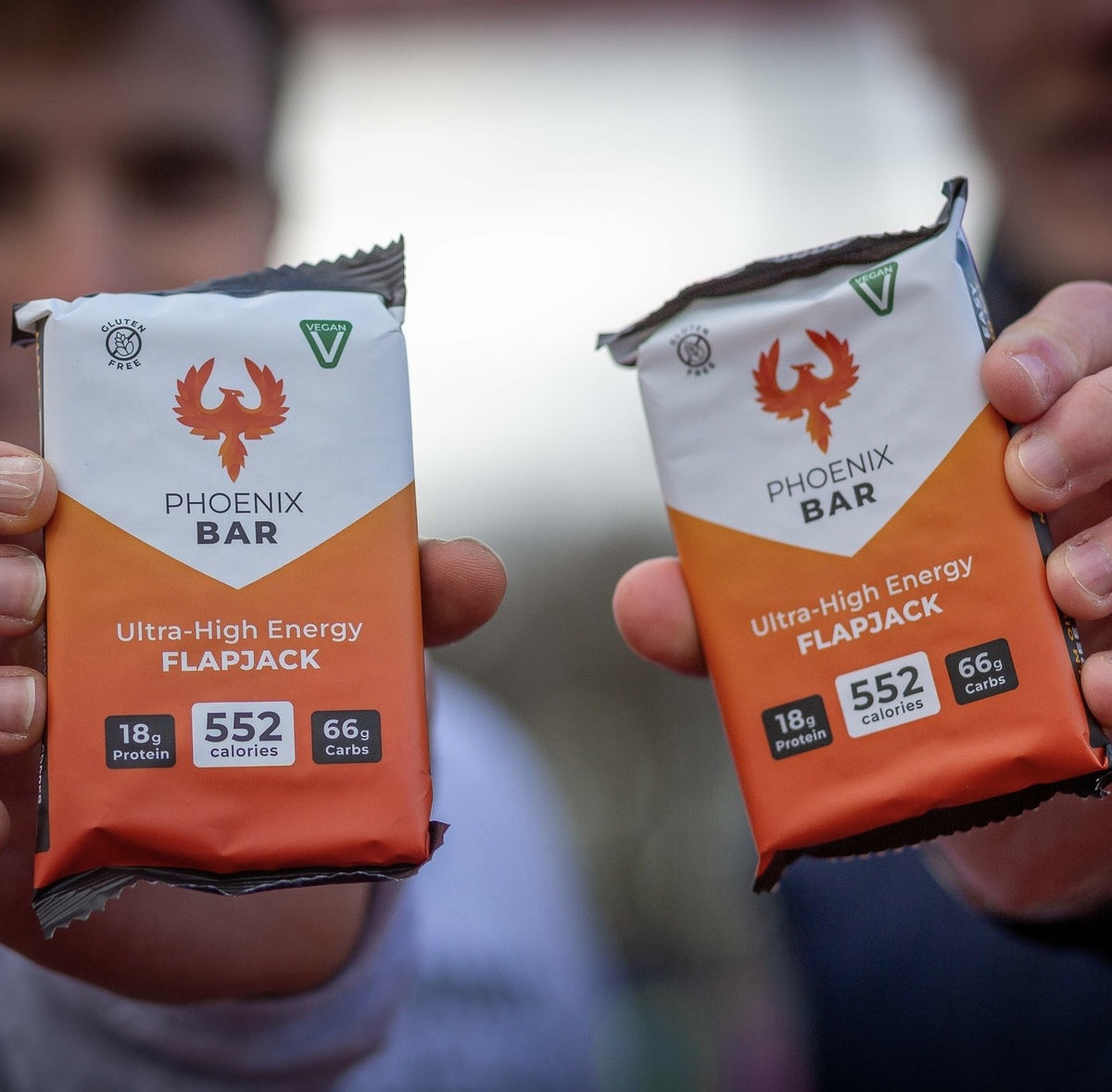
| Phoenix Bars, one compact 120g bar | 529 to 557 | 60 to 66g | 18 to 19g | £5.25 | Long days; break it into four to six pieces |
The oatcake price assumes about 10.4g per oatcake, worked out from the label (194 kJ per oatcake against 1,865 kJ per 100g), so four cost about 26p and the Cheddar about 24p. If you would rather mix your own bag, see homemade trail mix, and to see what a walk uses, try the walking calorie calculator.
How much should you pack for a four-hour ride?
About 160 to 170g of carbohydrate covers a four-hour ride at roughly 40g an hour, inside the 30 to 60g range. Here is one bag that does it, built from the snacks above.
| Snack | Carbs | Calories | Price |
|---|---|---|---|
| Two Soreen malt lunchbox loaves | 36.0g | 176 | 72p |
| Three Bolands fig rolls | 37.2g | 195 | 48p |
| 50g Tesco jelly babies | 40.2g | 172 | 27p |
| One banana | 30.5g | 135 | 16p |
| One SiS GO Isotonic gel | 22.0g | 87 | £1.65 |
| Total | 165.9g | 765 | £3.28 |
That is 41.5g of carbohydrate an hour (165.9 divided by 4) for £3.28. Keep the gel for the last climb or the point where you stop wanting to chew. The bag is planned around carbohydrate, not total calories: the cycling calorie calculator shows what the whole ride uses, and the gap is for your meals before and after. If you have ever run out of food on a long ride, my guide to hitting the wall explains what happened; for rides of 100km and more, see long-distance cycling nutrition.
What should you eat after a long day?
Eat carbohydrate with some protein, and do it sooner if you are going out again within hours. The BDA's advice is to start replenishing with a high-carbohydrate snack or meal straight after exercise. The International Society of Sports Nutrition goes further for quick turnarounds: about 1.2g of carbohydrate per kg of body weight an hour when you have less than four hours to recover, and protein in doses of 20 to 40g (0.25 to 0.40g per kg) every three to four hours.
| Snack and portion | Calories | Carbs | Protein | Rough price | Best for |
|---|---|---|---|---|---|
| Yazoo chocolate milk, 400ml | 248 | 35.2g | 12.8g | £1.60 | Straight after, when food does not appeal |
| New York Bakery Co plain bagel with 1 tablespoon (15g) of peanut butter | 319 | 45.8g | 12.1g | 44p | Within the hour; packs into a bag |
| 30g mature Cheddar with four Nairn's rough oatcakes | 309 | 23.2g | 12.0g | About 50p | Savoury, after a day of sweet food |
A worked example: a 70kg rider heading out again the same afternoon would aim for about 84g of carbohydrate in the first hour (70 x 1.2). The Yazoo and the bagel with peanut butter together give 81.0g of carbohydrate (35.2 + 45.8), 24.9g of protein and 567 calories, for £2.04. That protein works out at 0.36g per kg, inside the ISSN range. If you are not going again until tomorrow, a normal meal does the same job.
Which high energy snack bars are worth buying?
For most people, supermarket bars are the best value, and a dense bar is worth its price only when weight and space matter. Flaming Phoenix makes Phoenix Bars, so they are in this table. Clif Bar appears in Google's shopping results for this search; the others are supermarket bars you can buy almost anywhere. Labels and prices were checked on Tesco's site on 22 October 2026, and Phoenix Bars values are from our product page.
| Bar or gel | Weight | Calories | Carbs | Calories per 100g | Price (per 100 kcal) |
|---|---|---|---|---|---|
| Soreen malt lunchbox loaf | 30g | 88 | 18g | 294 | 36p (41p) |
| McVitie's Hobnobs oaty flapjack | About 26g | 127 | 18.1g | 443 | 30p (24p) |
| Nature Valley Crunchy Oats and Honey (2 bars) | 42g | 196 | 27.0g | 467 | 50p in a 5-pack (26p) |
| Clif Bar, White Chocolate Macadamia Nut | 68g | 266 | 37g | 390 | £2.50 (94p) |
| SiS GO Isotonic gel | 60ml | 87 | 22g | 144 per 100ml | £1.65 (£1.90) |
| Phoenix Bars | 120g | 529 to 557 | 60 to 66g | 441 to 464 | £5.25 (94p to 99p) |
The flapjack weight is the pack weight (131.8g) divided by five. Per 100 calories, the flapjack, Nature Valley and malt loaf cost roughly a quarter to under a half of what Clif Bar and Phoenix Bars do. Where a dense bar earns its price is weight and space: up to 557 calories and up to 66g carbohydrate in only 120g, and that is what you want when everything goes in a running vest or a bike bag. Calories per gram is the whole point of Phoenix Bars, and it is the honest reason to pay more for high calorie bars: carrying less, not saving money. For a longer list ranked by calories per bar, see the highest calorie bars in the UK, and for hill days, bars for hiking.
Customers use them before and during, too. Brittney Stewart, training for a multi-day ultra in the jungle, wrote: “I like having half a bar before I run and the other half during my run.” Chris ate a whole bar with a cup of tea about an hour before a seven-hour orienteering event: “I had mine as a pre event snack.”
What snacks work for long shifts, work and travel?
For a long shift, a drive or a day of travel, pick snacks that keep in a bag or a drawer without a fridge and can be eaten one-handed. From the tables above, malt loaf, fig rolls, raisins, peanuts and raisins, oatcakes and cereal bars all fit, and a mix of sweet and savoury stops one taste wearing thin by mid-afternoon. A malt loaf, three fig rolls, 50g of peanuts and raisins, two boxes of raisins and a two-bar Nature Valley pack add up to 801 calories (88 + 195 + 242 + 80 + 196) for about £2. If you work nights, my night shift nutrition guide plans food around a 12-hour shift.
What goes wrong with snacks on long days?
- Waiting until you are hungry. The 30 to 60g an hour guidance assumes you eat steadily through the session, so start in the first hour.
- Trying something new on the day. Test every snack in training first; the gut can be trained to handle more carbohydrate, as my guide to gut training explains.
- A fatty snack just before a hard start. Keep the peanuts and the pork pie for the steady parts or the lunch stop; the BDA's pre-exercise advice is low fat.
- Forgetting to drink. Jeukendrup notes that solid food and concentrated carbohydrate can reduce fluid absorption, so drink with your snacks.
- Packing fruit alone for a long walk. A typical 150g banana gives 135 calories; 50g of peanuts and raisins gives 242 in a third of the weight.
Frequently asked questions
What is the cheapest snack per calorie?
A banana is the cheapest snack on this page at about 12p per 100 calories, followed by a bagel with peanut butter (14p) and jelly babies (16p). Flapjacks and fig rolls are about 24p. Specialist products cost more: about 94p per 100 calories for a Clif Bar, 94p to 99p for Phoenix Bars and £1.90 for a SiS GO gel.
Do you need a snack for a one-hour workout?
Usually not. Jeukendrup's 2014 review found that exercise lasting about 30 minutes to an hour does not need large amounts of carbohydrate; in the studies it covered, a carbohydrate mouth rinse or a small amount was enough. For longer sessions, plan on 30 to 60g an hour.
Are high energy snacks the same as high calorie snacks?
They overlap, since both come down to calories, but the jobs differ. For active days you want carbohydrate you can eat on the move, timed around the effort. For gaining weight you want the most calories per bite, which favours nuts, nut butters and chocolate; my high calorie snacks page ranks those.
Is a banana a good snack for a long ride or walk?
Yes, as part of the bag. A typical 150g banana gives 135 calories and 30.5g of carbohydrate for about 16p, but you would need five or six to cover a four-hour ride at 40g an hour (160 divided by 30.5 is 5.2), and they bruise in a pocket. Mix them with malt loaf, fig rolls or jelly babies.
Are gels better than real food?
Not for most people. Jeukendrup's review says carbohydrate during exercise can come from drinks, gels or low-fat, low-protein, low-fibre bars, chosen by preference. Gels are easiest at race pace but cost more: a SiS GO gel is £1.65 for 22g of carbohydrate, against about 14p for the 20.1g in 25g of jelly babies.
Sources: British Dietetic Association, Sport and exercise food fact sheet (2026); Jeukendrup, carbohydrate intake during exercise, Sports Medicine, 2014; Kerksick and others, International Society of Sports Nutrition position stand: nutrient timing, 2017; McCance and Widdowson's Composition of Foods Integrated Dataset 2021; Regulation (EU) No 1169/2011, Annex XIV, as retained in UK law; snack labels and prices from Tesco product pages, checked 22 October 2026 (standard shelf prices).

Plein de calories. Petit format.
Jusqu’à 557 calories dans une barre compacte et légère de seulement 120 g, avec jusqu’à 66 g de glucides et 19 g de protéines. Mangez-la entière, en morceaux sur quelques heures, ou mélangez-la à de l’eau chaude ou du lait chaud pour en faire un porridge.
Facile à manger, facile à digérer et pas trop sucrée. Des clients les ont mangées à -45 °C et dans la chaleur du Marathon des Sables, et elles se conservent jusqu’à deux ans : elles conviennent en montagne, pendant un travail de nuit ou à la maison, les jours où manger suffisamment est difficile.
- 557 calories dans seulement 120 g (529 à 557 selon la saveur)
- 4,6 calories par gramme
- 66g glucides par barre (jusqu’à)
- 19g protéines par barre (jusqu’à)
Soumettre une demande de rétractation
Veuillez remplir le formulaire suivant pour soumettre votre demande de rétractation.

