

Stand Up Paddleboarding Nutrition: How to Fuel Day Paddles, Multi-Day Tours, and Races
In this guide

 Written by James Frost, Founder of Flaming Phoenix. Last reviewed 8 May 2026.
Stand up paddleboarding burns more calories per hour than most people expect, and the demands on your nutrition are higher than they look from shore. A steady hour of touring burns roughly 600 to 700 calories. A SUP race at threshold can exceed 1,100. A multi-day expedition pushes daily energy expenditure into 4,000 to 6,000 calories territory once you add cold water exposure, gear weight, and the constant core engagement of standing on an unstable surface. Most paddlers under-fuel, cramp, or fade in the back third of long sessions for one of three reasons: they treat SUP like a casual activity, they pack food that melts or won't go down with one hand, or they ignore hydration until they are already behind. This guide covers paddleboarders from one-hour sessions on flat water to multi-day expeditions and competitive ultra distances. It is written from the angle of the long efforts our high calorie protein bars are designed for, where you carry every gram and eat one-handed.
How many calories does stand up paddleboarding burn?
Calorie burn during SUP varies widely with paddling style, paddler weight, water conditions, and effort level. The published ranges are reasonably consistent across sources and useful as a planning baseline.
Recreational flat-water paddling burns roughly 300 to 430 calories per hour for an average-weight adult. SUP yoga sits in the 400 to 540 calorie range thanks to the constant core engagement. SUP touring, paddling at a steady pace to cover distance, runs from 500 to 700 calories per hour and is the most common style for anyone reading a nutrition guide. SUP racing, including downwinders and competitive distance events, regularly exceeds 700 calories per hour and can reach 1,100 to 1,200 in shorter, harder races. SUP surfing tends to land in the 600 to 750 range. The University of Montana built the first SUP-specific calorie equation in partnership with NK Sports, which is now used in the SpeedCoach SUP 2 to give real-time energy expenditure rather than the rough MET-based estimates most fitness apps rely on.
For practical planning, assume a steady tour at a moderate pace burns roughly 600 calories per hour. A loaded multi-day expedition with gear on the board, cold water, and headwinds can easily push that to 800 plus. SUP costs more than it looks because you are standing the entire time. Your stabilising muscles, particularly your core, glutes, and feet, are engaged continuously even when your paddle stroke is relaxed. A sea kayaker sits and a runner has solid ground, so neither pays this balancing cost for the whole session. There is more on calorie burn comparisons in our broader guide to calorie-dense foods.
How is SUP nutrition different from running or cycling?
Three things make paddleboard fuelling different from land-based endurance disciplines, and all three argue against simply packing standard sports nutrition products.
First, you have no pockets. Your hands are on the paddle, your board has limited deck space, and anything you carry has to be either strapped down, in a hydration pack on your back, or stowed in a deck bag you can reach while staying upright. This rules out a lot of bulky food and rewards compact, sealed, single-bite formats.
Second, you are standing on an unstable surface for the entire session. Eating requires either pausing to kneel or sit, or developing the balance to chew, swallow, and get straight back into your paddling rhythm. Most paddlers under-fuel simply because eating is harder than it is on a bike or even on foot. So choose foods that go down in two or three bites, do not require unwrapping with both hands, and do not need water to swallow.
Third, you are exposed to wind, sun, and water spray for the duration. This destroys soft chocolate, energy bars with poor wrappers, anything that absorbs water, and most homemade snacks. The food you choose has to survive the conditions for the full session, not just the first hour. This is the same principle that drives food selection in ocean rowing nutrition and offshore sailing nutrition, and is one of the reasons compact, sealed, calorie-dense formats outperform standard energy bars on the water.
What should you eat before a long SUP session?
For sessions over 90 minutes, eat a carbohydrate-forward meal 2 to 3 hours before launch. Aim for roughly 80 to 120 grams of carbohydrate alongside 20 to 30 grams of protein. Practical examples include porridge with banana and a spoon of nut butter, white rice with eggs, or a bagel with peanut butter and honey. Avoid heavy fibre, large quantities of fat, and anything that has historically given you stomach trouble. The pre-session meal exists to top up liver glycogen and start the session with stable blood sugar, not to provide most of your fuel for the day.
For early starts where eating a full meal is unrealistic, a calorie-dense breakfast becomes the bottleneck. Eating 800 calories of porridge at 5am before a 7am race start is a tall order for most people. This is one of the situations where a compact, soft-textured option works better than a full breakfast. A Phoenix Bar mixed with water turns into a high-calorie porridge in two minutes, gives you up to 557 calories with up to 66 grams of carbohydrate in something you can eat without chewing through dense food at dawn, and avoids the bloat of a heavy breakfast on the water.
In the 30 to 60 minutes before launch, a small carbohydrate top-up of 25 to 40 grams is useful for sessions over an hour. A banana, a handful of dates, half an energy bar, or a sports drink. Caffeine, if you tolerate it, in the 1 to 3 mg per kg range, modestly improves endurance performance and is worth trialling in training first.
What should you eat during a long SUP paddle?
For sessions over 90 minutes, aim for 30 to 60 grams of carbohydrate per hour. For races and very long efforts, well-trained athletes can absorb up to 90 grams per hour using a glucose-fructose mix, but this requires gut training and is rarely necessary outside competitive contexts.
Getting food into you on a moving board is the hard part. The food has to be packaged in a way you can open one-handed, in bites you can swallow without sitting down, and in a wrapper that will not blow into the water. Soft formats outperform hard formats once fatigue sets in, because chewing dense bars while balancing is harder than people expect. Foods that work well include energy chews, soft flapjacks and bars, dates, banana, gels, and isotonic drinks. Foods that work poorly include anything that melts above 25°C, hard nuts in plain packets, sandwiches with wet fillings, and chocolate-coated anything in summer.
For touring efforts of 3 hours or more, alternating sweet and savoury becomes important. Flavour fatigue is real on the water and is one of the reasons paddlers stop eating before they intended to. Phoenix Bars come in six flavours including Apple & Cinnamon, Cherry Bakewell, Chocolate, Vanilla, Salted Caramel, and Ginger, specifically because palate variety keeps you eating when sweetness fatigue would otherwise stop you. The same principle applies whether you are running 100 miles or paddling for 8 hours.
How do you fuel for a multi-day SUP expedition?
Multi-day SUP touring sits in a different category and requires expedition-level thinking rather than session-level thinking. Norm Hann, who has led multi-day SUP expeditions on Great Slave Lake and Vancouver Island, packs his food in dedicated dry bags strapped rail-to-rail in front of his feet where the board has the most volume. Daily energy needs for a fully loaded SUP expedition typically run 4,000 to 6,000 calories depending on paddler size, water temperature, and gear weight. Cold water raises this further because thermoregulation is a significant calorie sink even with neoprene.
The constraints on expedition food are weight, packability, calorie density, and shelf stability. The same principles that govern lightweight high-calorie food for backpacking apply on a paddleboard, with the added requirement that everything has to survive water exposure and humidity for the full duration of the trip. Freeze-dried meals work well for the main meal of the day if you are willing to carry a stove and water. Compact bars, nut butters, dehydrated fruit, jerky, and hard cheese work well as on-water snacks and lunches. Avoid anything that requires fresh ingredients beyond day two, anything that melts at tropical or summer temperatures, and anything with a wrapper that will fail when wet. Our ranking of the best energy bars for expeditions sorts the bar options by calories per gram and how they cope with cold.
Phoenix Bars were designed for this kind of context. Up to 557 calories in a 120 gram bar works out at roughly 4.6 calories per gram. The shelf life of up to 2 years means a single batch covers most expedition planning windows. And the porridge trick, where you add water to turn the bar into porridge, gives you a meal option without carrying separate breakfast supplies. There is more on this in our guide to how to use Phoenix Bars. For a deeper expedition framework, see the ultra-endurance and expedition nutrition guide.
How do you fuel for a SUP race?
SUP race nutrition follows the same principles as any endurance race, with adjustments for the on-board eating constraint. Carbohydrate-load lightly across the 24 to 36 hours before the race by raising carbohydrate portions and lowering fibre. Eat a familiar breakfast 2 to 3 hours before the start. Take a 25 to 40 gram carbohydrate top-up 30 to 60 minutes before the start. During the race, target 40 to 60 grams of carbohydrate per hour for races up to 4 hours, and 60 to 90 grams per hour for longer events if your gut is trained for it.
Aim to eat something every 30 to 45 minutes rather than waiting for hunger. Hunger on the water is a lagging indicator and chasing it leads to under-fuelling. Pair every meaningful food intake with fluid. For races over 5 hours, alternate sweet drinks with plain water to manage palate fatigue and reduce the risk of stomach upset.
For ultra-distance SUP events, including 12-hour and 24-hour races and the multi-day adventure races covered by SUPracer, the strategy moves closer to expedition fuelling. Protein begins to matter in the fuel mix from around 3 hours in, fat from around 5 to 6 hours in, and the carbohydrate target stays at the upper end of what your gut can absorb. The principles are similar to adventure racing nutrition and ultra running nutrition, with the on-board mechanical constraints layered on top.
What about hydration and electrolytes?
For sessions under 90 minutes in mild conditions, plain water is enough. Beyond that, you need both fluid and sodium. Target 400 to 800 ml of fluid per hour and 300 to 600 mg of sodium per hour, biased toward the upper end in heat or in salt water spray where evaporative losses are higher. Use a hydration pack with a bite valve that you can drink from without breaking your paddle stroke. Hip packs, vest packs, and bladder systems all work, as long as you can sip often without thinking about it.
A common mistake is overhydration with plain water during long sessions, which dilutes blood sodium and can cause cramps, nausea, or in extreme cases hyponatremia. The solution is electrolyte drinks, salt tablets, or salted snacks alongside your fluid intake, not water alone. Bart de Zwart, one of the most experienced ultra-distance SUP racers, uses two bladders for races, one with an endurance drink mix and one with plain water and electrolytes, specifically to avoid flavour fatigue and to manage sodium. The same approach works for any session beyond a couple of hours.
Cold water paddling needs different hydration thinking. Cold suppresses thirst, your body still loses fluid through sweat under wetsuits or drysuits, and you lose more through respiratory effort than you realise. Drink to schedule, not to thirst, in cold conditions. The same principle applies to open water swimming nutrition, where cold-induced appetite suppression is one of the most consistent reasons swimmers under-fuel.
What foods work best on a paddleboard?
Anything that meets four tests will work. It has to open one-handed, eat in two or three bites, survive heat and water, and taste good enough that you will actually eat it three hours into a paddle when palate fatigue is setting in.
Foods that pass all four tests reliably include compact bars in robust wrappers, energy chews, gels (though many paddlers find them unappealing in volume), dates, dried mango, banana, and isotonic drinks. Foods that pass two or three tests but require care include sandwiches (great for taste, poor for water resistance), nut butter sachets (good for calories, can be messy), and cheese (good in cold weather, fails in heat). Foods that fail include chocolate-heavy products in summer, anything in a paper wrapper, energy bars without proper sealing, and homemade flapjacks that crumble.
The 4 to 5 calorie per gram density target is a useful planning shortcut. Foods below 3 calories per gram are usually too water-heavy to justify the carry weight on long sessions. Foods above 5 calories per gram are usually fat-dominant and can be hard to eat in volume because of palate fatigue and slower digestion. Phoenix Bars sit at roughly 4.6 calories per gram, which is unusually high for a flapjack and is one of the reasons they pack down well in deck bags. There is more on density and selection in calorie-dense foods.
How do cold water and wind change SUP nutrition?
Cold water raises calorie burn by 10 to 30 percent compared with warm water, depending on temperature, exposure, and what you are wearing. UK water temperatures sit between 8 and 16°C for most of the season, which is cold enough to materially affect daily energy needs even for paddlers in wetsuits or drysuits. Wind raises calorie burn further by increasing the muscular effort of every stroke, particularly when you are paddling into a headwind or trying to hold a line in cross-wind.
The practical implication is that you should plan to eat more in cold conditions, not less, even though appetite is suppressed. The fuel does not feel necessary while you are paddling, but the deficit shows up as deep fatigue at the end of the session, slow recovery the next day, and increased risk of hypothermia in the back third of long efforts. Pack 20 to 30 percent more food than you think you need for cold-water sessions over 3 hours. Soft, calorie-dense formats are particularly useful in cold conditions because hard bars become difficult to chew in cold hands and with cold-numbed faces. Phoenix Bars have a soft texture for this reason, and one customer found them easy to eat at -45°C on a South Pole expedition.
What about post-paddle recovery?
Recovery eating is easy to skip, particularly after cold-water sessions where a suppressed appetite hides the fuel deficit. The standard advice applies: aim for 20 to 35 grams of protein and 1 to 1.2 grams of carbohydrate per kilogram of body weight in the first 30 to 60 minutes after finishing. Practical options include a protein shake with a banana, Greek yogurt with honey and oats, or a recovery meal of rice, eggs, and vegetables.
Rehydration matters as much as solid food. Weigh yourself before and after a long session once and you will see how much fluid you have lost; most paddlers lose 0.5 to 1.5 kg of body weight from fluid loss across a 3-hour session, and replacing this with electrolyte-containing fluid is what enables you to train or paddle again the next day rather than feeling wrecked.
For multi-day trips, recovery is continuous rather than session-based, and the question becomes whether you can eat enough each evening to refill what you spent that day. This is where calorie-dense food becomes structural rather than optional. The same principle applies to 3,000 calorie meal planning for high-output athletes generally, scaled up for the demands of multi-day SUP touring.
How do Phoenix Bars fit into SUP nutrition?
Phoenix Bars are soft flapjacks with up to 557 calories in a compact, 120 gram bar, up to 66 grams of carbohydrate and up to 19 grams of protein. They were designed for ultra-endurance and expedition contexts where weight, calorie density, ease of eating, and shelf stability all matter. For SUP specifically, three properties make them useful.
The soft texture can be eaten with gloves on and goes down faster than dense traditional energy bars when you are short on time and balance. The 4.6 calorie per gram density is high enough to be worth the carry weight on multi-day trips without straying into the fat-dominant range that causes palate fatigue. And the porridge trick, mixing a bar with water, gives you a breakfast or recovery meal without carrying separate supplies. Six flavours across Apple & Cinnamon, Cherry Bakewell, Chocolate, Vanilla, Salted Caramel, and Ginger addresses palate fatigue across long efforts.
Phoenix Bars have been carried on Atlantic ocean rows, on South Pole expeditions, and at the Marathon des Sables. The same characteristics that make them work in those contexts make them well-suited to multi-day SUP touring and ultra-distance paddle racing.
Frequently asked questions
How many calories should I eat for a long SUP paddle? For sessions over 90 minutes, aim for 30 to 60 grams of carbohydrate per hour during paddling, with a carbohydrate-forward meal 2 to 3 hours before launch. For sessions over 4 hours, increase to 60 to 90 grams of carbohydrate per hour if your gut tolerates it, and add small amounts of protein from around 3 hours in.
What is the best food to eat on a stand up paddleboard? Anything that opens one-handed, eats in 2 to 3 bites, survives heat and water, and tastes good enough that you will still want it three hours into the paddle. Compact bars in robust packaging, energy chews, dates, and banana all work well. Chocolate-heavy products and homemade flapjacks tend to fail in summer or in spray.
How many calories does paddleboarding burn per hour? Recreational paddling burns 300 to 430 calories per hour. SUP touring at a steady pace burns 500 to 700. SUP racing burns 700 to 1,100 plus. Cold water, wind, and gear weight all raise these numbers by 10 to 30 percent.
Should I eat before paddleboarding? Yes, for any session over 60 to 90 minutes. A carbohydrate-forward meal 2 to 3 hours before launch sets you up with stable blood sugar. For early starts where a full meal is impractical, a compact calorie-dense option such as a Phoenix Bar mixed into porridge gives you 500 plus calories without the bloat of a heavy breakfast.
How do I carry food on a SUP? Use a hydration pack on your back, a deck bag strapped to the front of the board, or both. Anything you want to eat during the paddle should be reachable while you stay upright, ideally in a hip pack or pack pocket. Anything you can leave for stops can go in the deck bag.
Can I drink water while paddleboarding? Yes, and you should. A hydration pack with a bite valve lets you drink in small sips without breaking your paddle stroke. Aim for 400 to 800 ml per hour for sessions over 90 minutes, with electrolytes added for sessions over 2 hours or in heat.
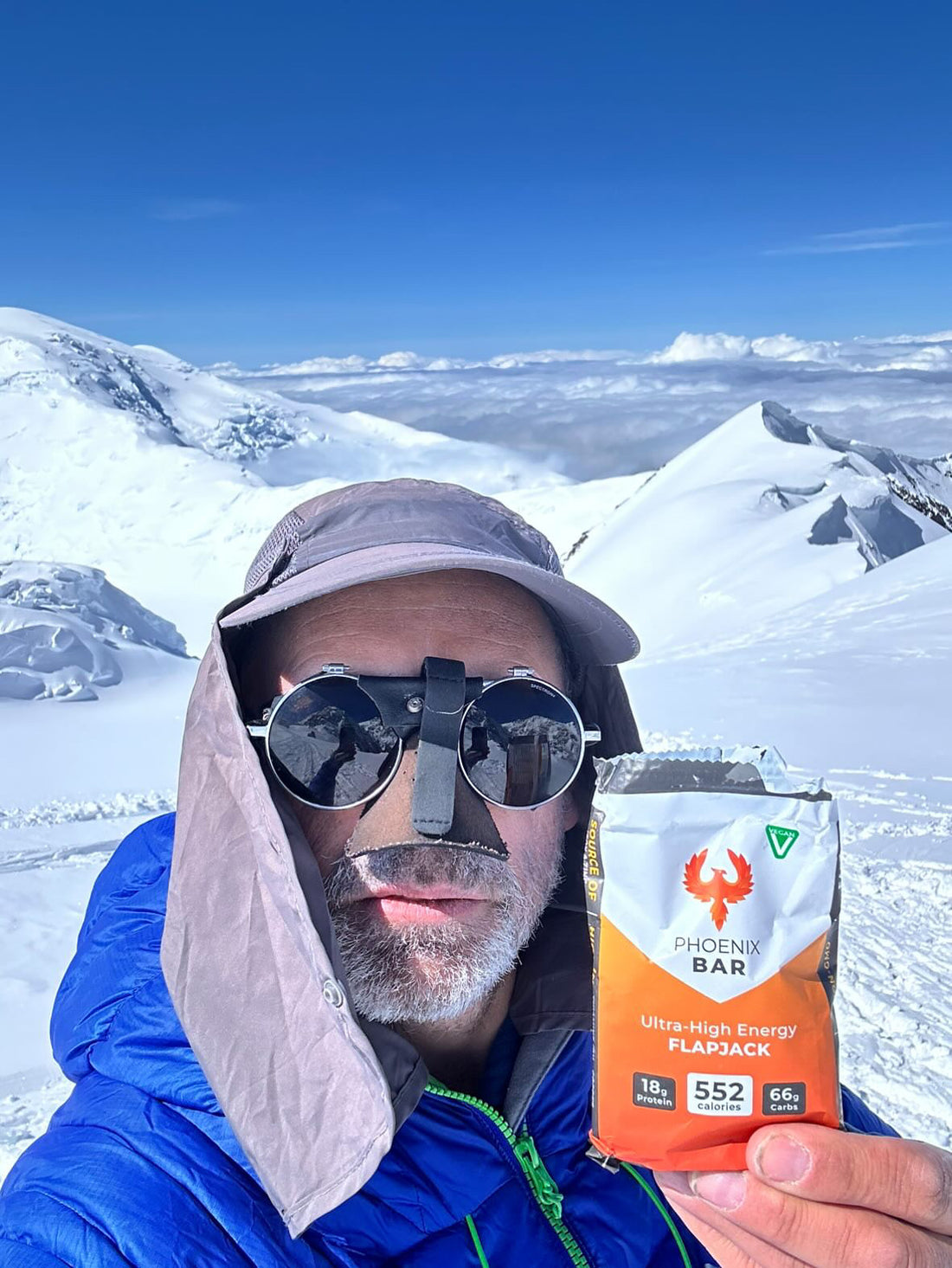
Big calories. Small bar.
Up to 557 calories in a compact, lightweight bar of only 120g, with up to 66g of carbs and 19g of protein. Eat it whole, break it into pieces over a few hours, or mix it with water or milk for porridge.
Easy to eat, easy to digest and not sickly sweet. Customers have eaten them at -45°C and through the heat of the Marathon des Sables, and they keep for up to 2 years, so they work on a mountain, on a night shift, or at home on days when eating enough feels hard.
- 557 calories in only 120g (529 to 557 by flavour)
- 4.6 calories per gram
- 66g carbs per bar (up to)
- 19g protein per bar (up to)
