

Open Water Swimming Nutrition: What to Eat Before, During and After
In this guide

Open water swimming nutrition is mostly about timing: swims under about 5 km need only a carbohydrate-based meal 3 to 4 hours before, while swims over 10 km need a feed every 20 to 30 minutes, building towards as much as 90g of carbohydrate an hour on the longest races. Cold water changes recovery more than it changes the swim.
This guide sets out what to eat before, during and after a long swim, with the numbers behind each step, what to feed on an overnight or Channel swim, and why you may be ravenous, not off your food, when you get out of cold water. For your own calorie figure, the swimming calorie calculator works it out from your weight, stroke and time in the water.
How many calories does open water swimming burn?
A 70 kg swimmer doing steady front crawl burns about 560 calories an hour, using the 8.0 MET value for medium-speed crawl in the 2024 Adult Compendium of Physical Activities.
The working: the 2024 Adult Compendium rates front crawl at about 50 yards a minute at 8.0 METs, slow crawl at 5.8 METs and racing an open water 5 km at 10.5 METs, and one MET is roughly 1 calorie per kg of body weight per hour. So a 70 kg swimmer uses about 8.0 x 70 = 560 calories an hour at a steady pace, 406 at an easy pace and 735 racing. A 10 km swim that takes 3.5 hours at steady pace comes to about 560 x 3.5 = 1,960 calories. On a Channel swim, Michael Read, who made 33 crossings, puts energy use at 600 to 900 calories an hour in an article for the Channel Swimming Association, and works through a 12-hour swim at 750 an hour: 9,000 calories, far more than anyone can eat in the water.
Does cold water make you burn more calories?
Not as much as most swimmers assume: in a controlled study, 45 minutes of exercise in 20°C water used the same calories as in 33°C water, but people ate 44% more afterwards.
In that study by White and colleagues (2005), 11 men exercised on an underwater bike in water at 20°C and 33°C and burned about 505 and 517 calories respectively; after the cold session they ate an average of 877 calories in the following hour. Colder water and longer swims add heat loss and shivering, and the RNLI treats anything below 15°C as cold water and gives the average UK and Irish sea temperature as just 12°C. The Channel Swimming Association records the Channel at about 15°C at the end of June, rising to 18°C by early September. The practical point is that you will probably be hungry after a cold swim, so have food ready for when you get out.
Free download
Free: the Ultra & Expedition Fuelling Checklist
A printable 2-page plan with your hourly carb targets, race-week plan and pack-weight maths. Free, sent straight to your inbox.
Free. Unsubscribe anytime. Privacy policy
What should you eat before an open water swim?
Eat a carbohydrate-based meal 3 to 4 hours before a race or long swim and a smaller snack 1 to 2 hours before, which is the timing Aquatics GB (British Swimming) recommends for its swimmers.
3 to 4 hours before: a main meal rich in carbohydrate with moderate protein and little fat or fibre, such as porridge with honey and banana, toast with jam, or rice. This gives your stomach time to empty before you are horizontal in the water, where indigestion affects breathing and sighting.
1 to 2 hours before: a smaller carbohydrate snack, such as a banana (about 135 calories and 30g of carbohydrate in 150g), two slices of malt loaf (129 calories, 25g) or a calorie-dense bar; the guide to the highest calorie bars in the UK compares them. Aquatics GB also suggests drinking about 500ml two hours before and 125 to 250ml just before you start.
The last 15 to 30 minutes: some swimmers take a few mouthfuls of sports drink or a gel; others prefer nothing. Find out which suits you in training, not on race morning.
Most UK open water events start early, and with a 7am start a 3am meal is unrealistic. A smaller, denser breakfast at 5 to 5.30am works better: something with plenty of calories in a small volume, such as high calorie bars or a thick porridge, rather than a large plate you will still be digesting at the start. The calorie-dense foods guide lists more options.
Do you need to eat during an open water swim?
Under about 5 km you usually do not need to eat during the swim; beyond about 10 km you do, because the glycogen in your arm muscles runs down, says Greg Shaw in an interview with Dietitian Approved.
Between those distances, a carbohydrate drink from a kayaker, boat or feeding pontoon is usually enough. For long races, Shaw and colleagues (2014) recommend using feeding pontoons to reach up to 90g of carbohydrate an hour from mixed sugars such as glucose and fructose. For scale, an elite swimmer tracked across seven Grand Prix races of 15 to 88 km by Kumstát and colleagues (2016) averaged 83g of carbohydrate, 12g of protein, 423mg of sodium and about 394 calories an hour, almost all from sports drinks and gels fed from support boats. Most recreational swimmers will do better starting at 40 to 60g an hour and building up in training.
The hard part is delivery. You have no pockets, you are treading water, and every second of a feed is time lost or, on a Channel swim, distance drifted. Keep feeds to a few mouthfuls; marathon swimmer Sarah Thomas, writing in Outdoor Swimmer, suggests a feed every 30 minutes of no more than about 8 fluid ounces (about 240ml). Liquid feeds mixed from one powder are quickest; soft solids such as banana, tinned peaches or a piece of soft bar can be added for longer swims. Practise the whole routine, from signalling to swallowing to restarting your stroke, on long training swims.
What to eat on an overnight or Channel swim
On an overnight swim, plan warm, liquid-led feeds every 20 to 30 minutes, because night air in the Channel swimming season averages only 10.6 to 13.9°C and cold feeds chill you further.
Channel Swimming Association rules allow no physical contact with the swimmer and no wetsuit, so every feed is passed across from the boat, and warm feeds are one of the few ways your crew can help you stay warm. Shaw and colleagues note that the temperature of what you drink can be used to help regulate body temperature. Useful overnight feeds:
- Warm carbohydrate drink: a 50g serve of sports drink powder gives about 186 calories and 46g of carbohydrate (ISSN values); make it with warm water in an insulated bottle.
- Thin porridge: a quarter of a Phoenix Bar (132 to 139 calories) stirred into plenty of water or milk gives a thin porridge; test in training whether it suits your feeding bottle.
- Banana or tinned peaches: soft, easy to swallow in seconds; a 150g banana is about 135 calories.
- Jam sandwich cut into small squares: about 218 calories and 46g of carbohydrate per sandwich (ISSN values), passed across in a small bag.
Expect your appetite and your stomach to change as the hours pass and the boat moves, and agree a fallback feed with your crew before you start. Michael Read, after trying everything from soup to chicken, found that late in his swims the only thing he could keep down was fruit sugar in water, so keep the simplest feed you know in reserve.
What should you eat after open water swimming?
After a long or cold swim, take about 1g of carbohydrate per kg of body weight straight away, with 10 to 20g of protein and around 600ml of fluid, which is the Aquatics GB recovery guidance.
For a 70 kg swimmer that means about 70g of carbohydrate in the first half hour. A Phoenix Bar (up to 66g of carbohydrate and up to 19g of protein) gets close on its own; a jam sandwich (about 46g of carbohydrate) with a 330ml can of cola (35g, according to the manufacturer's product sheet) would also do it, though with little protein. Get dry and dressed first, then eat something warm: a hot drink and warm food help you rewarm, and porridge made with hot milk covers carbohydrate, protein and warmth at once.
If you come out cold and shivering, prioritise dry clothes, shelter and a warm drink before food; if you are too queasy to face much, small amounts of something soft and calorie-dense are more realistic than a full meal, and the guide on what to eat when you have no appetite has ideas. On days with two swims, what you eat after the first decides how the second goes.
Where Phoenix Bars fit for open water swimmers
Phoenix Bars, which we make, have up to 557 calories and 66g of carbohydrate in a compact, lightweight 120g bar, which suits the two hardest moments in open water: the early-morning pre-race window and the cold, shaky half hour after you get out.
Before a swim, eat one 1 to 2 hours ahead, or break it into pieces over the morning. For breakfast or a recovery feed, stir it into water or milk to make a porridge; the guide on how to use Phoenix Bars covers the different ways. During long swims a thin quarter-bar porridge is one option to test. The bars are vegan and gluten-free, with a shelf life of up to two years, so one can live in your swim bag.
Frequently asked questions
How long before swimming can you eat? Aquatics GB suggests a main meal 3 to 4 hours before racing or hard training and a snack 1 to 2 hours before. A small, easily digested snack closer than that is fine for most swimmers, but a large or fatty meal within an hour of a long swim is more likely to cause indigestion.
Is full-fat Coke good after open water swimming? It is a quick, familiar source of carbohydrate: a 330ml can is 139 calories and 35g of carbohydrate, about half the 70g a 70 kg swimmer needs straight after a long swim. It has no protein and is a cold drink, so pair it with something warm and some protein.
Why am I so hungry after cold water swimming? Cold water appears to increase appetite. In a controlled study, people ate 44% more in the hour after exercising in 20°C water than after the same exercise in 33°C water, even though they burned about the same. Having a planned snack ready stops that hunger turning into whatever the café sells first.
Do you need electrolytes for sea swimming? Experts disagree. Sarah Thomas recommends electrolytes in fresh and salt water; Michael Read argues on the Channel Swimming Association site that Channel swimmers already take in salt from seawater; the elite swimmer in the Kumstát study took 423mg of sodium an hour. For long swims, test both approaches in training.
How many calories does a Channel swim burn? Around 600 to 900 calories an hour, according to Michael Read writing for the Channel Swimming Association, so a 12-hour crossing at 750 an hour is about 9,000 calories. Nobody can eat that in the water; swimmers start well fuelled, feed every 20 to 30 minutes and accept a large deficit.
This guide is part of our series on nutrition for endurance activities. For related reading, see the guides to long-course triathlon nutrition, ultra-endurance and expedition nutrition, high-calorie drinks, smoothies and milkshakes and high-calorie porridge.
Sources: Shaw G et al., Nutrition considerations for open-water swimming, IJSNEM 2014; Kumstát M et al., competition nutrition intakes in an elite open water swimmer, IJSNEM 2016; White LJ et al., Increased caloric intake soon after exercise in cold water, IJSNEM 2005; Aquatics GB nutrition guidance; Channel Swimming Association nutrition, water temperatures and regulations; RNLI cold water shock; 2024 Adult Compendium of Physical Activities; food values from the ISSN ultra-marathon position stand.
Written by James Frost, founder of Flaming Phoenix. Updated October 2026.
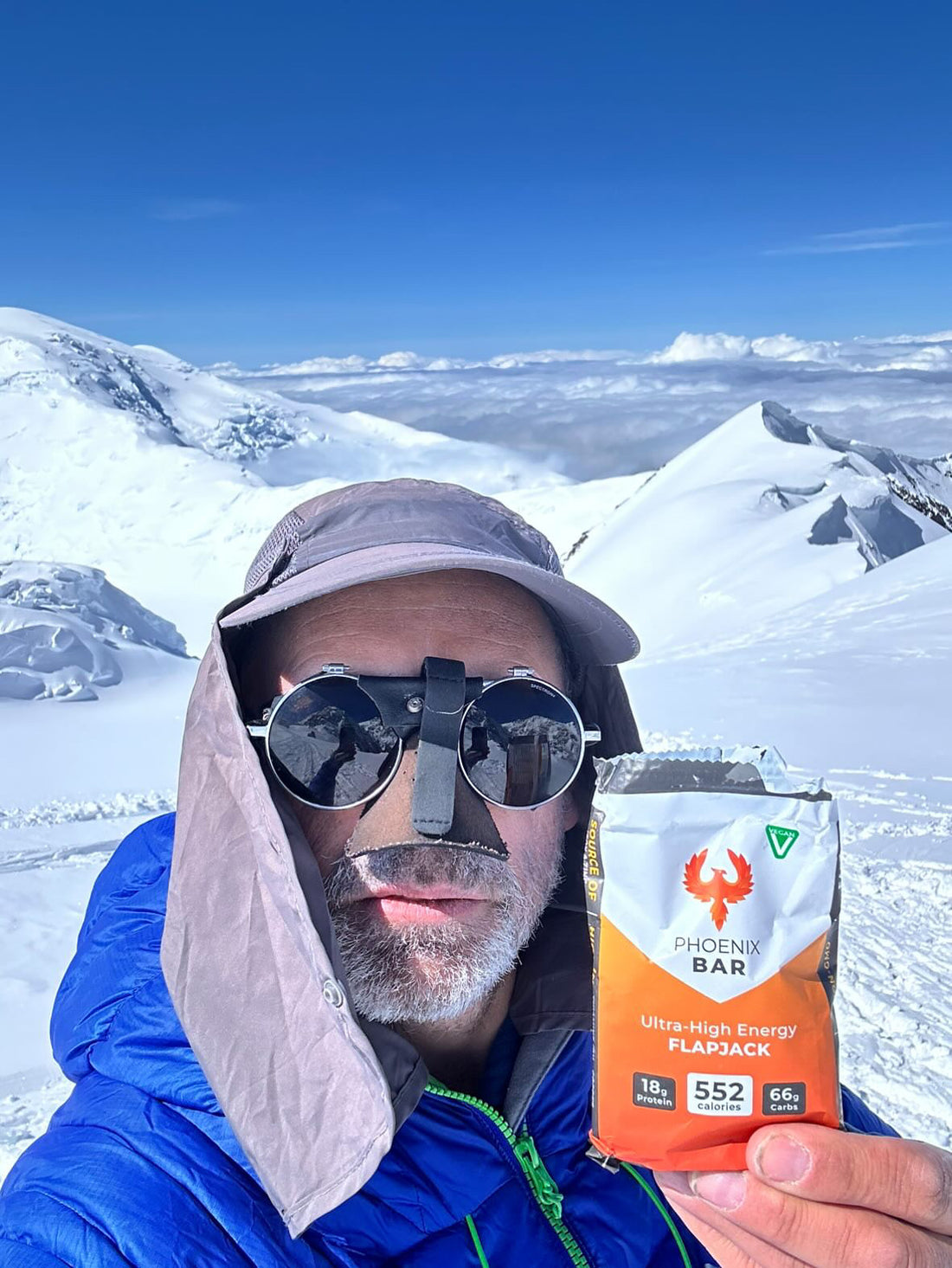
Big calories. Small bar.
Up to 557 calories in a compact, lightweight bar of only 120g, with up to 66g of carbs and 19g of protein. Eat it whole, break it into pieces over a few hours, or mix it with water or milk for porridge.
Easy to eat, easy to digest and not sickly sweet. Customers have eaten them at -45°C and through the heat of the Marathon des Sables, and they keep for up to 2 years, so they work on a mountain, on a night shift, or at home on days when eating enough feels hard.
- 557 calories in only 120g (529 to 557 by flavour)
- 4.6 calories per gram
- 66g carbs per bar (up to)
- 19g protein per bar (up to)
