

What to Eat on Kilimanjaro: A Climber's Day-by-Day Food Guide
In this guide

ABOUT THIS GUIDE
Most Kilimanjaro food guides are written by tour operators who serve your meals and want you to buy a bigger meal package. This one is not. It is written by the founder of a high-calorie expedition food brand whose bars have been carried to the summit of Everest. It tells you exactly what to bring, what to expect from your operator, and what to eat on summit night.
Climbing Kilimanjaro is a 5 to 9 day trek where altitude, route choice, summit night, and porter logistics all shape what you should eat and when. Your operator will feed you three hot meals a day and a tea-time snack. You are responsible for everything that fits between those meals, plus the climb you do in the dark from midnight onwards on summit night.
This guide covers exactly what to pack, by route, with realistic quantities. It complements rather than replaces the underlying physiology of altitude appetite suppression, which is covered in the High Altitude Mountaineering Nutrition guide.
What it covers:
- daily calorie demand by altitude band on Kilimanjaro
- exactly what your operator serves vs what you need to bring
- route-by-route food plans for the five most-used routes
- summit night nutrition protocol, the meal most climbers fail at
- realistic packing quantities (1 bar per day plus summit night, not 3)
- common Kilimanjaro-specific nutrition mistakes
This guide is informational. It is not medical advice. If you have a chronic condition or take medication, speak to a travel clinic or expedition doctor familiar with altitude before climbing.
Written by: James Frost, Founder of Flaming Phoenix. Phoenix Bars have been carried to the summit of Everest and used on Marathon des Sables, Aconcagua, polar expeditions, and ocean rowing crossings.
Last updated: April 2026
KEY POINTS
Six things to know before you read further.
Calorie demand on the mountain rises from around 3,500 a day in the rainforest to 6,000 to 8,000 on summit day. Most climbers eat only 50 to 70 percent of what they need above 4,000m, and the gap is widest on summit night.
Your operator will feed you well at the three meals per day, but you need your own snacks and your own summit-night fuel. Plan one calorie-dense bar per day for between meals, plus two to three for summit night, plus a bit of margin.
The 9-day Northern Circuit has the highest summit success rate, with the 8-day Lemosho close behind. Ultimate Kilimanjaro, one of the larger operators, estimates 85 to 95 percent across all operators for the Northern Circuit and about 90 percent for Lemosho. The 5-day Marangu route has the lowest, around 50 to 60 percent. Undereating during acclimatisation is one of the main preventable reasons climbers turn back.
Chocolate bars and most high-street energy bars freeze solid above 4,000m. Climbers who pack them spend summit night with rocks in their pockets. The fix is freeze-resistant bars or gels.
Summit night begins at midnight at -10 to -25°C. You need to eat in pieces, with gloves on, while moving. Whatever you bring needs to work in those conditions.
Phoenix Bars carry up to 557 calories in only 120g and can be eaten one bite at a time when full meals are intolerable. They are made for exactly this kind of trek, and climbers who took them to Manaslu and Denali say they don't freeze easily.
CONTENTS
- Why this guide is different from operator content
- How Kilimanjaro nutrition is different from a normal trek
- Daily calorie demand by altitude band on Kilimanjaro
- What your operator serves vs what you bring from home
- Day-by-day food plan: 7-day Machame route
- Day-by-day food plan: 8-day Lemosho route
- Day-by-day food plan: 5 to 6-day Marangu route
- Day-by-day food plan: 6 to 7-day Rongai route
- Day-by-day food plan: 9-day Northern Circuit route
- The summit night protocol
- What to bring from home and what to leave behind
- Common Kilimanjaro nutrition mistakes
- How many bars to actually pack
- Frequently asked questions
- Related guides
1. Why This Guide Is Different from Operator Content
Almost every Kilimanjaro food article online is written by the company that wants to sell you the climb. They cover how delicious their meals are, how their chefs trained at the Culinary Institute of America, and how you barely need to bring anything because they have it covered.
Some of that is true. Operator meals on Kilimanjaro are good. You will not go hungry at mealtimes. But three things they tend not to write about, because there is no commercial reason to:
The summit night gap. Operators serve a light breakfast at 11pm, then send you up the mountain at midnight for a 6 to 7 hour climb in -10 to -25°C. What you eat between leaving camp and reaching Uhuru Peak is entirely on you. This is the meal that separates climbers who summit from climbers who turn around.
Freeze and melt failures. Standard chocolate bars, gels, fruit, and most supermarket energy bars become inedible above 4,000m. Operators do not warn you about this because they do not sell snacks. The result is climbers reaching summit night with frozen Snickers bars in their pockets. Our ranking of the best energy bars for expeditions scores bars on cold performance for this reason.
What to actually pack. Operator advice is usually some variation of "bring some treats from home." Real numbers, by route, by day, are rare.
This guide fills those three gaps.
2. How Kilimanjaro Nutrition Is Different from a Normal Trek
Three things make Kilimanjaro nutritionally distinct from any other multi-day hike.
You are supported by porters, but your snacks are entirely your own responsibility. Every operator runs a similar model: a head guide, assistant guides, a chef, and porters. Three to four staff per climber. The chef cooks all main meals at camp. You climb with a daypack containing water, layers, sun protection, and food for the day's walking. Mealtimes are fixed at roughly 7am, 1pm and 6pm. The hours between meals, and the entire summit night, are when the snacks you packed at home matter.
The summit attempt is at night. On every standard Kilimanjaro route, summit night begins at 11pm or midnight. You climb 1,200m of altitude in 6 to 7 hours, eating very little because nausea, cold, and hypoxia have suppressed your appetite. The dinner you ate the previous evening is the last full meal you will tolerate before the summit. This is the most important nutritional event of the trek and the one most climbers prepare for the least.
Altitude rises faster than the body acclimatises. A 7-day Machame climb takes you from 1,800m to 5,895m and back in a week. Your body has barely begun to adapt by the time summit night arrives. Eating well at lower altitudes builds the calorie reserves you will draw on during the days when food becomes hard to face.
For the underlying physiology of altitude appetite suppression, the digestive slowdown, and what makes food work in thin air, see the High Altitude Mountaineering Nutrition guide. This page focuses on the specific Kilimanjaro application.
3. Daily Calorie Demand by Altitude Band on Kilimanjaro
Kilimanjaro passes through five climate zones, and your calorie demand changes in each.
In the rainforest zone (1,800m to 2,800m), on Day 1, you are walking in warm humid conditions and burning roughly 3,500 to 4,500 calories a day. Appetite is normal. Digestion is normal. Eating is easy.
In the heath and moorland zone (2,800m to 4,000m), typically Day 2 to Day 3, calorie demand rises to 4,500 to 5,500 a day as the climb gets steeper and the air thinner. Appetite begins to dip slightly but most climbers still eat normally.
In the alpine desert zone (4,000m to 4,700m), Day 3 to Day 5 depending on route, calorie demand climbs to 5,000 to 6,000 a day. This is where most climbers start to skip lunch because they feel nauseous, headachy, or simply not hungry. This is also the most dangerous time to undereat. The calories you fail to put in here are the calories you do not have on summit night.
In the summit zone (4,700m to 5,895m), on summit night and the descent the next day, calorie demand spikes to 6,000 to 8,000 calories. Most climbers manage 1,500 to 2,500. The gap is closed only with a deliberate, pre-planned snack protocol.
The most useful rule on Kilimanjaro is to eat by the clock, not by appetite. Above 3,500m, hunger is no longer reliable. Set a snack alarm every 90 minutes during walking hours and eat something each time, regardless of whether you feel like it. The climbers who summit are the ones who treat eating as discipline rather than instinct.
4. What Your Operator Serves vs What You Bring from Home
Tanzanian Kilimanjaro operators broadly cook in a consistent style across companies. Knowing what arrives on your plate helps you pack the right gaps.
Breakfast at around 7am is typically porridge, eggs (often scrambled with vegetables), toast, jam, fruit, and hot drinks. On the order of 600 to 1,000 calories. Quality is generally good and most climbers eat well at breakfast even at altitude.
Lunch at around 1pm is either a packed lunch (sandwich, hard-boiled egg, fruit, biscuit, juice box) or a hot lunch served at camp (soup, fried chicken, rice, vegetables). Packed lunches are widely reported as the weakest meal of the day. Most operators include a hard-boiled egg and a basic sandwich. Hot lunches are better but only available when the chef has time to set up. 700 to 1,200 calories.
Tea-time snack at around 4pm in camp is hot drinks plus popcorn, peanuts, biscuits, or fried plantain. Light but welcome after a hard walking day. 300 to 500 calories.
Dinner at 6 or 7pm starts with soup, then a main of pasta with meat sauce, rice with stew, or ugali (Tanzanian maize porridge) with vegetables and meat. Fruit for dessert. 800 to 1,400 calories.
Total operator-provided calories run roughly 2,400 to 4,100 per day. Below your demand at every altitude band above 2,800m. The gap is what your packed snacks, usually high calorie protein bars and a few treats from home, need to fill.
Plan for two operator weak points before you pack. Packed lunches are merely fine, not good. Real climber accounts consistently call them "fine but not spectacular." Bring something to eat alongside the packed lunch on Day 2 and Day 3. The summit night meal is small. Porridge and biscuits at 11pm. After that you are on your own until you descend back to high camp.
For more on the underlying calorie density principle that makes some snacks dramatically more efficient than others on a weight-constrained climb, see Calorie-Dense Foods.
5. Day-by-Day Food Plan: 7-Day Machame Route
The Machame route, known as the "whisky route," is the most popular Kilimanjaro itinerary. Around 40 percent of climbers take it. Steeper and more scenic than Marangu, with a slightly higher summit success rate.
Day 1: Machame Gate to Machame Camp (1,800m to 3,000m). Rainforest walking, warm humid conditions, 5 to 7 hours. Eat your breakfast at the gate, your packed lunch on the trail, your hot dinner at camp. Bring one calorie-dense bar to eat between lunch and dinner.
Day 2: Machame to Shira Camp (3,000m to 3,840m). Steep ascent above the treeline into moorland. 5 to 7 hours. One bar between lunch and dinner. This is where you should also start drinking electrolyte tablets in your water if you have them.
Day 3: Shira to Lava Tower to Barranco (3,840m to 4,630m to 3,960m). This is the acclimatisation day, the "climb high, sleep low" day, and the day most first-time climbers feel terrible. Lava Tower at 4,630m is your first real exposure to altitude. Most climbers lose their appetite for lunch here. Eat one bar in the morning, force lunch even if it tastes wrong, then a bar in the afternoon as you descend to Barranco. This is the most important calorie day of the climb.
Day 4: Barranco to Karanga (3,960m to 3,995m). A short walking day with a steep wall at the start. 4 to 5 hours. One bar between lunch and dinner. Use the rest afternoon to eat well, hydrate, and prepare your summit night kit.
Day 5: Karanga to Barafu, summit camp (3,995m to 4,673m). A short ascent to the camp from which you summit. 3 to 4 hours of walking. Early dinner around 5pm, then sleep until 11pm. Eat one bar during the day. Put two to three bars in an inner jacket pocket, against your body, before you go to sleep.
Day 6: Summit night and descent. Midnight start, 6 to 7 hours to Uhuru Peak at 5,895m, then a fast descent to Mweka Camp at 3,100m. Eat the porridge at 11pm. Eat your two to three bars in pieces every 45 to 60 minutes during the climb. Detailed protocol in section 10. Eat your full breakfast and lunch on the descent. Bring one or two extra bars in the daypack for descent calories.
Day 7: Mweka to Mweka Gate (3,100m to 1,640m). Easy descent, 3 to 4 hours, big celebration breakfast at camp. One bar for the road home is plenty.
For a 7-day Machame, plan 9 to 11 bars total: 7 for the climbing days, 2 to 3 for summit night, 0 to 1 spare. The 12-bar Starter Bundle is the right size with margin built in.
6. Day-by-Day Food Plan: 8-Day Lemosho Route
Lemosho has the second-highest success rate on Kilimanjaro after the 9-day Northern Circuit, at about 90 percent on the 8-day version by Ultimate Kilimanjaro's estimate. The extra acclimatisation day matters. If you have the time and budget, this is the route worth choosing.
The first three days are gentler than Machame, traversing the western shoulder of the mountain through rainforest into moorland. Days 1 to 3 each cover roughly 4 to 6 hours of walking with modest altitude gain. One bar per day is plenty alongside operator meals.
Day 4 mirrors the Machame Day 3 acclimatisation day: Shira 2 to Lava Tower to Barranco. Same advice: one bar morning, force lunch at altitude, one bar afternoon. The same principles apply for Days 5 to 7 as Days 4 to 6 of the Machame schedule, including summit night.
Day 8 descends to Mweka Gate.
For an 8-day Lemosho, plan 10 to 13 bars total: 8 for the climbing days, 2 to 3 for summit night, 0 to 2 spare. The 12-bar Starter Bundle covers the conservative pack. Climbers who want margin or who plan to share with team-mates should size up to the 18-bar Essential Bundle.
7. Day-by-Day Food Plan: 5 to 6-Day Marangu Route
Marangu is the only hut-based Kilimanjaro route and the cheapest option. Both factors make it the route most often chosen by less-experienced climbers, which is also why it has the lowest summit success rate at around 50 to 60 percent. The reason is almost always inadequate acclimatisation, not weakness or undereating, but eating well still matters.
Days 1 and 2 walk from Marangu Gate to Mandara Hut and on to Horombo Hut. One bar per day alongside operator meals.
Day 3 is an optional acclimatisation day at Horombo. If your itinerary includes it, take it. Eat one bar during the rest day to keep calorie reserves up.
Day 4 climbs to Kibo Hut at 4,703m, the summit camp. Short walking day. One bar in the day, two to three bars into your inner pocket for summit night.
Day 5 is summit night and a long descent back to Horombo.
Day 6 is the descent to the gate.
For a 5 to 6-day Marangu, plan 8 to 10 bars total: 5 to 6 for the climbing days, 2 to 3 for summit night, 0 to 1 spare. The 12-bar Starter Bundle is the cleanest fit and gives margin for sharing with porters or team-mates.
8. Day-by-Day Food Plan: 6 to 7-Day Rongai Route
Rongai approaches Kilimanjaro from the dry northern side and is the quietest route. The altitude profile is slightly easier than Machame or Lemosho, but summit night ends at the same 5,895m and follows the same protocol.
Days 1 to 4 cover the approach and acclimatisation. One bar per day alongside operator meals.
Days 5 to 6 follow the standard summit-night-then-descend pattern.
For a 6 to 7-day Rongai, plan 9 to 11 bars total: 6 to 7 for the climbing days, 2 to 3 for summit night, 0 to 1 spare. The 12-bar Starter Bundle is the right size.
9. Day-by-Day Food Plan: 9-Day Northern Circuit
The Northern Circuit is the longest route on Kilimanjaro and has the highest summit success rate of all the variants. It loops the mountain on the quieter northern slopes before joining the Machame summit camp at Barafu. Nine days of walking is a lot, and the calorie discipline matters more here than on shorter routes because the cumulative deficit grows.
Plan one bar per climbing day alongside operator meals, plus two to three for summit night, plus one or two spare. 11 to 14 bars total for a 9-day Northern Circuit. The 12-bar Starter Bundle covers the minimum. Climbers who want comfortable margin or who plan to share with their team should size up to the 18-bar Essential Bundle.
10. The Summit Night Protocol
Summit night is where Kilimanjaro nutrition succeeds or fails. Get it wrong and a perfectly fit, perfectly acclimatised climber turns back.
The timing problem
Most operators wake climbers at 11pm and start the summit attempt at midnight. The chef serves a light breakfast: porridge, biscuits, hot tea. By the time you start walking, it has been roughly 6 hours since dinner, you are at 4,673m, you are likely cold, and you may have slept badly. You will not feel hungry. You should eat anyway.
Before starting (11pm to midnight)
Eat the porridge if you possibly can. Add sugar, honey, or a broken-up bar if it helps you finish it. Drink 500ml of warm fluid with electrolytes if you have them.
Before you leave camp, put two to three calorie-dense bars in an inner jacket pocket, against your body. Outside pockets at -15°C are too cold for most bars. Bars that freeze are inedible. Bars kept against your body stay soft.
During the climb (midnight to dawn)
Eat a few bites every 45 to 60 minutes. Do not wait for hunger. It will not come. Pieces, not whole bars. Break a bar in half before each rest stop and eat in two or three bites with gloves on.
Drink small amounts often. A hydration bladder will freeze on summit night. Use an insulated bottle stored upside down inside your pack instead, so any ice that forms is at the bottom of the bottle rather than blocking the lid.
If nausea hits, slow down. The combination of altitude, cold and forced food intake can trigger it. Sip water, take a few breaths, then try a small bite again.
Why bars beat the alternatives on summit night
Two facts the operators do not emphasise. Standard chocolate-coated bars freeze solid at summit-night temperatures and become inedible. Ridgeline Report and the WHOA Travel Kilimanjaro packing guide both warn against them in identical terms. Energy gels work but only carry 100 calories per gel. You would need 6 to 8 gels for the calorie load you actually need.
A bar that does not freeze, that can be broken with cold fingers, and that delivers up to 557 calories per 120g is the gap product for summit night. Phoenix Bars were designed for exactly this, and one customer found them easy to eat at -45°C on a South Pole expedition. Keep them in an inner pocket on summit night all the same.
At the summit (dawn) and the descent
Take photos first. Eat in shelter rather than on the exposed summit if it is cold and windy. A few bites and a hot drink at Stella Point on descent if you can manage it. By the time you reach high camp again at Barafu or Kibo Hut, you will be ravenous. Eat fully. Lunch and dinner that day are the recovery meals that get you down the mountain on Day 7.
11. What to Bring from Home and What to Leave Behind
Bring
One calorie-dense bar per climbing day, plus two to three extra for summit night, plus one or two for margin. The bar needs to not freeze, not melt, and be edible with gloves on.
Electrolyte tablets: not provided in most operator packages. Bring one to two tablets per day. Two of the bigger Kilimanjaro operators (Ultimate Kilimanjaro, Follow Alice) explicitly recommend climbers bring their own electrolytes.
Hot drink sachets: instant coffee, hot chocolate, or chai sachets. Lightweight, comforting, and a way to add calories on low-appetite evenings.
A familiar small comfort food: anything that smells like home and you would actually eat at altitude. Crisps, beef jerky, dried mango, gummy sweets. When local food fails on Day 4 or 5, this is what gets you eating again.
A summit pouch: a separate small ziplock bag with your two to three summit-night bars, prepared on Day 1 and kept inside your sleeping bag every night thereafter. It is one less decision at 11pm on Day 5 or 6.
Leave behind
Chocolate-coated bars or anything cocoa-coated. They freeze. The Snickers in your pocket on summit night will be a frozen brick.
Anything fragile that needs preparation, water beyond what you have, or hot food. Summit night is a no-preparation environment.
Bulk multi-pack snacks. Individual portions are easier to eat at altitude than rummaging through a bag. Pre-portion before you fly out.
More bars than you can realistically eat. Operators serve a lot of food. One bar per day is enough alongside operator meals.
12. Common Kilimanjaro Nutrition Mistakes
These are the patterns I see and hear about most often from real climbers and from the operator-side material I've reviewed.
Bringing chocolate. Chocolate freezes above Karanga. By Day 5 it is inedible. The chocolate bar in your pocket on summit night will be a brick.
Eating only at mealtimes. Three meals plus tea give you 3,000 to 4,000 calories. You need 5,000 to 6,000 from Day 3 onwards. The gap closes only with snacking.
Skipping the porridge on summit morning. "I'm not hungry" is the most common summit-night failure mode. Eat it anyway. It is the last warm food you will see for 8 hours.
Carrying summit-night food in an outer pocket. Bars in an outer pocket on summit night freeze. Bars in an inner pocket against your body stay soft.
Skipping lunch on the Lava Tower day. Day 3 (Machame) or Day 4 (Lemosho), the day with Lava Tower, is the day most climbers feel terrible and skip lunch. This is the day they need the calories most.
Drinking too little. Dehydration at altitude masquerades as nausea, headache, and loss of appetite. Most climbers feel better after 500ml of warm electrolyte drink than after any food.
Trying new food on the mountain. Test every snack at altitude before the trip if you can. At minimum, eat the bars you plan to bring on a long training walk so you know your stomach tolerates them under exertion.
Overpacking. Three bars a day is too many. One per day plus summit night is right.
13. How Many Bars to Actually Pack
The most reliable rule for Kilimanjaro is: one calorie-dense bar per climbing day, plus two to three for summit night, plus one or two for margin or sharing.
For a 5 to 6-day Marangu, that is 8 to 10 bars total. The 12-bar Starter Bundle is right.
For a 6 to 7-day Rongai, 9 to 11 bars total. The 12-bar Starter Bundle is right.
For a 7-day Machame, 9 to 11 bars total. The 12-bar Starter Bundle is right.
For an 8-day Lemosho, 10 to 13 bars total. The 12-bar Starter Bundle is right for a conservative pack. Climbers who want margin or who plan to share with team-mates should size up to the 18-bar Essential Bundle.
For a 9-day Northern Circuit, 11 to 14 bars total. The 12-bar Starter Bundle is the minimum; the 18-bar Essential Bundle gives comfortable margin.
For groups of four or more climbing together and wanting to share a bulk pack, contact me directly at jfrost@flaming-phoenix.co.uk for expedition pricing.
14. Frequently Asked Questions
How many calories do I burn on Kilimanjaro?
Between 4,000 and 6,000 calories per day climbing Kilimanjaro, rising to 6,000 to 8,000 calories on summit day. Most climbers consume only 50 to 70 percent of their need above 4,000m, creating a progressive calorie deficit across the trek.
What food do guides cook on Kilimanjaro?
Tanzanian operators provide three cooked meals per day plus a tea-time snack. Breakfast is usually porridge, eggs, toast, and fruit. Lunch is either packed (sandwich, hard-boiled egg, fruit, biscuit) or hot at camp (soup, fried chicken, rice, vegetables). Dinner starts with soup followed by pasta, rice, ugali, stewed meat or vegetables. Total provided calories are roughly 2,400 to 4,100 per day, below climber demand above 2,800m.
How many snacks should I bring on Kilimanjaro?
One calorie-dense bar per day of climbing, plus two to three extra for summit night, plus one or two for margin. For a standard 7-day Machame climb that is 9 to 11 bars total. Most operators serve enough food at meals that more than this becomes leftover weight.
Will my food freeze on Kilimanjaro?
Above Barranco at 3,960m, overnight temperatures regularly drop below freezing. On summit night above Barafu at 4,673m, temperatures range from -10 to -25°C. Chocolate, gels, sandwiches, fruit, and most standard energy bars freeze solid at these temperatures. On the Winter Spine Challenger South, in temperatures around or below freezing, Christian Poulton found Phoenix Bars stayed soft enough to eat when some of his other food was too hard. Whatever you carry, an inner pocket against your body keeps it softer.
What should I eat on Kilimanjaro summit night?
Eat the porridge breakfast at 11pm before the midnight start. Carry two to three calorie-dense bars in an inner jacket pocket against your body to keep them from freezing. Eat a few bites every 45 to 60 minutes during the climb, regardless of hunger. Drink small amounts of warm fluid with electrolytes throughout. After summiting, eat at the first reasonable break on descent.
Which Kilimanjaro route has the highest success rate?
The 9-day Northern Circuit, because it allows the most acclimatisation time: Ultimate Kilimanjaro estimates 85 to 95 percent across all operators, with the 8-day Lemosho next at about 90 percent. The park itself has published no figures by route since 2006. The 5-day Marangu route has the lowest at around 50 to 60 percent. Eating well on acclimatisation days is one of the most important controllable factors in summit success on any route.
Are Phoenix Bars suitable for Kilimanjaro?
Phoenix Bars carry up to 557 calories in only 120g, with up to 66g of carbohydrate and up to 19g of protein. They have been carried to the summit of Everest and are used by Kilimanjaro climbers as between-meal snacks and summit-night fuel.
Are Phoenix Bars vegan and gluten-free for Kilimanjaro?
Yes. All six Phoenix Bar flavours are vegan and gluten-free. On Kilimanjaro, operator camp food is often heavy in wheat (pasta, bread) and meat-based protein, which can be limiting for climbers with dietary restrictions. Carrying your own calorie-dense bars guarantees you have appropriate fuel regardless of what the camp menu serves.
Can I make porridge from a Phoenix Bar on Kilimanjaro?
Yes. Crumble a bar into a mug, add water, and stir. It makes a calorie-dense porridge that is often easier to face than solid food at high altitude. Particularly useful at Barafu and Kibo Hut, and on rest days at Horombo or Karanga. Full instructions are on the How to Use Phoenix Bars page.
Do I really need to bring snacks if my operator feeds me?
Operator meals cover roughly 2,400 to 4,100 calories per day. Your demand above 2,800m is 4,500 to 6,000 calories per day. The gap has to come from somewhere. One calorie-dense bar per day plus summit-night reserves is the minimum that closes the gap without overpacking.
15. Related Guides
- High Altitude Mountaineering Nutrition: the underlying physiology of altitude appetite suppression and what makes food work in thin air
- Everest Base Camp Nutrition: for climbers progressing from Kilimanjaro to higher trekking peaks
- Calorie-Dense Foods: a full explanation of calorie density for any trip where you carry every gram
- How to Use Phoenix Bars: practical guidance including the porridge method
- Hiking and Trekking Nutrition: broader principles for multi-day walking
- Three Peaks Challenge Food: a useful UK training challenge for Kilimanjaro climbers
- Lightest High Calorie Food for Backpacking: calorie-to-weight ratio comparison
- Ultra-Endurance and Expedition Nutrition Guide: the broader expedition nutrition framework
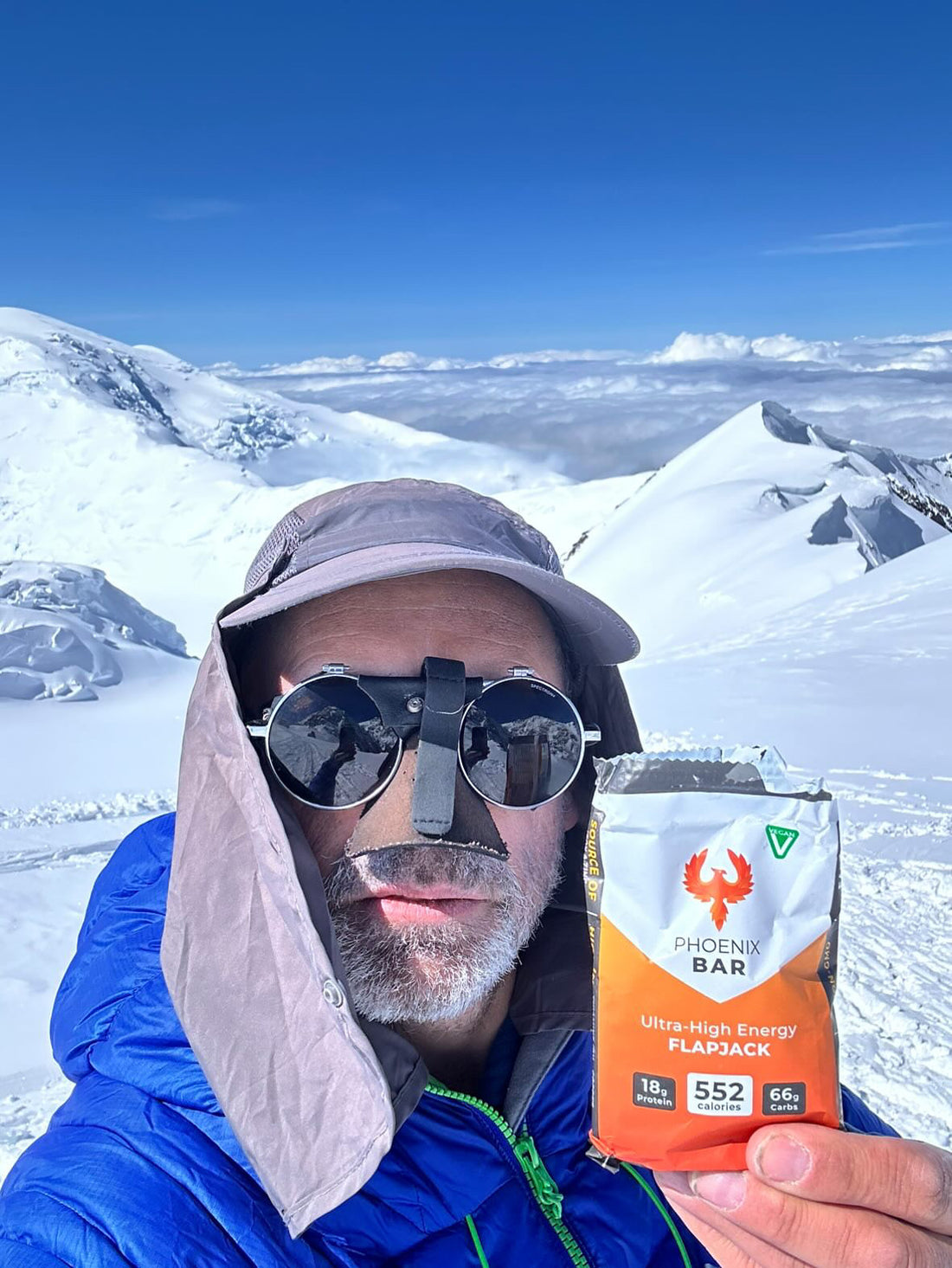
Big calories. Small bar.
Up to 557 calories in a compact, lightweight bar of only 120g, with up to 66g of carbs and 19g of protein. Eat it whole, break it into pieces over a few hours, or mix it with water or milk for porridge.
Easy to eat, easy to digest and not sickly sweet. Customers have eaten them at -45°C and through the heat of the Marathon des Sables, and they keep for up to 2 years, so they work on a mountain, on a night shift, or at home on days when eating enough feels hard.
- 557 calories in only 120g (529 to 557 by flavour)
- 4.6 calories per gram
- 66g carbs per bar (up to)
- 19g protein per bar (up to)
