

Greenland crossing food: a 30-day ice cap food plan
In this guide

 Written by James Frost, founder of Flaming Phoenix. Updated October 2026.
A Greenland ice cap crossing covers 550 to 600km in 24 to 30 days on skis, with no resupply, so a month of food starts in the pulk. Plan 5,500 to 6,000 calories a day in 1.2 to 1.4kg of dry food: 36 to 42kg for 30 days, plus about 0.25 litres of stove fuel a day for melting snow.
Those planning figures come from Swedish explorer Mikael Strandberg's crossing preparation guide. The classic route runs between Kangerlussuaq on the west coast and Isortoq or Tasiilaq in the east, in either direction, in spring. Ousland Polar Exploration meets its west to east team in Kangerlussuaq at the end of April and spends 26 to 28 days on the ice, and Polar Explorers puts the crossing at about 550km as the crow flies. Strandberg gives temperatures of minus 15 to minus 35°C, with wind chill down to minus 45°C.
This page is the weighed food plan: a day of food meal by meal, what a month weighs, the permit and insurance rules that shape the budget, and how to keep the day's food edible. For the calorie burn measured on polar journeys and a 60-day version of the maths, see my guide to food for Antarctica.
How many calories do you need to cross Greenland?
Plan on 5,500 to 6,000 calories a day, the range Strandberg's guide uses, and expect to eat a little less than you pack. When two British Army teams crossed Antarctica in the 2017 to 2018 season on 5,000 and 6,500 calories a day, they ate 85 to 92% of what they carried and still lost 6.5 to 7.8% of their body mass, according to a 2020 study in Scientific Reports.
Greenland is half the length of an Antarctic trip, so the deficit has less time to build. The advice is the same, though: pack food you will still want on day 25, and eat by the clock, not by appetite.
What does a day of Greenland crossing food look like?
The table is one day of food for one skier, weighed, with calories from the UK's CoFID food tables and from the Phoenix Bar label, using the lowest-calorie flavour (529). It comes to about 5,730 calories in 1,175g, or 4.9 calories per gram.
| When | What goes in | Weight | Calories |
|---|---|---|---|
| Breakfast | 90g porridge oats, 30g skimmed milk powder, 50g butter, one Phoenix Bar stirred in | 290g | 1,348 |
| Chest bag, through the day | One Phoenix Bar, 80g salami, 80g Cheddar, 100g plain chocolate, 100g mixed nuts, 50g peanut butter | 530g | 2,607 |
| Hot drinks | 60g drinking chocolate powder, 30g sugar | 90g | 344 |
| Dinner | 125g couscous, 50g olive oil, 50g butter, 40g instant soup powder | 265g | 1,430 |
| Day total | 1,175g | 5,729 |
Breakfast and dinner are cooked while the stove is melting snow anyway, so they cost little extra fuel. Everything eaten between them lives in the chest bag, cut into pieces the night before. Many skiers carry a freeze-dried meal instead of the couscous; check the label, because pouches vary a lot in calories per gram, and add the butter and oil either way.
How much does a month of food weigh?
At 1.2 to 1.4kg a day, 30 days of food weighs 36 to 42kg before fuel. The table gives totals for a fast, a typical and a slow crossing, with white gas at the 0.25 litres per person per day that Strandberg's guide allows for cooking and melting snow.
| Days of food | At 1.2kg a day | At 1.4kg a day | Fuel at 0.25 litres a day |
|---|---|---|---|
| 26 | 31.2kg | 36.4kg | 6.5 litres |
| 30 | 36kg | 42kg | 7.5 litres |
| 34 | 40.8kg | 47.6kg | 8.5 litres |
Strandberg puts a typical starting pulk at 70 to 80kg with 25 days of food and 20 litres of fuel on board. Food is the one load that shrinks every day, so each kilo you save by choosing denser food comes off when the pulk is heaviest. The weighed day above, at 4.9 calories per gram, gives a 30-day bag of about 35kg.
Do you need a permit to cross the Greenland ice sheet?
Yes. Greenland's Expedition Office requires a permit for any travel more than 1km from the ice edge, whatever the duration. Expeditions also need search and rescue insurance of DKK 1,000,000 for the group and evacuation cover of DKK 280,000 per person south of 78°N, according to the office's insurance rules. Strandberg advises applying at least 90 days before you leave.
That cover has a cost. In April 2025 ExplorersWeb reported that the French insurer Groupama would meet the new requirements, at an estimated $4,300 per team member for a west to east crossing. Budget for it before you budget for food.
How do you stop food freezing on the Greenland ice cap?
Keep the day's food in a bag inside your jacket, eat it in small pieces at every stop, and carry hot drinks in vacuum flasks filled from the morning's melted snow. At minus 15 to minus 35°C, anything left in the pulk goes hard within hours.
Cut cheese, salami and bars into bite-sized pieces in the tent the night before, so nothing needs a knife or bare fingers on the ice. Chocolate goes brittle but stays edible; bread, fruit and anything wet freeze solid, which is why they rarely make the list. Fat-heavy foods such as nuts, butter and peanut butter contain very little water, so they stay chewable for longer.
Customers have used Phoenix Bars in deep cold. Stuart Deel-Smith wrote in September 2026: "I have used Phoenix bars on several events including deep arctic cross-country ski-ing in -35 degrees".
Should Greenland food be high fat or high carbohydrate?
Both approaches are in use, and no study on the ice has settled it. Strandberg's guide targets 60% of calories from fat, 30% from carbohydrate and 10% from protein, because fat carries 9 calories per gram against 4 for carbohydrate and keeps the pulk light. The day in the table above works out at roughly 55% fat, 34% carbohydrate and 11% protein.
The limit is what you can face. A very fatty diet is heavy going for some people after two weeks, so test your mix on a long winter weekend first, and keep some sweet and starchy food for the hard afternoons. More on how calorie density decides pack weight is in my calorie-dense foods guide, and the carbohydrate side in ultra high carb solid foods.
How many Phoenix Bars do you need for a Greenland crossing?
Two a day covers the plan above: one stirred into breakfast porridge and one in the chest bag. For a 30-day crossing that is 60 bars, plus six for reserve days, 66 in all. A Complete Bundle (36), an Essential Bundle (18) and a Starter Bundle (12) make exactly 66 bars, £346.50 at £5.25 a bar.
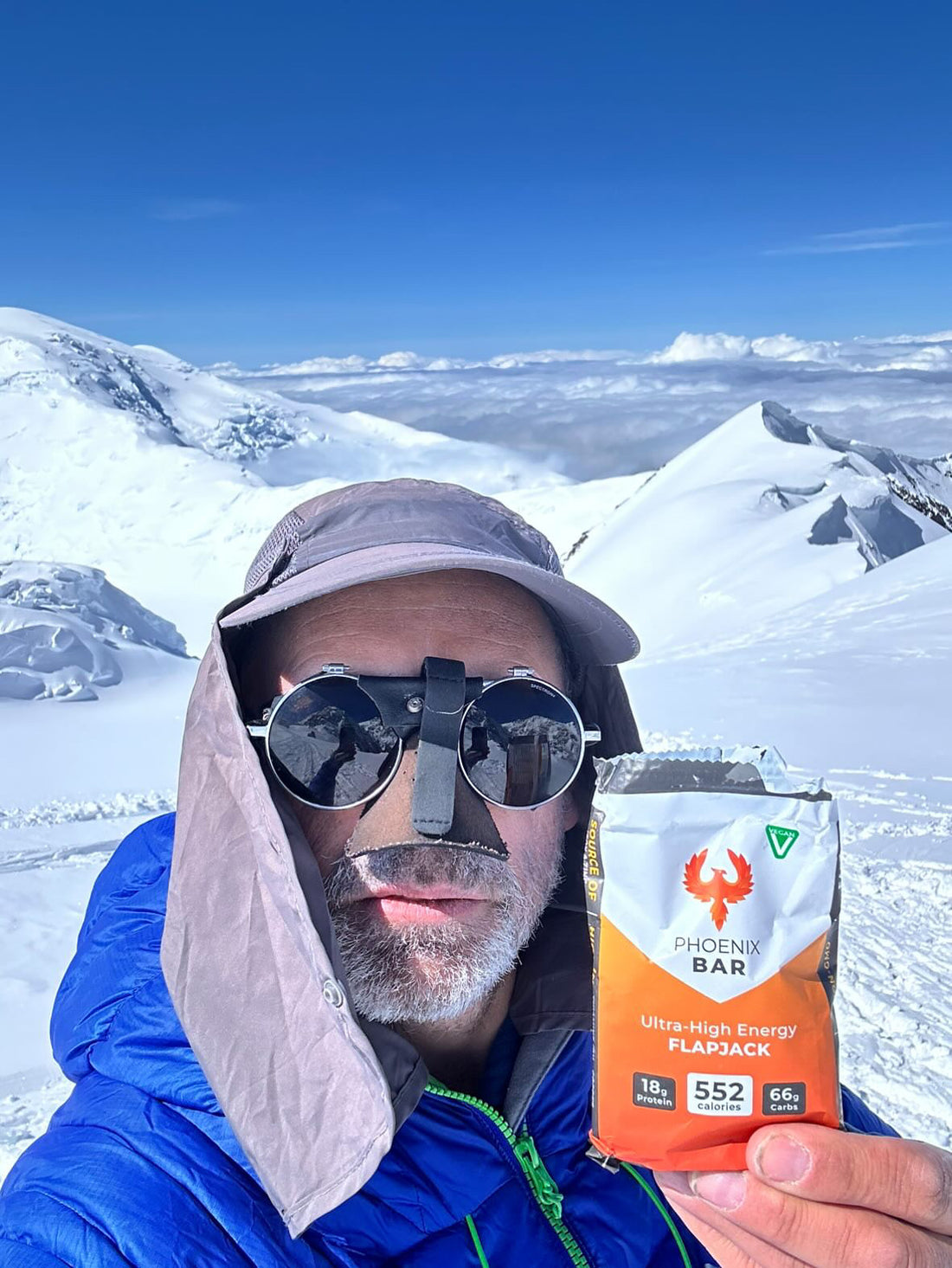
Phoenix Bars carry up to 557 calories in a compact, lightweight 120g bar, 4.4 to 4.6 calories per gram, with up to 66g of carbohydrate and 18 to 19g of protein. Six flavours give some change of taste across a month on the ice, and the shelf life of up to two years (Cherry Bakewell 12 months) means a spring crossing can be stocked the autumn before. Paul Vicary, who has travelled to both Poles, wrote after a trip to Greenland: "I found this one really good, tasty and providing the calories having just used it in Greenland."
Pack them alongside butter and oil, a hot dinner and salty food to break up the sweet: two bars are about 1,060 to 1,110 of a 5,700-calorie day. Dense high calorie bars of any brand are compared for polar use in my ranking of the best energy bars for expeditions, and the porridge method is in how to use Phoenix Bars and the high calorie porridge guide.
Frequently asked questions
How long does it take to cross the Greenland ice cap?
Most crossings take 24 to 30 days of skiing, and Strandberg's guide adds three to five days for weather. Ousland's guided west to east crossing allows 26 to 28 days on the ice. Pack food for the slow end of your estimate: on a 30-day plan, 34 days of food at 1.2 to 1.4kg a day is about 41 to 48kg.
When is the best time to cross Greenland?
Spring. Guided crossings set off from late April into May. Ousland's west to east team meets in Kangerlussuaq at the end of April, and its trip notes point out that a May start means travelling with the weather and the spring melt. Whatever the date, the food plan is the same; only the reserve days change if the weather turns.
How much stove fuel do you need to cross Greenland?
Strandberg's guide allows about 0.25 litres of white gas per person per day for melting snow and cooking, based on a 35-day itinerary. For 30 days that is 7.5 litres each, which his guide carries in one-litre bottles. Every hot drink and every rehydrated meal comes out of that fuel, so count both when you plan.
Which way do people cross Greenland?
The classic crossing runs between Kangerlussuaq in the west and Isortoq or Tasiilaq in the east, in either direction, over about 550 to 600km. A longer variant on Nansen's line runs from the east coast to Nuuk, about 600km and 30 to 35 days on the ice, according to Strandberg's guide.
Sources: Mikael Strandberg, Greenland icecap crossing preparation guide; Ousland Polar Exploration, Greenland spring crossing; Polar Explorers, Greenland crossing information; Greenland Expedition Office, when a permit is required; Greenland Expedition Office, insurance and bank guarantee; ExplorersWeb, new insurer for Greenland expeditions (April 2025); Hattersley et al. 2020, Scientific Reports; CoFID, Public Health England.
Related guides
Food for Antarctica | Arctic Circle Trail food | Polar expedition nutrition | Sledging rations | Expedition kit list | Ultra-endurance and expedition nutrition guide | Energy gel alternatives | Ocean rowing nutrition | Marathon des Sables food
Big calories. Small bar.
Up to 557 calories in a compact, lightweight bar of only 120g, with up to 66g of carbs and 19g of protein. Eat it whole, break it into pieces over a few hours, or mix it with water or milk for porridge.
Easy to eat, easy to digest and not sickly sweet. Customers have eaten them at -45°C and through the heat of the Marathon des Sables, and they keep for up to 2 years, so they work on a mountain, on a night shift, or at home on days when eating enough feels hard.
- 557 calories in only 120g (529 to 557 by flavour)
- 4.6 calories per gram
- 66g carbs per bar (up to)
- 19g protein per bar (up to)
