
How to Eat in a Calorie Surplus Without Obsessing Over Numbers
A calorie surplus means taking in more calories than your body burns. The surplus is the part it does not use, and over time the body stores it. That is the mechanism people are working with whenever they set out to put on weight, and there is no route around it. If the scales are not moving, the surplus is not there, however much it feels like you eat.
So the useful question is not what a surplus is. It is how to be in one, reliably, without weighing every meal and tracking every calorie. After years of helping people who are trying to eat more, I can tell you the maths is the easy part. Holding the surplus across real weeks is where it goes wrong.
What counts as a calorie surplus?
A surplus is anything above your maintenance level, which is the number of calories that keeps your weight steady. Eat above it consistently and you are in a surplus. Eat at it, and you are not, no matter how large any single day looks.
This is the bit most people get wrong. A surplus is judged over weeks, not meals. One big day means nothing if the days either side are light. What matters is the average, and the average is usually lower than people think.
How big should a calorie surplus be?
For most people, a few hundred calories a day above maintenance is plenty. A surplus of roughly 300 to 500 calories is enough to make steady progress and small enough that you can actually keep it up.
Bigger is not better. A very large surplus, 800 or 1,000 calories a day, moves faster but is harder to sustain and puts more of the gain on as body fat. The common mistake is going too aggressive for two weeks, finding it miserable, and quitting. A smaller surplus you can hold for months beats a large one you abandon in a fortnight.
How do you know if you are actually in a surplus?
The honest answer is the scales, tracked over a few weeks rather than day to day. Bodyweight bounces around daily with water and food in the gut, so a single weigh-in tells you nothing. The trend over two or three weeks tells you everything.
You do not have to count calories forever, but it is worth doing for a week or two at the start, just to see where your real intake sits. Almost everyone who says they eat loads but cannot gain is not in a surplus at all. A couple of big days get cancelled out by a few light ones, the odd skipped meal quietly erases the extra, and the weekly average lands right back at maintenance. Measuring once removes the guesswork.
Why staying in a surplus is harder than it sounds
Because appetite works against you. The first few hundred extra calories are easy. The next few hundred, every day, on busy days and tired days and days you do not fancy eating, are not. The surplus does not usually fail on the good days. It fails on the days life gets in the way and intake quietly drops back to normal.
This is the real problem, and it is a consistency problem, not a knowledge problem. The people who succeed are not eating enormous meals. They have made the extra calories so easy to get in that a bad day does not wipe them out.

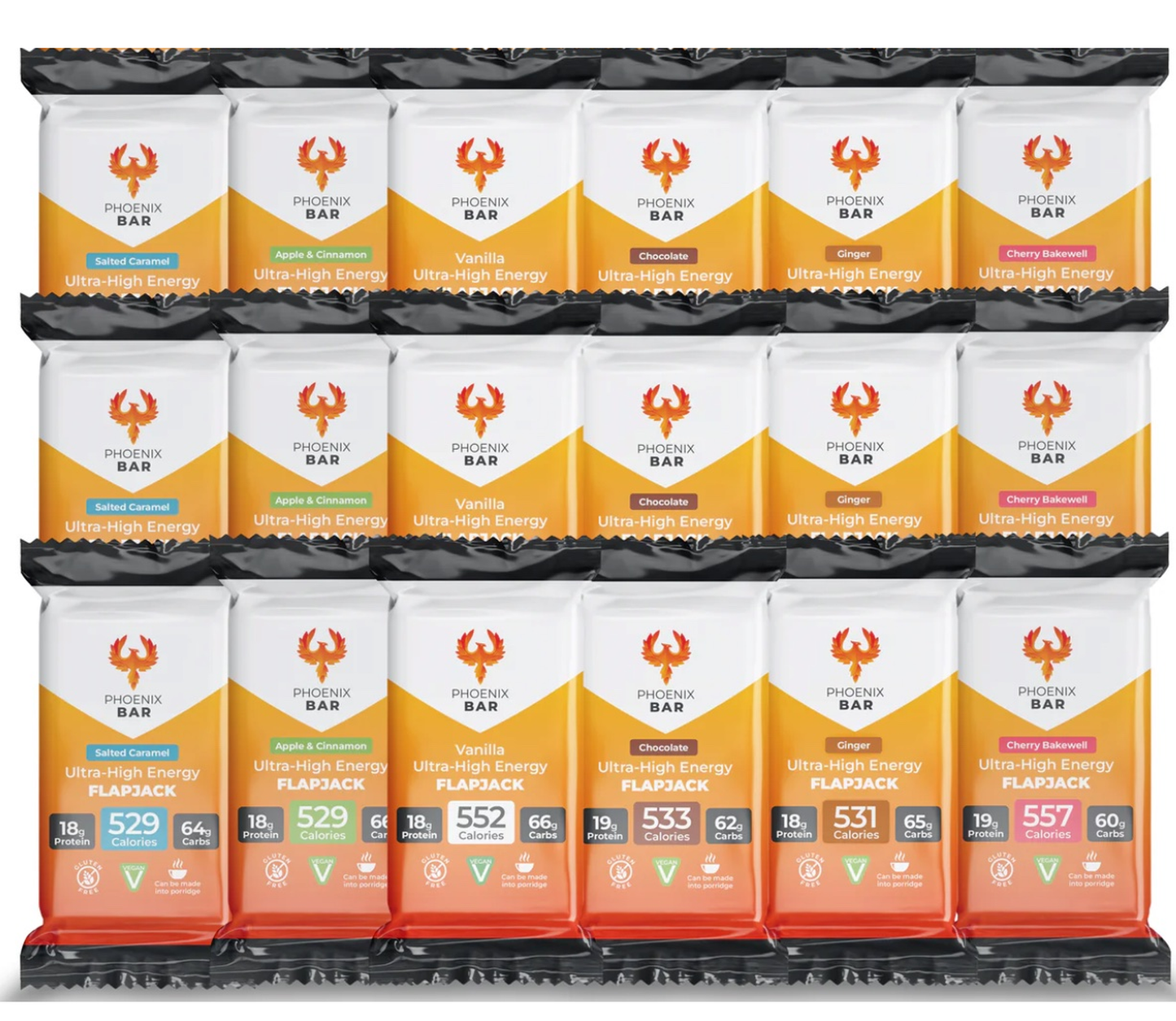
Phoenix Bars: Up to 557 Calories Per Bar
Highly compact, low-volume, calorie-dense bars. Soft, easy to eat whole or as a warm porridge. Vegan, gluten-free and contain up to 66g of carbohydrates, 19g of protein & 8 vitamins & minerals.
The easiest way to hold a surplus
The trick is to remove the effort, so the surplus survives the days you cannot be bothered. A few principles do most of the work:
- Add calories to food you already eat, rather than cooking extra meals. See easy ways to eat more calories.
- Lean on calorie density, so the portions stay manageable. See calorie-dense foods.
- Drink some of the surplus, since liquids are the easiest calories to add. See high calorie drinks and smoothies.
- Keep a no-prep backup for the days you eat least, so the surplus never depends on cooking.
That last point is worth a line of its own. The single most reliable way I know to protect a surplus is to keep a compact, high-calorie option to hand at all times. Each of our high calorie bars is up to 557 calories in a 120g bar, with no preparation, and the same bar can be stirred into hot water or milk to make porridge. It is the kind of fixed, easy option that keeps a tired day from undoing a good week. You can see the range of high calorie bars on the homepage.
If your problem is the opposite, that you fill up long before you reach a surplus, the approach is different and the priority becomes density over quantity. If you want the gym framing of all this, see bulking, and for the broader goal, how to gain weight.
Frequently asked questions
How many calories is a calorie surplus?
A surplus is any amount above your maintenance calories, the level that keeps your weight stable. A practical daily surplus for most people is around 300 to 500 calories. There is no fixed number, because maintenance differs from person to person depending on size, activity and metabolism.
Do I have to track calories to be in a surplus?
Not forever, but it helps to track for a week or two at the start so you know where your real intake sits. After that, the scales over a few weeks tell you whether the surplus is there. Most people who struggle to gain are simply not eating as much as they assume.
Why am I not gaining even though I eat a lot?
Almost always because you are not actually in a surplus across the week. Big days get cancelled out by lighter ones, and the average lands at maintenance. Track honestly for a week and the gap usually appears. The fix is making the extra calories consistent, not occasional.
Is a bigger surplus better for faster results?
No. A large surplus moves faster but is harder to sustain and adds more body fat. A moderate surplus you can hold for months is more effective than an aggressive one you give up on. Consistency over weeks matters more than the size of any single day.
Related guides
For the practical side, see easy ways to eat more calories and calorie-dense foods. For meals across the day, see high calorie meals. For the porridge method and how to eat a bar, see how to use Phoenix Bars.
Written by James Frost, Founder of Flaming Phoenix. James started Flaming Phoenix in 2024 and has spent the years since working out how to get the most calories into the least food, building and testing compact, calorie-dense recipes. He can be reached at jfrost@flaming-phoenix.co.uk. Last reviewed: June 2026.


Flaming Phoenix



Contact Us
Declare withdrawal
Please fill out the following form to declare your withdrawal from the contract.

