

Adventure Racing Nutrition: How to Fuel When the Discipline Keeps Changing
In this guide

Adventure racing is the only endurance sport where your body position, effort intensity, and digestive environment change repeatedly throughout a single event. You run, you cycle, you paddle, you scramble, you navigate, and somewhere in between all of that, you are supposed to eat.
Most endurance nutrition advice is written for single-discipline athletes. Runners fuel like runners. Cyclists fuel like cyclists. Adventure racers need to fuel like both, sometimes within minutes of each other, while also managing the unique challenge of eating in a kayak, on a mountain bike descending singletrack, or while waist-deep in a bog at 2am.
This guide is structured around the disciplines themselves, because the biggest mistake adventure racers make is treating nutrition as one problem when it is actually three or four different problems happening in sequence.
Written by James Frost, founder of Flaming Phoenix.
The Core Problem: Your Stomach Doesn't Switch as Fast as Your Discipline
When you transition from cycling to running, your legs know about it immediately. What most racers do not realise is that your digestive system also has to transition, and it is slower to adapt.
On a bike, your body is relatively stable. Blood flow to the gut is reasonable. You can eat solid food, chew properly, and digest without too much trouble. The moment you start running, blood diverts away from the gut to the working muscles. Food that was sitting comfortably in your stomach five minutes ago can suddenly feel like a brick. Nausea, cramping, and the urgent need to find a bush are all common in the first 20 to 30 minutes after a bike-to-run transition.
Kayaking introduces a different problem entirely. Your torso is compressed. Your core is engaged. The rocking motion of the boat adds a low-level seasickness effect even on calm water. Many racers who can eat perfectly well on the bike and on the run find that their stomach completely shuts down on the water.
This means you cannot have a single nutrition plan for an adventure race. You need a plan for each discipline and, critically, a plan for each transition between disciplines.
How Many Calories You Need
Adventure races range from three-hour sprint events to multi-day expedition races lasting a week. The calorie demands scale accordingly, but the maths is always the same: you are burning far more than you can replace.
For a 6-hour race at moderate to hard intensity, expect to burn 3,000 to 5,000 calories depending on your weight and the terrain. For a 12-hour race, 5,000 to 8,000 calories. For a 24-hour race, 8,000 to 12,000 calories.
Your body can absorb roughly 60 to 90 grams of carbohydrate per hour during exercise, which translates to 240 to 360 calories per hour. That means even with perfect nutrition, you are running a significant deficit in any race longer than about four hours. The goal is to keep the deficit manageable enough that your body can draw on fat reserves and stored glycogen to cover the gap without your performance collapsing.
A realistic target is 200 to 350 calories per hour of racing, adjusted depending on which discipline you are in and how your stomach is behaving.
Discipline-by-Discipline Fuelling
Running Legs
Running is the hardest discipline to eat during. The constant jarring motion, the upright body position, and the high blood flow demand to working muscles all conspire against your digestive system. Most racers find that their food tolerance on the run is roughly half what it is on the bike.
What works: small, frequent bites of soft food that dissolves quickly in the mouth. Bars that can be broken into pieces and nibbled over 20 to 30 minutes. Jelly sweets. Liquid calories from sports drinks. Anything you can eat without breaking stride. My round-up of the best energy bars for ultra running compares the bars ultra runners use for the same problem.
What does not work: large portions eaten in one sitting. Anything that requires significant chewing. High-fibre foods. Anything with a strong flavour that might trigger nausea when you are already working hard.
Timing: eat early and often. Start within the first 30 minutes of a running leg, even if you do not feel hungry. By the time hunger hits on a run, you are already deep in deficit and catching up is very difficult.
Steven Archer used Phoenix Bars during Rat Race's Coast to Coast event in September 2024, which involved 100 miles of running, cycling and kayaking. He said: "They taste great and being packed full of calories they helped carry me to the finish line."
Cycling Legs
The bike is your best eating opportunity in any adventure race. Your body is supported, the motion is smooth, blood flow to the gut is better than on the run, and you usually have more carrying capacity (frame bags, top tube bags, jersey pockets).
What works: almost anything, which is why the bike leg is where you should front-load your calories. Full-size high calorie bars, wraps, sandwiches, flapjacks, nuts, even real food if the pace allows it. This is your window to eat more substantial food that would cause problems on the run.
What does not work: food that requires two hands to unwrap or eat. Anything that crumbles and gets into your eyes on a descent. Food stored in hard-to-reach places.
Timing: aim for the higher end of your calorie target on the bike, 300 to 350 calories per hour, because you know the next discipline will likely reduce your intake. Think of the bike leg as banking calories for later.
Critical point: stop eating solid food 15 to 20 minutes before you expect to transition to running. Switch to liquid calories or easily digestible sweets. This gives your stomach time to clear before the jarring impact of running begins. Ignoring this is a common cause of post-transition nausea in adventure racing.
Kayaking and Paddling Legs
The water section is where nutrition plans go to die. The compressed torso position restricts stomach capacity. The motion of the boat, even on flat water, creates a low-grade nausea that makes eating unappealing. Your hands are wet, which makes unwrapping food difficult. And if conditions are rough, eating becomes impractical.
What works: food that can be eaten one-handed in under 30 seconds. Pre-unwrapped bars stored in a drybag or deck bag within arm's reach. Liquid calories through a hydration tube. Jelly sweets or energy chews that you can pop in your mouth without looking down.
What does not work: anything that requires preparation. Anything stored in a hatch or compartment you cannot reach while paddling. Powdery or crumbly food that absorbs water and turns to paste on wet hands.
Timing: eat before you get on the water, not after. Many racers arrive at the kayak transition, rush to get on the water, and then discover 30 minutes later that they cannot eat in the boat. Eat 200 to 300 calories in the transition area before launching.
Ethan from parOARmedics, who ordered Phoenix Bars for an Atlantic row, highlighted this exact dynamic in August 2024: "They've been particularly great when I've been seasick and they're all I can eat."
Scrambling, Climbing, and Navigation Legs
Some adventure races include technical terrain where both hands are occupied and eating is physically impossible. These sections can last one to three hours and create unavoidable gaps in your nutrition.
The fix is simple: eat before you enter the technical section, not during it. If you know a scrambling or roped section is coming, eat 200 to 300 calories in the 15 minutes before you reach it. Then accept that you will not eat again until the terrain eases.
Tom Livingstone used Phoenix Bars while climbing in Scotland in January 2025: "I ate one before climbing and found myself well fuelled for the next couple of hours."
Mark Pugh used them in the Alps in July 2024 and put it simply: "Perfect for a long day of climbing in the mountains."
The Transition Problem: Where Most Adventure Racers Lose the Race
Transitions decide races on nutrition as well as speed. The 5 to 15 minutes you spend in a transition area, swapping shoes, adjusting kit, consulting maps, is also your best opportunity to eat and drink properly.
Most racers waste this time. They focus entirely on kit and navigation and forget to eat. Then they start the next discipline already behind on calories and spend the first hour trying to catch up, usually unsuccessfully.
Build eating into your transition checklist:
Before you touch your kit, eat 200 to 300 calories. While you are changing shoes or adjusting your pack, drink 300 to 500ml of water or electrolyte drink. Before you leave the transition area, confirm you have food accessible for the next discipline (pockets, top tube bag, deck bag, wherever it needs to be).
This takes 60 to 90 seconds of deliberate action and it is worth more than any amount of fast shoe-changing.
C-J Green ordered and re-ordered Phoenix Bars for Rat Race's 100-mile adventure race in Scotland in October 2025 and noted they were "particularly useful for helping to meet the mandatory kit requirements of carrying 1000 emergency calories." That mandatory calorie requirement exists in many adventure races, and two Phoenix Bars meet it in only 240g.
Flavour Fatigue: The Silent Race-Ender
In a three-hour race, flavour fatigue is not an issue. In a 12-hour race, it starts to matter. In a 24-hour race, it can end your event.
Flavour fatigue is when your body physically rejects a food you have eaten too many times. Your favourite bar that tasted amazing at hour two makes you gag at hour fourteen. Sweet foods become unbearable. The smell of another energy gel is enough to make you feel sick.
The fix is variety and the deliberate inclusion of savoury options. Pack at least three different types of food across sweet, savoury, and neutral flavours. In the second half of a long race, salted nuts, cheese, savoury wraps and crisps become proper race food. My list of the best foods for ultra running has more savoury options that pack well.
Phoenix Bars are deliberately mild in flavour for exactly this reason. Multiple customers have noted this as a strength during long events.
Stephanie Strachan used Phoenix Bars on the Marathon des Sables Legendary in April 2025 and observed: "The taste was great, quite plain in a good way, which meant I didn't experience any flavour or palate fatigue, especially compared to other products I was eating at the time."
Idai Makaya, an experienced ultra-endurance athlete, made the same point in June 2024: "Tastes mild enough to be eaten for days and days without making you sick."
Andrew C said in February 2025: "Mild, not sugary. Can imagine having many before flavour fatigue sets in."
For the full range of six flavours and nutritional information, see the product page.
Packing Food for an Adventure Race: The Discipline-Split Method
Most adventure racers pack all their food into one bag and rummage through it at random. A better approach is to split your food by discipline.
Pre-race bag: your pre-race meal and any food for the first transition. Eat this before the start or leave it at the first transition point if the race allows gear drops.
Running bag: small, soft, individually portioned food that fits in a running vest or waist belt. Bars broken into thirds, energy chews, jelly sweets. Nothing bulky.
Bike bag: more substantial food. Wraps, full bars, nuts, savoury options. Stored in jersey pockets, a top tube bag, or a frame bag where you can reach it without stopping.
Kayak bag: pre-unwrapped food in a small drybag, clipped or tucked where you can reach it one-handed. Liquid calories in your hydration system. Nothing that will dissolve or go soggy if it gets wet.
Transition bag: 200 to 300 calories of easy-to-eat food at each transition point. This is the food you eat before you start faffing with kit.
Emergency reserve: one extra high-calorie bar that stays in your pack for the entire race. This is for real emergencies: wrong turn adding two hours, injury slowing you down, teammate in trouble.
John Beamson made this point in his review in July 2024: "I think Phoenix Bars are an amazing emergency ration to have, considering their long shelf life, compact size, and substantial calorie count. I'll definitely keep one in my bag at all times, just in case."
How Phoenix Bars Fit Into an Adventure Race
Phoenix Bars deliver up to 557 calories in only 120g (Cherry Bakewell flavour, other flavours over 500 calories). They are vegan and gluten-free, which eliminates dietary conflicts in mixed teams. They keep for up to two years, and customers report them coping at both extremes: Shaun Weston found them "Easy to eat, even at -45c" on his South Pole expedition, and Paul Blinstone said they kept their shape in the desert heat of the Marathon des Sables.
For adventure racing specifically, there are three ways people use them.
Broken into chunks for running legs. Break a bar into six to eight pieces before the race and store them in a zip-lock bag in your running vest. Eat one piece every 20 to 30 minutes. This gives you 70 to 90 calories per piece, spread across two to three hours of running without needing to unwrap anything.
Christian Servini, an experienced ultra runner, described this approach in October 2024: "I have never come across something that was so high energy but also easy to eat. I was really impressed with how easy they are to consume on the move, particularly considering how many calories they provide."
As a whole bar on cycling legs. The bike is where you can eat a full bar comfortably. Eat half at the start of the cycling leg and half midway through. This banks 500+ calories during the discipline where your stomach is most cooperative.
As porridge in transitions. Add water and stir for 60 seconds. This creates a calorie-dense meal in a mug that you can eat in a transition area.
For more on the different ways to use Phoenix Bars, see How to Use Phoenix Bars. For general principles of fuelling ultra-endurance events, see the Ultra-Endurance and Expedition Nutrition Guide.
Frequently Asked Questions
How do I carry food during the kayaking leg?
A small drybag clipped to your spraydeck or wedged between your legs works best. Pre-unwrap everything before you get on the water. Some racers tape bars to their paddle shaft for easy access, though this only works with waterproof-wrapped food. If you use a hydration pack on the water, mix carbohydrate powder into it so you are getting calories through your hydration tube without needing to stop paddling.
Should I eat differently for a sprint race versus a 24-hour race?
For races under four hours, your glycogen stores plus a good pre-race meal will carry most of the load. Top up with 30 to 60 grams of carbohydrate per hour from easy sources like gels, sweets, or sports drinks. For races over six hours, you need real food, savoury options, and a plan for flavour fatigue. For 24-hour races, plan as if you are eating meals on the move: breakfast, lunch, dinner, and snacks, just in smaller portions and more frequently.
What if I cannot eat during the kayak section?
This is common. If your stomach shuts down on the water, do not force it. Switch to sipping a carbohydrate drink through your hydration tube. Aim for 150 to 200 calories per hour through liquid alone. Then eat aggressively in the transition after you get off the water, before you start the next discipline.
How do I manage food for a team?
In team races, designate one person as the nutrition monitor. Their job is to remind the team to eat at regular intervals and to check that everyone has accessible food before each discipline starts. It is easy for a strong navigator or a fast paddler to forget to eat entirely because they are focused on the race. Teams fall apart when one member bonks, and it is almost always preventable.
What about caffeine?
Caffeine does improve performance in adventure racing, but time it carefully. Use it in the second half of the race, not the first. A caffeine gel, a coffee in a transition area, or a caffeinated sports drink can provide a significant lift during the 12 to 18 hour mark when fatigue is at its worst. Do not use it early or you will build tolerance and lose the boost when you need it most.
Is there a minimum food requirement for adventure races?
Many races require you to carry a minimum number of emergency calories as part of mandatory kit, typically 500 to 1,000 calories. A single Phoenix Bar meets a 500-calorie emergency requirement in one bar, which simplifies your kit check and saves pack space.
About Flaming Phoenix
Flaming Phoenix makes Phoenix Bars, high-calorie nutrition bars delivering up to 557 calories in a small, soft 120g bar (Cherry Bakewell flavour, other flavours over 500 calories). They are vegan, gluten-free, and have a shelf life of up to two years. Phoenix Bars are manufactured in the UK by a SALSA-certified facility.
Flaming Phoenix was founded by James Frost after approximately 150 conversations with endurance athletes and people who struggle to eat enough. Phoenix Bars have been used on Everest, at the South Pole, across the Atlantic, on Rat Race's Coast to Coast, and by over 150 Marathon des Sables runners. Phoenix Bars are rated 4.9 out of 5 from 391 reviews, all published on the reviews page.
For the full range of flavours and nutritional information, visit the product page.
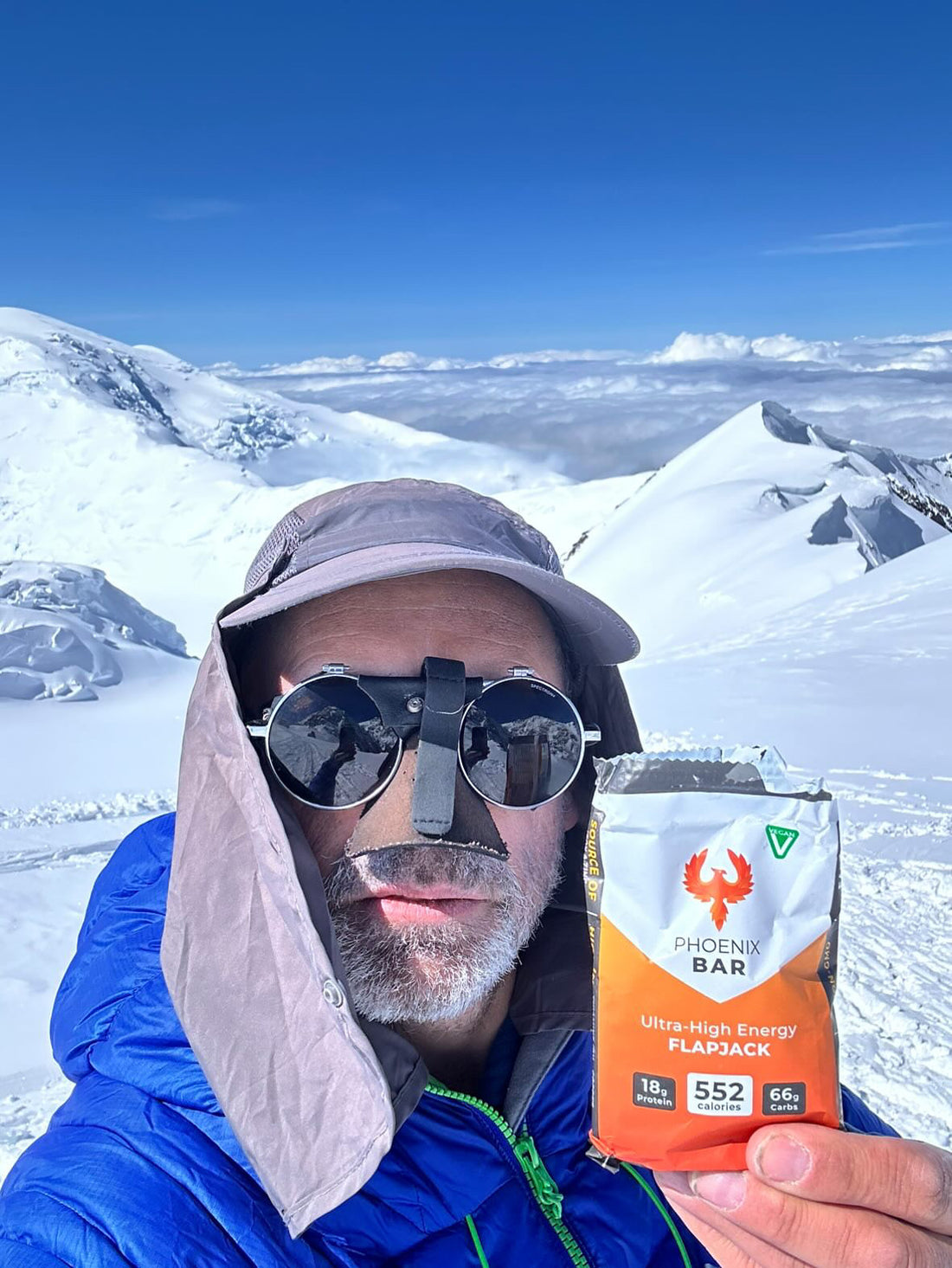
Big calories. Small bar.
Up to 557 calories in a compact, lightweight bar of only 120g, with up to 66g of carbs and 19g of protein. Eat it whole, break it into pieces over a few hours, or mix it with water or milk for porridge.
Easy to eat, easy to digest and not sickly sweet. Customers have eaten them at -45°C and through the heat of the Marathon des Sables, and they keep for up to 2 years, so they work on a mountain, on a night shift, or at home on days when eating enough feels hard.
- 557 calories in only 120g (529 to 557 by flavour)
- 4.6 calories per gram
- 66g carbs per bar (up to)
- 19g protein per bar (up to)
