

Ultra marathon kit list: the mandatory kit, explained item by item
In this guide

 Written by James Frost, founder of Flaming Phoenix. Updated October 2026.
Quick answer: Most UK ultras ask for the same core kit: a waterproof jacket with sealed seams, a spare warm layer, hat, gloves, a survival bag or blanket, a whistle, a charged phone, two lights for any night running, a cup, 1 litre of water capacity and often emergency food. Your race's own list is the one that counts.
This page goes through each item, puts two real UK kit lists side by side, explains how kit checks work and what happens when you fail one, and covers what runners carry beyond the list. Flaming Phoenix makes Phoenix Bars, which many runners carry as their emergency food, so I say where they fit and what else does the job. I spoke at a Marathon des Sables expo in 2025, and food is the part of the kit list I know best.
What is mandatory kit for an ultra marathon?
It is the list of items a race makes you carry so that a runner who stops, through injury, exhaustion or a wrong turn, can stay warm, be found and call for help until someone reaches them. Ultras are long enough for the weather to turn and for a twisted ankle to mean hours standing still on an exposed hill, which is why most race directors set a list and check it.
Lists differ more than people expect. The table compares the 2025 rules for Centurion Running's Autumn 100, a 100-mile trail race in south-east England, with the kit list for The Lap, a 72km (47 mile) signposted loop of Windermere in the Lake District. Both were checked in October 2026.
| Item | Centurion Autumn 100 (2025) | The Lap, Windermere (2026 and 2027) |
|---|---|---|
| Waterproof jacket | Gore-tex or similar, at least 10,000mm, sealed seams | Breathable, with a hood and factory-taped seams |
| Waterproof trousers | Not on the list | Required, factory-taped seams |
| Spare warm layer | Long-sleeved base layer or fleece, carried dry and separate from what you start in | Long-sleeved technical top, fleece or light synthetic or down jacket |
| Hat and gloves | Beanie or Buff, and gloves | Hat or Buff, and full-finger gloves |
| Emergency shelter | Survival blanket, at least 1.4m x 2m | Heat-reflective bag; a foil blanket does not count |
| Lights | Head torch or main light of at least 100 lumens, plus a backup light of at least 100 lumens | Head or chest torch plus a spare torch; spare batteries and power banks no longer allowed |
| Phone | Charged, with the race medic and race director numbers | Charged, with the organiser's number; not for navigation |
| Water | At least 1 litre | At least 1 litre |
| Cup | Cup or mug | Not listed, but no cups at aid stations |
| Emergency food | Not on the list | At least 500 kcal, still with you at the finish |
| Also required | Whistle | Whistle, compass, supplied map, basic first aid kit, cash (£20 suggested), race GPS tracker |
| Missing an item | One hour penalty per item; refusing a check means disqualification | Instant DNF |
The Lap's list is longer and enforced harder: Centurion adds an hour to your time per missing item, while at The Lap a missing item ends your race. Read the manual for your own event, and read it again the week before, because some races add items when the forecast is poor.
The Lap kit list in brief
The Lap is run in both directions: anticlockwise on 12 September 2026 and clockwise on 8 May 2027, with 24 hours to finish (event site). Four things on its list catch people out. You need factory-taped waterproof trousers as well as a jacket. The survival item must be a proper heat-reflective bag, not a foil blanket or plastic bag. A phone or watch does not count as your compass. And the organisers no longer accept spare batteries or a power bank in place of a second torch. The leading finishers have their bags checked at the finish.
The mandatory core, item by item
Most items on a UK list fall into six groups. Each one is there for the stopped-runner scenario, so judge your choice by one question: would this keep me warm and findable if I could not move for two hours?
Waterproofs
A shower-resistant or windproof shell does not pass. Centurion asks for a fabric rated at 10,000mm or more with sealed seams, and its kit explainer says plainly that a jacket without sealed seams will not keep you dry. The Lap also wants a hood and factory-taped trousers. Many hill races ask for trousers; many trail races in the south-east do not.
Spare warm layer, hat and gloves
The spare layer is for emergencies, so it has to be separate from what you start in and stay dry in a bag. Centurion is explicit that starting in two tops does not count. Gloves earn their weight late at night: cold hands cannot open food, zips or a phone. The Lap specifies full-finger gloves.
Survival bag or blanket
A bag you can climb into keeps the wind off far better than a sheet you have to hold round you. Centurion accepts a blanket of at least 1.4m x 2m; The Lap only accepts a heat-reflective bag.
Lights
For any race where some of the field will be out after dark, expect two independent lights. Centurion sets a 100 lumen minimum for both, and neither race accepts a phone as a light. Your main torch should be bright enough to run downhill on rough ground at 3am, not only to be seen.
Phone, whistle and map
Carry the phone charged, switched on and in a waterproof bag, with the race numbers saved. If you need help on the hill, the British Mountaineering Council's advice is to dial 999 and ask for the police, then mountain rescue, and the distress signal is six blasts on a whistle, or six torch flashes, repeated every minute (BMC: mountain incidents). Many race vests have a whistle built into the chest strap.
Water and a cup
A litre of capacity is the usual minimum. Centurion's aid stations range from just over 3 miles to 12 miles apart, and a slow, rocky 10km between checkpoints can take far longer than its distance suggests. Neither race hands out cups, so a soft folding cup lives in a vest pocket; a heat-resistant mug is worth adding if you want hot soup at night.
How much emergency food do you need to carry?
Carry whatever minimum your race states, sealed, separate from your race food and still in your vest at the finish. The Lap's minimum is 500 calories. Some races, Centurion's Autumn 100 among them, do not list emergency food at all; carrying some anyway costs you very little weight.
It is easy to get wrong in two ways: treating it as a bag of jelly sweets you never think about, or eating it at mile 40 because your race food ran out. The neat answer is one dense item that covers the number on its own and packs small enough to forget. The table shows what 500 calories of common emergency food weighs, using CoFID values for the supermarket foods (McCance and Widdowson's tables) and our own label for Phoenix Bars.
| Emergency food | Calories per 100g | Weight for 500 calories |
|---|---|---|
| Roasted salted peanuts | 602 | 83g |
| Milk chocolate | 519 | 96g |
| Phoenix Bar, any flavour | 441 to 464 | One bar, 120g (529 to 557 calories) |
| Shop-bought flapjack | 434 | 115g |
| Cereal bar, fruit and nut | 354 | 141g |
| Fruit gums or jelly sweets | 324 | 154g |
Every Phoenix Bar flavour clears a 500 calorie minimum on its own: up to 557 calories in only 120g, in a wrapper a marshal can read at kit check. They keep for up to two years (Cherry Bakewell 12 months), so one can stay in the vest between races. Sabrina Amy, training for the Arc of Attrition, wrote: "Love the fact that 1 single bar meets the emergency calorie requirement of the essential kit list for my distance (c500kcal)." Our guide to the best energy bars for ultra running compares other bars by calories, which is the number kit check cares about. Whatever you choose, seal it and treat it as kit, not food, until the day you need it.
What race food should you carry beyond the mandatory list?
Your race food is a separate job from the emergency ration, and it is where most ultras are won or lost. A plan built on gels alone is a common way to come unstuck: after several hours of sweet gels, plenty of runners cannot face another. Carry a mix that includes solid food from the start, plus a plan B for when plan A stops going down; our guides to energy gel alternatives and ultra high carb solid foods cover the options, and first ultramarathon nutrition sets out how much to eat each hour.
Put the food you should be eating in the front pockets, where you will actually reach for it. Mike Williams, after the 5 Valleys Ultra, said of Phoenix Bars: "I couldn't find any other bar that had a better calorie-to-weight ratio, so these were great for packing in my run vest with all of the mandatory kit."
What do experienced runners add?
Anti-chafe balm and a strip of tape, spare socks for anything long and wet, poles where the race allows them and the climbing justifies them, sun cream and a cap for exposed summer courses, and some cash for a café or a taxi if you drop. None of it is usually on the mandatory list, and all of it is worth a place in the vest on a long day.
What goes in a drop bag?
Where a race offers drop bags: dry socks and shoes, a full warm change for the night, a charging cable, and real food you will want, not more of what is already failing in your vest. Our list of the best foods for ultra running has ideas for the late stages, and the drop bag and aid station guide covers packing and timing in full.
How do kit checks work?
Expect a check at registration and possibly more on the course or at the finish. Centurion's rules say there will be checks before the race and potentially during and after it. The Lap checks at registration, targeting items according to the forecast, can spot-check anywhere on the route, has asked mountain rescue teams to check kit if they attend, and checks the top finishers' bags at the end.
Lay everything out against the race manual a week before, not the night before. Put each item in the same pocket every race so your hands know where it is. Then train with the vest loaded to race weight a few times, because a list you have never run with tends to show you where it rubs at mile 30.
The condensed ultra kit list
Use this as a checklist, then tick it against your own race's manual.
- Waterproof jacket with sealed or taped seams (and trousers where required)
- Spare long-sleeved warm layer, kept dry and separate
- Warm hat or Buff, and gloves (full-finger where specified)
- Survival bag or blanket of the type your race accepts
- Head torch and a second light; check whether spare batteries count
- Charged phone with race numbers saved, in a waterproof bag
- Whistle, and a map and compass where required
- At least 1 litre of water capacity and a folding cup
- Sealed emergency food that meets the stated minimum
- Basic first aid and blister kit, and cash
- Race food in the front pockets, plus a plan B
Ultra kit list: common questions
Do all ultras check kit? Most UK trail ultras check at registration and keep the right to check again on the course or at the finish. Penalties range from an hour per missing item at Centurion's Autumn 100 to an instant DNF at The Lap, so assume you will be checked and pack the full list every time.
What counts as emergency food? Sealed food, separate from your race nutrition, that meets your race's stated minimum and is still with you at the finish. At The Lap that is at least 500 calories. One of the denser high calorie bars covers it in one item; 83g of salted peanuts or 96g of milk chocolate would too.
What happens if you fail a kit check? It depends on the race. Centurion gives a one hour penalty for each missing item and disqualifies anyone who refuses a check; The Lap treats missing kit as a DNF. It is the easiest DNF in the sport to avoid.
Can a phone count as your head torch or backup light? Not at either race in the table. Centurion says a phone is not acceptable as a primary or backup light, and The Lap says the same about a phone light at feed stations after dark. Carry two proper torches.
What size race vest do I need? Pack your race's full list into it before you buy. A short summer list for a well-supported race often fits a small vest of around 5 litres; a winter or fell list with waterproof trousers, a warm layer and more food usually needs a bigger one. Choose the one that bounces least when loaded, then train in it.
Sources: Centurion Running: Autumn 100 2025 rules and mandatory kit; Centurion Running: why we ask for mandatory gear; The Lap: kit list; The Lap: event information; British Mountaineering Council: mountain incidents, what to do; McCance and Widdowson's Composition of Foods Integrated Dataset.
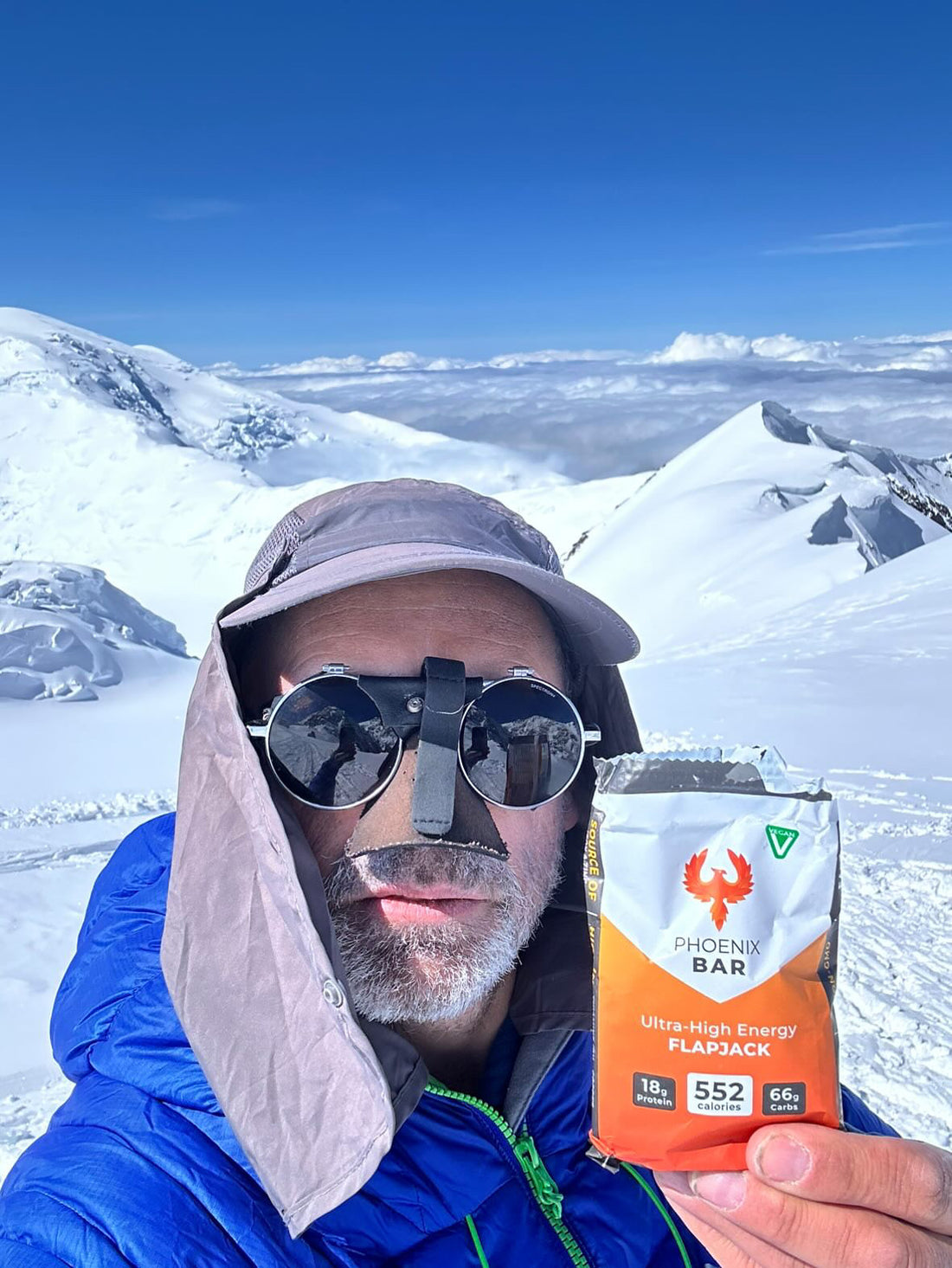
Big calories. Small bar.
Up to 557 calories in a compact, lightweight bar of only 120g, with up to 66g of carbs and 19g of protein. Eat it whole, break it into pieces over a few hours, or stir it into hot water or warm milk for porridge.
Easy to eat, easy to digest and not sickly sweet. Customers have eaten them at -45°C and through the heat of the Marathon des Sables, and they keep for up to 2 years, so they work on a mountain, on a night shift, or at home on days when eating enough feels hard.
- 557 calories in only 120g (529 to 557 by flavour)
- 4.6 calories per gram
- 66g carbs per bar (up to)
- 19g protein per bar (up to)
Declare withdrawal
Please fill out the following form to declare your withdrawal from the contract.

