
100-Mile Ultramarathon Nutrition: How to Fuel a Hundred
By James Frost, founder of Flaming Phoenix. I make dense, no-fuss food for exactly this kind of effort, and I have spent years talking to the runners who carry it through hundred-milers about what works at hour four and what works at hour twenty-six. I am not a coach or a dietitian, and a plan built with one for your body and your race will always beat a general guide, but this is the practical version. Last reviewed June 2026.
A hundred-mile race is not a longer marathon you can grit your way through, and it is not a 50k with more miles bolted on. It is the first distance where you physically cannot eat enough to cover what you burn. Studies of mountain hundred-milers put the cost at roughly 15,000 to 16,000 calories, and even strong finishers tend to take in only about half of that, crossing the line with a deficit of several thousand calories. You burn somewhere between 600 and 1,000 calories an hour and your gut can absorb perhaps 200 to 400, so the shortfall is built into the event. That changes the goal. You are not trying to replace what you burn, because you can't. You are trying to keep the deficit small and steady enough that you never run the tank dry, and most people fail at that not in the closing miles but in the first quarter, when they feel great and quietly under-fuel. Fuel from the start, aim for 60 to 90 grams of carbohydrate an hour in small regular amounts, and change what you eat as the race changes you. This guide walks through how, phase by phase.
The maths you cannot beat
It is worth sitting with the numbers, because they dictate everything else. Your body stores only about 90 minutes of hard-running fuel as glycogen, after which you depend on what you eat plus your fat stores. Across a whole hundred you will burn around fifteen thousand calories and absorb maybe half, which is normal and not a failure, but it means the race is a managed deficit rather than a balanced one. The research on who finishes is blunt about where it goes wrong: successful runners tend to take in roughly 65 to 80 percent of what they burn each hour, while those who drop out usually slip below half by the middle of the race, and the damage is done in hours four to eight rather than in some dramatic final collapse. So the target is not to feel full. It is to delay depletion, keep your blood sugar and your spirits up, and never let the deficit run away from you. Everything that follows is in service of that.
The first quarter: fuel before you need it
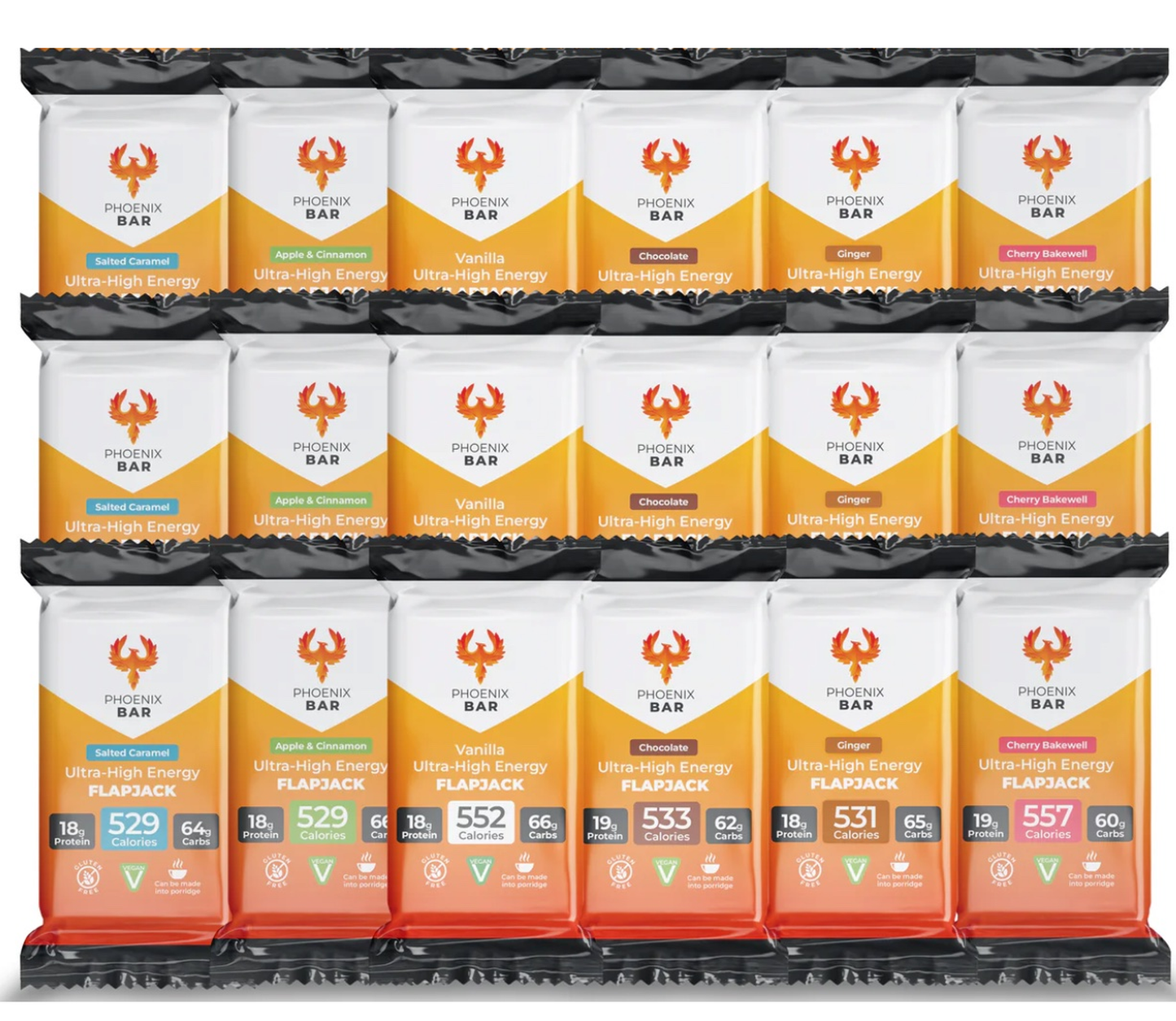
The opening miles are where hundreds are quietly lost, because you feel fantastic and food is the last thing on your mind. This is a trap. Start eating within the first half hour, before you are hungry, and hold to a steady 60 to 90 grams of carbohydrate an hour in small amounts every twenty to thirty minutes. Your gut works best now, while you are fresh and cool and the pace is easy, so this is when to bank calories that you will not be able to take on later. Resist the urge to push the pace, too, because going out hard both burns through your glycogen faster and starts shutting down your gut early. Dense, easy food that you barely have to think about works best here, the same low-bulk carbohydrate logic covered on the ultra-high-carb solid foods guide. A Phoenix Bar eaten cold and broken up on the move puts up to 557 calories in your hand in a small package, which is a lot of banked energy for very little stomach load, and that energy-to-volume ratio is exactly what you want when the aim is calories without bulk, as the calorie-dense foods guideexplains.
The long middle and the heat of the day
The middle of a hundred is a metronome: keep the same steady intake going, hour after hour, long after it has stopped being interesting. Two things tend to break the rhythm. The first is flavour fatigue, the point where your chosen fuel becomes genuinely unappealing, which is why variety across sweet and savoury matters and why I make six flavours rather than one. The second is the heat of the day, which for many runners is when the stomach first turns, often somewhere around the middle of the race. The fatal mistake is to stop fuelling because nothing sounds good, because that is the moment the deficit starts running away and the spiral begins. If your stomach is rebelling, the fix is to ease off, cool down, and switch what you are asking it to do rather than quit, which is covered in full on the mid-race nausea and appetite loss guide. Lean on savoury and real food, take smaller bites more often, and keep something going in even when it is a chore. This is also where having stashed the right food in your drop bags pays off, because the food that appeals at mile sixty is not the food that appealed in your kitchen the night before.
The night
The night section is where hundreds are won and lost. As the temperature drops and the hours stack up, your appetite craters further, sleepiness sets in, and everything feels harder. Two rules carry you through. First, eat on a schedule, not on hunger, because hunger has left the building and will not return until you stop. Second, go warm. A hot drink and warm food lift both your core temperature and your morale, and this is where a bar stirred into a warm porridge with hot water at an aid station earns its place, soft and easy and comforting when a cold solid is the last thing you want. There is a quick guide to both methods on how to use Phoenix Bars. A little caffeine helps with alertness, small bites beat big efforts, and if solids will not go down at all, liquid calories will. If your race climbs high, altitude flattens appetite and gut function further, which is its own discipline on the high-altitude mountaineering guide. The runners still moving well at dawn are almost always the ones who kept feeding themselves through the dark.

Phoenix Bars: Up to 557 Calories Per Bar
Soft, easy to eat whole or as a warm porridge. Low volume, two-year shelf life.
The final push
By the closing miles you are running on fumes and your gut may be wrecked. Sweet gels are usually finished as an option, and the strategy narrows to whatever still goes down: flat cola, broth, a few salty bites, a few spoonfuls of warm porridge, small amounts as often as you can manage. Do not aim for your earlier targets here, just keep a trickle of calories and fluid going to hold off the worst of the bonk and protect your decision-making to the line. Calories are courage at this stage, and a small win, a hundred calories you did not think you could take, can be the difference between shuffling and stopping. The case for real food over gels late in a race is on the energy gel alternatives guide, and the broader picture is on the ultra-endurance and expedition nutrition guide. If you fuel plant-based, the fibre and calorie-density angles deserve a read on the vegan endurance nutrition guide, and for staged races run over several days with sleep between them, which are a different problem, see the multi-day ultra running guide.
After the line
Finishing leaves you with a large deficit to repay and a body that has taken a real beating, especially from the descending. You usually have a short window before exhaustion drops you into sleep, so use it: get easy carbohydrate and a little protein in, plus fluids and electrolytes, even if your appetite has not woken up yet. Then keep refuelling steadily over the following days, because a deficit of several thousand calories is not cleared in one meal, and this is recovery rather than weight management. A bar or a warm porridge is an easy first thing to get down when nothing else appeals, and a steady run of small, calorie-dense meals over the next few days does more for how you feel than one big plate ever will.
Common questions
How many calories do you burn in a 100-mile race? Roughly 15,000 to 16,000 in a mountain hundred, depending on your size, the climbing, and your time on feet. It is one of the highest single-event energy costs in endurance sport.
How much should I eat during a 100-miler? You cannot match what you burn, so aim to minimise the deficit rather than close it: around 60 to 90 grams of carbohydrate an hour, roughly 200 to 400 calories, taken in small amounts every twenty to thirty minutes from the start. Staying above about half your hourly burn is the rough line between finishing strong and falling apart.
Why do so many people drop out of 100-milers? More often than not it is nutrition, not fitness. The cumulative energy deficit builds in the first half while runners feel fine and under-fuel, then a turned stomach or flavour fatigue mid-race makes them stop eating, and the deficit runs away. Runners who keep feeding the deficit are the ones who finish.
What should I eat at night during a 100? Eat on a schedule rather than waiting for hunger, lean on warm food and a hot drink for morale and core temperature, use a little caffeine for alertness, keep bites small, and switch to liquid calories if solids will not go down. A warm porridge made from a bar is a useful night-section option.
Why do gels stop working late in a race? A mix of flavour fatigue and a gut tired of concentrated sugar after many hours. The fix is variety planned in advance and a shift toward real, savoury, and liquid options as the race goes on.
Are Phoenix Bars good for a 100-miler? Yes. Each 120g bar carries up to 557 calories of real, low-bulk food, so it banks energy without loading your stomach, it comes in six flavours to beat flavour fatigue, it can be eaten cold early or made into warm porridge at night, and because it keeps for two years and does not melt, it stocks drop bags well. To build a rotation, the 12-bar Starter bundle lets you test flavours in training, while the 18-bar Essential and 36-bar Complete box cover a full race and its drop bags.
The one idea to carry to the start line is that you cannot out-eat a hundred, so the race is really a long exercise in managing a deficit you can never close. Fuel early while it is easy, hold the rhythm through the heat, feed yourself through the night when every instinct says not to, and keep a trickle going to the line. The runners who finish are rarely the most talented. They are the ones who kept eating when it stopped being fun. If you want to go further, the drop bag and aid station guide and the mid-race nausea guide are the natural next reads, and a mixed-flavour Starter bundle is the simplest way to find what your stomach will still accept at hour twenty.


Flaming Phoenix



Contact Us
Declare withdrawal
Please fill out the following form to declare your withdrawal from the contract.

