

Denali Expedition Food: Sled, Backpack, Summit Day Fuel
In this guide

 By James Frost, Founder of Flaming Phoenix. Phoenix Bars have been used on Arctic and polar expeditions, Marathon des Sables, Aconcagua, and ocean rows. They've been carried to the summit of Everest.
Last updated: May 2026
The short answer
Denali at 6,190m / 20,310ft is the coldest major commercial peak in the world, sitting at 63°N latitude where the atmospheric pressure makes the effective altitude feel like 7,000m+. Temperatures at the 17,200ft High Camp routinely hit minus 40°F. Most food you'd take to Aconcagua or Everest fails here.
Food planning for Denali is fundamentally a two-stage problem. Below 14,200ft you're hauling supplies on plastic sleds, so calorie density per gram matters less. Above 14,200ft it's all backpack carries, and every gram is judged. The smart provisioning split makes use of this contrast.
You'll burn 4,000 to 6,000 calories per day on normal climbing days and 8,000+ on summit day. Your operator (if you have one) will provide group breakfasts and dinners; lunch and snacks are 100% on you across all 17 to 21 days. The personal-pack list is where most Denali attempts fail nutritionally.
Below I set out the two-stage plan, then what still works at minus 40°F and how many bars to pack. For climbers comparing Denali to other expedition peaks, see the Aconcagua nutrition guide (warmer, longer, lower altitude) and the High Altitude Mountaineering pillar for general principles.
Why Denali is the coldest food planning problem in mountaineering
Denali punishes food choices in ways most climbers don't expect until they're on the mountain.
Latitude effect. At 63°N, atmospheric pressure is significantly lower than at the same altitude near the equator. Climbers consistently report Denali "feels" like a 23,000ft peak rather than its 20,310ft height. Appetite suppression and digestive issues kick in earlier than on Aconcagua or Kilimanjaro, both of which sit much further south.
Sustained extreme cold. High Camp at 17,200ft routinely sees minus 20°F to minus 40°F. Wind chill on summit day can push effective temperatures below minus 60°F. This is colder than any commercial Aconcagua or Kilimanjaro climb and on par with mid-Antarctic conditions, but compressed into a 17 to 21 day expedition. The cold-stability filter for food is harsher than almost anywhere else.
Self-supported food planning. Above Kahiltna Base Camp at 7,200ft, every calorie is carried, cached, and re-carried by you and your team. Operators provide group breakfast and dinner, but lunch and on-the-move snacks are 100% personal pack. There's no resupply, no operator catering at higher camps, and no shortcuts.
The variety problem over 21 days. Operators provision in 5-day food bags. By day 12 to 15, most climbers experience flavour fatigue and start under-eating, which compounds with altitude appetite suppression. The food plan has to fight monotony from the start.
For climbers who've done sub-zero expeditions on similar terrain, Denali sits between Greenland Crossing Food (slightly warmer, similar duration, ski-focused) and Antarctica Crossing Food (similar cold, 3 to 4 times longer).
The two-stage strategy: sled mountain vs backpack mountain
Operators rarely spell it out, but the route itself splits your food planning in two at 14,200ft.
Stage 1: The sled mountain (Base Camp to 14,200ft, days 1 to 8 to 10). From the Kahiltna Base Camp landing strip up through the lower glacier, 11,200ft Camp, and into the 14,200ft Camp (also called Camp 3 or "ABC", Advance Base Camp). On this stage you're hauling 50 to 80lb of group and personal gear on plastic sleds plus carrying a 40 to 50lb pack. The sled does most of the weight-bearing work, so calorie-to-weight ratio matters less. You can afford slightly heavier, more varied, more comfort-oriented foods.
Stage 2: The backpack mountain (14,200ft to summit and back, days 8 to 18+). Above 14,200ft Camp the route gets steep enough that sleds become impractical. Everything goes on your back. Pack weight rises to 50 to 65lb. Calorie density per gram becomes the critical variable. Up here, dense high calorie bars pay their way. Phoenix Bars carry up to 4.6 calories per gram, against the 1 to 2 cal/g of the bagel-and-cheese lunches that work fine on the lower mountain.
The smart provisioning split puts variety-rich foods on the lower mountain (bagels, tortillas, smoked salmon, fresh cheese, salami, dried fruit, candy) and switches to high-density solids and easy-cook hot meals above 14,200ft. A typical 21-day provisioning has 60% of food weight planned for Stage 1 (in calories) and 40% for Stage 2, even though Stage 2 is shorter, because Stage 2 calorie density is higher.
For the underlying logic of why solid bars beat real-food alternatives when weight matters, see Ultra High Carb Solid Foods.
Calorie demand by stage
The 2 lb/day, 3,500 to 4,000 cal/day numbers most Denali operators quote are based on 1990s-era research and are below modern targets.
Stage 1 (sled mountain) calorie burn: 4,000 to 5,500 cal/day on carry days, 3,000 to 4,000 on rest days. The sled does the brutal work; you're moving slowly with frequent rests.
Stage 2 (backpack mountain) calorie burn: 5,000 to 6,500 cal/day at 14,200ft, rising to 6,000 to 7,000 cal/day at 17,200ft High Camp due to thermoregulation costs.
Summit day calorie burn: 8,000 to 10,000 cal/day for the 12 to 15 hour push from 17,200ft to the 20,310ft summit and back. This is comparable to Aconcagua summit day, with the added cost of more sustained sub-zero exposure.
Realistic intake: most climbers consume 50 to 70% of burn above 14,200ft. The calorie deficit accumulates day by day. Weight loss of 3 to 8kg over a 21-day Denali expedition is normal and unavoidable. The goal is to keep the deficit survivable, not to eliminate it.
Food planning for Stage 1 (the sled mountain)
Days 1 to 10 cover the approach from Kahiltna Base Camp at 7,200ft up through the lower glacier, 11,200ft Camp, and into 14,200ft Camp. This is where you eat well, build calorie reserves, and stockpile body weight before altitude appetite kills your eating.
Group meals (operator provided if you're guided). Breakfast and dinner are typically cooked communally. Standard fare: oatmeal with butter and milk powder, eggs and bagels, pasta with sausage and cheese, freeze-dried mains supplemented with extras. Calorie totals: 1,200 to 1,800 for breakfast, 1,500 to 2,500 for dinner. If you're climbing unsupported, see How To Use Phoenix Bars for the porridge format that gives you a breakfast of up to 557 calories in 2 minutes from a single Phoenix Bar plus water.
Lunch and on-the-move snacks (100% personal pack). This is your job, no matter which operator you're with. The standard Stage 1 lunch list, refined over decades on Denali: bagels with cream cheese and salami, tortillas with peanut butter and honey, hard cheese (cheddar, Gruyère, pepper jack), Stroopwafels, GORP mix, smoked salmon (it doesn't spoil in Denali cold), dried fruit, chocolate bars, hard candies, energy bars, Phoenix Bars, Pringles, corn nuts, jerky.
Calorie target for personal pack on Stage 1: 2,500 to 3,000 cal/day from your own snacks, on top of the operator-provided 2,700 to 4,300 cal from group breakfast and dinner. Total daily intake on Stage 1: 5,200 to 7,300 cal/day, which most climbers can hit because appetite is still relatively normal at lower altitudes.
The sled-mountain Phoenix Bars role: 1 to 2 bars per day as the high-calorie, cold-stable backbone of your snack rotation. The Essential Bundle at 18 bars covers most climbers for Stage 1.
Food planning for Stage 2 (the backpack mountain)
Above 14,200ft Camp, the calculus changes. Days 11 to 21 cover the move to 17,200ft High Camp, the summit attempt, and the descent. Pack weight matters now. Appetite drops. Cold gets serious.
Group meals shrink. Above 14,200ft, breakfast and dinner are still typically operator-cooked but get simpler and more carb-heavy: instant porridge, freeze-dried meals, soups, hot drinks. You'll be cooking on stoves with limited fuel, often inside the tent due to wind. Cooked meals deliver 1,500 to 2,500 cal/day combined, less than on Stage 1.
Personal pack becomes more critical, and harder to eat. Above 14,200ft, taste perception dulls, nausea increases, and most snacks freeze solid. The lunch list that worked on Stage 1 fails here. Bagels turn to bricks. Cheese becomes brittle. Chocolate fractures like glass. Most energy bars go rock-hard too, which is why cold performance weighs so heavily when we rank the best energy bars for expeditions.
What still works above 14,200ft: Phoenix Bars (formulated to stay soft at sub-zero), butter and oils kept inside body layers, hard candies, glucose tablets, Stroopwafels (just), peanut butter (slow), gels (kept in inner pockets only, see Energy Gel Alternatives for why this format is barely workable on Denali). Almost everything else needs thawing in the tent.
Calorie target on Stage 2: aim for 5,000 to 6,000 cal/day total intake. Realistic intake is 3,500 to 4,500. The gap is unavoidable.
The high-camp Phoenix Bars role: 2 to 3 bars per day, kept in inner jacket pockets to prevent freezing, broken into pieces the night before so you can eat them with gloves on. Salted Caramel and Ginger flavours specifically reset taste fatigue when sweet bars and conventional snacks have stopped working around day 12 to 15. Pack a few more of these two than you think you need. Order these as a flavour mix from the Complete Bundle (36 bars, 6 of each flavour).
Summit day pack list at minus 40°F
Summit day on Denali is 12 to 15 hours of climbing in temperatures from minus 20°F at the start to minus 40°F or colder near the summit ridge with windchill. Anything left in an outer pocket will be frozen long before Pig Hill.
Calorie target: 2,500 to 3,500 cal from your personal pack. Expect to get 1,500 to 2,500 of it down, so pack more than you'll eat.
Three to four Phoenix Bars in inner jacket pockets, kept warm against the body. Up to 2,228 calories for four bars. Break them into 6 pieces each the night before so you can eat one piece at every rest stop without removing gloves. Phoenix Bars stay soft below freezing, which is why they go in the summit-day pocket while the Clif bars stay at High Camp.
One thermos of hot sugary drink (500 to 700 calories with added milk powder, butter, or honey). Cold water freezes; thermos drinks stay liquid. Fill it at High Camp just before you leave.
Two to three energy gels for the Pig Hill and summit ridge sections when chewing is too much effort. Keep them in the same inner pocket as the bars to prevent freezing. Gels above 14,200ft are problematic but workable for short windows; for the longer story on why gels fail in cold conditions, see Energy Gel Alternatives.
Hard candies and glucose tablets for the descent. Blood sugar tends to crash on the descent once the summit adrenaline fades, and that is when tired climbers make mistakes.
What to leave at High Camp: anything chocolate-coated (freezes solid), conventional energy bars (Clif, RX, etc., freeze rock-hard), dried fruit (ice rocks), nuts (frostbite-cold to chew), bagels, cheese, jerky. They are fine back in the tent after the summit, once thawed.
What survives at minus 40°F
The cold-stability filter on Denali is harsher than anywhere except Antarctica. At High Camp, this is the list that still works with gloves on.
Stays edible at sub-zero, accessible from a chest food bag or inner pocket: Phoenix Bars (formulated to stay soft), butter and oils kept inside body layers, hard cheese (brittle but workable), salami and dried sausage, hard candies, glucose tablets, peanut butter (slow but workable), Stroopwafels (just).
Freezes but recovers in tent: chocolate (fractures cold, fine warm), conventional energy bars (rock-hard cold, eatable warm), nuts (cold-painful, fine warm), dried fruit (ice rocks cold, fine warm), tortillas (freeze flat).
Avoid above 14,200ft entirely: anything water-based, fresh fruit, fresh vegetables, bread (turns to brick), most ready-to-eat meals, pre-mixed drinks (freeze in bottles), gels stored outside inner pockets.
The chest-pocket rule: every successful Denali summit day uses a "warm pocket" strategy. Snacks for active eating go in inner jacket pockets against the body. Body heat keeps them at jacket-internal temperature, 30 to 40°F warmer than ambient. Anything in an outer pocket or pack freezes within hours and becomes inaccessible until tent time.
For the same cold-stability principle applied across other expeditions, see Greenland Crossing Food and Antarctica Crossing Food.
Provisioning maths for a 17 to 21 day expedition
The practical breakdown for personal-pack provisioning, assuming an operator-supported climb with group breakfasts and dinners.
Approach and Stage 1 (days 1 to 10, sled mountain): 2 Phoenix Bars per day plus your wider snack mix (bagels, cheese, salami, candy, chocolate, GORP). Total Phoenix Bars for Stage 1: 18 to 20 bars. The Essential Bundle at 18 bars covers this stage.
Stage 2 (days 11 to 18+, backpack mountain): 2 to 3 Phoenix Bars per day, including 1 used as porridge breakfast on most days. Total Phoenix Bars for Stage 2: 16 to 24 bars.
Summit day: 3 to 4 bars in inner jacket pockets. Total: 4 bars.
Storm and emergency reserve: 5 to 8 bars for buffer days, summit retreats, or extended weather holds. Denali weather routinely pins teams for 3 to 5 days at 14,200ft Camp or 17,200ft High Camp.
Total recommended Phoenix Bar provisioning for a 17 to 21 day Denali expedition: 45 to 56 bars per climber.
The clean way to provision this is one Complete Bundle (36 bars, 6 of each flavour) plus one Essential Bundle (18 bars), totalling 54 bars. For climbers wanting more reserve, add a Starter Bundle (12 bars) for 66 bars total. Browse all Phoenix Bar bundles for the full range.
For bulk Denali expedition orders above 50 bars (4-person team and up), contact me directly for expedition pricing rather than ordering through standard bundles. We can ship internationally to Anchorage or Talkeetna for pre-staging.
How Phoenix Bars work on Denali
Here is how Phoenix Bars measure up against the Denali problems above, point by point.
Cold-stability: stays edible at minus 40°F when carried in inner jacket pockets. This single property separates them from 90% of conventional energy bars on Denali, where Clif bars, RX bars, and similar products freeze rock-solid above 14,200ft.
Calorie density: up to 4.6 cal/gram, or up to 557 calories in only 120g. Critical above 14,200ft where pack weight is judged by the gram.
Carb load: up to 66g of carbohydrate per bar aligns with the body's preference for carb metabolism at altitude. At 63°N, where Denali climbs like a 23,000ft peak, carb-led fuelling is worth getting right from 14,200ft upwards.
Variety across 21 days: six flavours rotate the palate over a 17 to 21 day expedition. Salted Caramel and Ginger bring a sharper taste that helps reset taste fatigue when sweet bars stop working around day 12 to 15. The variety problem is bigger on Denali than people expect because the operator's 5-day food bags get repetitive fast.
Porridge option: a Phoenix Bar plus water becomes a high calorie porridge of up to 557 calories in 2 minutes. This is fuel-efficient (no cooking needed) and morale-saving on bad-weather days when proper cooking is impractical.
Shelf life of up to two years: matters for Denali because most North American climbers buy and ship gear to Talkeetna 2 to 3 months in advance. The shelf life means no spoilage risk in pre-staged supplies.
What they don't replace: stove-cooked group dinners (you still need freeze-dried mains for variety and bulk), the Stage 1 real-food luxuries (bagels, cheese, salami) that operators count on for the lower mountain, and the comfort food (chocolate, hard candy) that handles the morale dimension. For practical guidance on the porridge format and pre-cutting bars for summit day, see How To Use Phoenix Bars.
How Denali compares to other major peaks
For climbers planning Denali after another expedition.
Vs Aconcagua: Denali is shorter (17 to 21 days vs 18 to 21), much colder (minus 40°F vs minus 25°F at high camp), self-supported above base camp (vs operator-supported at higher camps), and at a higher effective altitude due to latitude. Cold-stability is the dominant variable. See Aconcagua nutrition for the warmer-peak comparison.
Vs Kilimanjaro: Denali is in a different category. Kilimanjaro is a porter-supported trek; Denali is a self-supported mountaineering expedition with serious cold and altitude.
Vs Greenland Crossing: similar cold (minus 40°F), similar duration (Denali 17 to 21 days vs Greenland 25 to 34), but Denali adds altitude (20,310ft vs Greenland's 8,200ft) and is climbing-focused rather than ski-touring. See Greenland Crossing Food.
Vs Antarctica solo: Antarctica is 3 to 5 times longer (60 to 110 days vs 17 to 21), with similar cold and similar self-supported logistics. The provisioning maths and macro split logic transfer directly. See Antarctica Crossing Food.
Frequently asked questions
How many calories do I need per day on Denali? 4,000 to 5,500 cal/day on Stage 1 (sled mountain), rising to 5,000 to 7,000 cal/day at 17,200ft High Camp due to thermoregulation. Summit day burn is 8,000 to 10,000. Realistic intake above 14,200ft is 50 to 70% of burn. Expect 3 to 8kg of weight loss over a 21-day expedition.
What food survives at minus 40°F at 17,200ft High Camp? A short list: Phoenix Bars, butter and oils kept against the body, hard candies, glucose tablets, peanut butter, Stroopwafels, and hard cheese (brittle but workable). Almost everything else freezes solid until thawed in the tent. Use inner jacket pockets for active snacks; outer pockets and packs freeze.
How many Phoenix Bars do I need for a Denali expedition? 45 to 56 bars per climber for a 17 to 21 day expedition. The clean provisioning is one Complete Bundle plus one Essential Bundle, totalling 54 bars. Add a Starter Bundle for emergency reserve.
What's the difference between Stage 1 and Stage 2 food planning? Stage 1 is the sled mountain (Base Camp to 14,200ft), where the sled does the weight-hauling and you can afford heavier, more varied foods (bagels, cheese, salami). Stage 2 is the backpack mountain (above 14,200ft), where pack weight rules and only high-density solids work. The smart split puts variety on Stage 1 and density on Stage 2.
Can I use real food instead of bars on Denali? On Stage 1, yes, real food works well. On Stage 2 above 14,200ft, real food becomes a problem because of cold (most foods freeze) and weight (real food rarely exceeds 1.5 cal/g vs Phoenix Bars at 4.6 cal/g). The standard pattern is real food on the lower mountain, dense solids and freeze-dried mains on the upper mountain.
Will my snacks freeze in my pack at 17,200ft? Yes, almost everything will. The Denali workaround is the inner-pocket rule: snacks for active eating go inside your jacket against the body, where temperatures stay 30 to 40°F warmer than ambient. Phoenix Bars are formulated to stay soft in this inner-pocket environment even at minus 40°F ambient.
Are gels usable on Denali? Marginally. Kept in inner jacket pockets, gels work for short windows on summit day. In an outer pocket or pack at 17,200ft, gels freeze within hours and become unusable. Solid bars are more reliable for the bulk of fuelling. Full breakdown at Energy Gel Alternatives.
What's the variety problem on Denali? By day 12 to 15 of a 21-day expedition, most climbers experience flavour fatigue and start under-eating, which compounds with altitude appetite suppression. Operators provision in 5-day food bags that repeat. Six-flavour Phoenix Bar bundles help reset taste fatigue, especially the sharper Salted Caramel and Ginger flavours that sit outside the standard sweet-snack rotation.
Related guides
High Altitude Mountaineering | Aconcagua nutrition | Greenland Crossing Food | Antarctica Crossing Food | Ultra-Endurance and Expedition Nutrition Guide | Ultra High Carb Solid Foods | Energy Gel Alternatives | Calorie-Dense Foods | High Calorie Porridge | How To Use Phoenix Bars
Buy Phoenix Bars | Browse bundles | Complete Bundle (36 bars) | Essential Bundle (18 bars) | jfrost@flaming-phoenix.co.uk
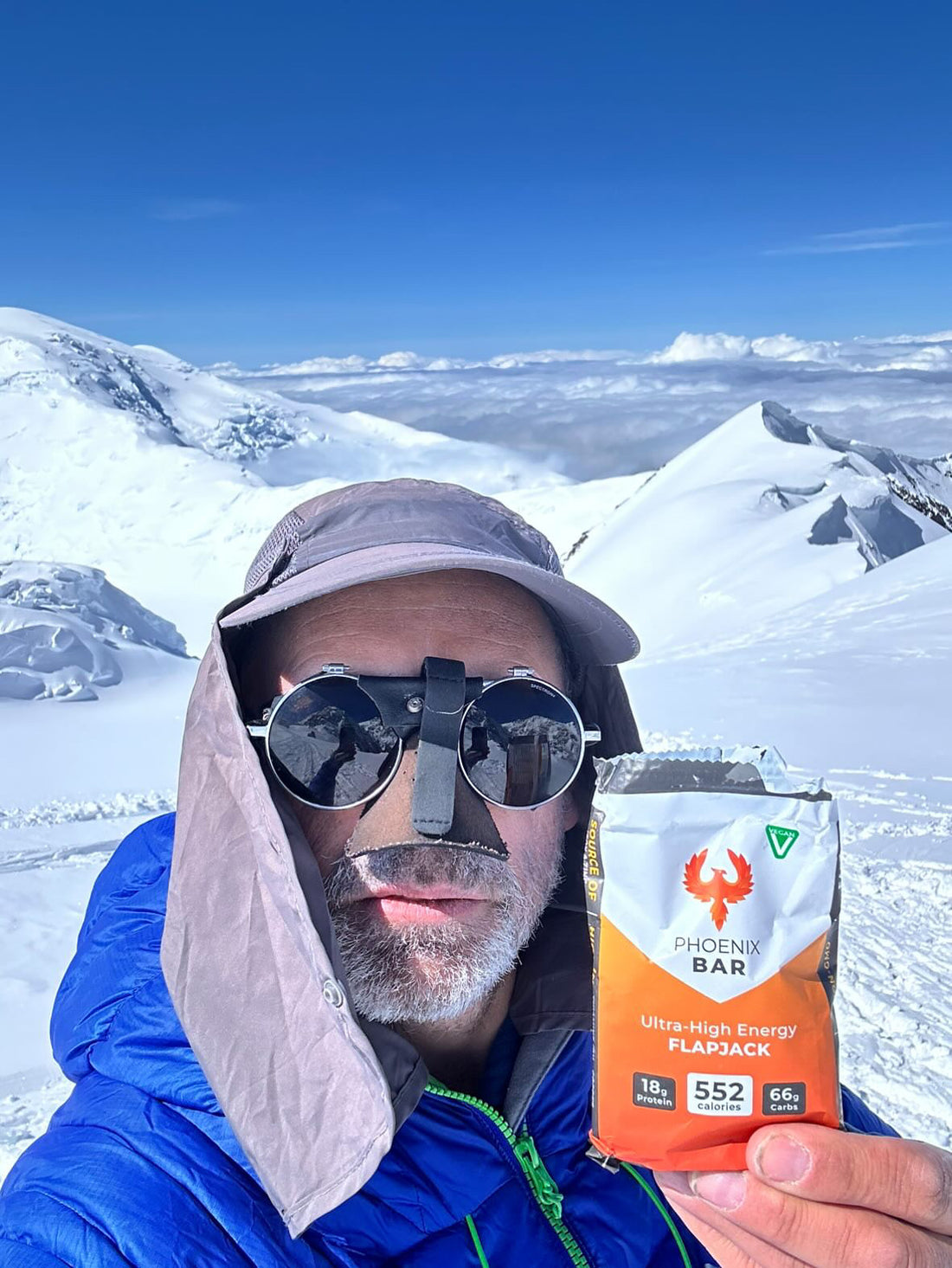
Big calories. Small bar.
Up to 557 calories in a compact, lightweight bar of only 120g, with up to 66g of carbs and 19g of protein. Eat it whole, break it into pieces over a few hours, or mix it with water or milk for porridge.
Easy to eat, easy to digest and not sickly sweet. Customers have eaten them at -45°C and through the heat of the Marathon des Sables, and they keep for up to 2 years, so they work on a mountain, on a night shift, or at home on days when eating enough feels hard.
- 557 calories in only 120g (529 to 557 by flavour)
- 4.6 calories per gram
- 66g carbs per bar (up to)
- 19g protein per bar (up to)
