

Haute Route Pyrenees Nutrition Guide: How to Fuel 800km from the Atlantic to the Mediterranean
In this guide

The Haute Route Pyrenees, or HRP, runs roughly 800km along the high spine of the Pyrenees from Hendaye on the Atlantic to Banyuls on the Mediterranean, crossing the French, Spanish and Andorran sides as it traces the most direct high-altitude line between the two seas. Most hikers complete it in 42 to 50 days. Total ascent across the full traverse is approximately 50,000 metres, more than five times Everest. The trail is unwaymarked across long sections, harder than the parallel GR10 and GR11, and food resupply gaps of two to five days are normal. This guide explains how to fuel it without breaking your back, your knees, or your appetite.
 Written by James Frost, founder of Flaming Phoenix and the maker of Phoenix Bars: up to 557 calories in a compact, lightweight 120g bar, built for this kind of fuel-density problem. Last reviewed May 2026.
The trail in numbers
The HRP was devised by Georges Véron in 1968 and remains the wildest of the three Pyrenees coast-to-coast options. Tom Martens' 2019 Cicerone guidebook splits the route into 44 stages, though faster hikers double up and combine sections to finish in the low 30s, and Florian Astor at Do What Make Good crossed the full route in 23 days carrying 17 to 23kg. Stages average 18km with 1,200 to 1,400 metres of vertical and 5 to 8 hours of walking time. The high passes regularly top 2,500m. The technical crux involves snowfield crossings into early July, several scrambles with chains, and one short via ferrata section. Cicerone's facilities table lists only seven full-resupply settlements across the entire 800km: Hendaye, Lescun, Gavarnie, Parzán, Salardú in Val d'Aran, Encamp in Andorra, and the descent into Banyuls. Everything else is shepherds' bergeries, small mountain refugios, and unmanned huts.
That sparseness is what makes the HRP a different fuelling problem from anything else in Europe. The GR20 in Corsica is intense for 16 days. The HRP is moderately intense for 45 days. Daily output is lower than the GR20's hardest scrambling stages but cumulative output is roughly five times higher, and you carry more food between resupply points. The calorie maths gets sharper every day you spend on the trail.
Why HRP fuelling is harder than every other European thru-hike
Three factors stack to make the HRP food problem difficult, and it pays to plan for all three before you start.
First, distance between resupply. The TrailnameBackstroke 2022 trip report puts the longest food carry on the standard HRP route at five days from Gavarnie to Salardú, with three-day carries common throughout the central and Andorran sections. By contrast the GR10 (the French waymarked sister trail) hits a village most days, and the GR11 (the Spanish one) has resupply every two days at worst. The HRP zigzags deliberately above the villages on both sides. That is what makes it the high route. It also means you are carrying significantly more food at any given moment.
Second, duration. Forty-five days of sustained moderate-to-hard hiking depletes muscle glycogen, suppresses appetite, and progressively erodes your ability to absorb calories the longer you are out. Research published in Sports Medicine (Jeukendrup, 2014) on multi-day endurance events shows that gastrointestinal tolerance decreases over time and that hikers who fail to adapt their carb intake during the first week often end up in chronic energy deficit by week three. On the HRP that decline has longer to build, because no other route in Europe runs at altitude for this long.
Third, summer heat. The HRP can only be safely walked from late June to mid-September because of snow on the high passes outside that window. That puts you on the trail during the hottest months. Florian Astor recorded valley temperatures of 37 degrees Celsius on his August 2019 traverse. The Trek's HRP write-up logged 99 degrees Fahrenheit in the lower stages. Heat suppresses appetite measurably through elevated peptide YY and leptin, an effect documented in iScience in 2023, and the Pyrenees climate trend is making this worse year on year.
The compounding effect of these three factors is what makes the HRP a "calorie density per gram" problem more than any other European trail. Every 100g of food in your pack that delivers less than 4 calories per gram is costing you. For comparison, a Phoenix Bar delivers about 4.6 calories per gram, comfortably above the threshold and ahead of nearly all the energy bars for hiking sold in the UK. The wider principle is set out in our calorie-dense foods guide, which is the right primer before you start gear-planning for a route like this.
The five sections of the HRP and what each one demands of your food bag
The HRP divides naturally into five sections, and the resupply pattern is different in each. The trick is to plan your food bag for the section ahead, not as a single uniform load across the whole trek.
Section one: the Basque country (Hendaye to Lescun, roughly 7 days). The opening section runs through the green rolling foothills of the Basque country before climbing into the limestone karst of Pic d'Anie. Daily ascents are moderate at 800 to 1,100 metres. Villages are relatively frequent (Sare, Olhette, Ainhoa, Bidarray, Saint-Étienne-de-Baïgorry, Esterencuby, Roncesvalles area) and you can resupply at small shops most days. This is the easiest section for fuelling, and it is the place to dial in your eating rhythm before the trail gets harder. Carry only one to two days of food at a time, eat large in the villages, and use the section to test your gut response to a higher-density bar-and-oat regime than you probably train on at home.
Section two: the central High Pyrenees (Lescun to Salardú, roughly 12 to 14 days). This is the heart of the HRP and the toughest section by every measure. The passes climb above 2,500m, including the Hourquette d'Ossoue at 2,734m and the optional summit of Vignemale at 3,298m. The Brèche de Roland at 2,807m on the Spanish-French border is the iconic image of the trail. Cicerone's facilities table shows only two full resupply points across the entire central section: Gavarnie roughly halfway, and Parzán in Spain a few days later. Most hikers carry three to five days of food between these. Daily ascents hit 1,400m. The combination of high passes, big daily climbs, and limited resupply means this is the section where Phoenix Bars carry their weight literally. Three bars a day carry up to 1,671 calories in only 360g, roughly half the weight of the same calories in bread, cheese and charcuterie, and a Marathon des Sables runner who used them found they kept their shape even in desert temperatures. The dense oat structure also means you can break a bar into water for the high calorie porridge preparation when your appetite drops at altitude. Detailed prep notes are in our guide to how to use Phoenix Bars.
Section three: Val d'Aran and the approach to Andorra (Salardú to Encamp, roughly 7 to 8 days). The trail crosses out of the high central massif and into the more rolling, forested terrain of the Val d'Aran and the Andorran approach. Daily ascents drop slightly to 1,000 to 1,200 metres. Refugios become more frequent and several are staffed in summer. Salardú is a full resupply town with supermarkets, an outdoor shop, and a pharmacy. The crossing into Andorra adds a customs complication if you are carrying meat or dairy from France or Spain, so this is the section where you switch to a more bar-and-snack-heavy carry. Plan for two to three days between resupplies.
Section four: Andorra and the Cerdagne (Encamp to Núria area, roughly 6 to 7 days). Andorra has full supermarkets, including Mercadona-equivalent shops in Encamp and Andorra la Vella, so this is the easiest section to fully restock at low cost. The trail climbs out of Andorra into the high border ridge and the Cerdagne plateau. The Pic Carlit area at 2,921m is the last 2,900-metre peak on the route. This section is where most hikers cross the psychological midpoint and where weight loss tends to become noticeable. The High Altitude Medicine and Biology research on multi-day altitude exposure shows that by week three to four most hikers have lost three to five kilograms of body mass even when eating ad libitum. Our guide to how to gain weight and the related notes in the ultra-endurance and expedition nutrition guide cover the science of why this happens and how to slow it.
Section five: the eastern Pyrenees and the Mediterranean descent (Núria to Banyuls, roughly 10 to 12 days). The trail loses altitude steadily as it heads east, but the days lengthen and the heat increases. By the final week most hikers are walking through 30-degree-plus valleys at the coastal end. This is the section where calorie intake drops most because of heat-driven appetite suppression. The defence is liquid calories, structured eating by clock not by hunger, and shifting more of your daily intake to early morning and late evening rather than the hot middle of the day. There are villages every day or two through this section, so the resupply problem is solved, but the eating problem is at its hardest.
The 45-day energy budget
A reasonable energy expenditure target for the HRP is 4,500 to 5,500 calories per day, averaged across the trek. Cumulatively that is around 220,000 calories across a 45-day traverse. No backpack carries that, which is why the fuelling strategy is structured around resupply windows rather than full self-sufficiency.
The published research on multi-week thru-hike expenditure converges on 300 to 500 calories per hour of moderate ascent hiking, climbing to 600 per hour on steep technical days. The HRP averages 5 to 7 hours of effective walking time per stage. Combined with a basal metabolic rate of 1,500 to 2,000 calories per day for a typical adult, the 4,500 to 5,500 daily range is the realistic band for most hikers. Stages with 1,400 metres of ascent or more (which is most of the central section) sit at the upper end. Easier days at lower altitude in the Basque section sit closer to 4,000.
Of that daily total, refugio dinners cover around 800 to 1,100 calories when they are available, refugio breakfasts cover 400 to 500, and the remaining 2,500 to 4,000 calories per day has to come from food you are carrying. That gap is the central fuelling problem of the HRP, and it is why the food you carry should be dense: nuts, oils, dried fruit and high calorie bars. Our high calorie snacks guide benchmarks the typical options against the density target.
Pack weight and the carry density problem
The 9kg refuge ceiling and 13kg camping ceiling commonly applied to alpine treks are too low for the HRP because the route requires carrying more food between resupplies. Realistic HRP pack weights for thru-hikers are 11 to 14kg refuge-leaning and 14 to 18kg camping-leaning, including food and water but excluding ice axe and crampons for early-season sections. Florian Astor crossed the trail at 17 to 23kg total. The pack weight you can actually sustain over 45 days is determined less by your fitness than by how dense your food choices are.
A practical HRP food bag target is 500 to 700 grams of carried food per day delivering 3,000 to 4,000 calories. That is a density requirement of around 6 calories per gram, achievable only with a deliberate mix of bars, nuts, dried fruit, hard cheese, and some form of dehydrated dinner. Each Phoenix Bar contributes up to 557 calories at 120g (about 4.6 cal/g). Two to three bars per day covers 1,100 to 1,700 calories of your between-refugio total on roughly 240 to 360 grams of pack weight. For the longer carries in the central section, the Complete Bundle of 36 Phoenix Bars gives you almost a full 14-day high-density carry without weighing down the rest of your pack with comparable calorie sources. Hikers planning the central section as a stand-alone two-week trek can size down to the Essential Bundle of 18.
For the underlying carb density logic that supports the bar choice over bread or pasta, see our breakdown of ultra high carb solid foods.
Wild camping versus refugio: why the HRP rewards a hybrid fuelling routine
The HRP is the European thru-hike where wild camping is most viable, most attractive, and most strategically important to your fuelling plan. Stiina at Hiking Trails and most experienced HRP thru-hikers confirm that wild camping is widely tolerated above the tree line as long as you follow Leave No Trace principles, pitch late, leave early, and avoid the few national park core zones where it is explicitly forbidden.
The implication for fuelling is that you can choose your nightly stops based on water and views rather than refugio bookings. That freedom is worth a lot on a 45-day trek. It also means you eat from your own pack most evenings rather than ordering a refugio dinner, which shifts the calorie burden onto your carried food.
Most experienced HRP thru-hikers settle into a hybrid pattern: wild camp three to four nights per week with self-cooked dehydrated meals or cold-soaked oats topped with broken Phoenix Bar pieces, then break the rhythm with a refugio or village meal every third or fourth night. The refugio meals serve two purposes: a calorie top-up of 1,000-plus calories you do not have to carry, and a morale lift. Refugios on the HRP serve hearty Catalan, Basque, and Aragonese mountain food. The going rate for a half-board refugio stay is 35 to 50 euros, which is twice what you would pay on the GR20 but still cheaper than equivalent UK or Alpine huts.
A reasonable working assumption: 30 of your 45 nights wild camping or self-catering, 15 nights in refugios or village inns with hot meals. That ratio sets your weekly food carry at roughly 5kg, which is manageable given the resupply pattern.
For wider context on what self-supported wild camping fuelling looks like, see our wild camping nutrition guide and the backpacking nutrition primer.
A typical fuelling day on the HRP
The structure of a strong HRP fuelling day is built around the heat and altitude curve. Early morning is the easiest time to eat and the coolest time to walk. Late afternoon is the hardest. Plan accordingly.
A worked example for a central section day with 1,300 metres of ascent and 18km of distance.
0530, wake at wild camp or refugio. Cold-soaked oats from the previous night plus one Phoenix Bar broken into the pot with water, eaten as porridge. Roughly 700 to 900 calories. Coffee. Walk by 0630 to beat the worst of the heat.
0930, snack stop at the first col. One Phoenix Bar, a handful of nuts, an electrolyte drink. 500 to 600 calories. The 60 to 90g of carbohydrate per hour absorption ceiling researched by Jeukendrup applies here, and one bar plus 30g of nuts is right at that ceiling.
1230, lunch at the second pass or a stream. Hard cheese, charcuterie, baguette if you bought one in the last village, plus a third Phoenix Bar or dried fruit and chocolate. 800 to 1,000 calories. Drink half a litre of water and refill from a stream.
1530 to 1700, afternoon arrival at the next refugio or wild camp pitch. Immediate snack within 30 minutes of stopping. The 30-minute post-exercise glycogen resynthesis window is the most efficient time to refill muscle stores for the next day, and it is the easiest recovery habit to skip when you are tired.
1900, dinner. Either a refugio meal or a self-cooked dehydrated meal supplemented with olive oil and a fourth bar broken in. 1,200 to 1,500 calories.
Total daily intake on this template is 3,800 to 4,800 calories, which sits at the right end of the band for a high-output central section day. Lower-output days in the Basque or Cerdagne sections can run on a similar template at the lower end of each meal range.
This rhythm is similar in structure to the daily template I wrote for the GR20 nutrition guide, but the HRP requires more calories carried per day because of the longer resupply gaps, and more attention to the timing of intake because of the longer total duration on trail.
HRP versus GR10 versus GR11: which one matches your fuelling tolerance
If you are choosing between the three Pyrenees coast-to-coast traverses primarily on the basis of how much you want to carry and how often you want to resupply, here is how they compare.
The GR10 on the French side is the most "supported." It is fully waymarked, hits villages most days, and is the easiest of the three for self-supplied resupply. Most GR10 hikers carry one to two days of food at a time and eat hot meals in villages or refugios most nights. It is also 866km versus the HRP's 800km, slightly longer, with less total ascent and easier terrain.
The GR11 on the Spanish side is the middle ground. 850km, waymarked, resupply every two days at worst, slightly more remote than the GR10 because the Spanish side is less populated. Daily ascents and overall toughness are between the GR10 and HRP.
The HRP is the high route. 800km, mostly unwaymarked, three to five days between resupply in the central section, mostly wild camping, more total ascent, and significantly more technical. It is also significantly harder to fuel, which is why the calorie-density-per-gram framework matters more here than on either GR trail.
The implication for your food plan: hikers attempting the GR10 can largely eat from villages and carry a small bar-based day bag for between-village fuelling. HRP hikers need a serious carried-food strategy. GR11 sits between. If you are doing all three over multiple years (a number of Pyrenees thru-hikers do), the HRP is the one where dialling in your nutrition makes the biggest difference to whether you finish.
For the broader thru-hike fuelling philosophy that underlies all three, our ultra-endurance and expedition nutrition pillar is the canonical reference. Our pages on Marathon des Sables, multi-day ultra running, and the Tour du Mont Blanc cover adjacent route types within the same endurance category.
Pre-trek preparation: the eight weeks before Hendaye
Three things to dial in before you fly to Biarritz or San Sebastián.
Gut adaptation. The thru-hiker GI tolerance literature consistently shows that hikers who pre-train their gut on the foods they will eat on trail experience significantly less GI distress in the first week. Eat bars, oats, dehydrated meals, and your preferred energy drink during your training hikes for at least the eight weeks before you start. If you have never eaten three Phoenix Bars in a day, do not start with three bars a day on day one of the HRP. Build up.
Carb-density training. Multi-day endurance researchers consistently recommend training the gut to absorb 60 to 90 grams of carbohydrate per hour during exercise. This requires deliberate practice. Long training walks at home should include the same on-trail eating rhythm you will use on the HRP. Our notes on trail running nutrition cover the carb-tolerance training protocol in detail.
Cold-weather backup. The HRP can hit zero-degree nights on the high passes even in July, and shoulder-season attempts in mid-June or mid-September need to plan for sleet and snowfields. Cold-weather fuelling shifts calorie demand upward by 10 to 20 percent because of thermoregulation costs. The same principles I cover in the polar expedition nutrition guide apply at smaller scale here: more fat, more protein, hot meals at the end of cold days.
Pack-weight rehearsal. Do at least three weekend walks with your full HRP pack weight before you leave home. Most hikers who quit the HRP early do so because of foot or knee injuries triggered by pack weight they had not trained for. The rucking nutrition guide covers the strength and conditioning side of pack-weight tolerance.
Frequently asked questions
How many calories do you burn per day on the HRP? Most hikers burn 4,500 to 5,500 calories per day across the full traverse, with higher-output days in the central section reaching 6,000. Cumulatively that is roughly 220,000 calories over a 45-day traverse.
How many days of food do you need to carry between resupply points on the HRP? Cicerone's guidebook and trip reports converge on three days as typical and five days as the maximum in the central section between Gavarnie and Salardú. Plan for three days in most sections, with one or two five-day carries in the high central Pyrenees.
Is the HRP suitable for vegans or gluten-free hikers? Refugio food in the Pyrenees is heavily based on lamb, cheese, lentils, and bread. Vegan and gluten-free options are limited but more available than on the GR20. Carry your own day food regardless. Phoenix Bars are both vegan and gluten-free, with up to 557 calories in only 120g, which makes them well suited to filling the gap.
How heavy should my pack be on the HRP? Realistic ranges are 11 to 14kg if leaning on refugios, 14 to 18kg if camping. Total pack weight is determined more by the calorie density of your carried food than by gear choices.
When is the best time to walk the HRP? Late June through to mid-September is the safe weather window. June can carry residual snow on the high passes and requires an ice axe. July and August are the hottest months and bring the most appetite-suppression risk. September is the most temperate but daylight shortens quickly through the month.
Can the HRP be wild camped end to end? Wild camping is widely tolerated above the tree line outside the national park core zones. Most experienced HRP thru-hikers wild camp 60 to 70 percent of nights and break the rhythm with refugios every third or fourth night.
How does the HRP compare to the GR20 for difficulty? The GR20 is more intense day by day, with steeper scrambling and harder daily terrain. The HRP is less intense per day but five times longer in total ascent, two and a half times longer in distance, and far more demanding on long-term food carry. They test different things. The GR20 tests scrambling fitness and short-term resilience. The HRP tests long-distance fuelling, pack-weight tolerance, and gut endurance.
What is the difference between the HRP and the Pyrenees Haute Route walker's route? They are the same trail. HRP stands for Haute Randonnée Pyrénéenne in French. Some English-language sources call it the Pyrenean High Route or the Pyrenees Haute Route. All three names refer to Georges Véron's 1968 route described in the Tom Martens Cicerone guidebook.
Related guides
The HRP sits within a broader category of multi-week European thru-hikes that share similar fuelling logic. Plan adjacent to it using these guides: the GR20 nutrition guide for the Corsican equivalent at higher daily intensity over a shorter span; the Tour du Mont Blanc nutrition guide for the classic alpine traverse with stronger refuge infrastructure; the Cape Wrath Trail nutrition guide for the British equivalent of the HRP in self-supported demand if not in altitude; the long-distance walking nutrition guide for the foundational principles common to all multi-week treks; and the fastpacking nutrition guide if you are attempting an HRP traverse in under 30 days or aiming for the FKT under 23 days.
For the wider expedition fuelling philosophy that connects every page in this cluster, start with the Ultra-Endurance and Expedition Nutrition Guide.
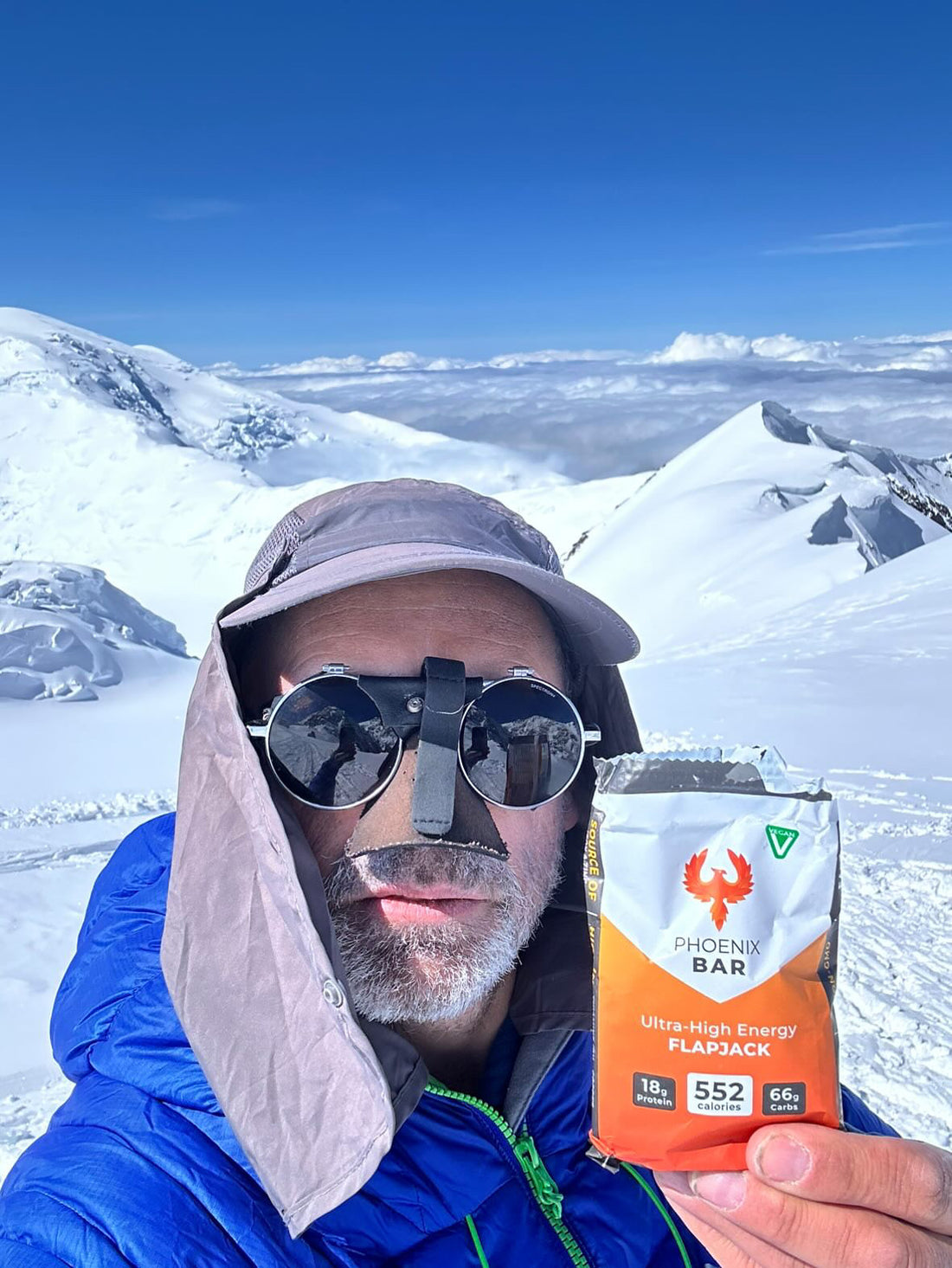
Big calories. Small bar.
Up to 557 calories in a compact, lightweight bar of only 120g, with up to 66g of carbs and 19g of protein. Eat it whole, break it into pieces over a few hours, or mix it with water or milk for porridge.
Easy to eat, easy to digest and not sickly sweet. Customers have eaten them at -45°C and through the heat of the Marathon des Sables, and they keep for up to 2 years, so they work on a mountain, on a night shift, or at home on days when eating enough feels hard.
- 557 calories in only 120g (529 to 557 by flavour)
- 4.6 calories per gram
- 66g carbs per bar (up to)
- 19g protein per bar (up to)
