
How to Acclimatise Before a High-Altitude Expedition: The Rules, the Timelines, the Day-by-Day Plans and How to Eat When Your Appetite Disappears
Written by James, founder of Flaming Phoenix and the maker of Phoenix Bars. Updated September 2026. This page summarises published medical guidance for healthy adults; it is not medical advice, and anyone planning a trip above 2,500 m should talk to a GP or travel clinic.
Quick answer: acclimatising to altitude comes down to one rule that every medical body agrees on. Once you are above 3,000 m, do not raise the altitude you sleep at by more than 300 to 500 m a day, take a rest day at the same altitude every three or four days, and climb higher during the day if you like as long as you come back down to sleep. Spend two or three nights at 2,500 to 3,000 m before going higher, and never go from below 1,200 m to above 3,500 m in a single day. Symptoms of altitude sickness (headache with nausea, loss of appetite, fatigue, dizziness or poor sleep) appear six to twelve hours after arriving at a new height; if you have them, do not go higher, and if they get worse, go down. Fitness does not protect you, forcing water down does not help and can hurt, alcohol and sleeping pills make it worse, and hypoxic tents are no longer recommended as a substitute for real acclimatisation. The only things that shorten the process are real nights at altitude in the two weeks before you go and, on a doctor's advice, acetazolamide. Everything below is built from the 2024 Wilderness Medical Society guidelines, the 2025 CDC Yellow Book, the UIAA medical commission, the NHS and Medex, with day-by-day sleeping-altitude plans for the trips British walkers actually book.
Why this page exists
The pages that rank for this question disagree with each other and with the current science. The most-cited one dates from 1999 and gives ascent rates in feet and a drug schedule that has since changed; another sells hypoxic tents that the Wilderness Medical Society explicitly says not to rely on; several repeat "drink three to four litres a day", which the same society warns can cause a dangerous drop in blood sodium. Nobody plots the rules against real itineraries, and nobody explains what happens to your appetite up high, which is the bit I know best because I make high calorie barsthat expedition members carry precisely because they cannot face proper food at 5,000 m. I am not a doctor, so this page quotes the medical bodies and links to them, and it is honest about what the evidence does and does not support.
What altitude does to your body
The air holds the same proportion of oxygen at every height; what falls is the pressure that pushes it into your blood. At 1,500 to 2,500 m (moderate altitude) most people notice nothing except breathlessness on stairs; blood oxygen saturation, which is 97 to 99 percent at sea level, is still above 95 percent. Between 2,500 and 3,500 m (high altitude) saturation drops to around 90 percent and altitude sickness becomes possible; between 3,500 and 5,500 m (very high) it falls to 85 to 90 percent and acclimatisation is essential; above 5,500 m (extreme) the body cannot fully adapt and slowly deteriorates. The CDC notes that around a quarter of visitors who sleep above 2,450 m in Colorado develop acute mountain sickness, and altitude studies on Kilimanjaro trekkers find it in 70 percent or more.
Acclimatisation is the set of changes that compensate: breathing rate rises within hours, the kidneys adjust the blood's acidity over a few days so that faster breathing can continue, and from four to seven days the body starts making more red blood cells, a process that continues for two or three weeks and reaches its maximum after three to six weeks. That timeline is why "how long does it take" has two answers: one to three days to feel normal at a new altitude up to about 3,000 m, roughly a week to adapt to 5,000 m, and several weeks for the full blood changes.
The rules the medical bodies agree on
The Wilderness Medical Society's 2024 guideline states that above 3,000 m you should not increase your sleeping elevation by more than 500 m a day and should include a rest day every three to four days. The CDC Yellow Book (2025) gives the same 500 m figure and adds an extra night for every 1,000 m of sleeping-altitude gain. The UIAA medical commission and NHS Scotland's Fit for Travel service are more conservative, recommending 300 to 500 m a day with a rest day every three to four days, and the Medex booklet used on most British expeditions says 300 m. The NHS adds two practical rules: spend a few days below 2,500 m before going higher, and do not travel from under 1,200 m to over 3,500 m in one day. All of them agree on "climb high, sleep low": going higher for a few hours and returning to a lower camp helps, because it is the sleeping altitude that counts. And all of them agree on the three golden rules from the altitude research charity in Edinburgh: if you feel unwell at altitude it is altitude sickness until proven otherwise; do not go higher with symptoms; if you are getting worse, descend immediately.
A worked example makes the rule concrete. Sleeping at 3,000 m on night one, you would sleep at 3,300 to 3,500 m on night two, 3,600 to 4,000 m on night three, take night four at the same height, and continue in 300 to 500 m steps with a rest every third or fourth night. From 3,000 m to a 5,000 m sleeping altitude that is six to eight days, which is exactly why the good Kilimanjaro routes take eight and the bad ones take five.
How the popular trips measure up
Kilimanjaro (5,895 m). The Machame and Lemosho routes sleep at roughly 2,800 m, then 3,800 m, 3,950 m (after climbing to Lava Tower at 4,600 m and dropping to Barranco, the classic climb-high-sleep-low day), 4,000 m at Karanga, and 4,670 m at Barafu before the summit night, then straight down to 3,100 m. The second night's 1,000 m jump breaks the rule, which is why the seven and eight-day versions add nights at Shira and Karanga and why the five-day Marangu route has the worst summit and sickness rates. If you can, book eight days. My guide to what to eat on Kilimanjaro covers the food side of that week.
Everest Base Camp trek (5,364 m, Kala Patthar 5,644 m). The standard itinerary flies to Lukla (2,860 m), sleeps at Phakding (2,610 m) and Namche Bazaar (3,440 m) for two nights, then Tengboche (3,860 m), Dingboche (4,410 m) for two nights, Lobuche (4,940 m) and Gorak Shep (5,160 m). With the two acclimatisation days it follows the rule almost exactly, which is why it works for so many people; itineraries that skip the Dingboche rest day are the ones that end in helicopter evacuations. The Everest Base Camp nutrition guide has the day-by-day food plan.
Toubkal (4,167 m). The classic two-day trip sleeps at Imlil (1,740 m) and the refuges (3,207 m) and summits the next morning. That is a 1,470 m jump in sleeping altitude, so headaches at the refuge are common. Adding a night at Aroumd or Imlil with an acclimatisation walk towards Tizi n'Tamatert, or two nights at the refuge with the summit on day three, brings it much closer to the rule.
Mont Blanc (4,806 m). The Goûter route sleeps at the Tête Rousse (3,167 m) or Goûter (3,835 m) hut, so the recommended six-day programmes spend the first three or four days acclimatising on Gran Paradiso or the Aiguille du Tour, which is why they succeed far more often than three-day attempts.
Elbrus (5,642 m). From the huts at about 3,800 m, guided groups spend three or four days walking to the Pastukhov Rocks (4,700 m) and back before the summit night, which is the climb-high-sleep-low principle done properly.
Aconcagua (6,962 m). The normal route sleeps at Confluencia (3,400 m) for two nights with a walk to Plaza Francia, Plaza de Mulas (4,370 m) for several nights with carries to the higher camps, then Canada (5,050 m), Nido de Cóndores (5,570 m) and Cólera (5,970 m) before the summit, over about three weeks. The success rate is 30 to 40 percent, and almost every failure is acclimatisation or weather rather than fitness. The Aconcagua nutrition guideexplains why the food problem there is as big as the oxygen problem. For the same logic on the bigger Himalayan and Alaskan objectives, see the Manaslu and Denali guides.

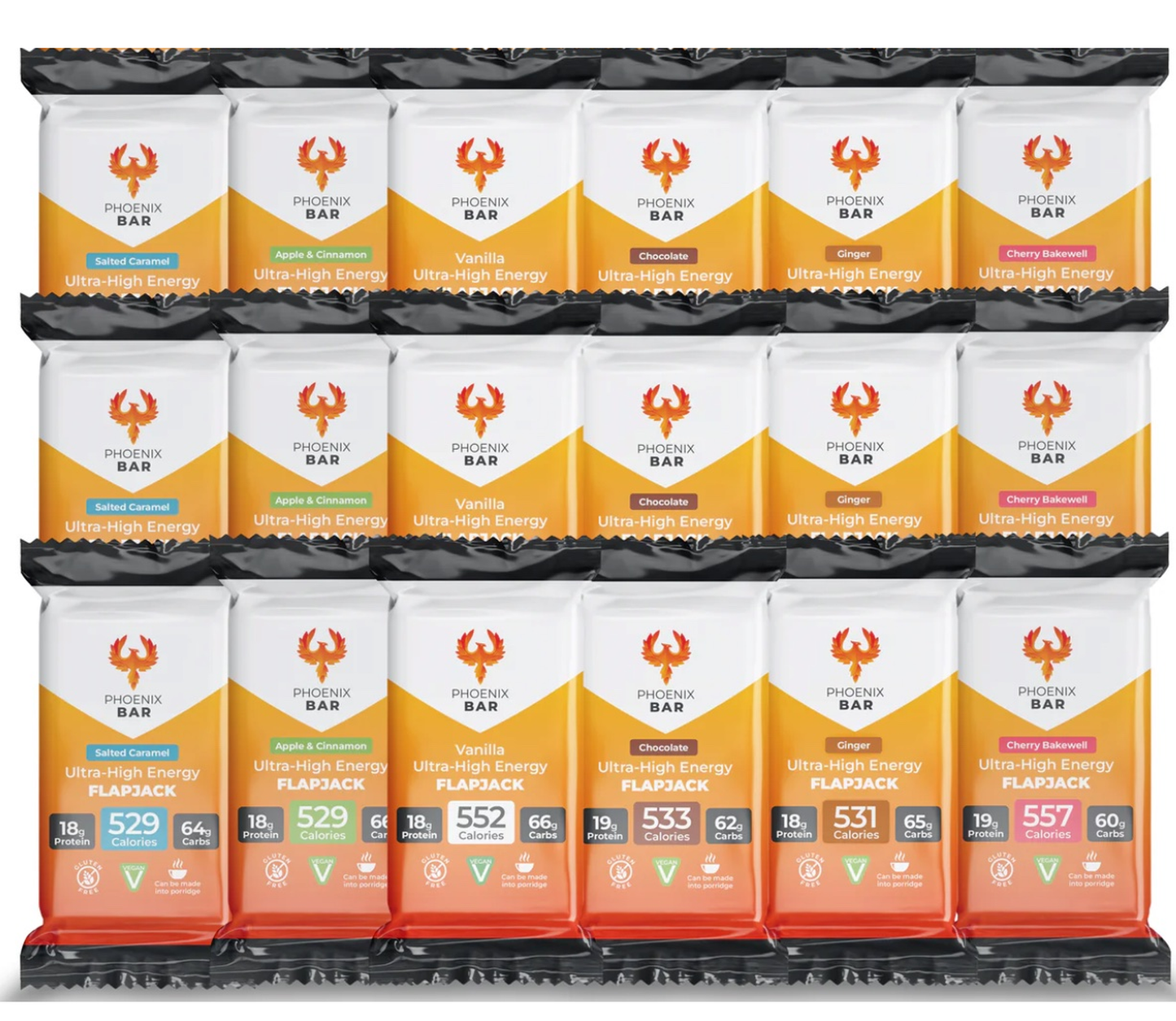
Phoenix Bars: Up to 557 Calories Per Bar
Highly compact, low-volume, calorie-dense bars. Soft, easy to eat whole or as a warm porridge. Vegan, gluten-free and contain up to 66g of carbohydrates, 19g of protein & 8 vitamins & minerals.
Pre-acclimatisation: what actually works, ranked by evidence
Real nights at altitude in the two weeks before you go. The best evidence. A study by Muza, Beidleman and Fulco found that six days at 2,200 m substantially reduced sickness and improved work capacity on a rapid ascent to 4,300 m, and that five or more days above 3,000 m within the previous two months significantly reduced sickness on a rapid ascent to 4,500 m. UK Climbing's altitude physiologist notes that people who had been above 4,000 m within two weeks summited about an hour faster. For British walkers this means an Alpine hut weekend, a couple of nights at a Pyrenean refuge, or the Toubkal refuge itself in the fortnight before a bigger trip. Nothing in the UK is high enough: Ben Nevis is 1,345 m, so there is no pre-acclimatising at home in Britain.
A staged ascent built into the trip. The Wilderness Medical Society recommends staged ascent and pre-acclimatisation as a means of prevention. The CDC says that two or three nights at 2,450 to 2,750 m before going higher is markedly protective. This is what the good itineraries above do.
Hypoxic tents and altitude masks. The 2024 guideline is unambiguous: hypoxic tents should not be relied upon for facilitating acclimatisation, preventing altitude sickness or increasing the odds of summit success, a strong recommendation based on moderate-quality evidence. They may help elite athletes with weeks of use and careful monitoring; for a trekker, they are an expensive way to sleep badly. Intermittent hypoxic breathing sessions have limited evidence.
Timing. Acclimatisation fades quickly: the gains are largely lost within one to two weeks, so schedule the pre-trip altitude as close to departure as you can and re-ascend within a week if you want to keep them.
Fitness, water, alcohol, sleep and supplements: the myths
Fitness does not protect you. The CDC states that training and fitness do not affect the risk of altitude sickness, and the Edinburgh altitude charity says the same. Fit people climb faster, which is why they often get sicker. Get fit for the workload, then go up slowly anyway.
Do not force water. The 2024 guideline says forced hydration has never been shown to prevent altitude illness and may cause hyponatraemia, a dangerous fall in blood sodium; UK Climbing's expedition doctor calls over-hydration a potentially life-threatening illness. The sensible rule from Medex is to drink enough to pass clear urine at least four times a day and no more. Dehydration mimics altitude sickness, which is where the "drink four litres" advice came from.
Avoid alcohol for the first 48 hours, and ideally throughout: it depresses breathing and its hangover is indistinguishable from altitude sickness.
Sleeping pills. Alcohol, opiates and older sedatives depress breathing and are not recommended; the CDC considers short-acting sleep medicines generally safe when there are at least eight hours before activity, but if the poor sleep is itself a symptom of altitude sickness, the UIAA says sleep medication is not the answer. Ask your doctor before you travel rather than a trekking forum.
Supplements. There is no good evidence that ginkgo, coca, iron (unless you are deficient), vitamin C or "altitude" gummies prevent altitude sickness. Ibuprofen has weak evidence for prevention and treats the headache. Caffeine withdrawal causes headaches that get blamed on altitude, so keep your usual coffee going.
Acetazolamide, and why it is a conversation with your doctor
Acetazolamide (Diamox) is the drug the Wilderness Medical Society, the CDC, the UIAA and the NHS name for preventing acute mountain sickness when a slow ascent is not possible or you have had altitude sickness before. It is prescription-only in the UK, so the route is a GP or a travel clinic. The guidelines describe a preventive dose of 125 mg twice a day started the night before you begin ascending and continued for two days at your highest altitude, and they recommend trying a dose at home first because of side effects (tingling fingers and lips, passing more urine, a strange taste from fizzy drinks) and because people with a sulphonamide allergy may not be able to take it. It speeds acclimatisation rather than masking symptoms, so a headache on acetazolamide still means altitude sickness. Dexamethasone treats altitude sickness and cerebral oedema but does not improve acclimatisation, is limited to short courses and is an emergency drug on guided expeditions, not a prevention strategy. Nifedipine and similar drugs are for pulmonary oedema only. None of this replaces descent.
Symptoms and red flags
Acute mountain sickness is a headache plus one or more of nausea or loss of appetite, fatigue, dizziness and poor sleep, arriving six to twelve hours after a new altitude and usually settling in a day or two if you stay put. A Lake Louise score of three or more counts; a persistent headache that does not respond to rest and simple painkillers means do not go higher. The two emergencies are high-altitude cerebral oedema (confusion, clumsiness, inability to walk heel to toe, drowsiness) and high-altitude pulmonary oedema (breathlessness at rest, a cough that becomes wet, frothy or pink sputum, blue lips, extreme weakness). Both are treated by immediate descent of at least 300 to 1,000 m, oxygen if available, and the emergency drugs in a guide's kit; a portable hyperbaric bag buys time when descent is impossible. The person who is sick is the worst judge of it, so on any trip agree in advance that the group decides.
Appetite, weight and how to eat at altitude
This is the part almost every acclimatisation guide misses. Above 3,000 m appetite falls, and it keeps falling the higher you go, independently of sickness. In Operation Everest III, a 31-day chamber simulation to the height of Everest, the subjects' energy intake dropped by around 1,000 kcal a day and they lost about 5 kg, mostly because meals felt bigger sooner; even at 5,000 and 6,000 m, with almost no sickness symptoms, they ate less. A ten-day study at a simulated 3,000 m found intake 13 percent lower, and the research points to the appetite hormone leptin rising in the first days at altitude and to carbohydrate absorption weakening above about 5,500 m. Loss of appetite is also one of the defining symptoms of altitude sickness itself.
The practical advice from the expedition medicine bodies is to eat a light but high-calorie diet, little and often, weighted towards carbohydrate in the first days, and to choose food you actually want to eat, because on a big mountain the meal you like is the one that gets eaten. That is the design brief for our high calorie energy bars: 120 g, 527 to 557 kcal, 60 to 66 g of carbohydrate and around 18 g of protein each, not very sweet (sweetness is the first thing people go off up high), soft to eat with cold hands at minus 45, and quick to turn into porridge with hot water in a tent. They are the same high calorie protein bars people use for training at home, and the same product customers buy as high calorie bars for weight gain when the problem is simply eating enough, which is exactly the problem at 5,000 m: one bar replaces the meal you cannot face. A pocket of high calorie snack bars on the summit day, eaten a piece at a time every hour, is how a lot of our customers get through the night without the stove. My mountaineering nutritionguide covers the full plan for camps and summit days, high calorie porridge and high calorie drinks are the warm and liquid options for mornings when chewing is too much, what to eat when your appetite is low has the small, dense ideas that work at any altitude, and the best energy bars for expeditions comparison ranks the options by calories per gram and cold performance. Salty and savoury foods stay palatable longest; pack more variety than you think you need; and if you want a mountain to aim all this at, the best mountains to climb guide grades the world classics by difficulty.
A planning checklist for a UK-based expedition member
Book an itinerary that sleeps no more than 500 m higher each night above 3,000 m with a rest day every three or four days, and refuse the five-day Kilimanjaro. Get a couple of nights at real altitude in the fortnight before you fly if you can (the Alps are two hours away), and do not buy a tent. See your GP or a travel clinic six to eight weeks out to discuss acetazolamide, vaccinations and your insurance's altitude limit. Get fit for the days, not for the altitude. Pack the expedition kit list, a pulse oximeter if your guide uses one, and food you will eat when you do not want to eat. Learn the three golden rules and agree with your group that anyone can call a descent. Drink to clear urine, skip the beer at base camp, keep your coffee, and walk slower than feels natural on every uphill for the first week.
Frequently asked questions
How to acclimatise to altitude at home? You cannot, in the UK. The only things with good evidence are real nights at altitude within two weeks of your trip (an Alpine or Pyrenean hut, the Toubkal refuge) and building acclimatisation days into the trip itself. The 2024 Wilderness Medical Society guideline specifically recommends against relying on hypoxic tents, and altitude masks do not simulate altitude at all.
How long does it take to adapt to altitude? One to three days to feel comfortable at a new altitude up to about 3,000 m, roughly a week to adapt to 5,000 m, and three to six weeks for the full increase in red blood cells. Following the 300 to 500 m a day rule builds the time in automatically.
At what altitude do you need to acclimatise? Altitude sickness becomes possible above about 2,500 m and common above 3,000 m, which is where the sleeping-altitude rules start. Most people can go to 2,500 m in a day with little more than breathlessness; the NHS advises spending a few days below 2,500 m before going higher.
Why am I so sensitive to altitude changes? Susceptibility is largely genetic and does not track fitness; if you have had altitude sickness before you are more likely to get it again. Fast ascent, a high first-night altitude, dehydration or over-hydration, alcohol and a cold all make it worse. If you know you are sensitive, ascend more slowly than the rules and talk to a doctor about acetazolamide.
What is the fastest way to adjust to high altitude? There is no fast way that is also safe. The closest things are recent real altitude exposure, a staged itinerary, and, on medical advice, acetazolamide, which speeds the body's adjustment rather than hiding symptoms.
What supplements can help prevent altitude sickness? None with good evidence. Ginkgo, coca leaf, vitamin C and iron (unless you are anaemic) have not been shown to prevent it. Acetazolamide is a prescription medicine, not a supplement, and ibuprofen has weak evidence.
How quickly does altitude acclimatisation wear off? Most of it within one to two weeks of returning to low altitude, and probably about as quickly as it was gained. Re-ascending within a week keeps most of the benefit.
What are the 3 stages of acclimatisation to high altitude? The usual description is immediate (faster breathing and heart rate within hours), short-term (the kidneys adjust blood chemistry over two to five days so breathing can stay high) and long-term (more red blood cells and capillaries over weeks).
Is VO2 max worse at altitude? Yes: maximal oxygen uptake falls roughly 1 percent for every 100 m above about 1,500 m, and in Operation Everest III it was 59 percent lower at 7,000 m. This is why everyone is slower up high and why pacing, not fitness, decides summit days.
How long does it take to acclimatise to 5,000 feet (1,500 m)? Most people feel nothing beyond mild breathlessness at 1,500 m and adjust within a day or two; this is below the altitude at which sickness normally starts.
Does Garmin's altitude acclimation feature mean anything? It estimates your recent exposure from barometric data and time spent above 800 m; it is a reasonable reminder of the two-week decay but not a medical measure. A pulse oximeter reading and how you feel are better guides.
Flaming Phoenix is not affiliated with the Wilderness Medical Society, the CDC, the UIAA, the NHS, Medex or any trekking company. This page reports their published guidance as of September 2026 for general information; it is not medical advice, and decisions about medication and fitness to travel belong with a doctor.


Flaming Phoenix



Contact Us
Declare withdrawal
Please fill out the following form to declare your withdrawal from the contract.

