Cycling and Bikepacking Nutrition: High-Calorie Food for Long-Distance Rides
Long-distance cycling, bikepacking, and audax demand thousands of calories per day. Compact, calorie-dense food that is easy to eat on the move can be the difference between finishing strong and running out of energy.
In this guide
- Why calorie intake matters on long-distance rides
- The calorie maths of cycling and bikepacking
- Why calorie density is critical
- What makes a food work on the bike
- How Phoenix Bars can be used for cycling and bikepacking
- Fuelling strategies by ride type
- Practical suggestions for daily use
- Frequently asked questions
This guide explains why calorie intake is the defining nutritional challenge of long-distance cycling, why calorie density per gram matters when carrying food on a bike, and how to build a fuelling strategy that works across training rides, audax events, bikepacking trips, and ultra-distance races.
Phoenix Bars are a high-calorie nutrition bar designed for situations where maximum calories in minimum weight and volume is critical. For broader guidance on fuelling across all ultra-endurance disciplines, see the Ultra-Endurance and Expedition Nutrition Guide.
Last reviewed: 2026
Long-distance cycling burns more calories per hour than almost any other endurance activity. A rider on a multi-day bikepacking trip, an audax event, or an ultra-distance race can burn between 3,000 and 6,000 calories per day depending on intensity, terrain, body weight, and conditions. That is roughly double the calorie intake of a normal day, sustained for days or weeks at a time.
The problem is not knowing this. Every experienced cyclist understands that long rides demand more food. The problem is actually consuming enough calories while riding, carrying enough food between resupply points, and maintaining the ability to eat when fatigue, nausea, and palate fatigue make food unappealing.
Most riders who fail to finish long events or who suffer severe energy crashes in the final stages are not under-trained. They are under-fuelled. The gap between calories burned and calories consumed accumulates over hours and days until performance collapses.
This guide is for any cyclist who rides long enough that nutrition becomes a limiting factor: audax riders, bikepackers, ultra-distance racers, multi-day tourers, and anyone who has bonked badly enough to know they need a better plan.
Why Calorie Intake Matters on Long-Distance Rides
On a short ride of an hour or two, your body can rely largely on stored glycogen. Nutrition strategy barely matters. Eat what you like, or eat nothing at all.
Once a ride extends beyond three or four hours, glycogen stores deplete and your body increasingly depends on the calories you consume during the ride. From this point on, how much you eat determines how well you ride.
On multi-day rides, the equation shifts further. You are not just fuelling the current day's effort. You are also replenishing what yesterday's riding consumed and building reserves for tomorrow. If calorie intake consistently falls short of calorie expenditure, the deficit accumulates. By day three or four, you are riding on empty, and the consequences are predictable: dropping power output, inability to sustain tempo on climbs, cognitive fog, mood collapse, and eventually the inability to continue.
The riders who perform best over multiple days are not always the strongest. They are often the ones who eat the most consistently.
The Calorie Maths of Cycling and Bikepacking
The numbers are worth understanding because they explain why calorie-dense food matters so much.
A cyclist riding at moderate intensity burns roughly 500 to 700 calories per hour, depending on body weight, speed, terrain, and conditions. Add this to a baseline metabolic requirement of around 2,000 to 2,500 calories per day, and the total daily calorie need on a long ride becomes substantial.
For a rider spending six hours in the saddle: approximately 5,000 to 6,500 calories needed per day. For a rider spending ten or more hours riding, as in an ultra-distance race or loaded bikepacking trip: 6,000 to 8,000+ calories.
Most riders struggle to consume more than 200 to 300 calories per hour while riding, meaning a significant portion of calorie intake has to happen during stops, at camp, or overnight. The more calorie-dense your food is, the easier it is to close the gap between what you burn and what you eat, both on the bike and off it.
Why Calorie Density Is Critical
Calorie density is how many calories a food delivers per gram. For cycling and bikepacking, it determines two things: how much weight you carry and how quickly you can get calories in.
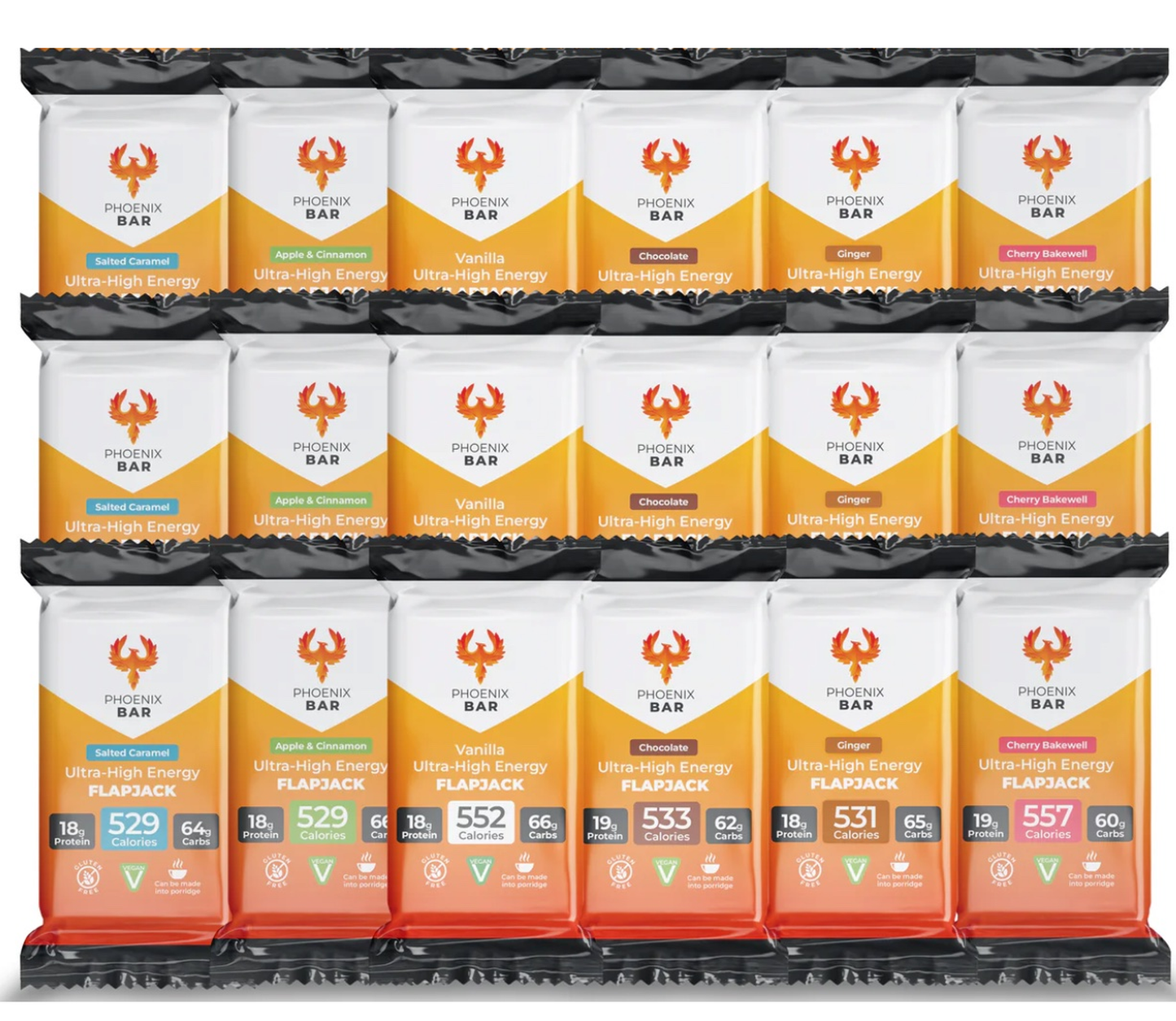
A standard energy gel delivers 80 to 100 calories in a 30 to 40g packet. A typical flapjack or energy bar delivers 150 to 250 calories. A single Phoenix Bar delivers up to 557 calories in 120g, roughly 4.6 calories per gram.
The weight implications are significant on a bikepacking trip. If you need 3,000 calories of on-bike food per day and your food averages 2 calories per gram, you are carrying 1.5kg of food. At 4.6 calories per gram, the same calorie load weighs roughly 650g. Over a five-day trip, that difference adds up to over 4kg of pack weight.
For audax and ultra-distance racing, the time implications matter too. Eating a 557-calorie Phoenix Bar takes a fraction of the time required to eat the same number of calories from gels, smaller bars, or sandwiches. Less time eating means more time riding or resting.
When every gram of pack weight matters and every minute of eating time counts, calorie density per gram is the most important characteristic of the food you carry.

Phoenix Bars: Up to 557 Calories Per Bar
Easy to eat and easy to open on the bike. Highly compact, contains up to 66g of carbs. Can be eaten as a bar or made into porridge.
What Makes a Food Work on the Bike
Not every calorie-dense food is practical for cycling. The food needs to work in the specific constraints of riding: on the move, from a jersey pocket or frame bag, often one-handed, and over many hours where palate fatigue becomes a real problem.
High calories per gram. This is the primary selection criterion for any food carried on a long ride. More calories per gram means less weight for the same energy.
Easy to eat while riding. Food that can be eaten with one hand, does not require a knife or spoon, and does not fall apart is far more likely to actually get consumed on the bike. Food that requires stopping to eat effectively reduces riding time.
Does not melt, freeze, or crumble. Gels become impossible to open in cold conditions. Chocolate melts in summer. Many bars shatter in sub-zero temperatures. Food needs to remain edible across the full range of conditions a long ride might encounter.
Does not cause palate fatigue. After eight hours of sweet gels and sugary bars, most riders reach a point where they cannot face another sweet mouthful. Food with milder, more neutral flavours sustains appetite across longer timeframes than intensely sweet alternatives.
Shelf-stable and durable. Food carried in a frame bag or handlebar roll for days needs to survive compression, heat, cold, and moisture without spoiling or disintegrating.
Provides a mix of macronutrients. Pure sugar delivers fast energy but crashes quickly and causes gut distress at high volumes. Food that combines carbohydrates with fat and protein provides both fast and slow-release energy, supporting sustained output over hours.
How Phoenix Bars Can Be Used for Cycling and Bikepacking
Phoenix Bars were designed for exactly this context: maximum calories in minimum weight and volume, in a format that survives real-world conditions and remains easy to eat over extended efforts.
Phoenix Bars deliver approximately 4.6 calories per gram, making them one of the most weight-efficient ready-to-eat foods you can carry on a bike. They survive frame bag compression, do not melt in summer jersey pockets, and can be eaten one-handed while riding. The six flavours are deliberately mild rather than aggressively sweet, which matters on day three of a multi-day event when gel-induced nausea has become the enemy.
Phoenix Bars can be eaten in three ways on a ride:
Whole or in large pieces. Eat a whole bar during a stop or break it into halves or thirds and eat them over 30 to 60 minutes of riding. Each bar delivers the calorie equivalent of five to six standard gels.
Broken into smaller pieces for grazing. Break a bar into bite-sized pieces and store them in a top-tube bag or stem bag for continuous on-bike fuelling. This mirrors the "eat little and often" approach that works best for sustained endurance output.
As a warm porridge at camp or during a stop. Adding hot water to a Phoenix Bar creates a calorie-dense porridge. This is particularly useful at camp, during overnight stops, or at checkpoints where a warm meal aids recovery and morale without requiring a stove, cooking equipment, or preparation time beyond boiling water.
Phoenix Bars have a two-year shelf life, weigh 120g per bar, and are packaged in water-resistant wrappers that withstand frame bag compression.
"As an ultra endurance cyclist, I've been searching for that one nutrition product I can consistently use to fuel multi-day races and sustain peak performance. Gels, nuts, sweets, Clif bars — they all work to an extent but each have their downsides. I tried Phoenix Bars for the first time during the 2024 Trans Alba race in Scotland. The impact and boost each bar gave to my body was amazing."
"I used a couple of Phoenix Bars on a 24-hour cycle recently and was impressed with the taste and how easily they went down. I find it hard to pack in calories in endurance events, as my stomach usually starts playing up, but these flapjacks didn't cause any problems."
Fuelling Strategies by Ride Type
Different types of long-distance cycling have different fuelling demands. Here is how Phoenix Bars fit into each.
Audax (200km to 600km). Audax events typically last 12 to 40 hours, with control points at regular intervals where food is available. The main challenge is maintaining consistent calorie intake between controls and avoiding the late-event energy collapse that comes from under-fuelling in the first half. Carrying two to three Phoenix Bars provides 1,100 to 1,650 calories of reliable, compact backup that does not depend on what is available at controls. Eat portions steadily between stops rather than relying entirely on control-point food.
Bikepacking (multi-day, self-supported). Bikepacking combines endurance cycling with the added weight of gear. Every gram of food weight matters. Phoenix Bars offer one of the highest calories-per-gram ratios available in a ready-to-eat bar format. For a three-day trip with limited resupply, carrying ten Phoenix Bars (1.2kg) provides 5,570 calories of shelf-stable, no-cook food. The porridge format also means a hot breakfast or camp meal is possible with just boiling water, no stove pots or cleaning required.
Ultra-distance racing (1,000km+). Ultra races like the Transcontinental, Pan Celtic Race, or North Cape 4000 last days or weeks. The defining challenge is eating enough, day after day, when fatigue and nausea make food repulsive. Phoenix Bars are effective here because their mild flavour does not trigger the palate fatigue that sweet gels and bars cause after multiple days. Many ultra riders carry Phoenix Bars alongside convenience-store food, using the bars as a calorie-dense baseline and supplementing with whatever real food they find on route.
Training rides (4+ hours). Long training rides are the place to test your nutrition strategy. Carrying a Phoenix Bar on a four-hour ride and eating it in portions teaches you how your gut responds and how the calorie density affects your energy levels compared to your usual fuelling approach. Do not race on a nutrition plan you have not tested in training.
Sportives and gran fondos. Most sportives have well-stocked feed stations, so carrying large amounts of food is less critical. A single Phoenix Bar in a jersey pocket provides a 557-calorie emergency reserve that weighs less than a standard water bottle. If a feed station is closed, under-stocked, or the queue is too long, you have a reliable backup.
Practical Suggestions for Daily Use
Pre-ride breakfast. Make a Phoenix Bar into porridge with milk or hot water for a 557 to 600+ calorie breakfast that takes two minutes. This is particularly useful for early starts where cooking a full breakfast is not practical.
On-bike fuelling. Break a bar into pieces and eat them steadily over one to two hours. This delivers 557 calories in a way that is gentle on the gut and does not require stopping.
At control points and checkpoints. Eat real food when it is available, and save your Phoenix Bars for the stretches between. The bars are most valuable when other food is not accessible.
Camp meals. The porridge format means a Phoenix Bar plus boiling water equals a 557-calorie hot meal with zero cooking equipment beyond a cup and a way to heat water. For stoveless bikepackers, this is a significant advantage.
Drop bags. For events that use drop bags (like the Marathon des Sables), Phoenix Bars are an ideal drop-bag item: shelf-stable, compact, calorie-dense, and ready to eat immediately.
Emergency reserve. Always carry at least one Phoenix Bar as an emergency calorie reserve. If you bonk, get lost, or your ride takes significantly longer than planned, 557 calories can be the difference between getting home and calling for a lift.
With a subscription. For riders who train and race regularly, a subscription ensures a consistent supply without having to reorder before each event.
Related Guides
You may also find these guides helpful:
- Ultra-Endurance and Expedition Nutrition Guide
- How To Use Phoenix Bars
- Marathon des Sables Nutrition
- High Altitude Mountaineering Nutrition
- Ocean Rowing Nutrition
- Military Field Nutrition
- Calorie-Dense Foods: What They Are and When They Help
Frequently Asked Questions
How many calories do I need per day when bikepacking?
Most bikepackers burn between 3,000 and 6,000 calories per day depending on hours in the saddle, terrain, load weight, and conditions. A rider spending six hours at moderate intensity needs roughly 5,000 to 6,500 calories per day. Your baseline metabolic rate plus approximately 500 to 700 calories per hour of riding gives a reasonable estimate.
How many calories per hour should I eat while cycling?
Most riders can absorb 200 to 300 calories per hour while riding, though trained guts can handle more. The key is consistency: eating small amounts frequently rather than large amounts infrequently. One Phoenix Bar eaten in pieces over 90 minutes delivers roughly 370 calories per hour.
What is the best food for bikepacking?
The best food for bikepacking maximises calories per gram while remaining easy to eat, shelf-stable, and palatable over multiple days. Nut butters, cheese, tortillas, dried fruit, and calorie-dense bars are all effective. Phoenix Bars offer one of the highest calorie-per-gram ratios available in a ready-to-eat format at approximately 4.6 calories per gram.
Do Phoenix Bars work in cold weather?
Yes. Phoenix Bars remain soft and easy to eat in sub-zero conditions. They have been used successfully on expeditions at temperatures as low as -45°C. Most standard energy bars and gels freeze solid or become impossible to open in extreme cold.
Do Phoenix Bars melt in hot weather?
Phoenix Bars are more heat-stable than chocolate-based bars or gels. They maintain their shape and texture in warm conditions. In extreme heat, they may soften slightly but remain fully edible.
If you have any questions about using Phoenix Bars for long-distance cycling, bikepacking, or audax events, contact me directly. I am always happy to help.
James Frost
Founder, Flaming Phoenix
07990 519422


Flaming Phoenix
High-Calorie Bars for Endurance, Expeditions and Weight Gain