

Manaslu Nutrition Guide: Food for an 8000m Climb
In this guide

 By James Frost, Founder of Flaming Phoenix. Phoenix Bars have been used on Himalayan, Arctic, and polar expeditions. They've been carried to the summit of Everest.
Last updated: May 2026
The short answer
Manaslu at 8,163m is the world's eighth-highest peak and increasingly the most-climbed 8000m mountain after Everest. A standard commercial expedition runs 35 to 45 days, structured around three to four acclimatisation rotations between Base Camp at 4,800m and progressively higher camps, culminating in a summit push that crosses into the death zone above 8,000m.
The food problem on Manaslu is not the same as on lower peaks. Above 7,000m your body begins to digest food poorly. Above 8,000m it stops digesting solid food meaningfully altogether. The whole nutrition strategy is built around eating aggressively at Base Camp during the 4 to 6 day rest windows between rotations, then carrying compact fuel, such as high calorie protein bars, for the climbing days when intake will be a fraction of burn.
You'll burn 4,500 to 6,500 calories per day on rotation days, 8,000 to 12,000 on summit day, and 3,000 to 4,000 on Base Camp rest days. Realistic intake on the mountain is 50 to 65% of burn. The deficit accumulates across 6 weeks. Most Manaslu climbers lose 4 to 8kg over the expedition.
The guide follows the rotation cycle, which is how an 8000m climb is actually structured, then covers eating in the death zone and the bar count for a 40-day expedition. For climbers comparing Manaslu to other major peaks, see the Aconcagua nutrition guide (lower altitude, no death zone) and Denali expedition food (colder, similar duration, lower altitude).
What makes Manaslu uniquely demanding
Manaslu sits in a category most expedition climbers haven't faced before: the true 8000m peaks. The physiology above 7,500m is different from anything you'd encounter on Aconcagua, Denali, or any of the Seven Summits except Everest.
Atmospheric pressure collapse. At the 8,163m summit, atmospheric pressure is roughly 35% of sea level. Your blood oxygen saturation drops to 60 to 70% even with full acclimatisation. Most climbers use supplemental oxygen above 7,400m on Manaslu; without it, the death zone is a roughly 24-hour survival window.
Digestive shutdown above 7,000m. Hypoxia slows gastric emptying severely. Above 7,500m many climbers report inability to swallow solid food. Above 8,000m most climbers can't keep down anything but liquid sugars. The food has to either land before you reach this altitude or be liquid by the time you eat it.
The rotation problem. Unlike Aconcagua or Denali, where you climb steadily upward, Manaslu is built around 3 to 4 distinct climb-down-recover cycles. You climb to a high camp, sleep there, descend to BC, recover for 4 to 6 days, then repeat at progressively higher camps. The rotation cycle is the unit of food planning, not the day.
Sherpa-supported logistics. Most commercial Manaslu climbs include Sherpa carries to higher camps and fixed-rope work. Group meals at BC are operator-provided. Personal pack covers all snacks, all higher-camp food not covered by Sherpa carries, and summit-day fuel. The Sherpa support changes the maths from full-self-supported peaks like Denali.
Length. A Manaslu expedition is 35 to 45 days door-to-door, longer than Aconcagua (18 to 21 days) and longer than most Denali climbs. Over 35 to 45 days, a snack bag with no variety is one you stop eating from.
For the underlying physiology of why food behaves differently at altitude, see the High Altitude Mountaineering pillar.
The rotation cycle: how 8000m food planning actually works
Most Manaslu nutrition advice fails because it treats the climb as a single timeline. It isn't. It's a rotation cycle, and the food strategy has to be built around that.
A typical commercial Manaslu expedition works like this:
Approach and Base Camp setup (days 1 to 8). Trek from Soti Khola or fly to Samagaon, then walk into BC at 4,800m. Eat aggressively. Build calorie reserves. This is the only window where appetite is normal and digestion is unimpaired.
Rotation 1 (days 9 to 13): BC to Camp 1 (5,800m) and back. Two to three day push to touch C1, sleep there, return to BC. Calorie burn 4,500 to 5,500 per active day.
BC rest cycle 1 (days 14 to 18): 4 to 5 days of recovery eating. This is where the calorie deficit from Rotation 1 gets repaired. Three meals a day plus snacking. Target 4,500 to 5,500 cal/day intake at BC.
Rotation 2 (days 19 to 24): BC to C2 (6,400m), some teams touch C3 (6,800m), back. Longer rotation, higher altitude, harder eating. Calorie burn 5,000 to 6,500 per active day.
BC rest cycle 2 (days 25 to 30): another 4 to 6 days of recovery eating. Critical window. Most climbers lose 1 to 2kg per rotation; this is when you replace it.
Summit push (days 31 to 38): BC to C2 to C3 to C4 (7,400m) to summit (8,163m) and back. Multi-day push, supplemental oxygen above 7,400m for most climbers. Summit day burns 8,000 to 12,000 calories. Realistic intake on summit day is 1,500 to 2,500.
Descent and exit (days 39 to 45). Walk out, eat normally below 4,000m.
The food planning insight: you have roughly 9 to 11 days at BC across the rest cycles to repair the calorie deficits accumulated during the 6 to 8 active climbing days of the rotations. The BC rest windows are where you do most of your real eating. The active climbing days are where you carry the most compact, dense, cold-stable fuel you can find. Our ranking of the best energy bars for expeditions compares the options on calories per gram and how they cope with the cold.
Calorie maths across the rotation cycle
Modern Himalayan nutrition science targets the following intakes by altitude.
Base Camp (4,800m): 4,500 to 5,500 cal/day. Appetite is impaired but functional. Three operator-cooked meals plus 2 to 3 high-calorie snacks. Most climbers can hit this with discipline.
Camp 1 to 2 (5,800m to 6,400m): 3,500 to 4,500 cal/day. Realistic intake on a rotation day. Operator-cooked dinner if Sherpa-supported, otherwise self-cooked. Personal snacks fill the gap.
Camp 3 to 4 (6,800m to 7,400m): 2,500 to 3,500 cal/day. The intake ceiling drops sharply here. Liquid calories (sugary drinks, soup) become more important than solid food. Solid bars eaten in small pieces every 30 minutes.
Above 8,000m (death zone): 1,000 to 2,000 cal/day intake against 8,000 to 12,000 cal/day burn. The ratio breaks down completely. Survival food only.
Total expedition calories needed: roughly 180,000 to 220,000 cal across 40 days, against burn of 220,000 to 270,000 cal. The unavoidable deficit is 40,000 to 80,000 cal across the expedition, which translates to 4 to 8kg of weight loss. The goal is to keep the deficit at the lower end of that range, not to eliminate it.
Above Base Camp every gram in your pack has to climb with you, so calories per gram start to count. Calorie-Dense Foods covers the arithmetic. Phoenix Bars carry up to 557 calories in only 120g, about 4.6 cal/gram, among the highest densities of any portable solid food.
Food strategy: the four eating windows
The Manaslu food day breaks into four distinct windows, each with different requirements. Understanding the windows is more useful than thinking about meals.
Window 1: Base Camp rest day eating (4 to 6 days at a time, 4,500 to 5,500 cal/day target).
This is your repair window. Three operator-cooked meals plus aggressive between-meal snacking. Standard BC fare on Manaslu: dal bhat (rice and lentils), pasta, eggs and chapati, soups, momos, occasional fresh meat. Operators feed you well at BC because eating is how you recover.
The personal-pack contribution at BC is between-meal snacking. One Phoenix Bar per day eaten as a mid-afternoon top-up adds up to 557 calories between operator meals. Two bars per day pushes daily intake from 4,500 to 5,600+ which is the difference between losing 2kg per rotation and losing 1kg.
The porridge breakfast trick: mixing a Phoenix Bar with water gives you a high calorie porridge of up to 557 calories on rest days when you want something different from the operator's eggs and chapati. See How To Use Phoenix Bars for the porridge format.
Window 2: Rotation climbing day eating (6 to 8 active days across the expedition, 3,500 to 4,500 cal/day target).
Climbing days are 6 to 10 hour pushes between camps. Operator hot meals at the camps cover 1,500 to 2,500 calories. The remaining 2,000 to 2,500 calories come entirely from your personal pack: snacks eaten on the move, broken into small pieces because long stops aren't possible at altitude.
A typical personal-pack rotation day: 2 to 3 Phoenix Bars (roughly 1,060 to 1,670 cal) plus chocolate, hard cheese, nuts, dried fruit, hard candies. Mix them up: flavour fatigue tends to set in by Rotation 2, around day 24.
Window 3: High camp eating (Camps 3 and 4, 2,500 to 3,500 cal/day target).
Above 6,800m, eating becomes a problem. Appetite is gone. Sleep is poor. Cold is constant. Most climbers lose 1 to 2kg in the 1 to 2 nights spent at C3 and C4. The food strategy shifts: liquid calories dominate (soup, sweet tea with butter, hot chocolate), and solid food gets eaten in small pieces only.
A Phoenix Bar broken into 6 pieces and eaten across 2 to 3 hours at High Camp is more workable than trying to eat a whole bar in one sitting. The same logic applies to all solid food at this altitude.
Window 4: Summit push and death zone (12 to 18 hours, 1,500 to 2,500 cal target intake).
Summit day starts from C4 at 7,400m at midnight or 1am. It's a 12 to 16 hour round trip to the 8,163m summit. Above 8,000m you're in the death zone with extreme oxygen limitation, severe cold, and digestive shutdown.
What works above 8,000m: hot sugary drinks from a thermos (the most calories you'll consume on summit day), gels kept in inner jacket pockets to prevent freezing, hard candies, glucose tablets. Solid bars become difficult but Phoenix Bars stay soft enough at sub-zero to be eaten in small bites if broken into pieces beforehand. Pack 3 to 4 Phoenix Bars for summit day; you'll likely consume 1 to 2 of them.
What fails above 8,000m: anything requiring chewing effort, cold solid foods, dry foods, anything the body has to work to digest.
Recovery between rotations: where the calories actually land
This is the section operators and other Manaslu nutrition pages consistently underplay. The 4 to 6 day BC rest cycles between rotations are the most important food planning windows on the expedition.
Three observations from polar and high-altitude metabolic studies that apply to Manaslu:
Appetite returns rapidly below 5,500m. Climbers who lose appetite at C2 and C3 typically have it back within 24 hours of returning to BC. The window for aggressive eating is therefore the BC rest cycle, not the rotation itself.
Calorie deficits compound across rotations. Failing to fully repair the Rotation 1 deficit during the first BC rest means you start Rotation 2 in deficit, which makes Rotation 2 harder, which produces a bigger deficit. Climbers who don't eat aggressively at BC degrade across rotations.
The summit push depends on accumulated reserves. By the time you start the summit push, your daily intake is below your daily burn for several consecutive days. The fuel that gets you up Manaslu is the fuel you ate during the BC rest cycles, not what you carry on summit day.
The practical implication: target 5,000+ cal/day at BC. Eat dal bhat twice a day. Add ghee or butter to everything. Snack continuously between meals. Two Phoenix Bars per BC rest day adds up to 1,114 calories on top of three operator-cooked meals, which is what closes the maths. The Essential Bundle at 18 bars covers most climbers' BC rest cycle needs alone.
Provisioning maths for a 35 to 45 day expedition
The personal-pack provisioning for a typical Manaslu commercial expedition.
Approach trek (days 1 to 8): 1 Phoenix Bar per day as a between-meal addition to teahouse food. Total: 8 bars.
BC rest cycles (9 to 11 total rest days across cycles): 2 bars per day, including 1 used as porridge breakfast on most days. Total: 18 to 22 bars.
Rotation climbing days (6 to 8 active days): 2 to 3 bars per day in jacket and pack. Total: 16 to 24 bars.
Summit push (3 to 4 days from BC departure to return): 3 to 4 bars per day across the push, including summit day pocket carry. Total: 12 to 16 bars.
Storm and emergency reserve: 5 to 10 bars for buffer days, weather holds, or extended summit waits.
Total recommended Phoenix Bar provisioning for a 35 to 45 day Manaslu expedition: 60 to 80 bars per climber.
The clean way to provision this is one Complete Bundle (36 bars, 6 of each flavour for variety) plus one Essential Bundle (18 bars), totalling 54 bars, plus a Starter Bundle (12 bars) for reserve, bringing the total to 66 bars. For climbers wanting fuller coverage, take a second Essential Bundle instead of the Starter Bundle for 72 bars total. Browse the full range at Phoenix Bar bundles.
For Manaslu expedition orders above 50 bars, contact me directly for expedition pricing rather than ordering through standard bundles. We can ship internationally to Kathmandu for pre-staging with the rest of your expedition gear.
Variety, morale, and the 40-day flavour problem
A 40-day expedition is long enough that flavour fatigue becomes a primary nutrition risk. Operators run set rotation menus at BC; teahouses on the approach run set Nepali menus; personal snacks tend to repeat. By Rotation 2 around day 25, most climbers report active aversion to whatever they've been eating most.
The defence is variety, planned in from the start. Six Phoenix Bar flavours rotate the palate across a 40-day window. The full range:
- Vanilla, the original flavour
- Cherry Bakewell, almond and cherry, sweet but not cloying
- Chocolate, the standard
- Salted Caramel, the salted change of pace when other flavours start to tire
- Ginger, a sharper, spiced flavour for a change of taste
- Apple & Cinnamon, the warming flavour, works well as porridge
The two sharper flavours, Salted Caramel and Ginger, are the most important for the back half of a long expedition. By day 25, sweet snacks become hard to eat. Climbers carrying only sweet bars start under-eating. Stocking 30 to 40% of your Phoenix Bar order in those two flavours helps.
The Complete Bundle ships with 6 bars of each flavour, which gives you a spread of flavours from day one.
How Phoenix Bars work on Manaslu
For your personal pack on Manaslu, this is what Phoenix Bars bring.
Calorie density: up to 557 calories in only 120g, about 4.6 cal/gram. Above C2, where every gram in your pack is hauled by your hypoxic body, this density is hard to beat in any solid food. For more on the density principle, see Calorie-Dense Foods.
Cold-stability: stays edible at sub-zero in inner jacket pockets. Above 7,000m, where temperatures hit minus 25°C with windchill, most conventional bars freeze. Phoenix Bars don't.
Carb load: up to 66g of carbohydrate per bar. At altitude, the body metabolises carbohydrates more efficiently than fat because carb metabolism requires less oxygen. Carb-led fuelling matters more on Manaslu than on any peak below 6,000m.
Variety across 40 days: six flavours, including the sharper Salted Caramel and Ginger, to help with the flavour fatigue problem inherent in long expeditions.
Porridge format: a Phoenix Bar plus water becomes a high calorie porridge of up to 557 calories in 2 minutes. This works at BC for breakfast variety, at Camps 1 to 3 as a quick calorie hit, and even at C4 if you have water. See How To Use Phoenix Bars for the format.
Shelf life of up to two years: plenty of time for climbers who send gear and food to Kathmandu 1 to 3 months ahead.
What they don't replace: operator-cooked dal bhat at BC (the cultural and emotional anchor of Himalayan eating), Sherpa tea with butter on summit day, the high-protein recovery meals you'll want during BC rest cycles, or the supplemental oxygen most climbers use in the death zone above 8,000m.
How Manaslu compares to other major expedition peaks
For climbers using Manaslu as preparation for Everest or as an Aconcagua follow-up.
Vs Aconcagua: Manaslu is much higher (8,163m vs 6,962m), longer (35 to 45 days vs 18 to 21), uses a rotation cycle structure rather than a single ascent, and crosses into the death zone above 8,000m. The food planning is different in kind, not just degree. See Aconcagua nutrition for the comparison framework.
Vs Denali: Manaslu is 2,000m higher than Denali but considerably warmer at altitude (Manaslu summit minus 20 to 30°C vs Denali summit minus 30 to 40°C). Manaslu is Sherpa-supported with operator BC catering; Denali is fully self-supported. The two peaks demand different food planning even at similar durations. See Denali expedition food.
Vs Everest: Manaslu is the standard preparation peak for Everest, and the food planning translates almost directly. Everest adds another 685m of altitude, longer time in the death zone, and 6 to 8 weeks expedition length. Climbers who eat well on Manaslu have proven the protocol that works for Everest.
Vs Aconcagua summit day specifically: Manaslu summit day burn is 8,000 to 12,000 cal vs Aconcagua's 8,000 to 10,000. Similar order of magnitude, but Manaslu summit day extends into the death zone where intake is essentially impossible, and it's preceded by 2 to 3 days of camp-pushes above 7,000m which already create their own deficit.
Frequently asked questions
How many calories do I need per day on Manaslu? Targets vary by altitude: 4,500 to 5,500 cal/day at Base Camp, 3,500 to 4,500 on rotation climbing days, 2,500 to 3,500 at high camps, and 1,500 to 2,500 on summit day. Total expedition burn is 220,000 to 270,000 calories across 40 days. Most climbers consume 70 to 80% of total burn and lose 4 to 8kg.
How many Phoenix Bars do I need for a Manaslu expedition? 60 to 80 bars per climber for a 35 to 45 day expedition. The clean provisioning is one Complete Bundle (36 bars) plus one Essential Bundle (18 bars) plus a Starter Bundle (12 bars), totalling 66 bars.
What food works above 8,000m in the death zone? Almost nothing solid. Hot sugary drinks from a thermos are the highest-yield calories. Hard candies, glucose tablets, and small pieces of soft bars (Phoenix Bars work because they stay soft) cover the rest. Most climbers consume 1,000 to 2,000 calories on summit day against 8,000 to 12,000 burned. The summit fuel was the food you ate during the BC rest cycles.
Why are the Base Camp rest days so important? Calorie deficits accumulate across the rotation cycle. The 4 to 6 day BC rest windows are the only periods when appetite is functional and digestion isn't impaired. These are the days where you actually rebuild from the deficits accumulated during the rotations. Climbers who eat lightly at BC degrade across rotations and rarely summit.
Will my snacks freeze at Camp 4 (7,400m)? At minus 25°C with wind chill, most snacks freeze within hours. Phoenix Bars are formulated to stay soft in inner jacket pockets where body heat keeps the temperature 30 to 40°C above ambient. Outer pockets and packs freeze. The inner-pocket rule applies on every 8000m peak.
Should I do high-fat or high-carb on Manaslu? Above 5,500m, carb-led fuelling outperforms fat-led because carb metabolism requires less oxygen. The standard high-altitude macro target is 65% carbs, 20% fat, 15% protein. Phoenix Bars at 47% calories from carbohydrate fit this profile when paired with the additional fat from operator-cooked Nepali meals (dal bhat, ghee, butter).
What's the variety strategy for a 40-day expedition? Plan flavour rotation from the start. Sweet snacks become hard to eat by day 25. Stock 30 to 40% of your bars in the sharper flavours. Phoenix Bars Salted Caramel and Ginger handle this. Operator BC menus also vary, but personal pack monotony is your responsibility.
Are Sherpa-carried foods enough above Base Camp? For most commercial expeditions, no. Sherpa carries cover group hot meals at camps. Personal snacks for the climbing days, summit day, and any extra calories above operator portions are 100% personal pack. Plan for 60 to 80 Phoenix Bars per climber on top of whatever Sherpa carries deliver.
Related guides
High Altitude Mountaineering | Aconcagua nutrition | Denali expedition food | Greenland Crossing Food | Antarctica Crossing Food | Ultra-Endurance and Expedition Nutrition Guide | Calorie-Dense Foods | High Calorie Porridge | How To Use Phoenix Bars
Buy Phoenix Bars | Browse bundles | Complete Bundle (36 bars) | Essential Bundle (18 bars) | Starter Bundle (12 bars) | jfrost@flaming-phoenix.co.uk
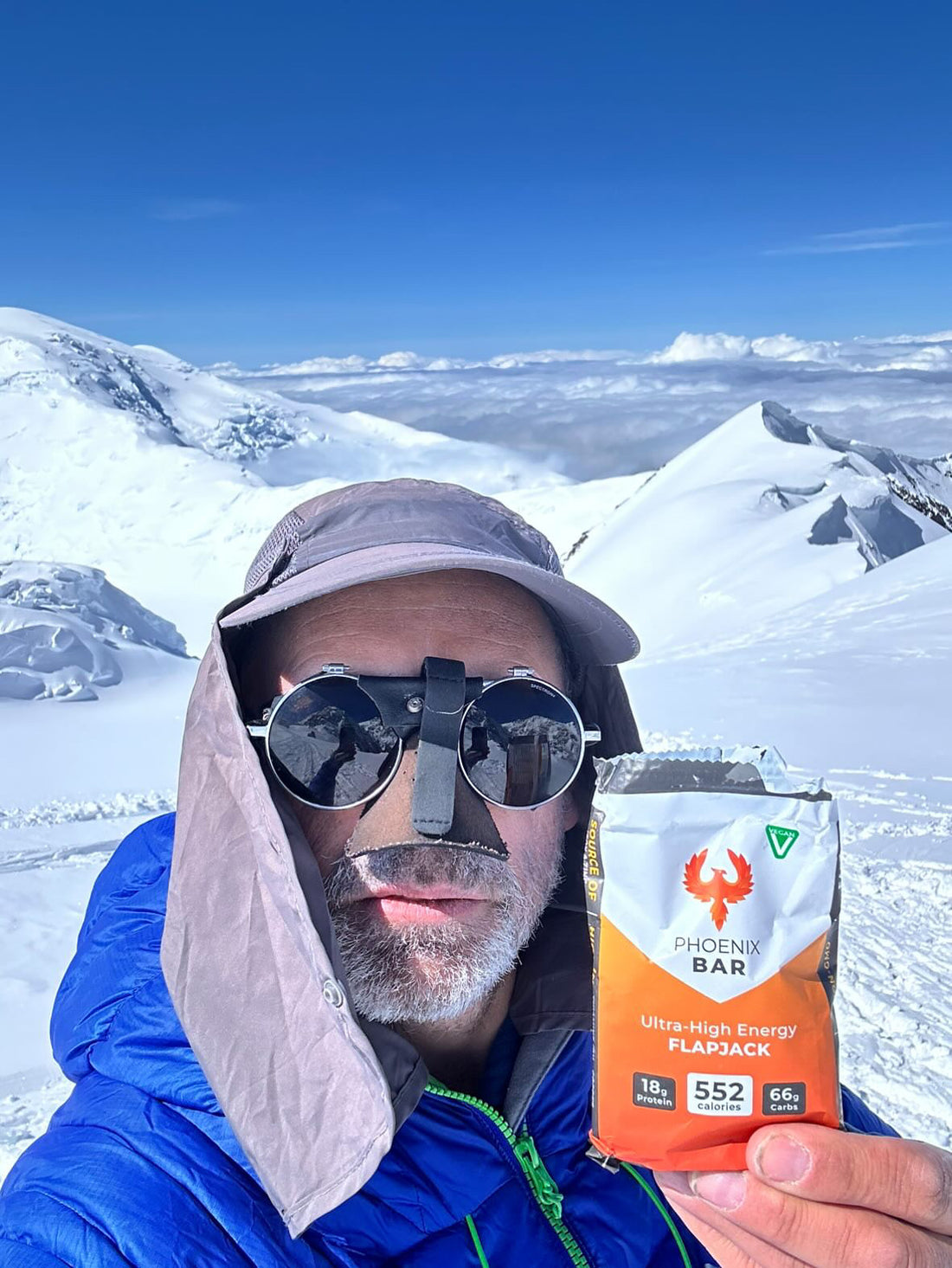
Big calories. Small bar.
Up to 557 calories in a compact, lightweight bar of only 120g, with up to 66g of carbs and 19g of protein. Eat it whole, break it into pieces over a few hours, or mix it with water or milk for porridge.
Easy to eat, easy to digest and not sickly sweet. Customers have eaten them at -45°C and through the heat of the Marathon des Sables, and they keep for up to 2 years, so they work on a mountain, on a night shift, or at home on days when eating enough feels hard.
- 557 calories in only 120g (529 to 557 by flavour)
- 4.6 calories per gram
- 66g carbs per bar (up to)
- 19g protein per bar (up to)
