

Offshore Sailing Nutrition: High-Calorie Food for Life at Sea
In this guide

Offshore sailing burns thousands of calories per day through physical exertion, cold exposure, and the constant effort of living on a moving boat. Compact, shelf-stable, calorie-dense food that requires no cooking is essential when galley time is limited and conditions are rough.
In this guide
- Calorie needs offshore
- Why calorie density is critical on a boat
- What makes food practical at sea
- How Phoenix Bars can be used
- Fuelling strategies by passage type
- Frequently asked questions
About this guide
This guide explains the specific nutrition challenges of offshore sailing, from weekend coastal passages to ocean crossings, and how to maintain calorie intake when cooking is impractical, storage is limited, and conditions make eating difficult.
For guidance on ocean rowing nutrition, see the Ocean Rowing Nutrition guide. For broader endurance nutrition principles, see the Ultra-Endurance and Expedition Nutrition Guide.
Phoenix Bars are high calorie bars designed for situations where maximum calories in minimum weight and volume is critical.
Last reviewed: 2026
Offshore sailing is physically and mentally demanding in ways that are easy to underestimate from shore. A crew member on a multi-day passage is working watch systems around the clock, grinding winches, handling sails, helming in rough seas, and living in a constantly moving environment where even basic tasks like making a cup of tea require bracing against the motion of the boat.
Calorie expenditure is high. Cold, wind, spray, and the constant physical effort of staying upright and functional on a heeling, pitching boat burn 3,000 to 5,000+ calories per day depending on conditions, watch length, and boat size. On a small yacht in rough weather, the number climbs higher.
At the same time, the conditions that increase calorie demand also make eating harder. Cooking in a galley on a heeling boat in rough seas is time-consuming, physically difficult, and sometimes dangerous. Seasickness suppresses appetite entirely. Fatigue from broken sleep on watch rotations reduces willingness to eat. Cold, wet conditions make hot meals feel essential but difficult to produce.
A calorie deficit builds over the course of a passage. Crew become progressively more tired, slower to react, more prone to poor decisions, and less able to handle the boat safely. Most experienced offshore sailors have seen the effect of under-fuelling on crew performance and morale, and the best skippers treat nutrition as a core part of passage planning.
Why Calorie Density Is Critical on a Boat
Calorie density matters offshore for three reasons: storage space, preparation time, and the practical difficulty of eating in rough conditions.
Storage space is limited. Even on a well-equipped cruising yacht, food storage competes with sails, safety equipment, spare parts, water, and personal kit. On a racing yacht, every kilogram of provisions is a kilogram of displacement. Food that delivers more calories per kilogram means less volume in the lockers for the same calories, which is how our ranking of the best energy bars for expeditions orders them.
Galley time is limited. In rough conditions, cooking a proper meal can take 30 to 60 minutes of bracing against the boat's motion, heating a stove on gimbals, and trying not to scald yourself. On a short-handed boat with two people splitting watches, the off-watch crew need to sleep, not spend their rest time cooking. Ready-to-eat food that requires no preparation eliminates galley time entirely.
Eating in rough seas is hard. When the boat is heeling at 25 degrees and slamming into waves, sitting down with a plate and fork is impractical. Food that can be eaten one-handed, from a packet, while wedged into a cockpit seat or standing at the chart table, is far more likely to be consumed than a plated meal.
A standard sandwich delivers 300 to 400 calories but goes stale within a day and takes up significant locker space. A single Phoenix Bar carries up to 557 calories in only 120g, keeps for up to two years without refrigeration, and can be eaten one-handed on watch.
What Makes Food Practical at Sea
Offshore food needs to survive the marine environment and work within the constraints of life on a boat.
No refrigeration required. Fridge and freezer space on a yacht is minimal and power-hungry. Food that is shelf-stable at ambient temperature is far more practical than anything that needs to be kept cold. Phoenix Bars have a shelf life of up to two years and require no refrigeration.
Waterproof or water-resistant packaging. Spray, condensation, and the occasional wave in the cockpit mean everything gets damp. Food in packaging that survives moisture without the contents being ruined is essential.
Compact and stackable. Locker space on a boat is oddly shaped and limited. Food that packs flat, stacks neatly, and does not waste space with excessive packaging is far easier to stow.
Edible one-handed. When one hand is holding on, the other needs to manage food. Unwrap, eat, done. No plate, no cutlery, no preparation.
Does not create mess. Crumbs in a boat are a nuisance. Spilled food in a galley at 30 degrees of heel is a disaster. Food that is self-contained and does not require decanting, pouring, or assembly minimises mess.
Not excessively sweet. On a multi-day passage, palate fatigue from sweet snacks sets in quickly. Milder, more neutral flavours sustain appetite across days at sea when intensely sweet bars and gels become repulsive.
Mixes carbohydrate with fat and protein. Watch systems mean four to six hour blocks on deck, often through the night. Food combining carbohydrates, fat and protein is absorbed over a longer stretch than sugar alone, which suits a full watch.
How Phoenix Bars Can Be Used
On a boat, food needs to survive spray, salt air, locker compression, and weeks without refrigeration. Phoenix Bars have a shelf life of up to two years and take up minimal locker space; stow them in a dry bag like the rest of your food. They can be eaten one-handed in the cockpit during a watch, made into porridge in a mug with just water, or stowed permanently aboard as reserve nutrition. For single-handed or short-handed crews, every meal that does not require galley time is time that can be spent resting.
On watch. Break a bar into pieces and eat them through a watch. A full bar eaten across a four-hour night watch delivers up to 557 calories without needing to go below, use the galley, or take your eyes off the sea. Store pieces in a jacket pocket for easy access.
When cooking is impossible. In rough weather, when the galley is out of action and nobody wants to risk the stove, Phoenix Bars provide a calorie-dense meal-equivalent that is immediately available. Two bars (up to 1,114 calories) replace a hot meal's calorie content without any preparation.
As a meal with minimal effort. With just water, a Phoenix Bar porridge provides a meal of up to 557 calories in a mug in two minutes. No pots, no pans, no washing up, and the minimum possible galley time.
During seasickness. In the early days of a passage, seasickness can make eating impossible. As nausea subsides, small amounts of bland, calorie-dense food are often the first thing that can be tolerated. Small pieces of a Phoenix Bar, eaten slowly, can get calories in when nothing else works.
As permanent boat stores. The shelf life of up to two years means Phoenix Bars can be stowed aboard permanently as emergency or reserve nutrition. Keep a supply in a locker and rotate stock annually. If a passage takes longer than expected, weather forces a change of plan, or crew provisions run low, they are there.
"From my experience (having raced three times around the world, winning the BT Global Challenge and becoming the fifth British sailor in history to complete the Vendee Globe), I think these flapjacks are well-suited to challenging, long-distance water sports, such as offshore sailing."
"They've been particularly great when I've been seasick and they're all I can eat!! My team and I have ordered loads of these for our Atlantic row later this year!!"
Full nutritional information and ingredient lists for all six flavours are available on the product page.
Fuelling Strategies by Passage Type
Coastal passage (1 to 3 days, harbours available). Provisions can be topped up ashore. Pack four to six Phoenix Bars per crew member as on-watch food and rough-weather backup. Supplement with fresh food bought in port. The bars cover the times when cooking is impractical or conditions prevent a proper stop.
Offshore passage (3 to 14 days, no resupply). This is where food planning matters. Pack six to eight bars per crew member per day as on-watch food and no-cook meal replacements. Supplement with whatever hot meals can be prepared in the galley on calmer days. For a two-person crew on a seven-day offshore passage, 100 bars (12kg) provide up to 55,700 calories of shelf-stable, no-cook food that does not require fridge space.
Ocean racing (fully crewed, high intensity). Racing crews need maximum calories with minimum weight and preparation time. Galley time is wasted racing time. Phoenix Bars provide calorie-dense, ready-to-eat nutrition that can be consumed on deck during a watch without going below. Pack as primary on-watch food and supplement with freeze-dried meals for sit-down eating.
Single-handed or short-handed sailing. When you are the only crew, or one of two, galley time comes directly out of sleep time. Every meal that does not require cooking is time you can spend resting. Phoenix Bars and the porridge format (just add water) are particularly valuable for solo and short-handed sailors who cannot afford to lose rest time to food preparation.
Rallies and events. For organised rallies where socialising at stops is part of the experience but passages between are serious sailing, Phoenix Bars serve as reliable on-passage food that frees up galley time for cooking at anchor when conditions and company make it enjoyable.
Related Guides
- Ocean Rowing Nutrition
- Ultra-Endurance and Expedition Nutrition Guide
- High Altitude Mountaineering Nutrition
- Hiking and Trekking Nutrition
- How To Use Phoenix Bars
- Calorie-Dense Foods: What They Are and When They Help
Frequently Asked Questions
How many calories do I need per day offshore?
Most offshore sailors burn 3,000 to 5,000+ calories per day depending on conditions, watch length, and physical demands. In heavy weather or cold conditions, the number is higher. Budget at least 3,000 calories per crew member per day of on-board food, with extra for rough weather days when hot cooking is impossible.
How many Phoenix Bars should I provision per person?
For on-watch food and no-cook backup, budget four to eight bars per person per day depending on how much galley cooking you expect to do. For a seven-day passage with limited cooking, 40 to 50 bars per person provides a substantial calorie base at a weight of 4.8 to 6kg.
Do Phoenix Bars survive the marine environment?
They need no refrigeration and have a shelf life of up to two years (12 months for Cherry Bakewell), which suits permanent stowage aboard, kept in a dry bag. For heat and cold, customers report that they kept their shape even in desert temperatures on the Marathon des Sables and were easy to eat at -45°C on a South Pole expedition.
Can Phoenix Bars replace hot meals at sea?
A single Phoenix Bar delivers up to 557 calories, comparable to a hot meal. Made into porridge with water, it provides a calorie-dense meal in a mug with no galley cleanup. It is not nutritionally complete, so it works best alongside varied food rather than as the sole food source for an extended passage.
What should I eat when seasick?
As nausea subsides, small amounts of bland, calorie-dense food are usually the first things tolerated. Dry crackers, ginger, and small pieces of a Phoenix Bar eaten slowly can help get calories in. Avoid rich, fatty, or strongly flavoured food until nausea has fully passed. Staying hydrated is the priority during active seasickness.
If you have any questions about using Phoenix Bars for offshore sailing, contact me directly. I am always happy to help.
James Frost
Founder, Flaming Phoenix
07990 519422
Big calories. Small bar.
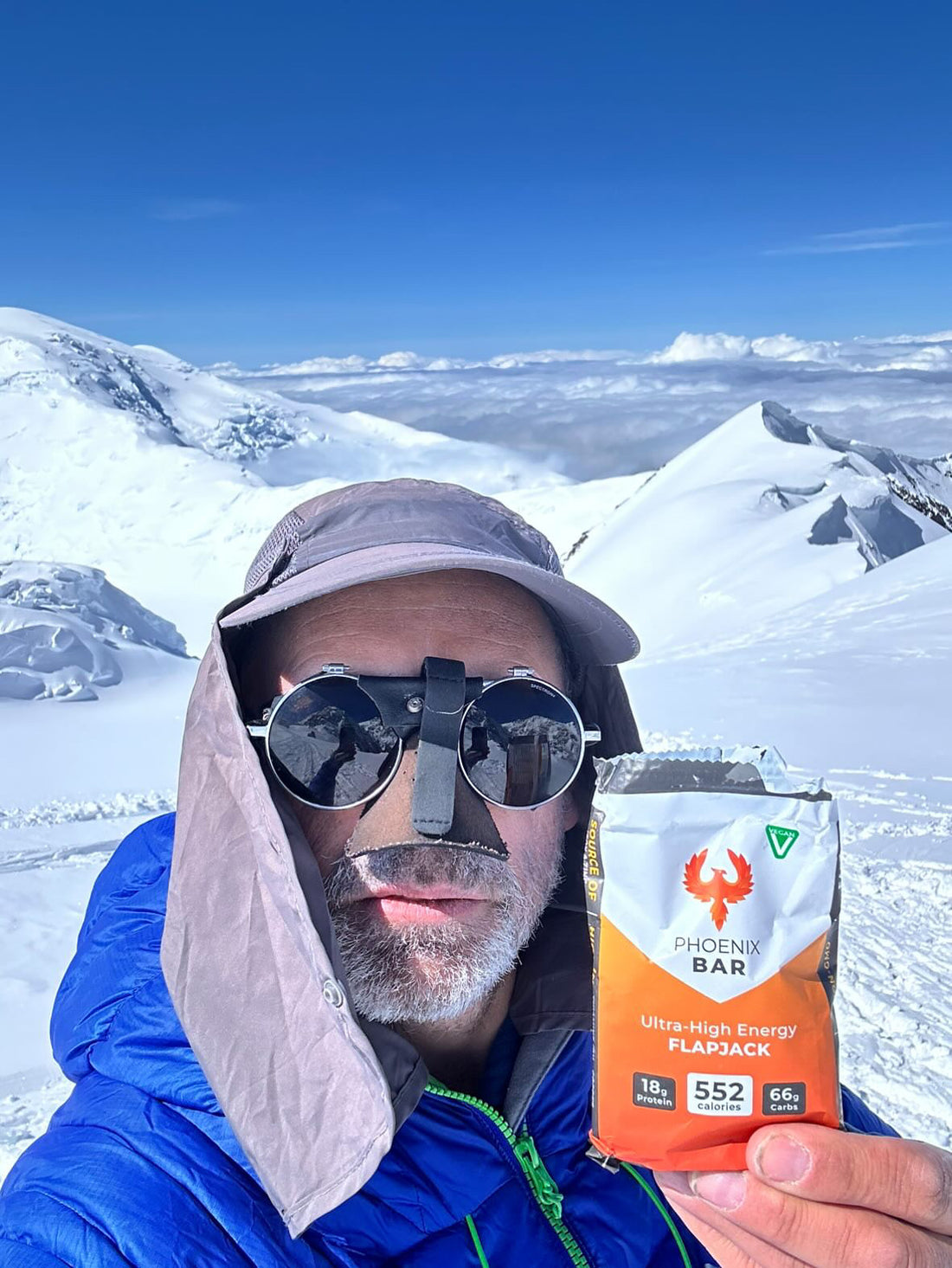
Up to 557 calories in a compact, lightweight bar of only 120g, with up to 66g of carbs and 19g of protein. Eat it whole, break it into pieces over a few hours, or mix it with water or milk for porridge.
Easy to eat, easy to digest and not sickly sweet. Customers have eaten them at -45°C and through the heat of the Marathon des Sables, and they keep for up to 2 years, so they work on a mountain, on a night shift, or at home on days when eating enough feels hard.
- 557 calories in only 120g (529 to 557 by flavour)
- 4.6 calories per gram
- 66g carbs per bar (up to)
- 19g protein per bar (up to)
