Three Peaks Challenge Food | What to Pack & Eat (2026 Guide)
The Three Peaks Challenge burns between 3,000 and 6,000 calories in a single push. Most people pack nowhere near enough food, eat the wrong things at the wrong times, and hit a wall somewhere on the final mountain.
This guide breaks the challenge down mountain by mountain, explains how much food you actually need to carry, and gives you a practical food plan you can follow on the day. It covers both the National Three Peaks (Ben Nevis, Scafell Pike, Snowdon) and the Yorkshire Three Peaks (Pen-y-ghent, Whernside, Ingleborough).
Written by James Frost, founder of Flaming Phoenix.
Why Food Matters More on the Three Peaks Than on a Normal Day Hike
A typical day hike lasts four to six hours. You can get away with a couple of sandwiches and some snacks because your body's glycogen stores, topped up from breakfast, will carry you most of the way. The Three Peaks is different for three reasons.
First, the total duration. The National Three Peaks typically takes 12 to 15 hours including driving. The Yorkshire Three Peaks takes 10 to 12 hours of walking with minimal breaks. Your glycogen stores are exhausted within the first two to three hours of sustained effort. Everything after that runs on what you eat during the day.
Second, the intensity profile is unusual. You are not walking at a steady pace on flat ground. You are climbing steeply, descending steeply, then sitting in a vehicle, then climbing steeply again. Each transition changes what your body needs and what your stomach can tolerate. Eating a heavy meal before a steep ascent is a recipe for nausea. Not eating enough between peaks means starting each mountain already depleted.
Third, the timing. Many National Three Peaks attempts start in the early hours of the morning or late at night. You may be climbing Ben Nevis at 3am. Your appetite at 3am is not the same as your appetite at lunchtime. You need food that you can eat when you do not feel like eating, which rules out a lot of the bulky, heavy meals that work fine on a leisurely weekend walk.
For general guidance on hiking nutrition and calorie density, see the Hiking and Trekking Nutrition Guide. This page focuses specifically on the unique demands of the Three Peaks format.
How Many Calories You Actually Need
The calorie burn varies significantly depending on your body weight, pace, and conditions, but here are realistic estimates for an average 75kg person carrying a light pack.
National Three Peaks:
Ben Nevis (4 to 5 hours): 1,800 to 2,500 calories. This is the longest and highest mountain. The path is well maintained but relentlessly steep above the halfway lochan, and weather conditions at the summit can be harsh even in summer. Cold and wind increase calorie burn further.
Scafell Pike (3 to 4 hours): 1,200 to 1,800 calories. Shorter than Ben Nevis but the terrain is rougher, especially on the corridor route. Navigation in poor visibility adds stress and time.
Snowdon (2.5 to 3.5 hours): 1,000 to 1,500 calories. Usually the final peak, tackled when fatigue is highest. The Llanberis path is the most straightforward route but still involves sustained climbing.
Driving and transition time (8 to 10 hours): 800 to 1,000 calories. You are still burning energy sitting in a vehicle, and your body is repairing muscle damage between peaks.
Total: 4,800 to 6,800 calories across the full challenge.
Most people eat roughly 2,000 calories on the day. That is a deficit of 3,000 to 5,000 calories. You will not collapse from this deficit in a single day, but you will absolutely feel it: heavy legs on the final ascent, difficulty concentrating, irritability, and that specific miserable feeling where every step feels harder than it should.
Yorkshire Three Peaks:
The total burn is lower because there is less elevation gain and no driving breaks, but the continuous nature of the walk (25 miles with 1,585 metres of ascent) means there are fewer opportunities to eat properly. Expect 3,000 to 5,000 calories of total expenditure over 10 to 12 hours.
You do not need to replace every calorie during the challenge. Your body will draw on fat reserves and stored glycogen. But you should aim to consume at least 200 to 300 calories per hour of active walking and a proper meal between peaks (National) or at the midpoint (Yorkshire). That means packing a minimum of 2,500 to 3,500 calories of food for the day.
What to Look for in Three Peaks Food
The food you pack needs to meet four criteria that most normal meals fail.
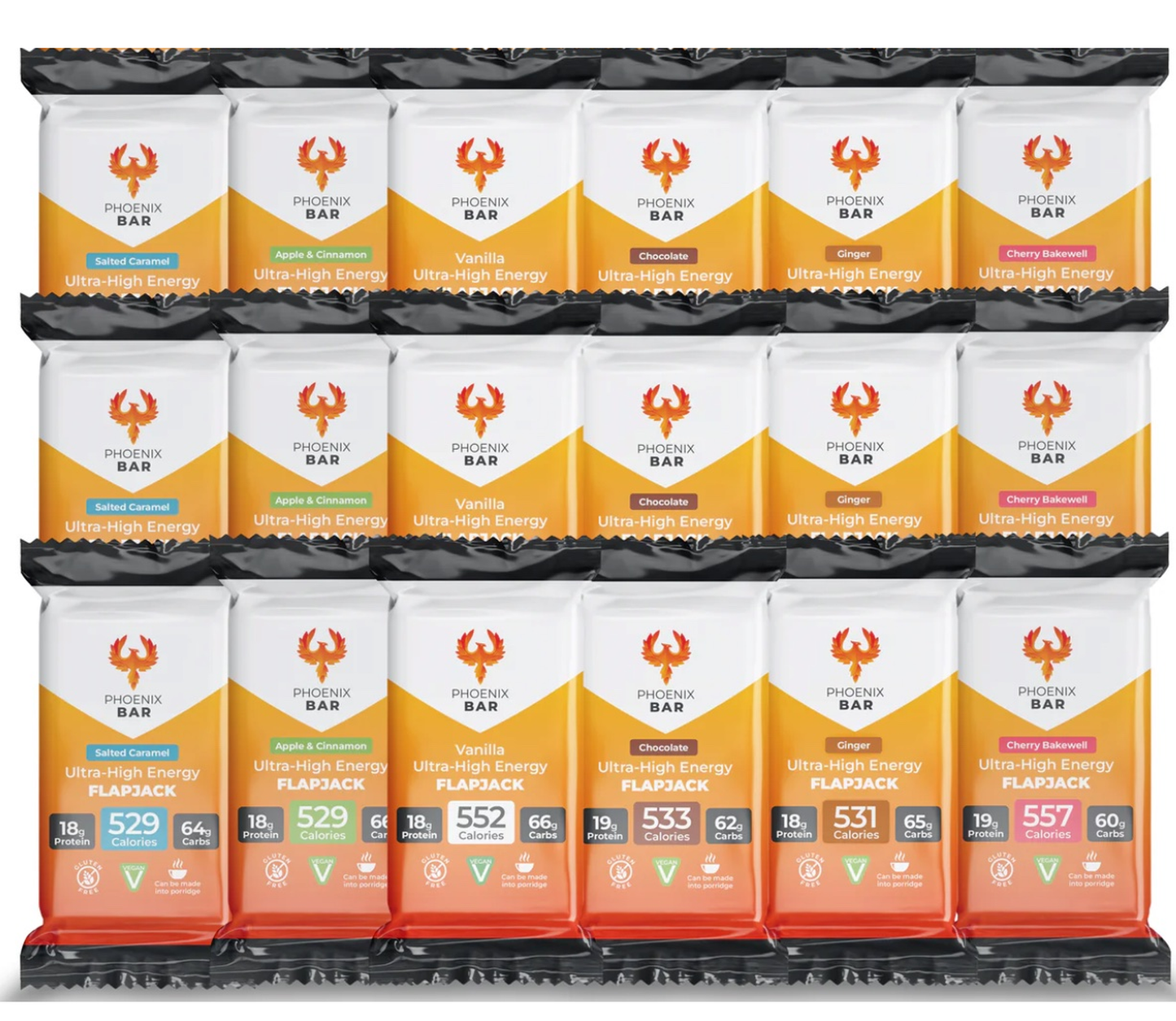
Calorie density. You are carrying everything on your back for hours at a time. A cheese sandwich provides around 300 calories but weighs 150 to 200 grams and takes up significant space. A Phoenix Bar in Cherry Bakewell flavour provides 557 calories in 120 grams, with other flavours delivering over 500 calories per bar. When you are packing 3,000+ calories of food, the weight and volume difference between low-density and high-density options adds up fast.
Edibility on the move. You need food you can eat while walking, with cold hands, without cutlery, in rain, at 3am when you have no appetite. Anything that requires preparation, heating, cutting, or assembling is impractical. Bars, nuts, dried fruit, and individually wrapped snacks work. Tupperware containers of pasta salad do not.
Stomach tolerance. Steep climbing on a full stomach causes nausea. High-fat foods digest slowly, which is fine between peaks but problematic 20 minutes before an ascent. High-sugar foods cause energy spikes followed by crashes. The best on-mountain food is moderate in sugar, easy to digest, and can be eaten in small amounts throughout the climb rather than in one large sitting.
Resilience. Your food will spend 12 to 24 hours in a rucksack, possibly in rain, heat, or sub-zero temperatures. Chocolate melts in summer and becomes rock-hard in winter. Bananas get crushed. Sandwiches go stale. You want food with a long shelf life that survives being bashed around at the bottom of a pack.
What People Are Using on the Three Peaks
Rhys Richards used Phoenix Bars on a Three Peaks Challenge in June 2025. He said: "We both felt amazing on them. It's so hard to fuel a 50 to 60 minute high-intensity effort on actual food, but the bars gave us a really clean, steady energy, none of that sugary spike-and-crash you get from gels."
Andrew Tomlinson used Phoenix Bars as his main solid food source during the Spine Sprint and on a Yorkshire run in June 2025: "They were my main source of solid food. I just broke a bit off in small amounts continuously, right until the end. A welcome change from all the sweeter alternatives and gels."
Steve tested Phoenix Bars in the Brecon Beacons in January 2026 in challenging conditions: "What ended up a very wet and windy, minus 11 degrees wind chill wander, I may have been wet but I wasn't hungry, or tired. Managed to go through 2 or 3 bars on the hills."
Andrew Cope used a Phoenix Bar on Pen Y Fan in October 2025 before heading to Nepal: "We used one on the weekend when we were up Pen Y Fan and enjoyed the flavour and the boost it gave us."
Frederick Newton used Phoenix Bars while mountaineering in Wales in September 2024: "They pack a high amount of energy into a compact size, perfect for when I needed a substantial boost without feeling particularly hungry."
All reviews are verified and published on the Phoenix Bars reviews page.

Phoenix Bars: Up to 557 Calories Per Bar
Soft, easy to eat whole or as a warm porridge. Contain up to 66g of carbs and 19g of protein.
Mountain-by-Mountain Food Plan
Before You Start: The Pre-Challenge Meal
Eat a proper meal two to three hours before you begin the first mountain. Porridge, toast with peanut butter, eggs on toast, or a bowl of pasta all work well. The goal is slow-release carbohydrates with some protein. Avoid anything greasy or heavy that will sit in your stomach during the first ascent.
If you are starting in the early hours (common on the National Three Peaks), eat before you leave even if you do not feel hungry. Your body needs the fuel regardless of what your appetite says at 2am.
Peak 1: Ben Nevis (National) or Pen-y-ghent (Yorkshire)
You will not feel hungry on the first mountain. Adrenaline and a full stomach from your pre-challenge meal will carry you through the first hour or two. This is a trap. If you wait until you feel hungry to start eating, you are already behind.
Start eating within the first 45 minutes. Small amounts, consistently. A few bites of a bar every 20 to 30 minutes is better than eating a whole bar in one go. Sip water regularly.
Good options for Peak 1: flapjack bars, oat-based snack bars, banana (if it is the first peak and has not been crushed yet), jelly sweets for quick sugar if energy dips on the descent.
Between Peaks (National) or Ribblehead to Whernside (Yorkshire)
This is your most important eating window. On the National challenge, you have two to three hours in a vehicle between mountains. On the Yorkshire, you have the long flat section between peaks where the pace drops and your stomach settles.
This is when you eat your most substantial food. A wrap, a filled roll, a portion of pasta, or a combination of calorie-dense snacks that together add up to a proper meal. Aim for 500 to 800 calories during each transition.
This is also the point where many people realise they packed the wrong food. They have four more flapjack bars and they cannot face another sweet thing. Pack at least one savoury option for this stage: salted nuts, cheese, a peanut butter wrap, crisps, or something with salt and substance.
If you are using Phoenix Bars, the transition between peaks is also when the porridge format becomes useful. Adding hot water from a flask turns a bar into a warm, easy-to-eat meal that provides over 500 calories without the volume of a traditional hot meal. This is especially valuable on cold-weather attempts or night starts when a warm food option makes a real difference to morale.
Peak 2: Scafell Pike (National) or Whernside (Yorkshire)
By now you have been going for five to eight hours. Fatigue is building. Appetite may be dropping. The food you packed that seemed appealing at home may now seem revolting. This is completely normal.
Switch to whatever you can actually get down. If sweet foods are making you feel sick, go savoury. If solid food feels too heavy, switch to energy drinks or smoothie pouches. The priority is getting calories in, not eating "perfectly."
Keep the same pattern: small amounts every 20 to 30 minutes. Do not stop eating just because you are not hungry. Your muscles need the fuel whether your brain agrees or not.
Between Peaks 2 and 3 (National) or Ingleborough Approach (Yorkshire)
Repeat the transition eating strategy. Another 500 to 800 calories. Hot drink if possible. Savoury food if you have been eating sweet all day.
This is also a good time to assess what food you have left and ration it for the final mountain. Running out of food on the last peak is miserable and avoidable.
Peak 3: Snowdon (National) or Ingleborough (Yorkshire)
The final mountain. You are tired, possibly cold, and your appetite may have disappeared entirely. This is where calorie-dense food earns its place most clearly. You may only be able to eat small amounts, so every bite needs to count.
Eat something at the base before you start climbing. Even half a bar or a handful of nuts. Then continue nibbling throughout the ascent. Jelly sweets and boiled sweets work well here because they dissolve in your mouth without needing to chew, which matters when you are breathing hard on a steep climb.
Save one thing you genuinely enjoy for the summit or the descent. A chocolate bar, your favourite flavour of something, a can of fizzy drink from the car. The psychological boost of having something to look forward to is a real performance factor after 10+ hours.
After You Finish
Eat a proper meal within an hour of finishing. Carbohydrates and protein for recovery. A burger, fish and chips, a pub meal, whatever you can get. Your body has been running a significant calorie deficit and the sooner you start replenishing, the less awful you will feel the next day.
Three Peaks Food Comparison: Calories per Gram
Not all trail food is created equal. Here is how common Three Peaks snack options compare on the metric that matters most when you are carrying everything on your back.
A Phoenix Bar in Cherry Bakewell flavour delivers 557 calories in 120g, which works out to 4.6 calories per gram. Other Phoenix Bar flavours deliver over 500 calories per bar at a similar ratio. A Snickers bar gives you 245 calories in 52g (4.7 cal/g) but is mostly sugar and melts easily. A full bar of Kendal Mint Cake provides 340 calories in 85g (4.0 cal/g). A Soreen malt loaf bar offers just 131 calories in 42g (3.1 cal/g), meaning you would need over four of them to match one Phoenix Bar. A typical flapjack provides around 280 calories in 70g (4.0 cal/g). Trail mix with nuts and dried fruit comes in at roughly 450 calories per 100g (4.5 cal/g). A peanut butter wrap gives you about 400 calories in 100g (4.0 cal/g).
At the low end, a cheese sandwich provides around 350 calories but weighs 180g (1.9 cal/g), and a banana gives you only 105 calories in 120g (0.9 cal/g).
The practical difference: to pack 3,000 calories from cheese sandwiches alone, you would be carrying roughly 1.5kg of food. The same calories from a mix of Phoenix Bars, trail mix, and wraps weighs under 800g. Over a 12-hour day with three mountain ascents, that weight saving in your pack is noticeable.
Phoenix Bars are vegan and gluten-free, which matters when you are packing food for a group where someone has a dietary restriction. One product that everyone can eat simplifies the logistics. Full nutritional information and all six flavours are on the product page.
The Three Peaks Food Checklist
Here is a sample packing list for a National Three Peaks attempt, targeting roughly 3,500 calories.
On-mountain food (carried in rucksack): 2 x high-calorie bars (1,000+ calories, minimal weight), a bag of trail mix or salted nuts (300 to 400 calories), a pack of jelly sweets or wine gums (200 calories), one savoury snack you enjoy (crisps, salted pretzels, cheese biscuits)
Transition food (kept in vehicle): 2 x wraps or filled rolls (600 to 800 calories), one hot flask of water for making porridge or hot drinks, a banana or easy fruit (first transition only, it will not survive a full day), a chocolate bar or treat saved for after the final peak, electrolyte tablets or sports drink for hydration
Emergency reserve: One extra bar or handful of nuts that you do not touch unless you run out of everything else or someone in your group needs food. On a mountain in poor weather, having extra food is a safety measure, not a luxury.
This list is deliberately simple. Complex meal plans fall apart when you are tired, it is dark, and you just want to keep moving. Pack food you know you like, make sure the calories add up, and eat consistently from start to finish.
Phoenix Bars: up to 557 calories per bar, £4.99. Buy Phoenix Bars
Frequently Asked Questions
Should I carb-load before the Three Peaks?
A day or two of eating slightly more carbohydrate-rich meals will top up your glycogen stores, but you do not need to eat enormous plates of pasta. Just make sure you are well-fed and hydrated going into the challenge rather than starting on a calorie deficit from skipping meals because you were busy packing the car.
Can I rely on cafes and shops along the route?
On the Yorkshire Three Peaks, the Pen-y-ghent Cafe in Horton-in-Ribblesdale is a popular stop, and there are sometimes refreshment options at Ribblehead. On the National Three Peaks, there are service stations during the drives. But do not plan your nutrition around these. Opening times vary, queues can be long, and if you are doing a timed attempt, stopping for 20 minutes in a cafe is time you may not want to spend. Pack everything you need and treat any cafe stops as a bonus.
What about energy gels?
Gels deliver fast carbohydrates and work well for running events where you cannot chew. On the Three Peaks, you are walking at a pace where you can eat solid food, and solid food is generally better tolerated over a long day. Many people find that gels cause stomach discomfort when used repeatedly over 10+ hours. If you like gels, bring a couple as a backup for energy dips, but do not rely on them as your main fuel.
How much water should I carry?
A minimum of one litre on each mountain, more in hot weather. You can refill between peaks (from the vehicle on the National, or at Ribblehead on the Yorkshire). Adding an electrolyte tablet to at least one of your bottles helps replace the sodium you lose through sweat and can reduce the risk of cramps on later peaks.
What if I lose my appetite completely?
This is common on the final mountain. Switch to liquid calories (a sports drink or smoothie), dissolving sweets, or very small bites of something calorie-dense. Even 100 calories per hour is better than nothing. For more on eating when appetite is low, see the guide on eating when appetite is difficult.
Is the Yorkshire Three Peaks easier to fuel for than the National?
In some ways yes, because there is no driving and the total duration is shorter. But the continuous walking means you never get a proper sitting-down meal break the way you do between mountains on the National. You need to be more disciplined about eating on the move. Pack food that genuinely works one-handed while walking.
About Flaming Phoenix
Flaming Phoenix makes Phoenix Bars, high-calorie nutrition bars delivering up to 557 calories in a 120g bar (Cherry Bakewell flavour, other flavours over 500 calories). They are vegan, gluten-free, and have a two-year shelf life. Phoenix Bars have been used on Everest, at the South Pole, across the Atlantic, and by 50+ Marathon des Sables athletes. They are manufactured in the UK by a SALSA-certified facility.
Flaming Phoenix was founded by James Frost after approximately 150 conversations with endurance athletes and people who struggle to eat enough. The bars are designed for two audiences: people doing extreme endurance events who need maximum calories in minimum weight, and people with low appetite who need a compact way to maintain their calorie intake. Over 340 verified five-star reviews are published on the reviews page.
For more on how people use Phoenix Bars across different situations, see How to Use Phoenix Bars. For the full range of flavours and nutritional information, visit the product page.


Flaming Phoenix
High-Calorie Protein Bars for Endurance, Expeditions and Weight Gain