Polar Expedition Nutrition - Food for Extreme Cold Environments

Polar expeditions place unique demands on nutrition that go far beyond simply eating more. In temperatures below -30°C, your body burns significantly more calories just maintaining core temperature. Appetite frequently drops when you need fuel most. Many foods freeze solid and become impossible to eat. And every gram of food weight must be justified against the fuel, equipment, and shelter you also need to carry or haul on a pulk.
This guide covers the nutritional principles behind polar travel, what makes food suitable for extreme cold environments, and how to plan food for expeditions ranging from Arctic treks to South Pole crossings.
Why Polar Expeditions Demand More Calories
In temperate conditions, a moderately active adult requires roughly 2,000–2,500 calories per day. On a polar expedition — hauling a loaded pulk across ice, sastrugi, or snow for eight to twelve hours per day in temperatures that can drop below -40°C — calorie expenditure rises dramatically, often to between 5,000 and 7,000 calories per day.
This increase comes from three sources. The first is the sheer physical effort of hauling a pulk weighing 70–100kg or more across uneven terrain. The second is thermogenesis — the energy your body uses to maintain its core temperature when the ambient temperature is far below what your clothing and shelter can fully compensate for. The third is the metabolic cost of operating in a hostile environment over many consecutive days, where sleep quality is often poor and recovery is limited.
The practical consequence is that most polar travellers lose weight during their expedition regardless of how much they eat. The goal of a polar nutrition plan is not to eliminate this deficit entirely — that would require carrying an impractical amount of food — but to minimise it enough that you retain the strength, cognitive function, and morale to complete the journey safely.
Calorie Density — The Defining Metric
On a polar expedition, food weight is one of the largest components of total expedition weight. A 60-day unsupported South Pole crossing might require 90–100kg of food per person. Every calorie per gram of food weight matters enormously, because every unnecessary gram adds resistance to your pulk and slows your daily progress.
This is why calorie density — the number of calories provided per gram of food — is the single most important metric in polar food planning. For a detailed explanation of calorie density and how it applies across different situations, see our guide to calorie-dense foods.
Fats provide the highest calorie density at approximately 9 calories per gram. This is why traditional polar diets have always been fat-heavy: butter, pemmican, cheese, salami, and oils all deliver maximum energy for minimum weight. Carbohydrates and protein both provide roughly 4 calories per gram — less than half the density of fat, but essential for sustained energy, muscle repair, and cognitive function.
In practice, polar expedition food targets a calorie density of roughly 4.0–6.0 calories per gram across the overall food supply. Foods below 3.0 calories per gram are generally too heavy to justify carrying. Water-rich foods — tinned goods, fresh fruit, bread — are almost never carried because they add weight without proportional energy, and many will freeze solid.
The balance between fats, carbohydrates, and protein varies by expedition style and personal preference. A common approach is roughly 50% of calories from fat, 35% from carbohydrates, and 15% from protein. Some polar travellers push fat intake even higher. The key principle is that the ratio should be tested extensively before the expedition — the polar ice is not the place to discover that your stomach cannot tolerate a high-fat diet under exertion.
What Happens to Food in Extreme Cold
One of the most critical and least discussed aspects of polar nutrition is how food behaves at temperatures below -20°C. Many foods that work perfectly in temperate conditions become impractical or inedible in extreme cold.
Foods that freeze solid. Anything with significant water content will freeze. Bread, cheese, cooked meats, energy gels, and many commercial energy bars become rock-hard below -15°C. Biting into a frozen energy bar at -35°C risks cracking a tooth. This is not a minor inconvenience — it can eliminate a food source entirely from your daily plan.
Foods that become impossible to handle. Polar travellers eat during brief rest breaks while wearing thick gloves or mittens. Fiddly packaging, small wrappers, foods that crumble into tiny pieces, and anything requiring preparation become impractical. Food needs to be accessible quickly, edible with gloved hands, and consumable in a few minutes.
Foods that lose palatability. Taste perception changes in extreme cold. Sweet foods often become cloying. Monotonous flavours lead to food aversion over multi-week expeditions — a phenomenon well documented in polar literature. Variety in flavour and texture is not a luxury; it is a practical necessity for maintaining adequate intake over extended periods.
The ideal polar food is calorie-dense, soft enough to eat at extreme low temperatures, available in multiple flavours to prevent palate fatigue, packable in a format that can be accessed with gloved hands, and genuinely palatable after weeks of repetition. For more on how food texture affects ease of eating in demanding situations, see our guide to soft high-calorie foods.
Structuring a Polar Expedition Day
Most polar expeditions follow a structured daily pattern, and food is planned around it.
Breakfast is typically consumed in the tent before breaking camp. It needs to be high-calorie, quick to prepare, and warm if possible. The most common approach is a calorie-dense porridge made from oats, powdered milk, sugar, and added fat — often butter or coconut oil — prepared with boiling water from a stove. Some expeditions add protein powder, dried fruit, or nut butter. The goal is roughly 1,000–1,500 calories in a single sitting to provide the foundation for the day's travel.
Trail food is consumed during brief rest breaks throughout the day — typically every 60–90 minutes. This is where food must be accessible, edible in cold conditions, and calorie-dense enough to deliver meaningful energy in a few bites. Common options include chocolate, nuts, salami, cheese, flapjacks, energy bars, and dried fruit — though many of these freeze at the temperatures encountered on polar expeditions. For ideas on maximising calorie intake through snacking, see our guide to high-calorie snacks.
Dinner is the main meal, consumed in the tent after the day's travel. Freeze-dried or dehydrated meals rehydrated with boiling water are the standard approach — they are lightweight, compact, quick to prepare, and provide a warm, satisfying meal. Many polar travellers add butter, oil, or cheese to increase the calorie content of their evening meal beyond what the packet provides.
Additional calories are often consumed as hot drinks — hot chocolate made with powdered milk and sugar, or soup — and as a pre-sleep snack. Some polar travellers also carry a thermos filled with a high-calorie drink to consume during the day's travel. For approaches to boosting calorie intake through drinks, see our guide to high-calorie drinks, smoothies and milkshakes.

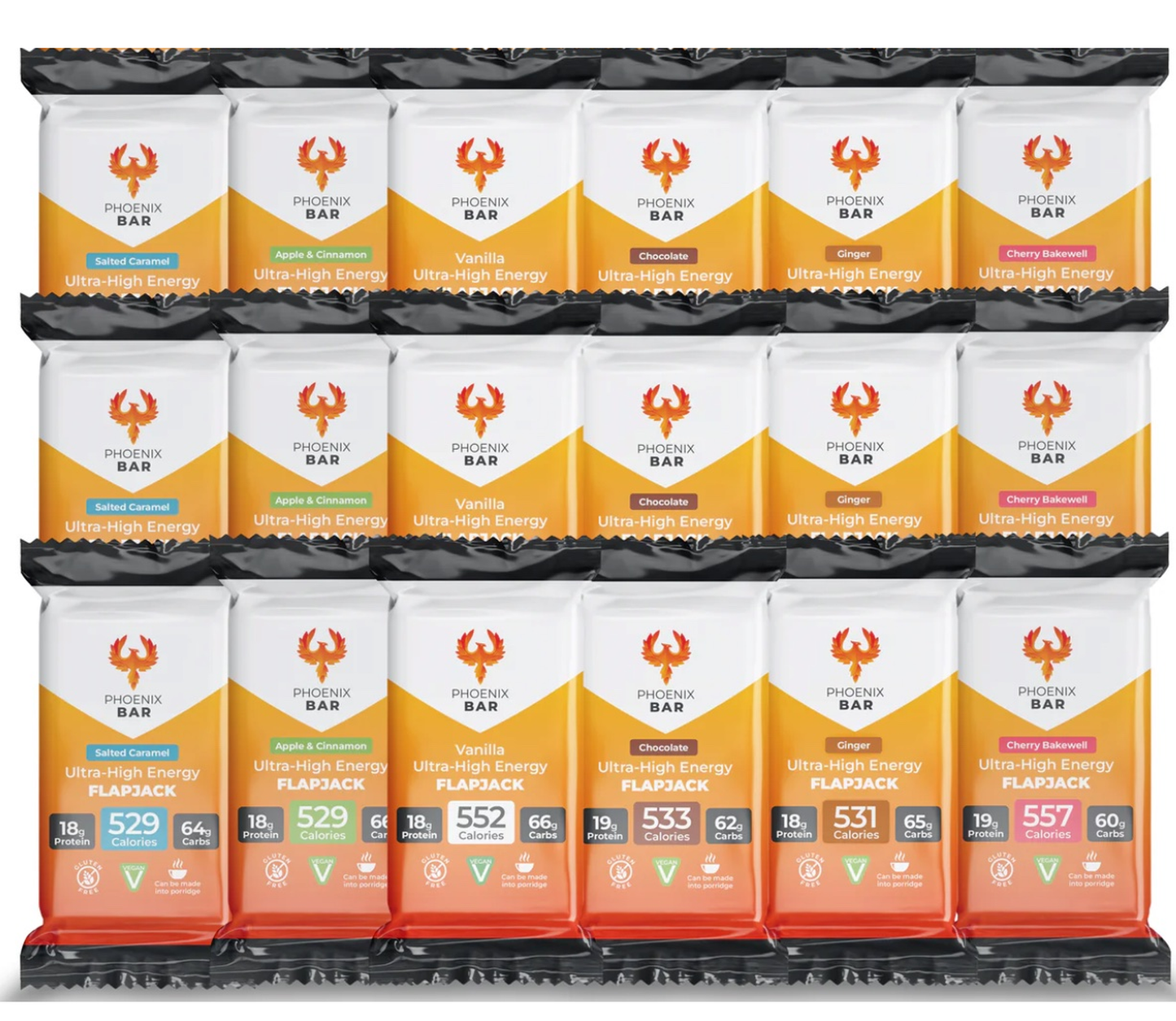
Phoenix Bars: Up to 557 Calories Per Bar
Highly lightweight, freeze-resistant nutrition bars which are specialised for Polar expeditions.
The Appetite Problem
One of the paradoxes of polar travel is that calorie requirements are at their highest precisely when appetite is often at its lowest. Cold, fatigue, altitude (on high-altitude polar plateaus), dehydration, and the psychological monotony of day after day of hauling across featureless terrain all suppress appetite.
This creates a dangerous feedback loop. Insufficient calorie intake leads to greater fatigue, which further suppresses appetite, which leads to a growing calorie deficit that compounds over days and weeks. By the time the deficit becomes apparent — through significant weight loss, reduced performance, or impaired decision-making — it may be difficult to recover.
The solution is disciplined eating: consuming food on a schedule regardless of hunger, choosing foods that are easy to eat when appetite is absent, and ensuring that every food item carried delivers maximum calories for its weight so that the practical barrier to eating is as low as possible.
For a broader discussion of strategies for maintaining calorie intake when appetite is reduced — including the principles of reducing portion size while increasing calorie density — see our guide on low appetite and difficulty eating enough calories.
Phoenix Bars in Polar and Extreme Cold Environments
Phoenix Bars have been used on expeditions to the South Pole, across Greenland, in the Arctic, on 8,000-metre Himalayan peaks including Everest, Manaslu, and Ama Dablam, and in ultra-endurance races at temperatures as low as -45°C. They were designed from the outset to remain soft and edible in extreme cold — a characteristic that distinguishes them from many energy bars and flapjacks that freeze solid below -15°C.
Each Phoenix Bar delivers up to 557 calories, weighs 125g, and provides approximately 4.5 calories per gram. They can be eaten whole, broken into pieces for trail snacking with gloved hands, or crumbled into hot water to make a calorie-dense porridge — an approach several polar and high-altitude mountaineers have adopted as a quick, high-calorie breakfast alternative.
Phoenix Bars are available in six flavours, which helps address palate fatigue on multi-week expeditions. They are vegan, gluten-free, and have up to a two-year shelf life — useful for expeditions that require food to be shipped months in advance.
Three characteristics come up repeatedly in feedback from people who have used Phoenix Bars in extreme cold:
They remain soft and edible at very low temperatures. At -45°C at the South Pole, at -40°C during the Beyond The Ultimate Ice Ultra, and during the Winter Spine Race in sub-zero conditions, Phoenix Bars stayed soft enough to eat when other foods in the same pack had frozen solid. One Ice Ultra competitor noted that the bars did not freeze at all despite temperatures reaching -40°. A Winter Spine finisher described how the bars remained soft enough to eat while other food was too hard to consume.
They reduce weight loss on extended expeditions. One mountaineer who has summited both Everest and Denali using Phoenix Bars reported that on a previous Denali attempt without them, he lost 16 pounds — but with Phoenix Bars as part of his food supply, he lost only 8 pounds on the same mountain. He attributed this partly to the bars' calorie density and partly to the fact that they were easy to eat consistently throughout the day without stopping.
They work when appetite fails. At high altitude and in extreme cold, appetite suppression is one of the biggest barriers to adequate calorie intake. Multiple users on Himalayan expeditions above 6,000m have described Phoenix Bars as one of the few foods they could consistently eat when appetite had dropped and other food felt unappealing. One climber on a tough Indian Himalayas expedition described them as having "saved the day" when high-altitude appetite issues made other food difficult to manage.
Further feedback from polar and extreme-environment users:
"Flaming Phoenix Bars featured as a star in my food supply for my recent South Pole expedition! Easy to eat, even at -45°C. Apple and cinnamon was a particular standout."
"Having tried many high-calorie flapjacks during my travels such as to the North and South Poles, I found this one really good, tasty and providing the calories — having just used it in Greenland."
"I used Phoenix Bars on a 5-day trek across Iceland and I enjoyed breaking off small pieces as they are really high in calories and because they aren't overly sweet."
Planning Your Polar Food Supply
When planning food for a polar expedition, consider the following:
Calculate total calorie requirements. Multiply your target daily intake (typically 5,000–7,000 calories) by the number of expedition days, plus a reserve of at least 10–15% for delays caused by weather, navigation issues, or slower-than-expected progress.
Calculate total food weight. Divide your total calorie requirement by the average calorie density of your food supply. If your food averages 5.0 calories per gram, a 60-day expedition requiring 6,000 calories per day needs approximately 72kg of food — a significant proportion of total expedition weight.
Test everything before the expedition. Your digestive system, taste preferences, and tolerance for specific foods under exertion may be very different from what you expect. Test your complete food plan during training, ideally in cold conditions and under physical load. Discovering that you cannot tolerate your chosen breakfast porridge after three consecutive days is far better discovered during a training weekend than on day four of a South Pole crossing.
Plan for variety. Palate fatigue is a genuine risk on any expedition lasting more than a week. Carry foods in multiple flavours and textures. Rotate snack options daily. Include at least one indulgent item — something that feels like a treat rather than fuel.
Account for packaging. Remove all unnecessary packaging before departure to save weight. Repackage into labelled zip-lock bags or similar. Ensure that everything can be opened and accessed with gloved hands.
For practical guidance on how to use Phoenix Bars across different expedition contexts — including as a porridge, a trail snack, or a calorie supplement alongside main meals — see How to Use Phoenix Bars. For the full product range, see Phoenix Bars.
Frequently Asked Questions
How many calories do you need on a polar expedition? Most polar expeditions require between 5,000 and 7,000 calories per day, depending on the intensity of travel, environmental conditions, and individual body weight. Even at this intake level, most polar travellers lose weight over the course of a multi-week expedition.
Why do polar explorers eat so much fat? Fat provides 9 calories per gram — more than double the calorie density of carbohydrates or protein. When every gram of food must be carried or hauled, fat delivers the most energy for the least weight. It also provides sustained energy release and helps maintain body temperature in extreme cold.
What foods freeze on a polar expedition? Most foods with significant water content freeze solid below -15°C, including bread, cheese, energy gels, many energy bars, cooked meats, and fruit. Nuts, chocolate, dried fruit, and foods specifically designed for cold environments — such as Phoenix Bars — generally remain edible at much lower temperatures.
Can you cook on a polar expedition? Yes. Most polar expeditions carry a stove and fuel for melting snow (the primary water source) and preparing hot meals. Cooking is typically limited to breakfast and dinner, with trail food consumed cold during the day's travel. Fuel weight is a significant consideration, so meals that require only boiling water — such as freeze-dried or dehydrated meals — are preferred over those requiring prolonged cooking.
How do you prevent weight loss on a polar expedition? Significant weight loss is difficult to avoid entirely. The most effective strategies are maximising calorie density of food carried, eating on a disciplined schedule regardless of appetite, adding extra fat (butter, oil) to meals where possible, and choosing foods that remain palatable and easy to eat in extreme cold so that the practical barriers to eating are minimised.
This guide is part of our series on nutrition for extreme environments. For related reading, see our guides to high-altitude mountaineering nutrition and ultra-endurance and expedition nutrition.


Flaming Phoenix
High-Calorie Protein Bars for Endurance, Expeditions and Weight Gain