

Food for Antarctica: what South Pole and crossing skiers eat
In this guide

 Written by James Frost, founder of Flaming Phoenix. Updated October 2026.
Antarctica has no farms or shops, so almost everything eaten there arrives by ship or plane. Research stations run on frozen, tinned and dried stores plus some hydroponic salad. Skiers heading for the South Pole haul all of theirs: usually 5,000 to 6,500 calories a day, which at about 5 calories per gram is 1 to 1.3kg of food a day.
This page answers both versions of the question. The first section covers what station crews eat. The rest is for anyone planning a ski expedition to the Pole or across the continent: the calories measured on real crossings, the weight of food you will drag, and how food and help reach you through Antarctic Logistics & Expeditions (ALE), which runs the camp at Union Glacier and the flights in from Punta Arenas, Chile. Flaming Phoenix makes Phoenix Bars.
What do people eat in Antarctica?
People on Antarctic research stations eat food that arrives once a year on the resupply ship, most of it frozen or tinned. The Australian Antarctic Program plans on about 780kg of food and 380 litres of drinks per person per year, drawn from around 700 different products. Fresh vegetables and eggs last for the first few months; eggs kept at about 4°C, oiled and turned weekly, keep for up to eight months. After that it is frozen, tinned and dried food, with salad from each station's hydroponics room.
A station chef cooks most meals, and the Midwinter Dinner in June, a tradition that goes back to Scott's 1901 to 1904 expedition, is the big meal of the year. One rule surprises visitors: on the Australian program, chicken, turkey and eggs are not taken out into the field, to keep poultry disease away from penguins, according to the Australian Antarctic Division.
The early explorers ate very differently. Their sledging food was built on pemmican, which Ohio State's Byrd Polar archive describes as made chiefly from beef, dried fruit and suet, cooked with melted snow into a meat soup called hoosh, plus seal, penguin and seabird meat when they could get it. The modern descendant of that ration is covered in my guide to sledging rations.
How many calories does an Antarctic expedition burn?
Hauling a sledge across Antarctica can burn 7,000 to 8,500 calories a day for weeks, with peaks above 11,000: more than any team in the table below managed to eat. The clearest figures come from Ranulph Fiennes and Mike Stroud's 1992 to 1993 crossing, where calorie use on the ice was measured with doubly labelled water.
Stroud and colleagues reported in the European Journal of Applied Physiology in 1997 that over the first 50 days the two men burned about 7,000 and 8,500 calories a day, rising to 10,660 and 11,640 a day between days 20 and 30, while eating about 5,090. Both lost more than a quarter of their body weight.
The table puts the best-documented Antarctic journeys side by side. Every figure comes from the paper or report linked in this section or in the sources at the end.
| Expedition | Season | Distance and time | Food per day | What happened |
|---|---|---|---|---|
| Scott's polar party | 1911 to 1912 | To the Pole and back towards base | About 4,400 kcal eaten, nearly 7,000 burned (2012 estimate) | The polar party of five died on the return |
| Fiennes and Stroud | 1992 to 1993 | About 2,300km in 95 days, 222kg sledges | About 5,090 kcal | Each lost over 25% of body weight; stopped on the Ross Ice Shelf, short of the open sea |
| Henry Worsley, solo | 2015 to 2016 | 913 miles (1,469km) in 71 days | Not published | Called for rescue about 30 miles (48km) from his goal; died in hospital in Punta Arenas |
| SPEAR17, six Army Reserve men | 2017 to 2018 | 1,750km in 67 days | 6,500 kcal packed, about 92% eaten | Lost 6.5% of body mass and 40% of their fat; lean mass held |
| Ice Maiden, six Army women | 2017 to 2018 | 1,700km in 61 days | 5,000 kcal packed, about 85% eaten | Lost 7.8% of body mass and 30% of their fat |
| Colin O'Brady and Louis Rudd, separate solo trips | 2018 | About 1,500km (932 miles); O'Brady 54 days, Rudd about two days longer | Not published | Both finished; the last 366 miles followed the graded South Pole Traverse road, so some polar historians dispute the "unassisted" label |
The military figures come from Hattersley and colleagues in Scientific Reports (2020); Worsley's from National Geographic; the O'Brady and Rudd details from a later National Geographic investigation; Scott's from Lewis Halsey and Mike Stroud's 2012 analysis, reported by ScienceDaily.
Every team that ate and kept records lost weight on 4,250 to 6,000 calories a day. So plan for a deficit, and plan food that actually gets eaten: the Ice Maiden packs held 5,000 calories a day and the women finished about 85% of them.
How much food do you need to ski to the South Pole?
For the usual route from Hercules Inlet, budget about 60 days of food at 6,000 calories a day, which comes to 60 to 90kg depending on how dense it is. ALE gives the route as 1,126km with an average of 53 days, so 60 days leaves a week for storms and slow days.
The table shows what calorie density does to that load, for 6,000 calories a day over 60 days. A bag of porridge oats and bars sits near the top row; the bottom row needs a large share of the weight in butter and oil.
| Calories per gram of food | Food per day | Food for 60 days |
|---|---|---|
| 4.0 | 1.5kg | 90kg |
| 4.5 | 1.33kg | 80kg |
| 5.0 | 1.2kg | 72kg |
| 5.5 | 1.09kg | 65.5kg |
| 6.0 | 1.0kg | 60kg |
Moving from 4 to 5 calories per gram takes 18kg off the sledge. That is why polar food bags carry so much butter, at 744 calories per 100g in the UK's CoFID food tables, and olive oil at 899, and why the dense high calorie bars in a chest bag are there for ease of eating more than for weight.
If you are skiing only the Last Degree, the final 111km from 89°S, the sums are smaller: ALE's 2021 group took six days, so a week of food at 5,000 calories a day and 5 calories per gram is about 7kg.
What goes in an Antarctic food bag?
Most South Pole teams eat a hot breakfast and dinner in the tent and graze from a bag of snacks during the day. Mountain Professionals' Hercules Inlet expedition, for example, supplies freeze-dried breakfasts and dinners, plus lunches of energy bars, chocolate, salami, cheese and other high-calorie snacks. Skiers then stir butter or oil into the evening meal, add sugar and milk powder to hot drinks, and keep salty food in the mix so the day is not all sweet.
A weighed, meal-by-meal day of polar food, with stove fuel, is set out in my Greenland crossing food plan. The same day scales up for Antarctica: more days, a bigger reserve and a heavier sledge. Bars are compared on calories per gram and cold handling in my ranking of the best energy bars for expeditions.
Which foods can you still eat at minus 30°C?
The average summer month at the South Pole is minus 28°C, according to the US Antarctic Program, and the Pole sits at 2,835m. Anything with a lot of water in it freezes hard: bread, fruit, cooked food, a drink left in a bottle. Foods with very little water, such as nuts (about 6% water in CoFID), chocolate (under 1%) and butter (15%), stay biteable for longer but still turn brittle.
Two habits make most of the difference. Keep the day's snacks inside your jacket in a chest or hip bag, and keep hot drinks in a vacuum flask. Break bars and chocolate into bite-sized pieces in the tent the night before, because doing it in mitts at minus 30°C is slow and cold on the hands.
Shaun Weston, who took Phoenix Bars on his South Pole expedition, wrote in January 2026: "Easy to eat, even at -45c. Apple and cinnamon was a particular standout."
How do food and rescue work on an Antarctic expedition?
Most South Pole teams fly to Punta Arenas, then to ALE's camp at Union Glacier, and a ski plane takes them to the start; Mountain Professionals' Hercules Inlet trip reaches the start by Twin Otter from Union Glacier. Buy or send your food in time to pack it into daily bags before the flight south, and avoid anything with a short shelf life.
Rescue is possible, but slow, weather-bound and expensive. In January 2016 ALE airlifted Henry Worsley from the ice to Union Glacier, and he was flown on to hospital in Punta Arenas. National Geographic later reported that a single flight from the end of a crossing back to ALE's base cost more than $100,000. Pack so that a week pinned in the tent costs you comfort, not safety: carry five to seven days of reserve food on top of the plan.
Where do Phoenix Bars fit on an Antarctic expedition?
Phoenix Bars carry up to 557 calories in a compact, lightweight 120g bar, 4.4 to 4.6 calories per gram. That is denser than porridge oats (3.8 in CoFID), and on a polar trip they go in the chest bag as quick food you can eat in a five-minute stop. Each bar also has up to 66g of carbohydrate and 18 to 19g of protein, comes in six flavours, and stirs into water as porridge on a morning when nothing else appeals.
Two or three a day is a sensible share: one at breakfast or in the evening and one or two in the chest bag. For a 55-day Hercules Inlet trip that is 110 to 165 bars; four Complete Bundles (144 bars, £756) sit in the middle. Shelf life is up to two years (Cherry Bakewell 12 months), so you can order months ahead. If you are ordering for a team, email me first at jfrost@flaming-phoenix.co.uk.
Pack them alongside freeze-dried dinners for a hot evening meal, and salty food such as salami and cheese to break up a sweet day. For the porridge method and cutting bars for gloves, see how to use Phoenix Bars and my high calorie porridge guide.
Frequently asked questions
How long does it take to ski to the South Pole?
From Hercules Inlet, the 1,126km route takes about 53 days on average, according to ALE's expedition round-up; its 2021 team took 56. Skiing only the Last Degree, the final 111km from 89°S, takes about a week, and ALE's 2021 group did it in six days. Pack food for the slow end of your estimate plus a reserve.
Did Scott's team starve?
Largely, yes. A 2012 analysis by Lewis Halsey and Mike Stroud, reported by ScienceDaily, estimated that Scott's polar party ate around 4,400 calories a day while burning nearly 7,000 hauling sledges, and concluded that they died from chronic, extreme emaciation. Modern teams pack 5,000 to 6,500 calories a day and still lose weight.
What is pemmican?
Pemmican is a dense block of dried meat and fat; the Byrd Polar archive describes it as made chiefly from beef, dried fruit and suet. Early Antarctic expeditions cooked it with melted snow into hoosh. Modern teams mostly use freeze-dried meals with added butter instead, which are easier to keep eating for weeks. My sledging rations guide traces the change.
Can you be rescued in Antarctica?
Yes, but not quickly. A private expedition relies on its logistics company sending a ski plane when the weather allows a landing, which can mean days of waiting. ALE flew Henry Worsley out in 2016, and a flight from the end of a crossing back to its base has cost more than $100,000. Rescue insurance and a food reserve are both part of the plan.
How much weight do polar skiers lose?
Expect to come home several kilos lighter, even when fed well. In the 2020 Scientific Reports study of two British Army teams, the men lost 6.5% of body mass and the women 7.8% over about two months, mostly fat. Fiennes and Stroud, eating about 5,090 calories a day for 95 days, each lost more than a quarter of their body weight.
Sources: Australian Antarctic Program, station food; Australian Antarctic Division, what food do you eat?; Ohio State University Byrd Polar archive, food of Antarctic exploration; Stroud et al. 1997, European Journal of Applied Physiology; Hattersley et al. 2020, Scientific Reports; ScienceDaily on Halsey and Stroud 2012; National Geographic on Henry Worsley; National Geographic on the 2018 crossings; ALE 2021 expedition round-up; Mountain Professionals, South Pole from Hercules Inlet; US Antarctic Program, South Pole; CoFID, Public Health England.
Related guides
Polar expedition nutrition | Greenland crossing food | Sledging rations | Expedition kit list | Adventure nutrition | Ultra-endurance and expedition nutrition guide | Calorie-dense foods | Ultra high carb solid foods | Energy gel alternatives | High altitude mountaineering | Ocean rowing nutrition
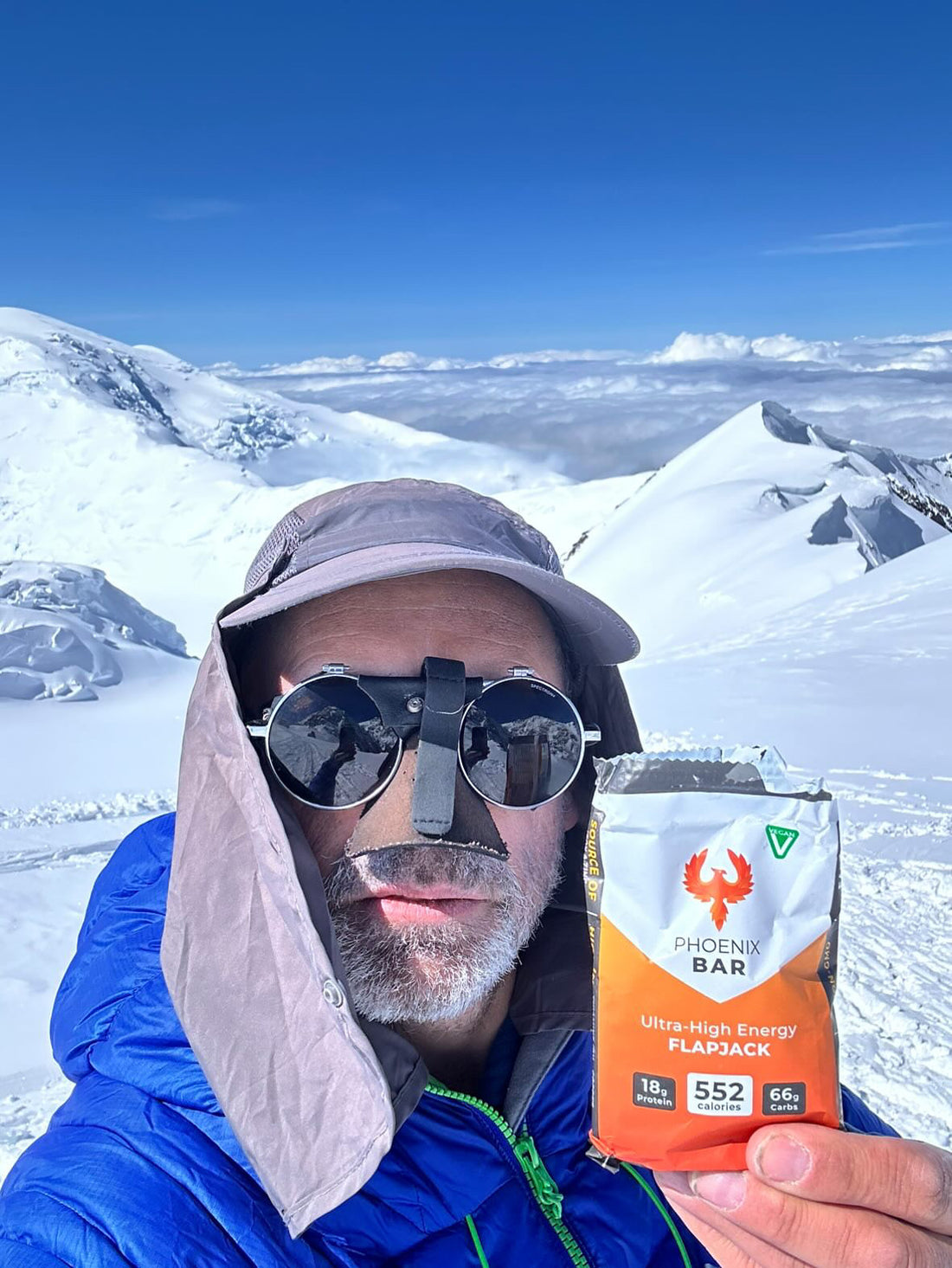
Big calories. Small bar.
Up to 557 calories in a compact, lightweight bar of only 120g, with up to 66g of carbs and 19g of protein. Eat it whole, break it into pieces over a few hours, or mix it with water or milk for porridge.
Easy to eat, easy to digest and not sickly sweet. Customers have eaten them at -45°C and through the heat of the Marathon des Sables, and they keep for up to 2 years, so they work on a mountain, on a night shift, or at home on days when eating enough feels hard.
- 557 calories in only 120g (529 to 557 by flavour)
- 4.6 calories per gram
- 66g carbs per bar (up to)
- 19g protein per bar (up to)
