GR20 Corsica Nutrition Guide: How to Fuel Europe's Toughest Thru Hike
The GR20 is a 180km high-mountain traverse of Corsica with around 12,000m of elevation gain, split into 16 stages between Calenzana in the north and Conca in the south. Most hikers complete it in 14 to 16 days. Daily energy expenditure sits between 4,500 and 6,000 calories for a fit hiker carrying a 9 to 13kg pack across rocky, exposed terrain. The fuelling problem on the GR20 is not finding food. Every refuge has a small shop and a guardian-cooked dinner. The problem is calorie density, gluten and vegan availability, monotony after day three, and getting enough fuel into your body when heat and altitude blunt your appetite. This guide solves those four problems.
Written by James Frost, founder of Flaming Phoenix and creator of Phoenix Bars, the 557-calorie 120g bar made for endurance and expedition fuelling. Last reviewed May 2026.
Quick facts: GR20 in numbers
The GR20 runs 180km from Calenzana to Conca with 12,000m of vertical gain, although tracked watch data from hikers including Karolina Tuszynska at Breaking the Borders shows total elevation change closer to 28,000m once descent is included. The trail is officially split into 16 stages, most around 10 to 15km, with 5 to 8 hours of effective walking per stage and ascents of up to 1,200m on the toughest day. Around 10,000 to 20,000 hikers complete it each year. The fastest known time was set by Lambert Santelli in 2021 at 30 hours 25 minutes, which gives a sense of how compressed the energy demand can become for fastpackers and trail runners. Most people walk it between mid-June and mid-September when the refuges are staffed.
Why fuelling decides whether you finish the GR20
Three things make the GR20 different from almost every other long-distance European trail when it comes to nutrition.
The first is the consecutive nature of the load. The GR20 is not one hard day. It is up to sixteen hard days back to back, with no real rest, no taxi-accessible bailout for long stretches and granite underfoot that hammers your legs on every descent. Recovery happens overnight in a dormitory, eating whatever the refuge has prepared. If you under-eat on day two, you pay for it on day six. Most hikers who quit the GR20 quit somewhere between stages four and seven, and the pattern is consistent: a deepening calorie deficit combined with sleep debt and accumulated leg damage.
The second is the food environment. There are no grocery stores on the trail. Resupply is only fully possible at Asco Stagnu, Castel di Vergio, Vizzavona at the midpoint, and Bavella in the south. Refuge shops carry the basics: pasta, tinned tuna, cheese, biscuits, charcuterie, chocolate. Refuge dinners are typically Corsican soup, then pasta with sausage or lentils, then cake or cheese for around 16 to 20 euros. They are honest, hearty meals that hit roughly 800 to 1,100 calories. They are also the same most nights, and pack weight pressure means most hikers carry only a day or two of food at a time. By stage four most people are sick of pasta. This is well documented across every major GR20 trail report, including TMBtent's guide and Tales of a Trail's resupply breakdown. The GR20 is not a place to assume you will magically want to eat. You won't, unless you have planned for it.
The third is the pack weight ceiling. Andrew McCluggage at Knife Edge Outdoor, who has covered the route extensively, recommends a maximum pack weight of 9kg for refuge-only hikers and 13kg for campers carrying their own shelter, including food and water. Every gram above that hurts you on the chains, ladders and slabs of the north. Calorie density per gram of pack weight is therefore the single most important number in your food plan. Bread is around 270 calories per 100g. Tuna is around 130 calories per 100g. Tinned sausage is around 250 calories per 100g. A Phoenix Bar is 464 calories per 100g, and unlike refuge bread, it does not go stale, get crushed, or need preparation.
For a wider primer on this kind of fuel-to-weight thinking, see our Ultra-Endurance and Expedition Nutrition Guide.
How many calories do you burn on the GR20
A reasonable, evidence-based target for daily intake on the GR20 is 4,500 to 6,000 calories, depending on body mass, pack weight, pace and ambient temperature. The published research on thru-hiking calorie expenditure converges on 300 to 500 calories per hour of moderate hiking, climbing toward 600 per hour on the steep, scrambling sections common in the GR20 north between Calenzana and Vizzavona. Most hikers move for 5 to 8 hours per day on the trail, with shorter active hours but higher intensity than something flat like the GR10.
Layer on basal metabolic rate (typically 1,500 to 2,000 calories for an adult), and you arrive at 4,500 calories as a floor and 6,000 as a realistic ceiling for stages with 1,000m or more of ascent. A useful internal benchmark: thru-hiker Hannah K. on the Pacific Crest Trail calculated 3,675 calories per day for 15-mile flat days at 75kg body weight. The GR20 has roughly double the vertical per kilometre, so the upper bound is higher.
Two physiological factors push your real intake below the calculated target.
Appetite suppression is the first. Peer-reviewed research published in High Altitude Medicine and Biology in 2018 shows that ghrelin (the hunger hormone) is suppressed and cholecystokinin and leptin (the satiety hormones) are elevated during energy deficit at altitude, with measurable effects from around 2,000m. Several GR20 passes sit between 2,000m and 2,600m. Heat compounds the effect: a 2023 study in iScience demonstrated significant appetite suppression in high temperature and high humidity environments through gut microbiota changes and elevated peptide YY. The GR20 in July hits 30 degrees in the valleys.
The second factor is "food fatigue." When refuge dinners are 80 percent the same starch every night, intake drops even when calorie need climbs. This is the same effect Polar explorers manage by including high-flavour, high-fat snack rotations in their day bags. Variety is calories.
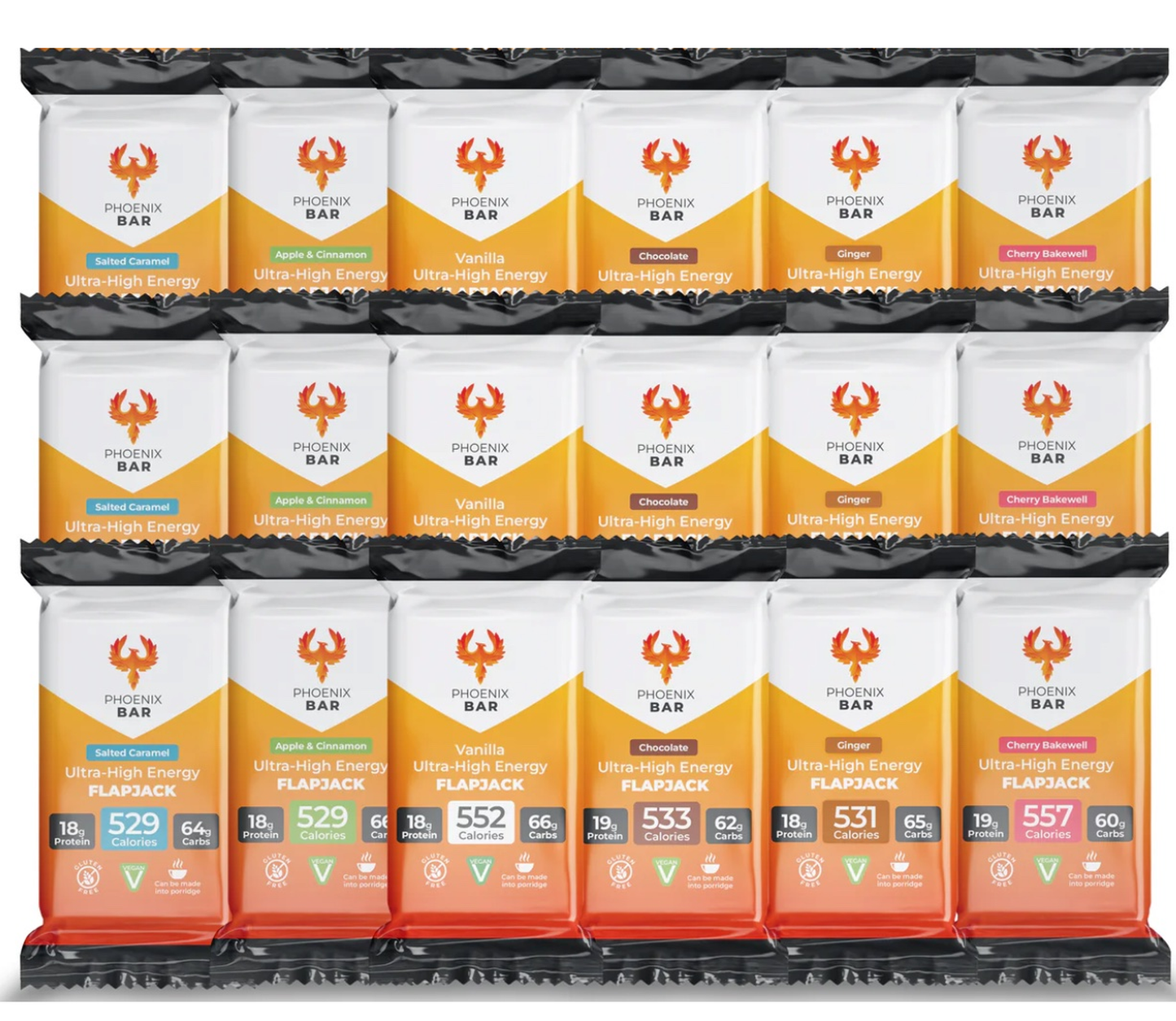
This is exactly why we developed Phoenix Bars in six flavours: Apple & Cinnamon, Cherry Bakewell, Chocolate, Vanilla, Salted Caramel and Ginger. Six rotations is enough to keep your palate moving for the duration of the trek. For a deeper dive into why flavour fatigue matters in multi-day endurance settings, our guide to calorie-dense foods for endurance and expeditions covers the science in full.

Phoenix Bars: Up to 557 Calories Per Bar
Soft, easy to eat whole or as a warm porridge. Low volume, two-year shelf life. Rated 5.0/5 from 344 reviews. £4.99 per bar.
The refuge food problem solved
Every refuge serves dinner and breakfast in season. Refuge dinners average 800 to 1,100 calories and 16 to 20 euros, breakfast around 6 to 10 euros and 300 to 500 calories. That leaves a gap of around 3,000 to 4,500 calories per day that you have to provide yourself, almost all of which needs to be eaten while moving.
The conventional GR20 fuelling kit, distilled from the most-read trail reports, looks like this: bread, hard cheese (typically Corsican brebis or chevre), saucisson or charcuterie, biscuits, dark chocolate, dried fruit, energy bars, sweets. That works, but it has three flaws. The bread is heavy and goes stale by day two. The charcuterie sweats in heat above 25 degrees. The biscuit and chocolate stack is high in calories but unbalanced toward refined sugar, which spikes and crashes blood glucose on long climbs. None of these foods serves the morning either, when most refuges only offer bread, jam and instant coffee.
A Phoenix Bar replaces almost all of that without the downsides. Each 120g bar delivers 557 calories from oats, dates, seeds, nuts and natural fats. They are vegan, gluten-free, and stable up to body heat without melting like chocolate bars or going rancid like charcuterie in your pack. Crucially, the dense oat structure means each bar can be broken into a refuge cooking pot, mashed with hot water and eaten as a high-calorie porridge when your appetite is suppressed at altitude or in heat. This is the difference between forcing food down on stage 9 and actually wanting it. For climbers and trekkers hiking with bars in heat, our note on how to use Phoenix Bars covers the porridge prep in detail.
For comparison shoppers, our wider analysis of high-calorie snacks for endurance benchmarks Phoenix Bars against the typical trail mix, gel and bar options you would otherwise carry.
Pack weight: the 9kg and 13kg rule
The two pack-weight ceilings widely accepted across GR20 guides are 9kg total for refuge stayers and 13kg total for campers, both inclusive of food and water. Water alone is 1 to 3kg per day on the GR20 in summer, depending on the heat and how exposed the next stage is. That leaves a tight envelope for food.
A practical day's food bag on the GR20, given a refuge dinner and breakfast, should weigh between 300 and 500 grams and deliver 2,500 to 3,500 calories. That is a calorie density requirement of around 7 to 9 calories per gram. Most trail foods do not hit this. Phoenix Bars hit 4.6 calories per gram, comparable to peanut butter and ahead of nearly every commercial energy bar on the UK market. By carrying two Phoenix Bars per day (1,114 calories at 240g), you cover the gap between refuge meals on roughly 50 percent the pack weight of an equivalent bread, cheese, charcuterie and biscuit combination.
For trail runners and fastpackers attempting the GR20 in 5 to 10 days, the maths gets sharper. Our fastpacking nutrition guide covers the specific calorie-density thresholds for sub-10-day attempts, where you are eating almost entirely from your pack between refuges.
Stage by stage: where the calorie demand spikes
Stages 1 to 8 between Calenzana and Vizzavona are the hard half. Stage 2 from Ortu di u Piobbu to Carozzu involves the Spasimata footbridge and ladders. Stage 3 from Carozzu to Ascu Stagnu crosses Bocca Piccaia and a long, exposed traverse. Stage 4 from Ascu Stagnu to Tighjettu now climbs Monte Cinto's shoulder at Pointe des Éboulis (2,607m), the highest point on the trail since the Cirque de la Solitude was closed permanently after the 2015 rockfall. Stage 5, stage 6 and the Manganu to Petra Piana traverse all involve sustained scrambling. These are the days you want 5,500 to 6,000 calories and the energy density to actually carry it.
Stages 9 to 16 between Vizzavona and Conca are mostly easier on the body but longer in distance, with Monte Incudine (2,134m), the Aiguilles de Bavella, and the long final descent to Conca. The Bavella alpine variant is technical and not to be underestimated on tired legs. Calorie demand drops slightly to 4,500 to 5,000 on the average southern day, although the heat is usually worse south of Vizzavona which makes appetite the limiting factor rather than calorie need.
A simple rule that holds for both halves: eat something every 45 to 60 minutes on the trail, regardless of whether you feel hungry. By the time you feel hungry on the GR20 you are already in deficit. Sports nutrition research consistently shows that 60 to 90 grams of carbohydrate per hour is the upper end of what most athletes can absorb during prolonged exercise. A Phoenix Bar delivers around 65 grams of carbohydrate, which makes one bar every two hours a clean, low-decision fuelling rhythm.
For broader hiking and trekking fuelling principles that apply across all multi-day routes, see our hiking and trekking nutrition guide.
North versus South: different fuelling strategies
The conventional north-to-south direction frontloads the technical difficulty. You arrive at the trailhead with full glycogen stores from carb-loading at home, then immediately spend three days scrambling. The risk is that you under-eat during the hardest section because your appetite has not adjusted to the workload. Pre-pack the first three days of trail snacks before you fly out. If you wait until Calenzana to shop, the SPAR there is well stocked but you will pay a premium and inevitably load up on whatever looks comforting rather than what is optimal.
Going south to north, the strategy is the opposite. You build up gradually through the southern half, your appetite catches up with your output by Vizzavona, and you hit the technical north already trail-fit and eating properly. Karolina Tuszynska at Breaking the Borders explicitly chose this direction for that reason on her 2023 thru-hike. The fuelling implication is that you can afford a lighter food bag in the first three southern days because your output is genuinely lower.
In both directions, Vizzavona is the natural resupply pivot. There is a Hôtel Monte d'Oro with a proper restaurant, a train station for bailout, and the only realistic full-restock point on the trail. Plan your bar carry around Vizzavona rather than trying to carry sixteen days from Calenzana.
The 5-day pre-trek loading window
Glycogen storage capacity in trained leg and trunk muscles is roughly 1,500 to 2,000 calories. You will burn through that in the first three to four hours of your first stage. Topping up before you fly is non-negotiable for a strong first three days.
A practical five-day pre-loading sequence: drop training volume to active recovery, increase carbohydrate intake to 7 to 10g per kg of body weight per day, and prioritise easy-to-digest carbs such as oats, rice, pasta, sweet potato, banana and white bread. Avoid novel foods or anything unfamiliar to your gut. The morning of stage 1 in Calenzana, eat 800 to 1,000 calories at least 90 minutes before you start walking. For more on the carbohydrate-density side of this, see our breakdown of ultra high carb solid foods.
A practical daily fuelling template
Morning: refuge breakfast plus one Phoenix Bar broken into your pot with hot water, eaten as porridge before you leave the refuge. This loads roughly 800 to 1,000 calories before you walk a step.
On the trail: one Phoenix Bar plus a handful of nuts or dried fruit every two hours, with sips of an electrolyte drink between. Aim for 60 to 90 grams of carbs per hour on the climbing stages.
Late afternoon arrival at the refuge: a snack within 30 minutes of stopping. Chocolate, biscuits, a third bar if you are hungry. The 30-minute post-exercise window is when glycogen resynthesis is most efficient, and skipping it is the single biggest recovery error most thru-hikers make.
Evening: refuge dinner. Order it on arrival because they stop accepting orders mid-afternoon. Pair with one beer if you want, but follow with a full litre of water before bed.
A typical day on this template runs 4,800 to 5,500 calories, which is the right band for most of the GR20.
Heat, altitude, and the appetite problem
Two physiological factors specific to the GR20 will quietly destroy your fuelling plan if you do not plan around them.
The first is heat. Daytime temperatures in the GR20 valleys hit 30 degrees from mid-July to late August. Appetite drops measurably in heat, and the research is clear that this is a real hormonal effect, not weakness. The solution is liquid calories during the hot middle of the day. Bring electrolyte powder, mix it strong, and consider drinking your calories on the hottest stages. Honey, maple syrup or fruit purée sachets blended into water work. A Phoenix Bar broken up and stirred into hot water becomes a slurry that goes down when solid food won't.
The second is altitude. Multiple passes on the GR20 sit between 2,000m and 2,600m. The appetite suppression at these altitudes is well documented, mediated by ghrelin suppression and leptin elevation. It is not severe, but it is real, and combined with heat and effort it pulls intake down. The defence is structured eating by clock, not by hunger. Every 45 to 60 minutes, something goes in.
What to pack: a calorie-dense food bag for the GR20
Per day, between refuges, target a 350g food bag delivering around 2,800 calories. A worked example: two Phoenix Bars (240g, 1,114 cal), 50g of mixed nuts (50g, 290 cal), 30g of dark chocolate (30g, 170 cal), 30g of dried fruit (30g, 100 cal), one packet of electrolyte powder (10g, 50 cal). Plus the refuge breakfast (around 400 cal), trail-bought baguette and cheese for lunch (around 600 cal), and refuge dinner (around 900 cal) brings the day to roughly 5,000 calories on a 350g carried food bag.
Scale up to three bars per day for the northern stages 2 to 6, and you cover the worst of the climbing without changing the structure.
For full sixteen-day carry planning, the Complete Bundle of 30 Phoenix Bars gives you almost two bars per day for the full GR20 with zero refuge dependence on bars. The Essential Bundle of 18 suits hikers who plan to use Vizzavona as a midpoint resupply. The Starter Bundle of 12 covers a single half (north or south).
Frequently asked questions
How many calories do you burn per day on the GR20? Most hikers burn between 4,500 and 6,000 calories per day on the GR20, depending on stage difficulty, pack weight and body size. The northern stages between Calenzana and Vizzavona, with around 1,000m of ascent and scrambling sections, sit at the upper end. Southern stages after Vizzavona average 4,500 to 5,000 calories.
Can you buy food on the GR20? Yes. Every refuge has a small shop selling pasta, tinned fish, cheese, charcuterie, biscuits, chocolate, bread and drinks. Larger resupply is possible at Asco Stagnu, Castel di Vergio, Vizzavona and Bavella. There are no grocery stores between refuges and no ATMs on the trail, so carry enough cash for the full traverse.
Is the GR20 suitable for vegans and gluten-free hikers? Refuge food is heavily pasta, cheese and Corsican charcuterie based, with very limited vegan or gluten-free options. Hikers on either diet need to carry their own backup food. Phoenix Bars are both vegan and gluten-free at 557 calories per 120g bar, which makes them well suited to filling the gap.
How heavy should my pack be on the GR20? Refuge-only hikers should aim for 9kg total including food and water. Campers carrying a tent should target 13kg maximum. Calorie density per gram of pack weight is one of the most important variables on a 16-day technical trek.
What is the best food for the GR20? The best GR20 food is calorie-dense, shelf-stable in heat, gluten and dairy-flexible, and easy to eat when your appetite is suppressed by altitude or heat. Phoenix Bars score on all four. Trail-tested alternatives include hard cheese, saucisson, dark chocolate, dried fruit and Corsican biscuits, all available at refuge shops.
Do I need to carry food for all 16 days? No. Every refuge has a shop and serves dinner. Most hikers carry one to two days of food at a time and top up at refuges or full resupply points. Carrying more than that wastes pack weight you cannot afford on the technical sections.
How do I avoid food fatigue on the GR20? Rotate flavours and textures. Refuge dinners are reliably pasta-based, so vary your day-bag snacks. Phoenix Bars come in six flavours which is enough rotation for a full sixteen-day traverse. The other lever is form: a bar eaten as porridge tastes different to the same bar eaten dry, which extends palate variety for free.
Should I take protein supplements on the GR20? Most hikers do not need protein supplements on the GR20 because refuge dinners deliver adequate protein from sausage, cheese and lentils. If you are vegan or gluten-free and skipping refuge meals, a small bag of plant protein powder is worth considering. Phoenix Bars deliver 9g of plant protein each, which on three bars per day covers most of a thru-hiker's repair needs.
Related guides
The GR20 sits within a broader category of multi-day mountain traverses that share similar fuelling logic. If you are planning the GR20, you may also find these useful: the Tour du Mont Blanc nutrition guide, which covers a comparable 170km Alpine traverse with similar refuge dynamics; the backpacking nutrition guide, which covers the foundational principles for any multi-day carry; and the trail running nutrition guide, which applies if you are attempting the GR20 fastpacking or going for a sub-10-day push.
For the broader fuelling philosophy underlying all of these, start with the Ultra-Endurance and Expedition Nutrition Guide.


Flaming Phoenix