Ultra High Carb Solid Foods: The Endurance Fuelling Guide
By James Frost, Founder of Flaming Phoenix. Phoenix Bars have been carried to the summit of Everest and used on expeditions from the Sahara to the Arctic.
Last updated: May 2026
What this guide covers
Ultra-high-carb solid foods are the calorie-dense, carbohydrate-rich solid fuels that endurance athletes rely on when gels and sports drinks stop working. For efforts longer than six hours (ultra runs, Ironman, mountaineering, multi-day expeditions, ocean rowing, audax cycling), solid food is not a backup option, it is the primary fuel that lets you finish.
This guide explains the science of why solids win past hour 6, lists the highest-carb solid foods that actually work mid-effort, and shows how to hit the 90g per hour carb target without relying on gels alone.
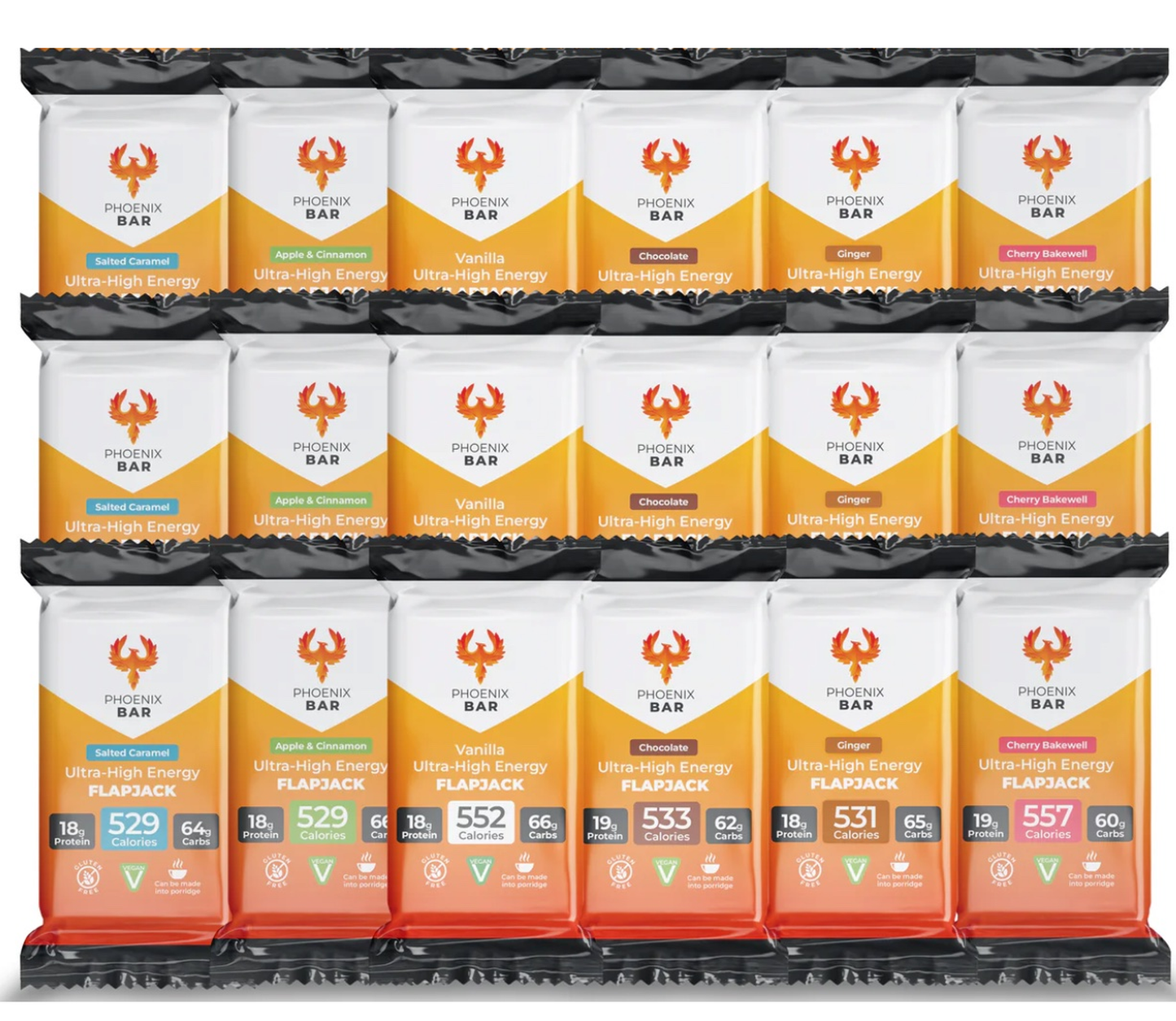
Key points: most ultra athletes under-fuel because of flavour fatigue from sweet gels, not because they don't know they need calories. Solid foods solve flavour fatigue, deliver psychological satiety, and reduce GI distress over multi-hour efforts. The trade-off is slower gastric emptying, so timing matters. Phoenix Bars deliver 66g of carbohydrates and 557 calories per 120g bar, the highest carb load I've seen in any portable solid food on the market.
Why solid carbs win past hour six
For efforts longer than six hours, solid food outperforms gels and drinks for three reasons: flavour tolerance, gut comfort, and psychological satiety.
The science is settled on the carbs themselves. Whether the source is liquid, gel, or solid, oxidation rates are roughly equivalent at moderate intensity. The 2019 University of Illinois study comparing potato purée, gels, and water during prolonged cycling found no performance difference. What changes over hours is what the gut and brain will accept.
Three things break down on long efforts. First, flavour fatigue: sweet liquid carbs become intolerable after 4 to 6 hours, and athletes stop eating not because they aren't hungry but because they cannot stomach another gel. This is the single biggest cause of ultra-distance bonking. Second, GI distress from concentrated sugars: sustained intake of high-osmolality liquid carbs damages the gut lining over multi-hour windows, and solid foods buffer the carb load. Third, psychological under-fuelling: the act of chewing real food signals satiety in a way liquid does not, and athletes consistently report eating more total calories when solids are part of the strategy.
The 2021 Japanese study of a female athlete completing a 438km mountain ultramarathon found that solid food intake correlated directly with faster running pace compared to liquid and gel sources, across 155 hours of continuous effort.
For efforts under 3 hours, gels and drinks are usually the right tool. This guide is not anti-gel. It is for the window where gels stop working, which is roughly hour 6 onwards.
The 90g per hour carb target
Current sports nutrition consensus puts ultra-endurance carb targets at 90 to 120g per hour, achieved through multiple-transportable carbohydrates (glucose plus fructose at a roughly 2:1 ratio). At this intake level, glucose uses the SGLT1 transporter (which saturates at 60g/hr) and fructose uses GLUT5, allowing total absorption above the single-source ceiling.
Hitting 90g/hr from solids alone requires careful food selection. Most commercial energy bars deliver 20 to 40g of carbs per serving, so to hit 90g/hr you'd need 2 to 4 bars per hour, which is impractical and expensive.
A Phoenix Bar delivers 66g of carbohydrates and 557 calories per 120g bar. One bar covers approximately 44 minutes at the 90g/hr target, or just over an hour at the 60g/hr target most ultra runners realistically achieve. For full coverage of how Phoenix Bars are used in ultras, see the Ultra-Endurance and Expedition Nutrition Guide.
What makes a solid food work mid-effort
Five attributes separate solid foods that work from solid foods that fail during sustained exercise.
High carb-to-fat ratio. Fat slows gastric emptying. High-carb solids empty the stomach faster and deliver fuel sooner.
Low fibre. Fibre is essential for everyday health but causes GI distress under exercise stress. Race-day solids should be low-fibre.
Soft texture, easy to chew. When you're exhausted, oxygen-deprived, or wearing gloves, dense or hard foods don't get eaten.
Heat and cold stable. Solids must not melt in summer heat or freeze in winter cold. This rules out chocolate-coated bars and fresh fruit.
Compact and packable. Calorie density per gram matters when you're carrying everything on your back. More on this in Calorie-Dense Foods.
High carb solid foods that work, ranked
The list below covers solid foods that consistently work for endurance athletes during efforts over 3 hours. Carb content per typical serving in brackets.
Tier 1, race-day solids (low fibre, fast emptying): Phoenix Bars (66g carbs, 557 cal per 120g bar), white rice cakes with jam (40g per cake), boiled new potatoes with salt (30g per 100g), maple syrup waffles or Stroopwafel-style biscuits (20g per waffle), Medjool dates (18g per date), ripe banana (27g per medium fruit).
Tier 2, multi-day expedition solids (slightly higher fat for satiety, still carb-led): Phoenix Bars (used as both race fuel and meal replacement, see How To Use Phoenix Bars), flapjacks made with rolled oats and golden syrup (50 to 70g per piece, varies), malt loaf (30g per slice), tortillas with honey or jam (30g per filled tortilla), fig rolls (15g per biscuit), boiled rice balls or onigiri (40g per rice ball).
Tier 3, recovery and base camp solids: pasta with white sauce (60 to 80g per portion), porridge with banana and honey (50 to 70g per bowl, see High Calorie Porridge), white bread sandwiches with jam (45g per sandwich).

Phoenix Bars: Up to 66g of Carbs per Bar
Soft, easy to eat whole or as a warm porridge. Low volume, two-year shelf life. Rated 5.0/5 from 344 reviews. £4.99 per bar.
Solid foods by sport
Ultra running
For ultras over 6 hours, target 60 to 90g carbs/hr with at least 50% from solids after the first 2 hours. Phoenix Bars work because they're soft enough to eat at race pace and don't crumble in a vest pocket. For a fuller breakdown of multi-day ultra fuelling, see Multi-day Ultra Running Nutrition.
Cycling and bikepacking
Cyclists tolerate higher carb intake than runners (no impact stress on the gut). For events over 5 hours, solids become essential to escape gel fatigue. Phoenix Bars sit flat in a jersey pocket and don't melt. Detailed cycling guidance lives at Cycling and Bikepacking Nutrition.
Mountaineering and high altitude
At altitude (above 2,500m), the body metabolises carbohydrates more efficiently than fat, so high-carb solids are the smartest fuel. Cold-stability becomes critical: most bars freeze solid above 5,000m. Phoenix Bars stay edible at sub-zero temperatures. Full altitude protocol at High Altitude Mountaineering.
Multi-day expedition (Marathon des Sables, polar, ocean)
For unsupported multi-day events where every gram is carried, calorie-to-weight ratio matters more than format. Phoenix Bars deliver 4.6 cal/gram, which is among the highest available in a ready-to-eat solid. See Marathon Des Sables for desert-specific protocols and Ocean Rowing Nutrition for sea-going expeditions.
Solid carbs vs gels vs drinks: when to use what
The optimal ultra strategy combines all three formats, switching as the effort progresses.
Drinks are the right tool in hours 1 to 4, especially in hot conditions or at high intensity. They deliver carbs and hydration simultaneously and have the fastest gastric emptying (1.0 to 1.2 litres per hour for liquid carbs versus 200 to 300g per hour for solids). The ceiling is around 90g carbs per hour, and the main risks are sloshing in the stomach and GI distress at high concentrations.
Gels dominate hours 1 to 6. They deliver fast carbs in a small package and are easy to carry. The ceiling is also around 90g per hour. The main risk is flavour fatigue: by hour 6, most athletes physically cannot stomach another sweet gel, which is why this is the exact window where solids take over.
Solid food comes into its own from hour 6 onwards. The carb ceiling is lower (60 to 80g per hour from solids alone is realistic for most athletes), but the psychological and gut-comfort benefits compound over time. The risk is slower absorption, so timing matters more.
For most ultras, the right pattern is drinks early, gels mid-race, solids late, with overlap throughout.
How Phoenix Bars fit the high-carb-solid profile
I designed Phoenix Bars specifically for the gap in the market: a solid food carrying enough carbohydrate per serving to be viable as primary ultra fuel, without the fat-heaviness of typical "energy bars" and without the bulk of real-food alternatives.
Per 120g bar: 66g carbohydrate, 557 calories total, 4.6 calories per gram, soft texture edible in sub-zero conditions, stable above 50°C and won't melt, vegan, gluten-free, six flavours, two-year shelf life.
Customers carry them on Marathon des Sables, Aconcagua, ocean rows, the Spine Race, and ultra cycling events. For practical guidance on how to use them mid-effort (porridge format, breaking into pieces, pre-race prep), see How To Use Phoenix Bars.
Frequently asked questions
What is the highest carb solid food per serving? A Phoenix Bar at 66g of carbohydrate per 120g bar is the highest carb load I've seen in any portable solid food. Most commercial energy bars deliver 20 to 40g per serving. Real-food alternatives like rice cakes or Medjool dates deliver less per gram and require more volume.
Can I hit 90g carbs per hour from solid food alone? Yes, but it's harder than from liquids. Two Phoenix Bars per hour delivers 132g, well above the 90g target. Mixing solid foods with one drink mix or one gel per hour is the most realistic way for most athletes to hit 90g/hr without GI distress.
Why do gels stop working after 6 hours? Sweet flavour fatigue and concentrated sugar fatigue are the two main mechanisms. The gut's tolerance for high-osmolality sugar drops over time, and the brain stops registering sweet flavours as palatable. Solid foods reset both.
Are solid foods better than gels for performance? For efforts under 6 hours, gels usually win on absorption speed and convenience. For efforts over 6 hours, solids win on total calories consumed (because athletes can keep eating them). Total calories consumed is the variable that determines finish time in ultras.
What solid foods work at altitude? High-carb, low-fat, cold-stable solids. Most chocolate bars freeze solid above 5,000m. Phoenix Bars stay soft. Detailed altitude protocol at High Altitude Mountaineering.
Can I eat solid food during a marathon? Marathons under 4 hours rarely benefit from solid food, gels are faster and lighter. Marathons over 4 hours and any ultra over 50km benefit from at least some solid food.
Related guides
Ultra-Endurance and Expedition Nutrition Guide | Multi-day Ultra Running Nutrition | Cycling and Bikepacking Nutrition | Marathon Des Sables | Ocean Rowing Nutrition | High Altitude Mountaineering | Calorie-Dense Foods | High Calorie Porridge | How To Use Phoenix Bars


Flaming Phoenix