

Bob Graham Round Nutrition: A Leg-by-Leg Fuelling Plan for a Sub-24 Attempt
In this guide

The Bob Graham Round is 66 miles, 42 peaks, and 27,000 feet of ascent, completed in under 24 hours. Most BGR fuelling advice reads like generic ultra running nutrition with a Lake District postcode. The round's actual fuelling problem is more specific than total calories: five legs that differ in length, climb, terrain, and likely time of day, four support point handovers that can either rescue a flagging round or kill a good one, and one night section where most attempts unravel.
This guide is structured the way BGR aspirants actually plan: by leg, by support point, and by the night window. It assumes you have done the training and the recces. What it gives you is the fuelling plan to convert that preparation into a ratified round.
About this guide
Written for runners within twelve weeks of a BGR attempt. The framework covers the five legs, the four crewed handovers, and the night section that cuts across Leg 3 or Leg 4 depending on your start time. For the mechanics of running-specific intake that underpins all of this, see the Trail Running Nutrition guide and the UK Ultra Race Nutrition guide.
Phoenix Bars are referenced throughout because they fit two specific BGR use cases: fast-calorie support point food when your crew has 90 seconds to get you moving again, and compact on-hill fuel that does not degrade in rain or get crushed in a race vest across 20 hours of movement.
Written by James Frost, Founder of Flaming Phoenix. Last updated: April 2026.
The one constraint that defines BGR fuelling
Every calorie on a Bob Graham round comes through one of two channels: what you eat at the four road crossings where your support crew meets you, and what you carry on your back between them. Everything else is commentary.
Most rounds that fail nutritionally fail because the split between these two channels was wrong. Too much on-hill food means a heavy vest that slows your climbing and a gut that cannot cope with continuous intake. Too little on-hill food means you arrive at support points in calorie deficit, take too long to recover, and lose the minutes that compound into the wrong side of 24 hours.
The workable split for most BGR runners is roughly 60 percent of total calories through support points, 40 percent on the hill. On a round burning 10,000 to 12,000 calories total, that is around 6,000 to 7,000 calories taken in 2 to 5 minute windows at support points, and around 4,000 to 5,000 calories taken in bites on the move, from high calorie bars, gels and real food, across roughly 20 hours of continuous running and climbing.
The support point handover framework
A BGR support point is a road crossing where your ground crew has hot food ready, spare kit laid out, and a schedule telling them exactly how long you have to be in and out. The four crossings are Threlkeld (end of Leg 1), Dunmail Raise (end of Leg 2), Wasdale Head (end of Leg 3), and Honister Pass (end of Leg 4).
The handover is both the biggest calorie opportunity of the round and the biggest time risk. Stopped time at support points ranges from 2 minutes (the fast, practiced crew with a runner on form) to 25 minutes (the slow cup of tea and a sit-down that ends rounds). Every extra minute at a support point is a minute you cannot give back on the hill.
The workable handover pattern:
Eat first, kit second. The moment you arrive, a crew member puts warm food into your hand. Eat while you change shoes, add a layer, refill your pack. Real food works best at support points because the gut responds to variety after hours of bar-and-gel monotony. Bircher muesli, pizza slices, warm noodles, pastries, pasta with butter and cheese, and porridge with Phoenix Bars stirred in are the formats that consistently go down. Our list of the best foods for ultra running is ordered by hour of the race, which helps when deciding what the crew brings to each crossing.
Drink early. Most runners are more dehydrated at support points than they realise. A warm drink before solid food accelerates gastric emptying and clears the throat of hours of bar crumbs.
Leave with something in your hand. You should always leave a support point with a bar, wrap, or pastry already opened and in your palm for the first climb of the next leg. The climb out of every BGR support point is steep enough that eating on the first ten minutes feels wrong, which is when your body needs calories to stay ahead of the next leg.
Plan for the 90-second version. Every support point needs a designated two-minute drill: shoes on a towel, warm food in a thermos or foil wrap, pack contents laid out. If the round is on pace, you execute the fast version. Having a fast version available on every support stop is what separates 23:45 finishes from 24:15 finishes.
Part two: The leg-by-leg fuelling plan
Leg 1: Keswick to Threlkeld (14 miles, 5,800ft, approximately 3 to 3.5 hours)
Skiddaw then Blencathra, via Great Calva. The opening leg is the easiest place on the round to feel like things are going brilliantly, and the easiest place to poison the rest of the round through over-fuelling, over-pacing, or both.
Calorie demand: Roughly 1,800 to 2,400 calories burned.
Fuelling plan: Eat a substantial meal before start (400 to 600 calories, something sitting comfortably in the gut: porridge, banana on toast with peanut butter). On the leg, 200 to 300 calories per hour. Bar pieces every 30 minutes, a gel on the Blencathra climb if you are cutting it fine on sugar.
The Leg 1 mistake: Eating too much on a leg where the body is still fresh and fuelled from the pre-start meal. A packed gut on the Blencathra descent causes problems that persist all the way to Dunmail. Go lighter than you think on Leg 1.
Leg 2: Threlkeld to Dunmail Raise (14 miles, 6,300ft, approximately 3.5 to 4.5 hours)
Clough Head, the Dodds, Helvellyn, Dollywaggon, Seat Sandal. A long, high leg with limited shelter. Weather can change significantly between Threlkeld and Dunmail.
Calorie demand: Roughly 2,400 to 3,000 calories burned.
Fuelling plan: Leave Threlkeld with 400 to 500 calories consumed in the first 15 minutes of stopped time. On the leg, 250 to 350 calories per hour. Leg 2 is the one for bar pieces, because the ridgeline is mostly runnable and you get a chance to eat every 10 to 15 minutes. Our guide to the best energy bars for ultra running compares the main options.
The Leg 2 mistake: Letting the spread-out terrain and the social buzz of pacers distract you from eating on a schedule. Set a 30 minute alarm on your watch. The effort is not high enough to suppress appetite, which means there is no biological excuse for falling behind on intake.
Leg 3: Dunmail Raise to Wasdale Head (16 miles, 6,600ft, approximately 5 to 6.5 hours)
The crux of the round. The Langdales and Scafell range. Technical ground, multiple route choices, the Broad Stand or Foxes Tarn decision at Scafell. For most schedules, this is also the night leg or the leg that starts in the dark.
Calorie demand: Roughly 3,000 to 3,800 calories burned.
Fuelling plan: A significant eat at Dunmail (600 to 900 calories in 10 to 15 minutes). Warm, soft food works best because the leg ahead is long and rough and a heavy gut is a problem. On the leg, 300 to 400 calories per hour. This is where the night section problem bites for most schedules; see the next section.
The Leg 3 mistake: Under-eating on the approach to Scafell because the technical ground demands attention. The focus required on the Scafell massif means most runners stop eating for 45 to 60 minutes, which is exactly when their energy needs to be highest. Break small pieces into a wrist pouch or jacket chest pocket before the technical ground starts, so you can eat without breaking stride or focus.
Leg 4: Wasdale Head to Honister Pass (11 miles, 5,500ft, approximately 3.5 to 4.5 hours)
Yewbarrow, Red Pike, Steeple, Pillar, Kirk Fell, Great Gable, Green Gable, Brandreth, Grey Knotts. Brutal on tired legs. The Yewbarrow climb at the start of Leg 4 is where many rounds discover whether they are ratifiable.
Calorie demand: Roughly 2,400 to 3,200 calories burned.
Fuelling plan: Wasdale Head is the biggest support point feed of the round. Target 700 to 1,000 calories in 15 minutes. Real hot food. Pizza, pasta, rice, soup with bread, Phoenix Bar porridge. The Yewbarrow climb benefits enormously from leaving Wasdale already 80 percent topped up. On the leg, 300 to 400 calories per hour, but expect appetite to be the most suppressed it will be all round. Switch to liquid calories (gels, high-calorie drinks, dissolved carb powder) if solid food stops going down.
The Leg 4 mistake: Letting the Yewbarrow pain convince you that you cannot eat. From here, staying on schedule is a matter of discipline. You can eat. You will not want to. Eat anyway.
Leg 5: Honister to Keswick (10 miles, 2,500ft, approximately 2 to 2.5 hours)
Dale Head, Hindscarth, Robinson, then the long descent and road run back to Moot Hall. The easy leg on paper. Often punishing in practice because the body is registering the total cumulative load of the round.
Calorie demand: Roughly 1,500 to 2,000 calories burned.
Fuelling plan: Short, fast Honister stop. 400 to 600 calories. Something warm and easy: noodles, soup, a Phoenix Bar porridge. On the leg, steady bar pieces for the three summits, then the road descent is where you can pick intake back up if you have been light.
The Leg 5 mistake: Assuming it is in the bag and stopping eating or drinking. This is how runners arrive at Moot Hall hyponatraemic, hypoglycaemic, or mildly hypothermic and spend the celebration in the recovery position instead of a pub. The Robinson to Keswick road run is longer than memory suggests. Stay on your intake schedule until the Moot Hall steps.
The night section problem
Most BGR schedules put Leg 3 or Leg 4 substantially in the dark. The night window between roughly 11pm and 4am is where nutrition discipline collapses across the entire ultra-endurance space, and BGR is not an exception.
What happens physiologically: cortisol drops, core temperature drops, and hormonal hunger signals decline sharply across exactly the hours when you need intake to stay ahead of the Leg 3 or Leg 4 workload. Runners describe losing 30 to 60 minutes between 2am and 4am with no single obvious cause. It is almost always a quiet fuel-and-temperature collapse rather than a dramatic event.
The fixes that work:
Pre-plan the night calories in bite-sized portions. Break bars into 3 or 4 pieces at Dunmail so the night intake is mechanical. Warm food in a thermos (noodles, soup) becomes disproportionately effective in the 2am to 4am window.
Eat before you feel cold. Once core temperature drops, appetite is gone for the next hour. Eat pre-emptively in the second half of any leg that crosses 1am.
Keep caffeine small and late. A single 100mg caffeine tablet around 2am to 3am restores focus for the technical ground without creating a crash at sunrise. Save it.
Pack one safety calorie. Every BGR aspirant should have one 500+ calorie reserve on their body at all times. A Phoenix Bar or equivalent in the belt, untouched except for the night section or a blown support point transfer.
For the broader framework on eating when appetite has left the building, see the low appetite guide and the how to use Phoenix Bars porridge method.
What to put in your support crew's hands
Your ground crew's job at each support point is speed and calorie density, not variety. A good BGR support kit per road crossing includes:
One hot food option. Decided in advance with the runner. Pizza at Wasdale is the classic because it delivers 1,500+ calories at high speed. Noodles at Honister, bircher at Threlkeld, pastries at Dunmail. The runner knows what is coming before they arrive.
One warm drink. Tea, coffee, hot squash, or a warm carb drink. Warm liquid cuts bar fatigue and accelerates gastric emptying.
Three or four ready-to-go pocket items. Phoenix Bars, gels, wraps with filling, jam sandwiches, whatever has worked in training. The runner leaves with one in hand and two or three in pockets.
One backup calorie source in case of stomach rejection. Usually a liquid option: a milkshake, a drinkable yoghurt, or a carb powder in water. If the main hot food option will not go down, the backup prevents a missed calorie opportunity.
Zero new food. Nothing goes into a crew drop bag that has not been tested in training. A BGR is not the moment to discover a new flavour.
Where Phoenix Bars fit on a BGR
Two specific BGR use cases. On the hill, broken into three or four pieces in a jersey or vest pocket, delivering up to 557 calories per bar at roughly 4.6 calories per gram. The flapjack texture holds up to rain and hours of compression in a running vest, which gel packets and standard bars often do not.
At support points, stirred into water as a two-minute porridge. A single bar plus water equals a meal of up to 557 calories that can be eaten from a mug with one hand while the crew changes your socks. This is particularly useful at Wasdale, where the appetite for dense pizza or pasta can suddenly fail and runners need a backup calorie option.
A practical provisioning rule: 5 to 7 bars on the hill across the round (one per leg plus a night reserve), plus 2 to 3 for support point porridge backup. The cycling and bikepacking guide covers the mechanics of pocket-portioning bars in a running vest context.
The bars also work for the 5am pre-start breakfast on the morning of the round, when the support crew is still asleep and you need 600 calories that go down easily without upsetting a pre-start gut.
Related guides
- Trail Running Nutrition: the framework for running-specific intake mechanics
- UK Ultra Race Nutrition: multi-day and long single-stage ultra framework
- Ultra-Endurance and Expedition Nutrition Guide: eat-by-the-clock principles for sustained efforts
- Calorie-Dense Foods: the full framework on calories per gram
- Low Appetite and Difficulty Eating Enough Calories: for the Leg 4 and night section appetite drop
- How to Use Phoenix Bars: porridge method for support point use
Frequently asked questions
How many calories does the Bob Graham Round burn? Most runners burn 8,000 to 12,000 calories across a 20 to 24 hour round, depending on body weight, pace, and weather. Heavier runners on harder schedules sit at the upper end. The round's defining feature is not total burn but sustained burn across a window that includes a night section.
How much should I eat per hour on the BGR? While moving, aim for 200 to 400 calories per hour. Most sub-24 finishers land somewhere in the 250 to 350 range across the full round.
What do the best BGR runners eat at support points? Real, warm, calorie-dense food. Pizza at Wasdale is iconic. Other options include bircher muesli, pasta with butter and cheese, noodles, pastries, and Phoenix Bar porridge. The common features are hot, easy to chew, and delivered fast.
How do I fuel the night section? Plan calories in small, pre-broken pieces before the night starts. Eat pre-emptively before you feel cold. Warm food in a thermos at support points. One small caffeine dose around 2am to 3am if you normally tolerate caffeine.
What if my stomach stops working on Leg 4? Switch to liquid calories. Gels, carb drinks, high-calorie shakes, or a dissolved Phoenix Bar porridge. The gut will usually tolerate liquid when it will not tolerate solid. Most runners who stomach-fail on Leg 4 can still get calories in through drinks.
Should I practice my nutrition on recces? Yes. Fuelling is not something to debut on round day. Replicate your planned intake exactly on at least one full Leg 3 recce and one back-to-back Legs 4-5 recce, including support point simulation if possible.
How many Phoenix Bars should I carry on a BGR attempt? 5 to 7 on the body across the round (roughly one per leg plus a night reserve), plus 2 to 3 at support points for porridge backup. Total 7 to 10 bars for the full round.
Is the Bob Graham Round harder to fuel than the Lakeland 100? Different problem. The Lakeland 100 is longer but has more frequent aid stations. The BGR is shorter but has only four crewed support points and requires the sub-24 discipline. BGR fuelling is higher-stakes per minute stopped.
Questions about fuelling for your round
If you are preparing for a BGR attempt and want to talk through a specific leg or support point plan, drop me a line. I am always happy to help.
James Frost Founder, Flaming Phoenix jfrost@flaming-phoenix.co.uk 07990 519422
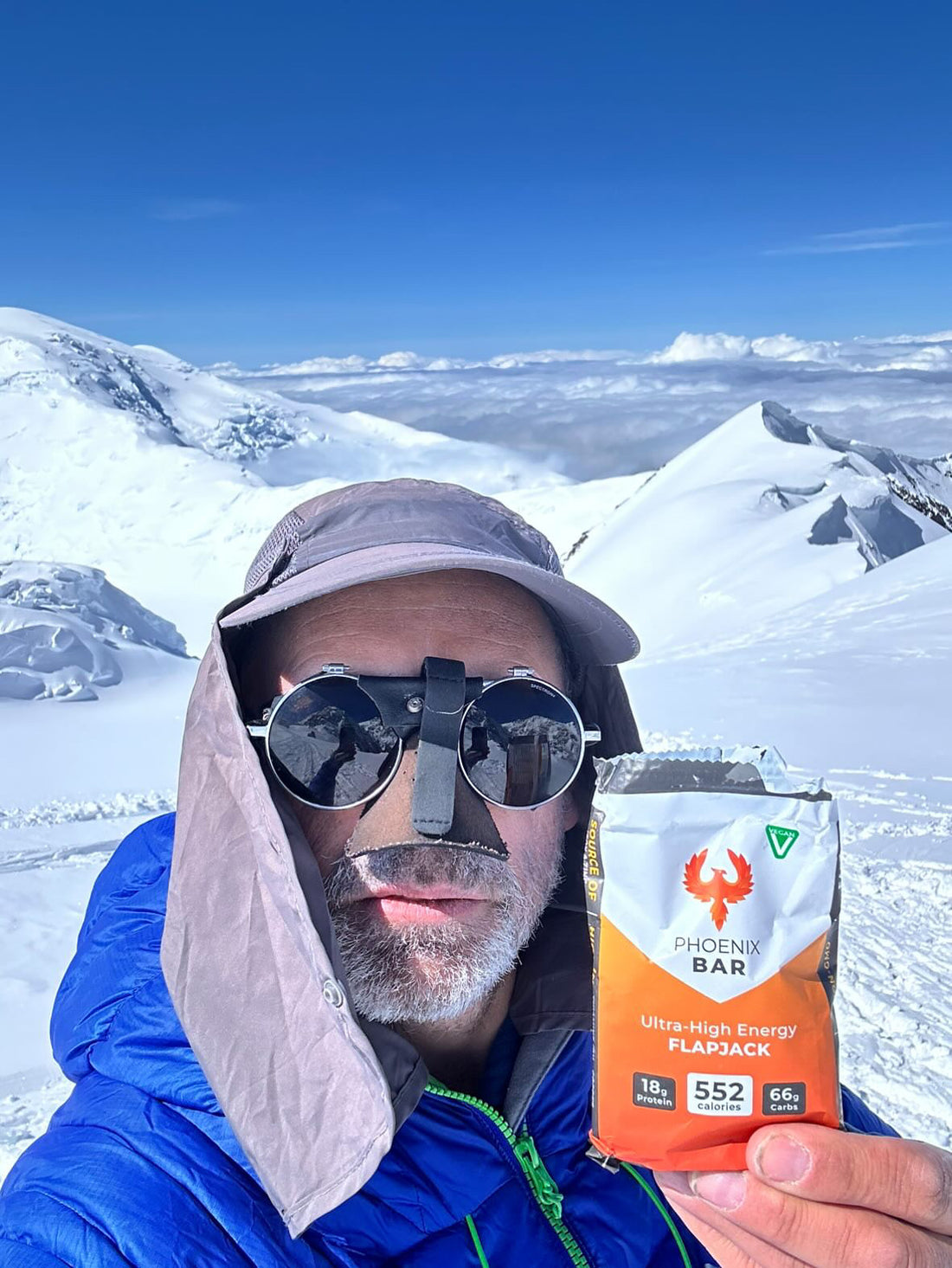
Big calories. Small bar.
Up to 557 calories in a compact, lightweight bar of only 120g, with up to 66g of carbs and 19g of protein. Eat it whole, break it into pieces over a few hours, or mix it with water or milk for porridge.
Easy to eat, easy to digest and not sickly sweet. Customers have eaten them at -45°C and through the heat of the Marathon des Sables, and they keep for up to 2 years, so they work on a mountain, on a night shift, or at home on days when eating enough feels hard.
- 557 calories in only 120g (529 to 557 by flavour)
- 4.6 calories per gram
- 66g carbs per bar (up to)
- 19g protein per bar (up to)
