
Hiking and Trekking Nutrition: Lightweight, High-Calorie Food for the Trail
Hiking burns 400 to 600 calories per hour. Lightweight, calorie-dense food that travels well and stays edible all day is the difference between finishing strong and running out of energy on the final climb.
In this guide
- How many calories hiking actually burns
- Why calorie density matters on the trail
- What makes a good hiking food
- How Phoenix Bars can be used
- What to pack by hike type
- Frequently asked questions
About this guide
This guide explains how to think about food for hiking and trekking, from day hikes to multi-day trails. It covers why calorie-dense, lightweight food matters, what to look for when choosing trail snacks, and how to avoid the mid-afternoon energy crash that ruins the last few miles.
For guidance on fuelling for ultra-distance events and expeditions, see the Ultra-Endurance and Expedition Nutrition Guide. For guidance on using Phoenix Bars across different situations, see How To Use Phoenix Bars.
Phoenix Bars are a high-calorie nutrition bar designed for situations where maximum calories in minimum weight is important.
Last reviewed: 2026
Hiking is one of the most popular outdoor activities in the UK, and one of the most calorically demanding. A day on the fells, a coastal path walk, or a weekend in the mountains burns far more energy than most people realise. A full day of moderate hiking with a loaded pack can burn 3,000 to 5,000 calories, roughly double a normal day's intake.
Most hikers know they need to eat on the trail. Far fewer think carefully about what they eat and how much energy it actually provides. The result is predictable: strong start, good pace through the morning, then a steady decline in energy, mood, and leg power from mid-afternoon onwards. That last climb feels twice as hard as it should. The final miles drag. The car park cannot come soon enough.
This is almost always a calorie problem, not a fitness problem. The food ran out, was not calorie-dense enough, or was not eaten consistently enough throughout the day.
This guide covers the basics of hiking nutrition for anyone who walks long enough and hard enough that food matters: day hikers, weekend walkers, long-distance trail walkers, and anyone planning a multi-day trek.
How Many Calories Hiking Actually Burns
The numbers are higher than most people expect.
A person weighing 70kg hiking on moderate terrain with a light day pack burns approximately 400 to 500 calories per hour. Add elevation gain, a heavier pack, rough ground, or adverse weather and the figure rises to 500 to 700 calories per hour. Over a six-hour day, that is 2,400 to 4,200 calories burned by the hike alone, on top of your normal baseline requirement of around 2,000 calories.
For a full day on a challenging route, total calorie need can easily reach 4,500 to 6,000 calories. On a multi-day trek, this adds up: a five-day hike can burn 20,000 to 30,000 calories above what you would use sitting at home.
Most hikers bring a sandwich, some fruit, a cereal bar, and perhaps some trail mix. That might total 800 to 1,200 calories. The gap between what they burn and what they eat is enormous, and by mid-afternoon they feel it.
You do not need to match calorie burn exactly. Your body can draw on stored energy. But the closer you can get to replacing what you burn, the stronger and more enjoyable the day will be, especially in the final hours when most people are running on empty.
Why Calorie Density Matters on the Trail
Calorie density is how many calories a food delivers per gram. On a hike, it determines two things: how much energy your food provides and how much weight you carry to get it.
An apple weighs about 180g and delivers roughly 95 calories. That is 0.5 calories per gram. A banana weighs about 120g and delivers roughly 105 calories. A standard cereal bar weighs 25 to 35g and delivers 90 to 130 calories. A Phoenix Bar weighs 120g and delivers up to 557 calories. That is approximately 4.6 calories per gram.
To carry 2,000 calories of trail food, you would need roughly twenty apples (3.6kg), fifteen cereal bars (525g), or fewer than four Phoenix Bars (480g). The weight difference is significant when it is in your pack all day.
Calorie density also determines how much eating time is needed. Consuming 557 calories from a single bar takes a fraction of the time and effort required to eat the same calories from multiple smaller snacks. Less time eating means more time walking.
For day hikes, the weight difference is a convenience. For multi-day treks where you carry all your food, it becomes a serious factor in pack weight and comfort.
What Makes a Good Hiking Food
Not every food works well on the trail. The best hiking food balances calorie density with practicality.
High calories per gram. This is the primary criterion, especially for longer hikes and multi-day treks. More calories per gram means less weight for the same energy.
Does not spoil. Food that needs refrigeration or goes off quickly is impractical for anything beyond a short morning walk. Trail food needs to survive a full day in a pack, and ideally longer for multi-day trips.
Does not crush, melt, or fall apart. A sandwich squashed flat at the bottom of a rucksack is demoralising. Chocolate melted into a wrapper is annoying. Food that survives being packed, sat on, and carried all day without disintegrating is worth choosing.
Easy to eat on the move. The best hiking food can be eaten without stopping, without cutlery, and without creating mess. Unwrap, eat, walk. Anything that requires a plate, a spoon, or a ten-minute sit-down is a snack for a summit break, not trail fuel.
Provides sustained energy. Pure sugar (sweets, gels, sugary drinks) delivers a fast spike followed by a crash. Food that combines carbohydrates with fat and protein provides both quick and sustained energy, keeping you fuelled across hours rather than minutes.
Does not cause palate fatigue. On a long day, you need to keep eating. If your trail food is all intensely sweet, you will eventually stop eating it. A mix of flavours, or food with milder, less sweet profiles, sustains appetite across a full day.

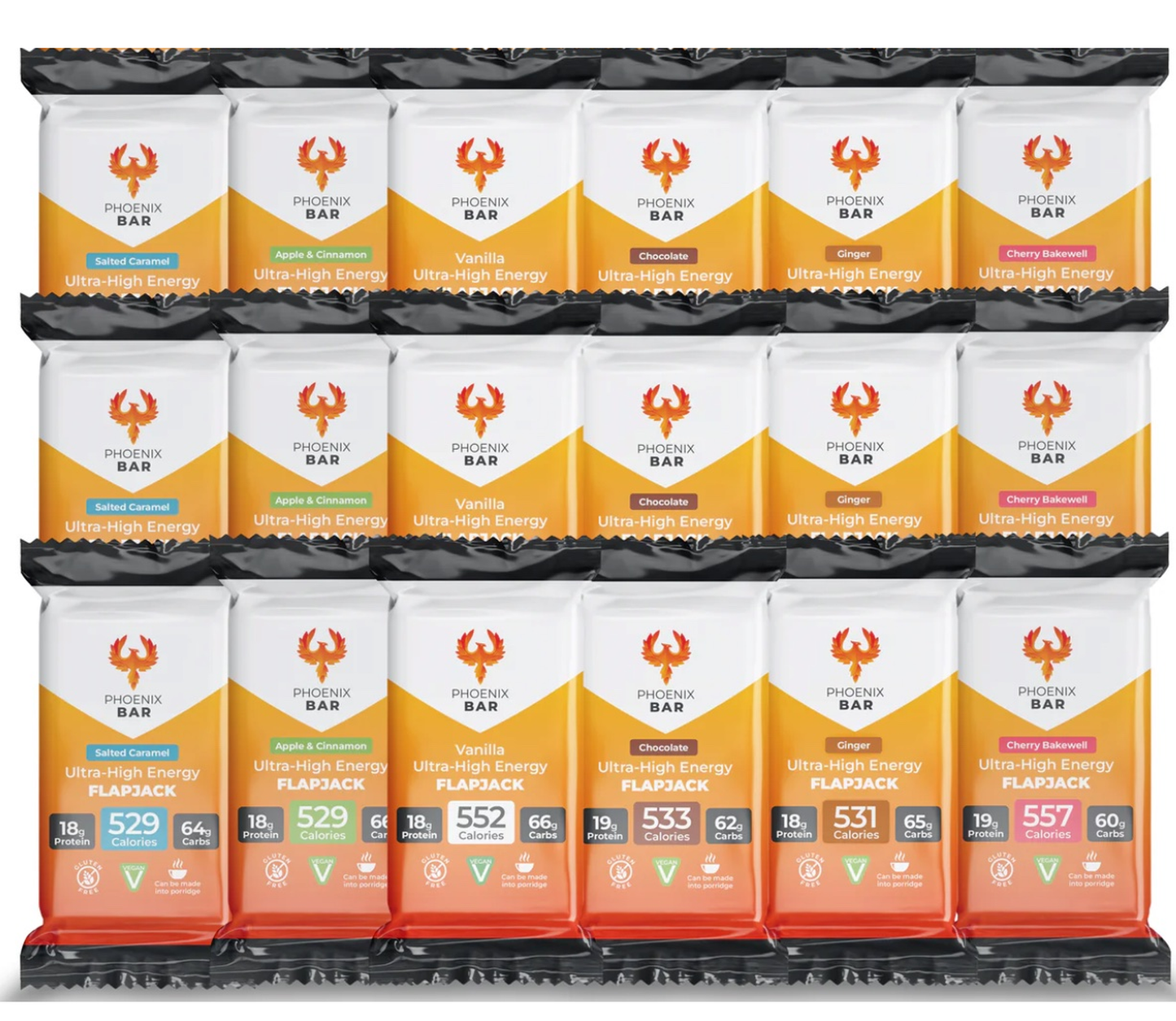
Phoenix Bars: Up to 557 Calories Per Bar
Highly compact and lightweight nutrition bars which are specialised for hiking and trekking. Ready to eat as a bar or mix with water to make nutritious porridge.
How Phoenix Bars Can Be Used
Phoenix Bars were designed for exactly this context: maximum calories in minimum weight, in a format that survives real conditions and stays easy to eat all day.
A single Phoenix Bar weighs 120g and provides 557 calories. To carry the same calories in apples, you would need roughly 3.6kg. In standard cereal bars, roughly 525g. The difference matters when it is on your back all day. The bars do not crush in a rucksack, do not melt in a warm side pocket, and can be eaten one-handed on the move. Add hot water from a flask and they become a camp porridge that replaces a stove meal.
The texture is soft and flapjack-like. They do not melt in summer heat, they do not freeze solid in winter cold, and they do not crumble into pieces at the bottom of a rucksack. The six flavours are mild rather than intensely sweet, which means they remain appetising deep into a long day when sugary bars have become unappealing.
On the move. Break a bar into pieces and eat them steadily over an hour or two. A full bar consumed gradually delivers 557 calories without needing to stop walking.
At a rest stop. Eat a whole bar or half bar alongside whatever other food you have brought. A Phoenix Bar plus a flask of tea on a summit is a 557-calorie lunch that weighs 120g and takes up less pack space than a sandwich.
As a warm meal. Adding hot water from a flask to a Phoenix Bar creates a calorie-dense porridge. On a cold, wet day, a hot porridge at a rest stop delivers calories and warmth simultaneously. No stove, no pot, no washing up. Just a cup and hot water.
As an emergency reserve. A single Phoenix Bar in the bottom of your rucksack is 557 calories of emergency food that weighs less than a water bottle, has a two-year shelf life, and is ready to eat immediately. If a hike takes longer than expected, the weather turns, or someone in the group runs out of energy, it is there.
"I enjoy Phoenix Bars whilst hiking as they are a great combination of being high in calories, tasty and lightweight. I like to use these specialist flapjacks on my tougher and longer hikes."
"I'm terrible at making sure I'm properly fuelled on long distance hikes, so finding these (especially as they're vegan) was a revelation! Tasted great, stayed in one piece in the bottom of my backpack until I needed a bite on the move."
Full nutritional information and ingredient lists for all six flavours are available on the product page.
What to Pack by Hike Type
Day hike (3 to 5 hours, moderate terrain). You can afford to be relaxed. A Phoenix Bar for steady energy, some fruit, a sandwich for your lunch stop, and water. Total food weight well under 1kg. The bar provides a reliable calorie backbone; the rest is for variety and enjoyment.
Long day hike (6 to 10 hours, challenging terrain). Calorie needs are significant: 3,000 to 5,000 calories across the day. Pack two Phoenix Bars (1,114 calories, 240g) alongside sandwiches, trail mix, and whatever else you enjoy. Eat one bar in portions through the morning and the second in the afternoon. This provides a consistent calorie base and saves the other food for the rest stops you look forward to.
Weekend or multi-day trek (2 to 5 days, carrying everything). This is where calorie density per gram matters most. Every extra gram of food weight is a gram on your back for the entire trip. For on-trail snacking, Phoenix Bars offer one of the highest calorie-to-weight ratios available in a ready-to-eat format. Pack three to four bars per day for trail food (1,671 to 2,228 calories at 360 to 480g), supplemented by whatever you eat at camp. The porridge format means a bar plus hot water becomes a camp breakfast or dinner, reducing the need to carry separate stove meals.
Winter hiking (cold, wet, short daylight). Cold conditions increase calorie burn and suppress appetite. Food that stays soft in near-freezing temperatures and can be eaten with gloves matters. Phoenix Bars remain edible in sub-zero conditions when most standard bars freeze solid. A warm Phoenix Bar porridge from a flask of hot water is one of the best things you can eat on a cold, exposed summit.
Overseas trekking (high altitude, multi-week, variable resupply). For treks where you carry food between resupply points, pack weight is critical. Phoenix Bars' two-year shelf life, compact size, and high calorie density make them practical for trips where resupply is uncertain. For altitude-specific guidance, see the High Altitude Mountaineering Nutrition page.
Related Guides
- Ultra-Endurance and Expedition Nutrition Guide
- High Altitude Mountaineering Nutrition
- Cycling and Bikepacking Nutrition
- UK Ultra Race Nutrition
- How To Use Phoenix Bars
- Calorie-Dense Foods: What They Are and When They Help
Frequently Asked Questions
How many calories do I need for a day hike?
A rough guide is 200 to 400 calories per hour of hiking, depending on terrain, pack weight, and conditions. For a six-hour moderate hike, plan for 1,500 to 2,500 calories of trail food on top of whatever you eat before and after. Most hikers significantly underestimate this and wonder why they feel exhausted by mid-afternoon.
What is the best food to carry for weight?
The most calorie-dense trail foods are nuts, nut butters, dried fruit, chocolate, and compact high-calorie bars. Phoenix Bars deliver approximately 4.6 calories per gram, which is among the highest available in a ready-to-eat format. For comparison, trail mix averages around 5 calories per gram but requires portioning and a container, while a standard cereal bar delivers 3 to 4 calories per gram.
Do Phoenix Bars work in hot and cold weather?
Yes. Phoenix Bars do not melt in summer heat like chocolate-based products and do not freeze solid in winter cold like most standard energy bars. They have been used at temperatures as low as -45°C and remain soft and edible. This makes them reliable year-round trail food regardless of conditions.
Can Phoenix Bars replace a meal on a multi-day trek?
A single Phoenix Bar delivers 557 calories, 66g of carbohydrates, and 19g of protein. That is comparable to a substantial meal. Made into porridge with full-fat milk or hot water, it can serve as a camp breakfast or dinner. It is not nutritionally complete (it does not contain the full range of vitamins and minerals), so it works best as part of a varied diet rather than the sole food source for multiple days.
How many Phoenix Bars should I take on a multi-day trek?
As a rough guide, budget two to four bars per day depending on how much other food you carry. For a three-day trek with limited resupply, ten bars (1.2kg) provides 5,570 calories of shelf-stable, no-cook trail food. This covers a significant portion of your daily calorie needs at a fraction of the weight of equivalent calories in other formats.
If you have any questions about using Phoenix Bars for hiking or trekking, contact me directly. I am always happy to help.
James Frost
Founder, Flaming Phoenix
07990 519422


Flaming Phoenix
High-Calorie Protein Bars for Endurance, Expeditions and Weight Gain




Why I built Phoenix Bars
Hi, I'm James.
I started Phoenix Bars at 23 after 150 conversations with ultra endurance athletes, extreme adventurers and people who struggle to eat enough calories.
Every design choice came directly from one of those conversations.
I pack every order from my home in Surrey, and I reply to every email myself, usually the same day.
Made in the UK. Hand-packed by James in Surrey. Used at Marathon des Sables, the South Pole, and in everyday situations where food feels hard.


