Ocean Rowing Nutrition: How to Fuel 5,000+ Calories a Day at Sea


About This Guide
Ocean rowing is one of the most calorically demanding activities on earth — and one of the most restrictive environments in which to eat.
Rowers in the ocean crossings typically burn between 5,000 and 9,000 calories per day while rowing two-hours-on, two-hours-off for 40–70 consecutive days. Every gram of food must be carried aboard a boat that's typically 24 feet long and 5 feet wide. There is no refrigeration, no fresh food, and no resupply. Race regulations require rowers to carry a minimum of 60 kcal per kg of bodyweight per day for the prescribed number of days.
Despite these extreme calorie needs, the average ocean rower loses 8–12kg during an Atlantic crossing — because getting enough calories in is almost as hard as the rowing itself. Fatigue, seasickness, limited preparation options, food fatigue, and the sheer volume of eating required all work against adequate fuelling.
This guide focuses specifically on practical approaches to maximising calorie intake during an ocean row, with particular focus on the role of compact, calorie-dense foods.
It covers:
- the calorie maths: how much you actually need and why most rowers fall short
- why food selection for ocean rowing is fundamentally a weight-to-calorie problem
- what food characteristics matter most in an open-ocean environment
- practical strategies for closing the calorie gap during a crossing
- how compact, calorie-dense options can supplement freeze-dried rations
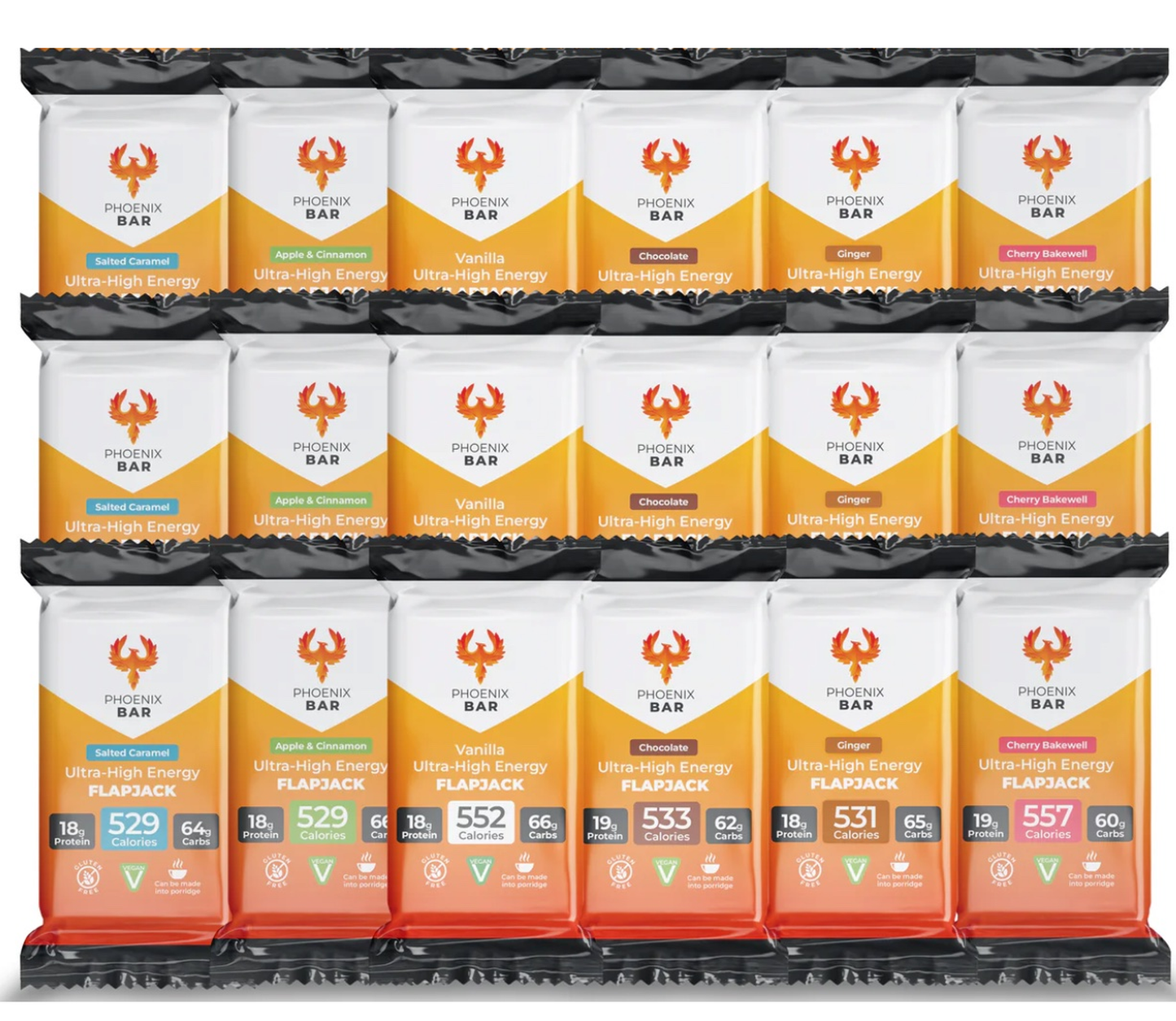
It also explains how ocean rowers have used Phoenix Bars, compact 557-calorie flapjacks that won't melt or spoil, as part of their on-board nutrition.
Written by James Frost, Founder of Flaming Phoenix. Phoenix Bars have been carried on Atlantic crossings and are used by ultra-endurance athletes and expedition teams worldwide.
Last updated: March 2026
Key points: Ocean rowers typically need 5,000–6,000+ calories per day for 40–70 days. The average rower loses 8–12kg during an Atlantic crossing despite trying to eat enough. Every gram of food competes for space and weight on a small boat. Calorie density — calories per gram — is the single most important food selection criterion. Phoenix Bars deliver up to 557 calories per 120g bar, won't melt in tropical heat, and have a two-year shelf life.
Contents
- The calorie problem on an ocean row
- Why most ocean rowers lose weight
- The weight-to-calorie equation
- What makes food work at sea
- Common food challenges during an ocean crossing
- Practical strategies to maximise calorie intake
- Why calorie density is the defining factor
- The role of snacking between rations
- How Phoenix Bars fit into ocean rowing nutrition
- Practical suggestions for an Atlantic crossing
- Frequently asked questions
- Related guides
The Calorie Problem on an Ocean Row
The calorie demands of ocean rowing are staggering.
A rower in the Talisker Whisky Atlantic Challenge — the world's most established ocean rowing race, covering approximately 3,000 miles from the Canaries to Antigua — will typically row for 12–16 hours per day in a continuous two-on, two-off shift pattern. This sustained, high-output effort burns between 5,000 and 9,000 calories per day depending on body weight, rowing intensity, and conditions.
For a 100kg male rower in a pairs crew, the Atlantic Campaigns minimum requirement is 60 kcal per kg of bodyweight per day — that's 6,000 calories per day, for a prescribed minimum of 65 days. That equates to nearly 400,000 calories that must be carried aboard the boat before departure.
To put this in perspective: 6,000 calories is roughly three times the normal daily intake for an adult male. It is the equivalent of eating six full meals per day — every day, for two months, in a cramped boat in the middle of the Atlantic.
The challenge is not knowing you need the calories. The challenge is physically getting them in.
Why Most Ocean Rowers Lose Weight
Despite carrying enough food and knowing the maths, the average ocean rower loses 8–12kg during an Atlantic crossing. Some lose as much as 20kg.
This happens because the barriers to eating are enormous.
Seasickness. Particularly in the first 1–2 weeks, seasickness can make eating impossible. Some rowers survive the opening days almost entirely on liquids and whatever they can keep down.
Exhaustion. After hours of continuous rowing, the energy to prepare and eat food can feel unavailable. The two-hour rest window is needed for sleep, navigation, and boat maintenance — eating competes with rest.
Food fatigue. Eating the same rotation of freeze-dried meals for 40–70 days creates deep monotony. Even foods that were enjoyable on day one become psychologically difficult by day 30. Many rowers report that the sight of certain meals triggers genuine aversion.
Mastication fatigue. When exhausted, even the physical act of chewing becomes effortful. Hard, chewy, or dry foods become increasingly difficult to eat as the crossing progresses.
Preparation time. Freeze-dried meals require boiling water and rehydration time. In rough seas, handling a stove and waiting 10–15 minutes for food to rehydrate can feel like an impossible luxury.
Heat and humidity. Tropical Atlantic conditions (up to 40°C) can cause some foods to deteriorate, melt, or become unpalatable. Chocolate, many energy bars, and some snacks become a melted mess.
Limited space. On a 24-foot boat shared with one or more crew members, food storage competes with safety equipment, sleeping space, water-making equipment, and everything else needed to survive.
The cumulative result is that most rowers eat less than they need, most days, for the entire crossing. The weight loss is the visible evidence of a persistent calorie gap.
The Weight-to-Calorie Equation
Ocean rowing nutrition is fundamentally a weight-to-calorie optimisation problem.
Every kilogram of food loaded onto the boat adds weight that must be propelled across 3,000 miles of ocean. Heavier boats are slower. In a race context, every unnecessary gram costs time. In any crossing context, total boat weight affects speed, manoeuvrability, and safety.
This means food selection is not just about nutrition — it is about the ratio of calories to grams. A food that delivers 300 kcal per 100g is literally twice as efficient as one that delivers 150 kcal per 100g. Over 65 days of eating, this difference translates to tens of kilograms of food weight — or hundreds of thousands of calories available in the same weight budget.
The most common food types on ocean rows reflect this:
Freeze-dried meals are the staple because removing water dramatically reduces weight. A typical freeze-dried meal delivers 500–800 calories per pouch at around 120–150g before water is added. They require a stove and fresh water to prepare.
Snack bars, nuts, and dried fruit fill the calorie gaps between meals. These are eaten throughout the day during rowing shifts. Their calorie density varies hugely — a standard cereal bar might deliver 100–150 kcal, while a calorie-dense bar can deliver 400–550+ kcal in a similar weight.
Protein shakes and calorie drinks deliver liquid calories that don't require chewing — increasingly valued as fatigue builds across the crossing.
"Wet rations" — foods that require no water to prepare — are reserved for emergencies, storms, and days when cooking is impossible. Race regulations typically require 13 out of 65 days of food to be in this format.
The implication for food selection is clear: the highest calorie-to-gram ratio wins. Every snack, bar, and meal should be evaluated on this basis.
What Makes Food Work at Sea
The open ocean is an unforgiving environment for food. What works in training or on land does not necessarily work on a mid-Atlantic rowing boat.
Food for an ocean crossing needs to be:
- Calorie-dense — maximum energy per gram of weight carried
- Heat-stable — temperatures on an Atlantic crossing can exceed 40°C. Foods that melt, spoil, or become inedible in tropical heat are a liability
- Long shelf life — food must remain safe and edible for 2–3 months from provisioning to consumption, with no refrigeration
- Robust packaging — salt water, humidity, constant movement, and rough handling will destroy anything that isn't well sealed. Packaging must be waterproof and crush-resistant
- Easy to eat with minimal preparation — anything that requires cooking time or complex preparation is a barrier. The ideal snack food is open-and-eat
- Easy to eat when exhausted — soft textures that require minimal chewing become increasingly important as fatigue builds across the crossing
- Not sickly sweet — flavour fatigue is a serious problem on long crossings. Overly sweet snacks become intolerable after weeks of consumption
- Varied enough to prevent food fatigue — multiple flavour options in any single food category help maintain willingness to eat

Phoenix Bars: Up to 557 Calories Per Bar
Highly lightweight, calorie dense nutrition bars designed for ocean rowing. Up to 19g of protein and 66g of carbs per bar.
Common Food Challenges During an Ocean Crossing
Beyond the general barriers to eating, several specific food challenges are reported by ocean rowers.
Standard energy bars fail. Many popular energy and protein bars are either too dry and chewy to eat when exhausted, too sweet for sustained daily use, too low in calories to justify their weight, or melt into an inedible mess in tropical heat. Rowers consistently report abandoning bars they had planned to rely on.
Freeze-dried meal fatigue. While freeze-dried meals are calorically efficient, eating them twice a day for 50+ days causes deep psychological aversion. The textures, smells, and flavours become triggers rather than appetisers.
The snack gap. The calories between main meals — the thousands of kcal that need to come from snacking during rowing shifts — are where most rowers fall short. Snacks need to be eaten one-handed while rowing, in any weather, without preparation. Most rowers underestimate how many snack calories they need and under-provision.
Night eating. During night rowing shifts, the combination of darkness, exhaustion, and cold makes eating feel impossible. Yet the calorie burn continues. Many rowers skip eating during night shifts entirely, creating a significant calorie deficit.
Wet ration days. During storms or equipment failure, the inability to heat water means freeze-dried meals are unusable. Ready-to-eat options become the only food source — and most crews don't carry enough of them.
Practical Strategies to Maximise Calorie Intake
Several approaches can help close the calorie gap during an ocean crossing.
Provision more snack calories than you think you need. Most crews under-provision snacks. The calories between freeze-dried meals — consumed during rowing shifts, at night, and between rest periods — should account for 40–50% of total daily calorie intake. Plan for this explicitly rather than treating snacks as an afterthought.
Choose the highest calorie-to-gram snacks available. Every gram matters. Compare snack options by kcal per 100g and select the most calorie-dense options that you can tolerate eating repeatedly. A 120g bar that delivers 557 calories is significantly more efficient than a 60g bar that delivers 150 calories.
Carry a variety of flavours and textures. Food fatigue is a genuine performance risk on an ocean crossing. Carrying 6+ flavour variations of any snack food you plan to eat daily gives you options when one flavour becomes intolerable.
Front-load calories early in the day. Many rowers report that appetite is strongest in the first few hours after waking. A calorie-dense breakfast — ideally a porridge or similar warm meal — before fatigue accumulates sets a solid calorie foundation.
Eat on a schedule, not on appetite. Hunger signals become unreliable at sea due to seasickness, exhaustion, and the constant low-level stress of open-ocean rowing. Eat by the clock — something every 2–3 hours — regardless of whether you feel hungry.
Have one-handed, open-and-eat options for rowing shifts. Anything that requires two hands, a spoon, or preparation time will not get eaten during a rowing shift. Break bars into pieces before your shift and keep them in a pocket or open container within reach.
Plan specifically for night shifts. Pre-portion calorie-dense snacks into night-shift bags before going to sleep. Having food ready to grab in the dark, with no preparation, is the only way most rowers eat anything between midnight and dawn.
Test everything in training. Never take food on a crossing that you haven't eaten repeatedly during long training rows. What tastes good at rest may be intolerable after 10 hours of rowing in 35°C heat.
Why Calorie Density Is the Defining Factor
In ocean rowing nutrition, calorie density — calories per gram of weight — is the single metric that matters most.
The entire food supply must be carried on a small boat. Every gram of food displaces something else or adds drag. At the same time, the rower needs 5,000–6,000+ calories per day for 40–70 days. The food that delivers the most calories in the least weight is the food that makes the crossing possible.
For context: a standard cereal bar delivers approximately 150 kcal at 40g — roughly 375 kcal per 100g. Trail mix delivers approximately 450–500 kcal per 100g. A freeze-dried meal delivers approximately 400–500 kcal per 100g (before water). A Phoenix Bar delivers approximately 464 kcal per 100g (557 kcal per 120g bar) — and requires no water, no preparation, and no cooking.
Over a 65-day crossing at 6,000 kcal per day, the difference between a snack delivering 375 kcal per 100g and one delivering 464 kcal per 100g translates to kilograms of saved weight — or thousands of additional calories in the same weight budget.
The Role of Snacking Between Rations
For most ocean rowers, freeze-dried meals provide the caloric foundation — typically 2–3 meals per day accounting for 1,500–2,400 calories. The remaining 3,000–4,000+ calories must come from snacking throughout the day.
This snacking component is where most rowers fall short and where the calorie gap accumulates. The ideal snack for ocean rowing:
- Can be eaten one-handed while rowing
- Requires no preparation or utensils
- Is calorie-dense enough to deliver meaningful energy in a few bites
- Won't melt, spoil, or deteriorate in tropical conditions
- Has a soft texture that can be managed when exhausted
- Isn't sickly sweet (to prevent flavour fatigue over weeks)
- Comes in multiple flavour options
Packing a mix of nuts, dried fruit, nut butters, chocolate (in cooler conditions), biltong, and calorie-dense bars — with variety across all of them — gives the best chance of maintaining snack intake across the full crossing.
How Phoenix Bars Fit into Ocean Rowing Nutrition
Phoenix Bars were designed for exactly the kind of demands that ocean rowing presents: maximum calories, minimum weight, extreme conditions, and eating under duress.
Each bar delivers up to 557 calories and 19g of protein in a 120g format. They are specifically designed to:
Not melt in extreme heat. Phoenix Bars are heat-stable and have been tested in conditions exceeding 50°C. They will not melt into an unusable mess in the tropics — unlike chocolate bars and many standard energy bars.
Not freeze in cold conditions. Night-time temperatures at sea can drop significantly. Phoenix Bars remain soft and edible in cold conditions, unlike many foods that harden and become impossible to chew.
Survive rough handling. Phoenix Bars come in robust, water-resistant packaging that won't crush or tear under the conditions of a rowing boat — constant movement, salt spray, compression from other supplies.
Be easy to eat when exhausted. The soft, melt-in-the-mouth texture means minimal chewing is required. After 12 hours of rowing, this matters. Bars can be broken into pieces and eaten one-handed during a shift.
Offer flavour variety. Phoenix Bars are available in six flavours — Vanilla, Cherry Bakewell, Chocolate, Salted Caramel, Ginger, and Apple & Cinnamon. Over a 50–70 day crossing, this variety helps combat the food fatigue that degrades eating in the later weeks.
Make porridge with water. Adding hot water to a Phoenix Bar creates a calorie-dense porridge — an alternative format when solid food feels difficult, particularly during seasickness or in the early days of a crossing. For instructions, see how people use Phoenix Bars.
Store for up to two years. The two-year shelf life means bars can be provisioned months before departure with no risk of expiry.
Phoenix Bars have been carried on Atlantic crossings by ocean rowers who chose them for the calorie-to-weight ratio and the practical qualities described above.
Practical Suggestions for an Atlantic Crossing
Provisioning: Carry 2–3 Phoenix Bars per day as snack rations alongside your freeze-dried meals. Over 65 days, that's 130–195 bars (approximately 15.6–23.4kg) delivering 72,000–108,000 additional calories. Bars can be ordered in the 24-bar Signature Bundle for bulk provisioning.
Daily pattern: Eat one bar as a pre-dawn porridge breakfast (add hot water from the desalinator). Break a second bar into pieces for grazing during day rowing shifts. Keep a third bar portioned for night rowing shifts.
Shift eating: Before each rowing shift, break half a bar into 4–5 pieces and put them in a pocket or open container within arm's reach. Eat one piece every 20–30 minutes while rowing. This adds approximately 275 calories per shift without interrupting rowing.
Seasickness days: During the first week when seasickness is likely, the porridge format may be more tolerable than solid food. Mix a bar with water to a thin consistency and sip it gradually. Any calories retained are better than none.
Storm days (wet ration days): Phoenix Bars require no water, no cooking, and no preparation. They function as a reliable wet ration — ready to eat straight from the packet in any conditions.
Flavour rotation: If carrying bars for 65 days, rotate through all six flavours on a weekly cycle. This prevents any single flavour from becoming aversive.
Storage: Store bars in a waterproof dry bag in an accessible location. They do not need refrigeration and will remain stable throughout a tropical Atlantic crossing.
Frequently Asked Questions
How many calories do ocean rowers need per day?
Most ocean rowers need between 5,000 and 9,000 calories per day depending on body weight, rowing intensity, and conditions. The Talisker Whisky Atlantic Challenge requires rowers to carry a minimum of 60 kcal per kg of bodyweight per day. For a 100kg rower over 65 days, that's 6,000 calories per day, or nearly 400,000 calories total.
Why do ocean rowers lose so much weight?
The average Atlantic crossing rower loses 8–12kg despite carrying adequate food. This is caused by seasickness (particularly in the first week), fatigue that reduces eating motivation, food fatigue from months of repetitive meals, difficulty eating during night shifts, and the sheer volume of calories required exceeding what most people can physically consume.
Will Phoenix Bars melt on an ocean rowing boat?
No. Phoenix Bars are heat-stable and have been tested above 50°C. They will not melt in tropical Atlantic conditions. This is a specific design feature — unlike chocolate bars and many standard energy bars, which typically become unusable in sustained heat.
How many Phoenix Bars should I take on an Atlantic crossing?
A practical recommendation is 2–3 bars per day, depending on how much of your total calorie target you plan to cover with bars versus freeze-dried meals and other snacks. Over 65 days at 2 bars per day, that's 130 bars. At 3 bars per day, 195 bars. Contact me directly to discuss bulk provisioning for your crossing.
Can I make Phoenix Bars into porridge on a rowing boat?
Yes. Adding hot water from your desalination unit to a Phoenix Bar creates a calorie-dense porridge. This is particularly useful during periods of seasickness when solid food is difficult to tolerate, or as a quick breakfast that doesn't require a full freeze-dried meal preparation.
Do Phoenix Bars count as wet rations?
Phoenix Bars require no water and no preparation — they can be eaten straight from the packet. They meet the practical definition of a wet ration, though you should confirm with your specific race organisation how they classify provisioned food.
Related Guides
You may also find these guides helpful:
- Ultra-Endurance & Expedition Nutrition Guide — broader guide to nutrition for extreme endurance events
- Marathon Des Sables Nutrition — another extreme endurance context with similar calorie-density demands
- Calorie-Dense Foods: What They Are and When They Help — a full explanation of calorie density
- How To Use Phoenix Bars — practical guidance including the porridge method
James Frost
Founder, Flaming Phoenix
07990 519422


Flaming Phoenix
High-Calorie Protein Bars for Endurance, Expeditions and Weight Gain