Long-Distance Cycling Nutrition: How to Fuel from 100km to 1,200km
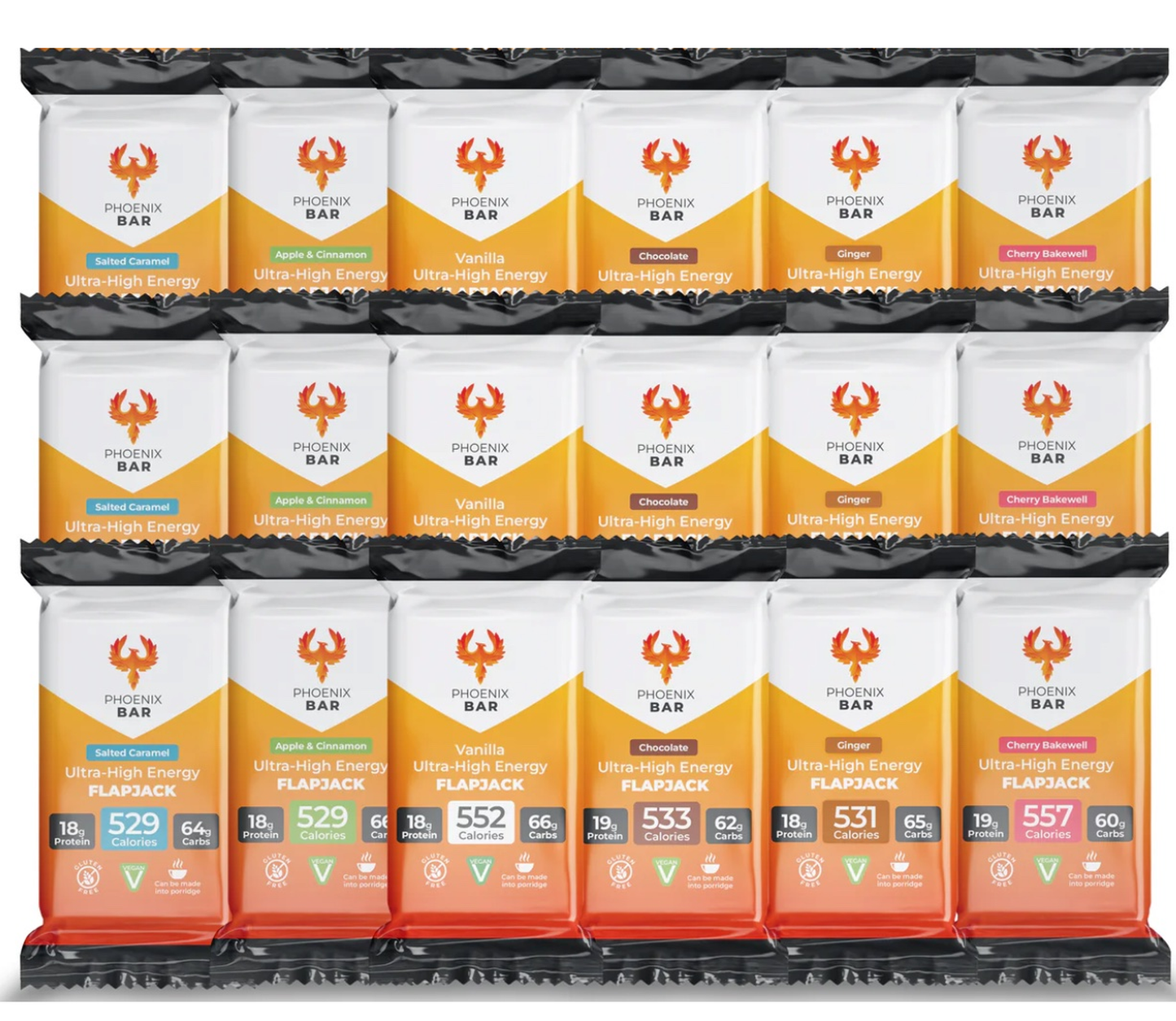
Quick answer: For rides over 3 hours, target 60 to 90g of carbohydrate per hour, mixing fast-acting gels with calorie-dense real food. For rides over 8 hours, real food becomes essential because palate fatigue makes gels unbearable. For rides over 24 hours (audax 400km+, LEJOG, ultra cycling races), carry food at 4+ calories per gram or you cannot physically pack enough energy. Eat proactively on a 30-minute timer rather than waiting for hunger, because by the time you feel hungry you are already in deficit. Calorie-dense bars like Phoenix Bars (557 calories in 120g) deliver more usable energy per jersey pocket than any other format.
Who This Guide Is For
This is a practical fuelling guide for cyclists riding more than 100km in a single effort, including audax brevets (200km, 300km, 400km, 600km, 1,200km), centuries, sportives, LEJOG, and ultra-distance road events. It assumes you already know the basics of cycling and are looking to solve the specific nutrition problem that emerges when rides extend beyond what gels alone can sustain.
If you ride mostly off-road on multi-day adventures with frame bags and camping gear, see the dedicated guide to bikepacking nutrition instead. If you are doing LEJOG or End-to-End specifically, see the LEJOG nutrition guide. For broader principles that apply across all multi-day endurance events, see the Ultra Endurance and Expedition Nutrition Guide.
Why Long-Distance Cycling Has a Different Nutrition Problem
For rides under three hours, your fuelling is mostly about topping up glycogen with simple carbs. For rides over six hours, the problem shifts. You are no longer fuelling a single effort. You are managing four overlapping issues that compound across the day.
Glycogen depletion is no longer the limiting factor. Your liver and muscle glycogen stores hold roughly 90 minutes of moderate-intensity riding. After that, every calorie you spend has to come from what you ate that day. Research published in the European Journal of Applied Physiology shows that endurance cyclists in events over 8 hours typically operate in a calorie deficit of 30 to 50% of their actual expenditure, and the riders who finish strongest are not the fastest, they are the ones who minimised that deficit.
Palate fatigue arrives faster than most cyclists expect. Gels and sweet sports drinks work well for the first 3 to 4 hours. By hour 6 to 8, most cyclists report nausea or aversion to sweet products. By hour 12, sweet food becomes physically difficult to swallow. This is a documented phenomenon and the reason most ultra cyclists shift to savoury or neutral-flavoured food in the second half of long events.
Pack weight matters more than people think. A jersey pocket holds roughly 500 to 700g of food. A small saddle bag adds another 500g to 1kg. On a 600km audax that takes 30 hours, you might need 6,000 to 9,000 supplementary calories beyond what you can buy at controls. The maths only works if your food delivers high calories per gram. This is why understanding calorie density is the most important single concept in long-distance cycling nutrition, and why a calorie-dense bar like Phoenix is built around the 4.5 calories-per-gram figure rather than the 3.5 cal/g of typical energy bars.
Eating while pedalling is harder than eating while running. A cyclist needs at least one hand on the bars, often both. Wrappers must open with one hand. Food must be chewable without stopping. Anything sticky, crumbly, or that requires tearing teeth into is impractical at speed.

Phoenix Bars: Up to 557 Calories Per Bar
Highly compact, low-volume, calorie-dense bars. Soft, easy to eat whole or as a warm porridge. Vegan, gluten-free and contain up to 66g of carbohydrates, 19g of protein & 8 vitamins & minerals.
How Many Calories Long-Distance Cyclists Actually Need
The maths depends on your weight, pace, terrain, and conditions, but here are realistic working numbers for an average 75kg cyclist riding at endurance pace.
A 100km century takes 4 to 5 hours and burns roughly 2,500 to 3,500 calories. Carb target on the bike is 60 to 90g per hour, which means 240 to 450g of total carbs across the ride. Most cyclists can hit this with a mix of gels, drinks, and one or two solid items.
A 200km audax takes 8 to 10 hours and burns 5,000 to 7,000 calories. Carb target stays at 60 to 90g per hour, but realistic intake drops slightly because gut tolerance starts to suffer in the back half. You need 480 to 900g of carbs total across the ride. This is where solid food alongside gels becomes essential.
A 400km audax takes 18 to 24 hours and burns 11,000 to 14,000 calories. Carb target drops to 50 to 80g per hour because most cyclists cannot tolerate higher intake into the second night. Total carbs needed is 900 to 1,900g, and you will be eating real food predominantly because gels stop working by hour 8 to 12.
A 600km audax takes 30 to 40 hours and burns 17,000 to 23,000 calories. Carb target drops further to 40 to 70g per hour. Total carb need is 1,200 to 2,800g. Almost no cyclist completes this on gels alone, and the riders who finish well are those who switch to mild, calorie-dense food before they have to.
A 1,200km event such as Paris-Brest-Paris takes 70 to 90 hours and burns 35,000 to 50,000 calories. Carb target is 40 to 60g per hour, and total carb need is 2,800 to 5,400g. Sleep deprivation, palate fatigue, and pack weight all become serious constraints.
Two things stand out across these distances. First, you cannot eat as much as you burn on anything beyond a century. Even the strongest stomachs absorb a maximum of around 90g of carbs per hour, which caps you at roughly 360 calories per hour from on-the-move fuelling. Above an 8-hour ride, you are definitionally in deficit. Second, the longer the event, the lower the realistic carb intake per hour, because gut tolerance degrades over time.
The goal is not to eliminate the deficit. It is to minimise it enough that you finish without your performance and judgment collapsing.
The Three Fuelling Strategies (and When Each One Works)
Long-distance cyclists fall into one of three camps. Knowing which you are determines what you carry.
Strategy 1: Café-only (the British classic)
You stop at petrol stations, pubs, cafés, and shops every 50 to 80km and buy whatever is available. You carry minimal food on the bike, maybe a single emergency bar. This works well on routes through populated areas with reliable opening hours and where time off the bike is acceptable.
The advantages are low pack weight, real food variety, and the mental break of stopping. The disadvantages are dependence on opening hours (most British villages have nothing open after 8pm or before 8am), weather exposure (queueing at a petrol station in driving rain at 3am is grim), and the time cost (each stop is typically 15 to 30 minutes once you account for ordering, eating, faffing, and getting moving again).
This strategy works for 200km audax in summer daylight, sportives, and leisure centuries. It does not work for anything that crosses a night.
Strategy 2: Carry-only (the time-trial approach)
You carry every calorie you need from the start, eating only what is in your jersey or saddle bag. Used by competitive ultra cyclists where every minute off the bike costs places. This works only when calorie density is high enough that the food fits the pack space.
Advantages: zero stop time, predictable nutrition, no exposure to whatever the convenience store stocks. Disadvantages: heavy, monotonous (your food choices are fixed at the start), and unforgiving if you guess your appetite wrong. This is where calorie density becomes the constraint that defines whether the strategy is even possible.
This strategy fits short ultra time-trials, supported events with feed stations, and riders chasing personal records.
Strategy 3: Hybrid (what most experienced ultra cyclists actually do)
Carry enough calorie-dense food to cover any 4 to 6 hour stretch without resupply. Top up at controls, cafés, or shops when convenient. Use carried food specifically for the difficult hours: night, dawn, between closed-shop villages, when nausea makes café food unappealing.
This is the strategy used by most experienced LEJOG and audax riders. It buys you optionality. You are not forced to stop if a café is closed, but you can stop if it is open and you fancy it. It also means your carried food can be optimised for one job: working when other food has stopped working. Phoenix Bars were designed specifically for this layer of the strategy.
This is the right approach for 400km audax and longer, LEJOG, and any UK ultra-distance ride that crosses a night.
What Real Food Beats Gels (and When)
The question is not "real food vs gels." It is "what to use, when." Here is the practical breakdown by hour.
In hours 0 to 4, gels and drinks work fine and absorb fastest. Most cyclists tolerate them well in the early hours.
In hours 4 to 8, mix gels with solid food. Bananas, rice cakes, malt loaf, energy bars. Sweet bars are still tolerable.
In hours 8 to 16, sweet fatigue kicks in. Most cyclists lose tolerance for gels. Switch to milder bars, sandwiches, savoury options like cheese or salted nuts. Calorie density becomes critical because pack space is finite.
In hours 16 to 30, almost no cyclist can eat gels at this point. Real, mild-flavoured food is the only thing most riders can keep down. This is where calorie-dense bars earn their place: they deliver 500+ calories in a single item, do not require chewing through a stiff wrapper, and remain palatable when sweet bars cause a gag reflex. See how to use Phoenix Barsfor the porridge method that many ultra riders use at controls.
Beyond hour 30, you eat anything you can get down. Cyclists report sandwiches, soup, hot drinks, mild bars, and small amounts of whatever appeals at controls. The rule is calories in any form, eaten on a schedule.
Cold-Weather UK Audax: A Specific Sub-Problem
Most cycling nutrition advice assumes summer riding. UK winter audax creates a problem most articles ignore: most energy bars freeze at temperatures below 5°C.
If you have ever tried to bite into a frozen Clif Bar at 3am in February, you know that "still edible" is the difference between fuelling and not fuelling. Foods that work in UK winter conditions need to stay soft below freezing, open with cold or gloved hands, and not require chewing through a brick.
Phoenix Bars were designed for this problem. They remain soft and edible at sub-zero temperatures and have been used in extreme cold environments well below anything a UK winter throws at a cyclist. For long-distance road cycling overnight in autumn and winter, this is one of the few practical advantages a calorie-dense bar offers over standard cycling nutrition.
Where Phoenix Bars Fit in a Long-Distance Cycling Strategy
Phoenix Bars deliver up to 557 calories in a 120g bar at roughly 4.5 calories per gram, which is significantly higher density than most cycling-specific bars (typically 3.5 to 4.0 cal/g).
For a 200km audax, one or two bars in jersey pockets provide reliable calorie backup alongside whatever you eat at controls. For a 400km or 600km, two to four bars distributed across pockets and saddle bag provide late-race insurance for when sweet products have failed. They can be eaten whole, broken into pieces for gradual on-the-bike grazing, or made into a porridge with hot water at a control or café (full instructions in how to use Phoenix Bars).
The six flavours are deliberately mild rather than sweet, which means they remain palatable in the late hours when most other foods have become difficult. They are vegan and gluten-free, which simplifies the logistics for riders with dietary requirements. Phoenix Bars have been used by riders on LEJOG and on UK audaxes from 200km up to 1,200km distances.
The Most Common Mistakes
Eating reactively rather than on a schedule. By the time you feel hungry, you are 30 to 60 minutes behind on calories. Set a watch alarm every 30 minutes. Eat regardless of appetite.
Stopping fuelling in the last 50km because "I'm nearly home." This is where most bonks happen. The deficit you have built across 8+ hours catches up on the final climb. Keep eating until the finish line.
Underestimating café reliance in the UK. Continental Europe has petrol stations every 20km that are open 24/7 with hot food. Rural UK does not. Plan for 4 to 6 hour stretches where nothing will be open.
Carrying only sweet food. The single most common cause of second-half DNFs is sugar fatigue. Carry at least one mild-flavoured or savoury option specifically for when sweet has stopped working.
Trying new food on event day. Your gut needs to be trained on whatever you plan to eat. Test every product in long training rides at race pace before relying on it.
Frequently Asked Questions
How many carbs per hour should I eat on a long ride? 60 to 90g per hour for rides under 8 hours. 40 to 70g per hour for rides over 8 hours, because gut tolerance drops with fatigue. Practise this in training because going from your normal 30g/hr training intake to 90g/hr on event day is a recipe for GI distress.
Do I really need real food, or are gels enough? For rides under 4 hours, gels alone work for most cyclists. For rides over 8 hours, real food is essential because palate fatigue from sweet products is the single most common reason cyclists stop eating in the second half.
What is the lightest calorie-dense food for cycling? Nut-based foods deliver around 5.5 to 6.5 calories per gram. Calorie-dense bars deliver 4 to 5 calories per gram. Most standard energy bars are 3.5 to 4 cal/g. Gels are 2.5 to 3 cal/g (mostly water weight). For pack-weight-constrained ultra rides, prioritise foods at 4+ cal/g. See the calorie-dense foods guide for a fuller comparison.
How do I avoid the bonk on long rides? Eat on a 30-minute timer from hour one. Do not wait for hunger. Carry at least 200 calories per planned hour of riding. Have a backup mild-flavoured food for when sweet products stop working.
Can I do an audax just on café food? Yes for 200km in summer daytime. Increasingly difficult above that, as overnight stretches and rural areas mean shops are closed. Most audax veterans use a hybrid carry-and-resupply approach.
What should I eat the night before a 200km audax? A normal-sized meal with carbs (rice, pasta, potatoes), some protein, low fibre, low fat. Avoid anything new or unusual. Hydrate well. Do not over-eat the night before, this rarely helps and often disrupts sleep.
Do Phoenix Bars work in cold weather? Yes. They remain soft and edible at sub-zero temperatures. The wrapper opens with cold or gloved hands.
Related Guides
For broader principles across multi-day endurance: Ultra Endurance and Expedition Nutrition Guide.
For off-road and multi-day adventure cycling: Bikepacking Nutrition.
For the End-to-End specifically: LEJOG Nutrition.
For understanding the calorie density principle: Calorie-Dense Foods Explained.
For practical Phoenix Bar usage including the porridge method: How to Use Phoenix Bars.
Written by James Frost, Founder of Flaming Phoenix. James developed Phoenix Bars after 150+ pre-development conversations with people who struggle to eat enough or fuel ultra-endurance efforts. Phoenix Bars have been carried by cyclists on LEJOG and on UK audaxes ranging from 200km to 1,200km. He can be reached at jfrost@flaming-phoenix.co.uk.


Flaming Phoenix