

Sea Kayak Expedition Nutrition: Fuelling the Four Moments of a Paddling Day
In this guide

Sea kayak expedition nutrition is not like any other expedition sport. You are not walking with a pack, where everything is accessible. You are not rowing continuously on an open ocean, where food comes from a boat-mounted stove. You are sitting in a sealed cockpit with one hand on a paddle, your food stored in hatches you cannot reach without rafting up or landing, and your body heat draining into a deck that is permanently wet.
The hard part of fuelling a multi-day paddle is physically getting the calories in at four specific moments of the day, each with its own constraints. Get those four moments right, and the trip works. Get them wrong, and you arrive at camp shaking, bonked, and already in deficit for tomorrow.
About this guide
This guide is written for expedition paddlers, not day trippers. It covers weekend crossings, week-long coastal trips, and multi-week expeditions. It is built around two frameworks: the four moments of a paddling day, and the four constraints that shape every food decision you make in a kayak. For nutrition on crossings where you never land, see the Ocean Rowing Nutrition guide. For broader expedition principles, see the Ultra-Endurance and Expedition Nutrition Guide.
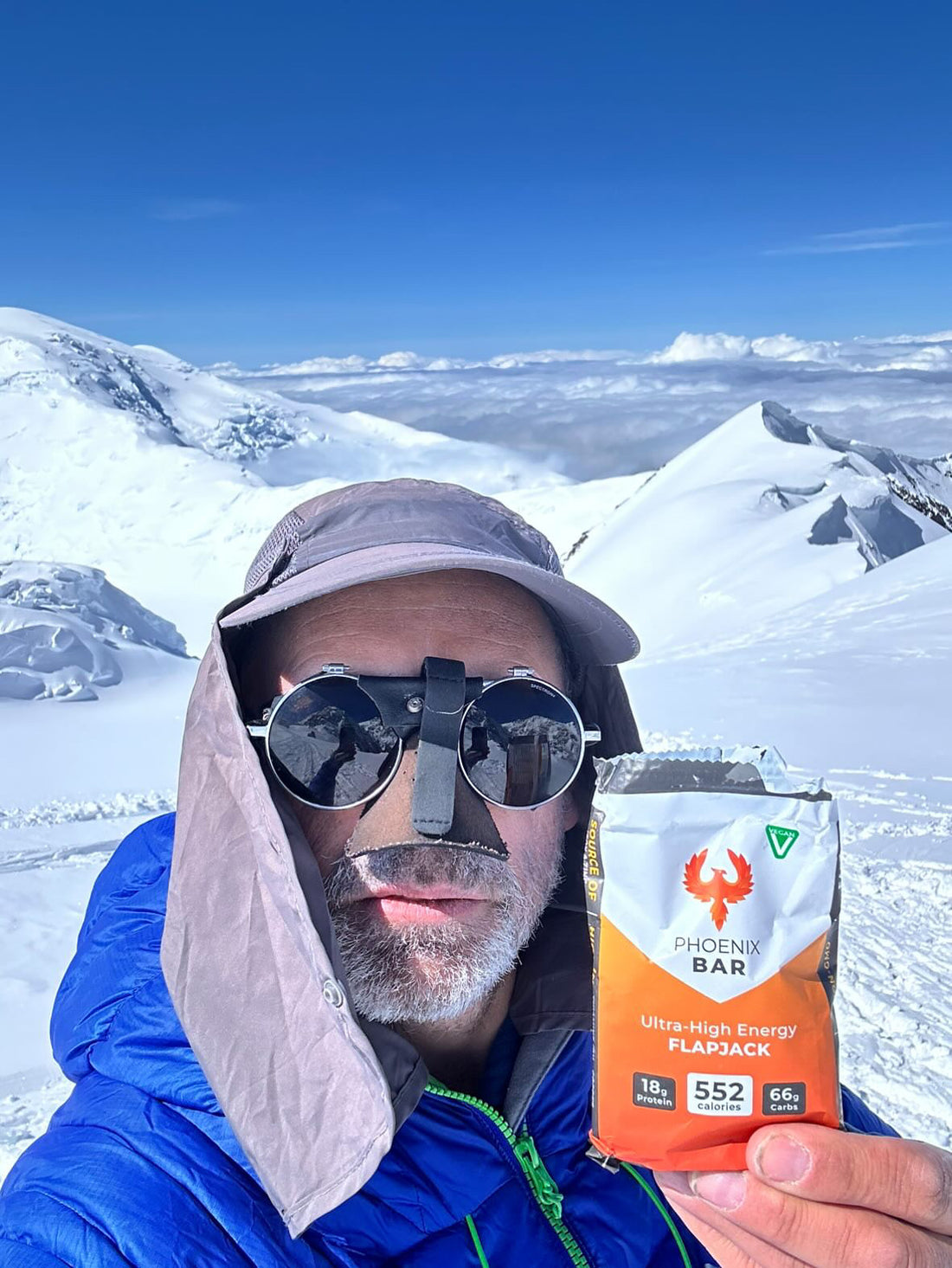
Phoenix Bars are compact flapjack-style bars with up to 557 calories, originally built for ultra-endurance and extreme expeditions. They are referenced throughout because sea kayakers use them specifically for the on-water moment, where most standard foods do not work.
Written by James Frost, Founder of Flaming Phoenix. Last updated: April 2026.
How sea kayak nutrition differs from other expedition types
Four things make sea kayak fuelling mechanically different from anything else. You work your upper body, not your legs, so energy systems are different. You eat from a cockpit with one hand, not a pocket you can dig through freely. Your food lives in hatches that are effectively volume-constrained boxes with saltwater around them. And you lose significant calories to thermoregulation even when the air is mild, because your legs and torso spend the day in a cold, damp environment. Other expedition sports share one or two of these. Sea kayaking is the only one that combines all four.
Part one: The four moments of a paddling day
Moment 1: Pre-launch
You wake up on a beach. You have maybe ninety minutes before the tide, the wind, or the forecast forces you onto the water. Breakfast has to do several things at once. It has to put a solid calorie base in the tank for the first two to three hours of paddling. It has to be dense enough to still be working when you hit the first headland, because you cannot stop to snack mid-crossing. And it has to be eaten calmly, before you put a spray deck on.
What works: a hot porridge with added calorie density. Oats cooked with full-fat milk powder, a spoon of nut butter, and dried fruit. Target 700 to 900 calories. A Phoenix Bar mixed into porridge is the easiest way to hit this if you are travelling light on camp ingredients, because a single bar added to water delivers up to 557 calories in a format you can eat from a mug with one hand while the tent is still packed around you.
What does not work: a small bowl of cereal, a cereal bar, a banana and a cup of tea. That breakfast suits a short day paddle. You will be hungry within ninety minutes, and on a kayak you cannot do anything about it until the next landing.
Moment 2: On water, in the cockpit
This is the moment most paddlers get wrong, and it is the moment that breaks expeditions.
On a paddling leg of two, three, or four hours, you need to eat. You are burning 400 to 500 calories an hour. You cannot afford to wait until lunch. But eating in a cockpit means: one hand on the paddle, the other reaching for something pre-positioned before launch, in weather ranging from mild to hostile, with wet gloves or pogies, and probably with salt spray on your face.
The food that survives this test has to meet all of the following. It has to be in a reachable location (deck bag, PFD pocket, or cockpit pouch, not a hatch). It has to open with one hand or come pre-opened. It has to hold together without crumbling down your dry top. It cannot melt in summer sun or harden in autumn chill. And it has to be mild enough in flavour that you will still want it after four days of the same thing.
What works: flapjack-style high calorie protein bars pre-broken into pieces and held in a deck bag, nut butter sachets, hard cheese in wax, salted nuts in a small dry bag clipped to your deck line. Phoenix Bars, with up to 557 calories in a compact 120g, fit this moment well. The soft texture needs little chewing when your jaw is already cold, and on the Winter Spine Challenger South, in temperatures around or below freezing, Christian Poulton found they stayed soft enough to eat.
What does not work: anything requiring two hands, anything requiring a wrapper to be unscrewed, chocolate bars in anything above 20°C, energy gels (too sweet over days, too little calorie per gram), sandwiches (disintegrate on deck). Our ranking of the best energy bars for expeditions compares bars on calories per gram and heat and cold tolerance.
Budget 600 to 900 calories per paddling leg. Spread it across the leg in bites, not one big intake, which upsets the core when you are bent at the waist.
Moment 3: The beach break
The midday landing is your best chance of the day to eat properly. You are off the water, briefly stable, and you can open a hatch.
Use it. A beach lunch should be 800 to 1,200 calories. This is where cheese, salami, oatcakes, tortilla wraps, olive oil, tuna pouches, and any fresh vegetable you are still carrying all belong here. Most expedition paddlers under-eat at lunch because they treat it as a snack break. It is not. On a kayak day, the beach break is the only moment between breakfast and dinner where you can eat with both hands and access your full food stores.
Practical rule: spend fifteen minutes eating seriously before you do anything else. Sort the boat afterwards.
Moment 4: Camp, dinner, overnight
You land at camp in the late afternoon. Core temperature is probably already dropping. Clothes are damp. The temptation is to set up the tent first and eat later.
Reverse this order. Eat 300 to 500 calories immediately on landing, before shelter goes up. A Phoenix Bar, a handful of nuts, or a cheese wedge in the hand while you drag the boat up the beach. This pre-dinner intake does two things: it stops the core temperature crash that sets in during the hour of setup after landing, and it spares your evening meal from having to carry the full afternoon deficit.
Dinner itself should be 1,000 to 1,500 calories. Freeze-dried meals work but benefit from boosting. Add olive oil, cheese, or half a bar crumbled in for density. One-pot pasta with tinned sardines, olive oil, and Parmesan is a classic sea kayak dinner because it cooks in one pot, packs down small, and delivers roughly 1,200 calories per serving.
Overnight, a small snack before sleep (another 200 to 300 calories) helps nocturnal thermoregulation in cold environments. On a Scottish or Nordic trip, this is not optional.
Part two: The four constraints that shape every food decision
Constraint one: hatches are volume-limited, not weight-limited
Unlike backpackers or climbers, sea kayakers rarely hit weight limits on their boats. Boats float. What you run out of is space. A loaded touring kayak has roughly 120 to 180 litres of hatch volume across fore, aft, and day hatch. Three weeks of food takes more of that than you expect. The implication: calorie density per volume matters as much as calorie density per gram. Compact, squashable foods beat bulky ones. Calorie-dense foods with high calories per 100ml win the hatch-space argument.
Constraint two: salt and wet will find anything permeable
Hatches are designed to stay dry, but reality is messier. Condensation, wet spray decks, the occasional hatch cover failure in surf. Anything in paper or thin plastic will eventually get damp. Double-bag everything in waterproof stuff sacks, and prefer foods with robust original packaging. Bars with water-resistant wrappers, sealed pouches, and hard containers for anything crumbly or powdery.
Constraint three: one-handed, eyes-forward eating is not a luxury
Any food that requires you to look down, open a zip, unscrew a lid, or peel back a wrapper with both hands belongs on the beach, not in the cockpit. This sounds obvious but most paddlers do not pre-sort their food into cockpit-appropriate and beach-appropriate categories, and then find themselves unable to eat on water because the only snacks they have are fiddly.
Constraint four: cold water thermoregulation is a hidden calorie cost
Your spray deck keeps water out of the cockpit, but your legs and hips still sit against a hull that is the temperature of the sea. On cold-water trips (below 12°C water temperature, which includes almost all UK coastal paddling outside July and August), your body burns an additional 300 to 600 calories a day simply maintaining core temperature. This is why low appetite becomes a paradox on kayak expeditions: you are cold, which suppresses hunger, at exactly the moment your body most needs calories. Eating past the point of appetite matters more on a kayak than almost any other expedition sport.
Calorie targets by trip length
A weekend coastal trip in the UK in shoulder season: 3,500 to 4,500 calories a day. The body has not yet adapted to the load.
A one to two week expedition: 4,000 to 5,500 calories a day for the first few days, dropping to around 4,000 as efficiency improves.
A multi-week or multi-month expedition (around-Britain, Inside Passage, Greenland coast): 4,000 to 4,500 calories a day sustained. Most paddlers still finish these trips in modest calorie deficit. The how to gain weight guide is worth reading if you are concerned about losing muscle on a long crossing.
What to pack: the kayak-specific food list
For the cockpit (on-water moment): Phoenix Bars or similar high-calorie flapjacks (pre-broken), nut butter sachets, salted nuts in a small dry bag, hard cheese in wax, jerky or biltong strips.
For the beach break: Tortilla wraps, oatcakes, hard cheese, salami, tinned fish pouches, olive oil sachets, peanut butter, dried fruit.
For camp dinner: Freeze-dried meals (with added olive oil and cheese for density), instant noodles upgraded with tuna and olive oil, couscous with dried vegetables and stock cubes, one-pot pasta bases.
For emergency and storm days: A reserve of 2,000+ calories per person of no-cook, ready-to-eat food. Weather can pin you on a beach for a day or more, and the worst time to need food is the time you cannot light a stove. Phoenix Bars, nuts, jerky, and nut butter sachets serve this function.
Where Phoenix Bars fit in sea kayak nutrition
The strongest case for Phoenix Bars on a kayak expedition is the cockpit moment. Few foods combine up to 557 calories in only 120g, a soft flapjack-style texture and a flavour mild enough to eat every day. Two to three bars a day deliver 1,100 to 1,700 cockpit calories, which covers the on-water gap where most paddlers fall short.
They also work for the pre-launch porridge (one bar plus water, up to 557 calories, one mug, no pan to wash), for the emergency reserve (shelf life of up to two years, fits anywhere, ready to eat), and for the on-landing temperature spike (eaten in hand while dragging the boat up). For deeper guidance on different use formats, see How to Use Phoenix Bars.
For an expedition provisioning rough guide: budget 2 to 3 bars per paddler per day. A two-week trip is 28 to 42 bars (3.4 to 5kg, occupying roughly 5 litres of hatch space). A three-week Scotland expedition around 45 to 65 bars.
Related guides
- Ocean Rowing Nutrition: continuous open-ocean crossings without landings
- Ultra-Endurance and Expedition Nutrition Guide: broader expedition fuelling principles
- Offshore Sailing Nutrition: wind-driven sea passages
- Calorie-Dense Foods: the full framework on calories per gram and per volume
- How to Use Phoenix Bars: porridge method and other formats
Frequently asked questions
How many calories does sea kayaking burn? Moderate-pace touring burns 400 to 500 calories per hour of active paddling. A six to eight hour paddling day, including thermoregulation and baseline metabolism, totals 3,500 to 5,500 calories for most adults. Cold water and headwinds push this higher.
What do you eat in the cockpit? Anything that works one-handed, opens without fuss, does not melt, and stays together in a deck bag. Flapjack-style bars pre-broken into pieces, nut butter sachets, hard cheese, salted nuts, and jerky are the best options. Gels, chocolate bars, and sandwiches do not work.
Do Phoenix Bars work when wet? Keep them in a dry bag or a sealed deck pouch, as you would any food on a kayak. Customers say they hold together well: Adam Eustace, bikepacking across Vancouver Island, found they didn't break up in his bag.
How much food do I need for a week-long expedition? Budget 4,000 to 5,500 calories per paddler per day, which translates to roughly 1kg of food per day by mixed weight. For a week that is around 7kg per person, using volume-efficient items. Calorie-dense compact foods reduce the total volume significantly.
Is cooking at camp worth the effort on short trips? On a weekend trip, a hot dinner is worth it for morale and for the calorie payload you can deliver in one pot. On mid-week days, breakfast porridge and dinner are enough hot meals to carry the trip. Cold lunches are the norm.
Can I replace cooked meals with Phoenix Bars? Phoenix Bars are a strong supplement and work as an emergency ration, but a nutritionally complete expedition diet benefits from mixed food formats. Two to three bars a day alongside freeze-dried meals and variable shore foods is the pattern that works best.
Questions about fuelling for a specific expedition
If you are planning a sea kayak trip and want to talk through provisioning, drop me a line. I am always happy to help.
James Frost Founder, Flaming Phoenix jfrost@flaming-phoenix.co.uk 07990 519422
Big calories. Small bar.
Up to 557 calories in a compact, lightweight bar of only 120g, with up to 66g of carbs and 19g of protein. Eat it whole, break it into pieces over a few hours, or mix it with water or milk for porridge.
Easy to eat, easy to digest and not sickly sweet. Customers have eaten them at -45°C and through the heat of the Marathon des Sables, and they keep for up to 2 years, so they work on a mountain, on a night shift, or at home on days when eating enough feels hard.
- 557 calories in only 120g (529 to 557 by flavour)
- 4.6 calories per gram
- 66g carbs per bar (up to)
- 19g protein per bar (up to)
