

2,000 Calorie Meals: How to Eat 2,000 Calories in One Sitting
In this guide

A 2,000 calorie meal (2000 kcal) delivers a full day's reference intake in a single sitting: 2,000 calories is the "average adult" figure on UK food labels and the NHS figure for an average woman's day. You can eat it in one meal, but almost never from one plate. It takes a stack: a main, a side, a pudding and a drink.
A Sunday roast with crumble shows how the stack adds up: roast chicken leg 470 + roast potatoes 485 + two Yorkshire puddings 125 + stuffing 150 + peas 70 + gravy 30 + apple crumble 400 + custard 170 + a glass of whole milk 130 = 2,030 calories.
Method: every item below has a weight, and its calories come from the per-100g values in McCance and Widdowson's Composition of Foods (CoFID 2021, the UK government dataset), rounded to the nearest 5. The freeze-dried meal and Phoenix Bars use their own pack labels.
This page is about the single sitting. If you want a whole day at 2,000 calories, skip to the sample day near the bottom. If you are trying to gain weight, note that 2,000 a day is below the NHS figure of 2,500 for an average man, and the guide on how many calories you need to gain weight covers your own number.
Can you eat 2,000 calories in one meal?
Yes, a healthy adult can eat 2,000 calories in one sitting, as long as the food is spread across courses rather than piled on one plate. In the stacks on this page the main plate carries 900 to 1,600 calories, a pudding 340 to 570, and a drink with calories in it 130 to 370. Each course on its own is an ordinary size.
The reason is density. Run the numbers from our calorie-dense foods guide and even a rich plate at 2 calories per gram would need to weigh a kilogram to reach 2,000. Split into courses, the stacks below weigh about 850g to 1.4kg in total, drink included, but you meet them one part at a time. Pudding is not optional here: it is often the densest course, which is what our high calorie desserts guide is for. If half the number is enough, the single-plate versions are on the 1,000 calorie meals page.
How much food is 2,000 calories?
2,000 calories of a single food ranges from roughly one jar of peanut butter to more than three litres of milk. Using McCance and Widdowson values, 2,000 calories is:
- About 1.4kg of boiled spaghetti, at 141 calories per 100g.
- About 2kg of baked potatoes with their skins, at 97 per 100g.
- About 3.1 litres of whole milk, at roughly 65 per 100ml.
- 480g of cheddar, at 416 per 100g.
- About 330g of smooth peanut butter, at 607 per 100g, which is close to one 340g jar.
It is also the number behind every "% RI" on a UK label. Under the Department of Health and Food Standards Agency front-of-pack guidance, energy percentages are worked out against the "reference intake of an average adult (8,400kJ/2,000kcal)". A ready meal labelled 50% of your reference intake for energy is a 1,000 calorie meal.
Who eats 2,000 calories in one meal?
Mostly people whose daily target cannot land any other way. If you are bulking at 3,500 calories a day or more, at least one meal has to be enormous; a 4,000 calorie day is close to two of these stacks, and the bulking meals guide has the everyday versions. Endurance athletes refuelling after a long session are another group. So are people with one proper eating window a day, such as night shift workers, drivers and trades. And on expeditions, the evening meal in the tent has to make up for the whole day, which is the world many of our customers come from.
2,000 calorie breakfasts
The full works, about 1,970 calories. Two large eggs fried, 120g out of the shell (240), three grilled pork sausages, 135g cooked (395), two rashers of grilled back bacon, 50g (145), half a 415g tin of baked beans (170), two 40g slices of toast (175) with 10g butter (75), a 40g slice of fried bread (200), 50g black pudding (150), 300ml whole milk (195) and a 60g croissant to finish (225). Weekend food, on purpose.
The brunch board, about 1,990 calories. Three toasted crumpets, 150g (310), with 20g butter (150) and 32g peanut butter (195); a Greek yoghurt bowl of 200g Greek-style yoghurt (265), 60g crunchy nut muesli (270), another 32g peanut butter (195), a 100g banana (80), 20g honey (60) and 30g pumpkin seeds (170); then 30g almonds (165) and 200ml whole milk (130). More big-morning builds are in high calorie breakfast and high calorie porridge.
2,000 calorie dinners
The full Sunday roast, about 2,030 calories. 200g roast chicken leg with the skin (470), 300g potatoes roasted in rapeseed oil (485), two Yorkshire puddings made with whole milk, 60g together (125), 60g sage and onion stuffing (150), 100g peas (70), 100ml gravy from granules (30), 200g apple crumble (400), 150g custard made with whole milk (170) and a 200ml glass of whole milk (130). The most natural 2,000 calorie meal in British cooking; the only change from the usual version is that nothing gets skipped.
Curry night, about 1,975 calories. 450g homemade chicken korma (570), 300g pilau rice (400), a 130g naan (370), 100g onion bhajis (270), 150g saag (165) and 300ml sweet lassi (200). The naan and bhajis add 640 calories between them, more than the korma itself, so do not swap them for extra rice.
Burger night, about 1,935 calories. 200g of cooked homemade beef burgers, two patties (595), an 80g soft white roll (205), 40g cheddar (165), 20g mayonnaise (135) and 250g oven chips (470), with a milkshake of 300ml whole milk blended with 100g vanilla ice cream (195 + 170). For shakes built to carry more, see weight gainer shakes.
The carbonara stack, about 1,950 calories. 175g dried spaghetti (600), 80g back bacon dry-fried in place of pancetta (235), two eggs, 110g (145), 40g parmesan (165) and 10g olive oil (90), with garlic bread made from 80g crusty bloomer and 20g butter (200 + 150) and a 150g portion of tiramisu (365). More evening builds that are not fixed at 2,000 are in high calorie dinner.
A vegetarian 2,000 calorie meal
Mac and cheese night, about 1,965 calories. 500g homemade macaroni cheese (915), garlic bread from 80g crusty bloomer and 20g butter (200 + 150), a 100g chocolate brownie (505) and 300ml whole milk (195). For fully plant-based swaps, high calorie vegan foods lists the dense options.
The endurance refuel plate, about 2,035 calories
A 200g baked salmon fillet (465), 400g roast potatoes (645), 100g broccoli (30) with 15g butter (110), two slices of bread (175) with 10g butter (75), 200g rice pudding made with whole milk (290) with 20g jam (50), and 300ml whole milk (195). After a long run or ride this plate is replacement rather than excess; the running calorie calculator shows what your own session burned.
The expedition camp dinner, about 1,985 to 2,015 calories
An 800 calorie freeze-dried main (for example the 132g "high energy" pouch of Expedition Foods chicken tikka with rice, 800 calories on its label), one Phoenix Bar as pudding (529 to 557 depending on flavour), a hot chocolate made from 30g drinking chocolate powder and 30g skimmed milk powder (115 + 105), and 100g of peanuts and raisins (435). Everything packs dry and needs only boiling water. On a multi-day route the evening meal has to make up for the day, and our guide to freeze-dried meals for backpacking compares the mains.
The smallest 2,000 calories on this page
Three Phoenix Bars and a pint of whole milk come to about 1,955 to 2,040 calories, with the solid food weighing 360g. Each bar has up to 557 calories in only 120g, about 4.4 to 4.6 calories per gram, and the pint adds 370. We make these. If eating enough is hard every day, not only on race days, high calorie low volume foods and what to eat when your appetite is low are the places to go next, and our page on high calorie bars compares the format with other options.
Is it bad to eat 2,000 calories in one sitting?
An occasional 2,000 calorie meal is not a problem for a healthy adult; expect to feel very full for several hours and to want a lighter meal next. Eating your whole day in one meal, every day, is a different question. Medical News Today's review of one-meal-a-day eating notes there is little research on how long that pattern is safe. If you have a health condition, take regular medication or are pregnant, talk to your GP before eating this way regularly.
Should you eat 2,000 calories in one meal or split it?
For most people trying to gain weight, two 1,000 calorie meals are easier to finish than one 2,000 calorie meal, and the usual way a giant meal fails is being abandoned two-thirds of the way through. The single sitting makes sense in three situations: when your day really does allow only one eating window, when you are refuelling after a long session and hungry, and in camp, where cooking twice is not going to happen. If you keep falling short of your daily target, the fix is usually in the structure of the day, which how to eat in a calorie surplus without obsessing covers.
How do you eat more in one sitting?
Treat a big meal as courses over an hour rather than one plate over fifteen minutes. The rest is order and texture:
- Eat the dense main first, while appetite is strongest, and leave anything watery or leafy until last.
- Keep the pudding small and rich. 100g of chocolate brownie is 505 calories; the same weight of apple crumble is 200.
- Put the drink at the end. A glass of whole milk or a milkshake will often go down after the plate is cleared, when another forkful will not.
- Skip fizzy drinks before and during the meal. The bubbles take up room you need for food.
How do you eat 2,000 calories a day?
Spread 2,000 calories over three meals and a snack of roughly 350 to 700 calories each, following the NHS Eatwell Guide: starchy foods and fruit and vegetables each making up just over a third of what you eat, plus some protein and dairy. One UK day that adds up:
- Breakfast, about 460: 60g porridge oats (230) made with 250ml semi-skimmed milk (120), a 100g banana (80) and 80g blueberries (30).
- Lunch, about 515: a sandwich of two 40g slices of wholemeal bread (175), 100g tuna in brine (110), 15g mayonnaise (105) and 40g sweetcorn (30), with 80g cherry tomatoes (20) and a 150g apple (75).
- Afternoon, about 345: 150g Greek-style yoghurt (200) and 25g mixed nuts (145).
- Dinner, about 705: 90g dried wholewheat spaghetti (295), 130g grilled chicken breast (190), 10g olive oil (90), 200g chopped tomatoes (40), 80g peppers (10), 80g broccoli (20) and 15g parmesan (60).
That is 460 + 515 + 345 + 705 = 2,025 calories, with at least five portions of fruit and veg across the day. If 2,000 is your minimum and you need more, the 3,000 calorie meal plan and the high calorie meals guide show how to build up from here.
Frequently asked questions
Is 2,000 calories a day enough to gain weight? For most men, no: the NHS puts an average man's needs at 2,500 calories a day and an average woman's at 2,000, so 2,000 is at or below maintenance for many adults. Gaining usually means eating a few hundred calories above your own maintenance, day after day.
How long should a 2,000 calorie meal take to eat? Allow 45 to 90 minutes. Treating it as courses, with a pause before pudding, makes finishing much more likely than racing a single plate in 15 minutes and stopping when fullness arrives.
Can a 2,000 calorie meal be vegan? Yes, and curry night is the easiest one to convert. A chickpea and spinach curry cooked in oil comes to about 200 calories per 100g in McCance and Widdowson, against 127 for homemade chicken korma, so 450g of it gives about 905 calories before the rice.
Why is 2,000 calories on every food label? It is the reference intake for an average adult that UK labels use (8,400kJ/2,000kcal), so a "% RI" for energy is a share of 2,000. It is a reference point for comparing foods, not a personal target; your own needs depend on your size, age and how active you are.
I just ate 2,000 calories in one sitting. Is that a problem? No. One large meal does not change your weight in any lasting way, because weight follows what you eat over weeks, not one evening. Eat normally at your next meal rather than skipping it to make up.
Sources: McCance and Widdowson's Composition of Foods Integrated Dataset 2021 (Public Health England); NHS, The Eatwell Guide; NHS, Understanding calories; Department of Health and FSA, Guide to creating a front of pack nutrition label; Expedition Foods, chicken tikka with rice (pack values); Medical News Today, One meal a day; Phoenix Bars values from our own labels.
Written by James Frost, founder of Flaming Phoenix. Updated October 2026: every stack recalculated from McCance and Widdowson values with weights shown, a new sample 2,000 calorie day, and new sections on how much food 2,000 calories is.
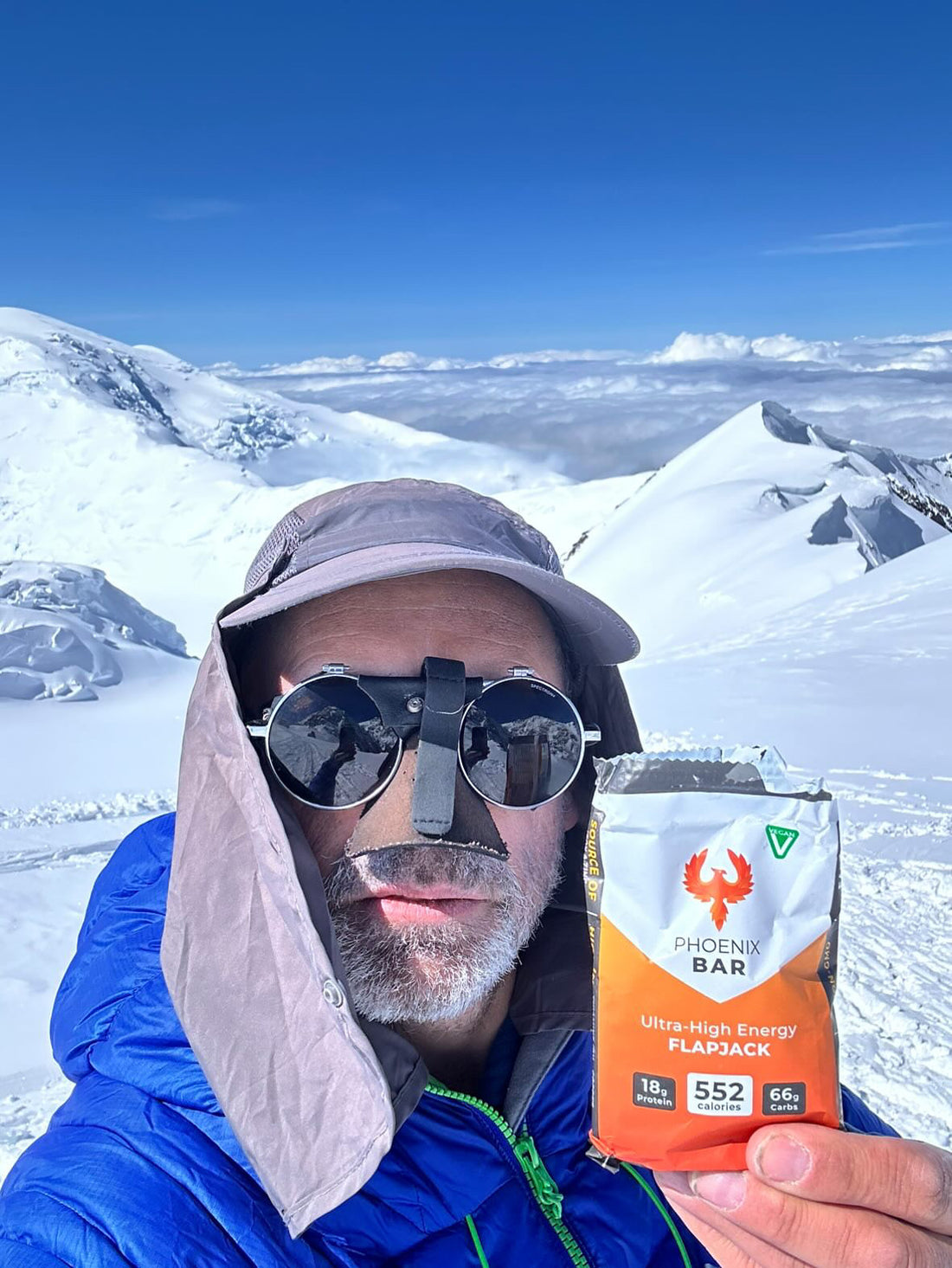
Big calories. Small bar.
Up to 557 calories in a compact, lightweight bar of only 120g, with up to 66g of carbs and 19g of protein. Eat it whole, break it into pieces over a few hours, or mix it with water or milk for porridge.
Easy to eat, easy to digest and not sickly sweet. Customers have eaten them at -45°C and through the heat of the Marathon des Sables, and they keep for up to 2 years, so they work on a mountain, on a night shift, or at home on days when eating enough feels hard.
- 557 calories in only 120g (529 to 557 by flavour)
- 4.6 calories per gram
- 66g carbs per bar (up to)
- 19g protein per bar (up to)
Declare withdrawal
Please fill out the following form to declare your withdrawal from the contract.

