

High calorie granola for weight gain: best buys and a recipe
In this guide

Granola is one of the most calorie-dense breakfast cereals, with UK labels running from about 426 to 634 calories per 100g against 376 for cornflakes. For weight gain, a 60g bowl of a nutty granola with 200ml of whole milk is about 400 calories, and layered with Greek yoghurt, peanut butter and a banana it reaches about 670.
 Written by James Frost, founder of Flaming Phoenix. Updated October 2026.
Brand figures come from the labels on UK supermarket pages, checked in October 2026. Everything else is worked out from McCance and Widdowson's CoFID 2021 food tables; their closest entry to granola, a crunchy muesli-type cereal with nuts, is 450 calories per 100g, and that is the figure used for "a typical nutty granola" below. I started Flaming Phoenix in 2024 after about 150 conversations with endurance athletes, expedition people and people who struggle to eat enough, so dense breakfasts like this are close to home.
Why is granola so high in calories?
Granola is high in calories because nearly every ingredient in it is calorie-dense, and unlike porridge, nothing dilutes it with milk or water. Oats provide a solid carbohydrate base, but the calories climb sharply from the additions. Per 100g, from CoFID:
- Oil, used to crisp it: about 900 calories.
- Nuts: about 550 to 690.
- Desiccated coconut: about 600.
- Pumpkin and sunflower seeds: about 565 to 575.
- Oats: 381.
- Honey or golden syrup, which binds the clusters: about 290 to 300.
- Raisins and dates: about 235 to 255.
Fat carries about 9 calories per gram, more than twice carbohydrate or protein, so the more nuts, seeds and oil a granola has, the higher it goes. That is why granola has a reputation in weight-loss circles, where a "healthy" bowl can easily pass 500 calories. If you are trying to gain weight, that density is exactly what you want. Gram for gram, a basic oat granola such as Jordans Tropical Fruits (426 per 100g) is only about 13% above cornflakes; a nut-heavy grain-free one is about two thirds higher. My guide to calorie-dense foods has the wider picture.
Is granola good for weight gain?
Yes. Granola is good for weight gain because it packs a lot of calories into a small, easy-to-eat serving, and it goes naturally with whole milk and yoghurt, which add protein.
The NHS suggests adding around 300 to 500 calories a day to gain weight gradually. Swapping a 30g bowl of cornflakes with 150ml of semi-skimmed milk (about 180 calories) for 60g of a nutty granola with 200ml of whole milk (about 400) adds about 220, close to half that target before any toppings. My how to gain weight guide covers the rest of the day.
Two things to watch. Granola is lighter on protein than its calories suggest: the labels below run from 10 to 15g per 100g, so a 60g bowl gives only 6 to 9g before the milk. And many granolas carry a lot of sugar: Jordans Tropical Fruits has 22g per 100g against 3.3g for Lizi's Low Sugar. Full-fat milk, Greek-style yoghurt and nut butter fix the protein; the label tells you the sugar.
Which granola is best for weight gain?
The best granola for weight gain is the highest-calorie one you will happily eat most days, which usually means one heavy in nuts and seeds. Four UK granolas, highest first, with labels and prices checked in October 2026:
- The Paleo Foods Co Pecan & Almond Grain-Free Granola: 634 calories and 15.3g of protein per 100g. £5.00 for 285g at Ocado, about 28p per 100 calories. Much the densest, because it is mostly nuts, and the dearest.
- Lizi's Low Sugar Granola: 493 calories and 13.4g of protein per 100g, with 3.3g of sugar. £4.15 for 400g at Sainsbury's, about 21p per 100 calories. "Low sugar" on a granola pack is not the same as low calorie.
- Sainsbury's Spiced Mixed Nuts & Seeds with Apple Granola: 440 calories and 12.4g of protein per 100g. £3.25 for 400g at Sainsbury's, about 18p per 100 calories.
- Jordans Crunchy Oat Granola Tropical Fruits: 426 calories and 10g of protein per 100g, with 22g of sugar. £3.75 for 750g at Tesco, about 12p per 100 calories, the cheapest calories here.
The gap is bigger than it looks in a bowl: 80g is about 340 calories of the Jordans and about 510 of the grain-free granola. Prices move week to week, so treat the pence as a guide. If a pack says "light" or "lower fat", compare its per-100g figure with these before you buy.
How to eat granola for weight gain
Eat granola in a proper portion, 60 to 80g rather than the 40 to 50g suggested on the packs above, and serve it with something that adds protein: whole milk, full-fat Greek-style yoghurt or nut butter. Three bowls, using a typical nutty granola at 450 calories per 100g:
- Granola and milk: 60g of granola with 200ml of whole milk, about 400 calories and 12g of protein.
- Yoghurt layers: 150g of full-fat Greek-style yoghurt with 60g of granola, 20g of peanut butter and a sliced banana, about 670 calories and 19g of protein.
- Big bowl: 80g of granola with 250ml of whole milk, a 30g handful of mixed nuts and a banana, about 770 calories and 24g of protein.
Granola also works as a topping. 30g scattered over high-calorie porridge, a yoghurt or a bowl of high-calorie ice cream adds about 135 calories to something you are already eating. It makes a good high-calorie breakfast alongside eggs or toast, and if you would rather have something soft and made ahead, see my high-calorie overnight oats guide.
A high calorie granola recipe
Making your own lets you load it with nuts and seeds. This batch comes to about 4,060 calories: 14 portions of about 290 calories each, or 10 of about 405.
- 300g rolled oats: 1,140 calories.
- 150g mixed nuts, roughly chopped: 870 calories.
- 50g pumpkin seeds and 25g sunflower seeds: 425 calories.
- 50g desiccated coconut: 300 calories.
- 80g coconut oil or rapeseed oil, melted: 720 calories.
- 120g honey, or golden syrup to make it vegan: 345 to 360 calories.
- 100g raisins or chopped dates, added after baking: 235 to 255 calories.
Mix the oats, nuts, seeds and coconut in a large bowl. Warm the oil and honey together until runny, pour it over and stir until everything is coated. Spread it on a lined baking tray and bake at 150°C (fan 135°C) for 25 to 30 minutes, stirring once halfway, until golden. Leave it to cool completely on the tray, where it crisps up, then stir in the dried fruit and keep it in an airtight jar.
For more calories per spoonful, stir 40g of peanut butter into the warm oil and honey, and add 50g of chopped plain chocolate once the granola is cold. That takes the batch to about 4,560 calories, so each of 14 portions is about 325.
Can granola help when your appetite is low?
It can, because a small serving of something crunchy and full of flavour is often easier to face than a big bowl of something plain. Keep portions small and lean on the additions above rather than a bigger bowl.
If the crunch is tiring, stir granola into yoghurt or warm milk and let it sit for a few minutes so it softens, or see my guide to soft high-calorie foods. Using it as a topping, not a whole meal, as above, adds calories to food you can already manage.
If your appetite has been low for a while, or you are losing weight without meaning to, it is worth speaking to your GP.
Where Phoenix Bars fit
Phoenix Bars have up to 557 calories in only 120g, with up to 19g of protein, and need no bowl, milk or spoon. Broken into pieces over a granola and yoghurt bowl they add calories and a softer bite; on a morning when breakfast is not happening at all, a bar does the job a bowl of granola would. They are vegan and gluten-free, so they suit people who cannot eat standard granola. There is more about our high calorie bars for weight gain on the homepage.
Frequently asked questions
How many calories are in a handful of granola? A 30g handful is about 130 calories of a basic oat granola such as Jordans (426 per 100g) and about 190 of a grain-free nut granola (634 per 100g). Handfuls vary a lot between people, so if you are counting, weigh your usual handful once.
Does granola make you gain weight? Only if it takes your daily total above what you use. Because it is dense, it is easy to pour 80g instead of 45g without noticing, which is about 160 extra calories of a typical nutty granola each time. That is why weight-loss guides warn about it, and why it is useful if you are trying to gain.
Is granola good for bulking? Yes, as a calorie source: 80g of a nutty granola with 250ml of whole milk is about 520 calories. At 10 to 15g of protein per 100g it is not a strong protein source on its own, so pair it with Greek-style yoghurt or milk. My guide to the best high-calorie foods for bulking covers the rest of the plate.
Is homemade granola better than shop-bought for weight gain? Homemade lets you decide how much nut, seed, oil and fruit goes in, and the recipe above works out at roughly 460 to 500 calories per 100g once baked, depending on how much moisture bakes off. A nut-heavy shop-bought granola such as Lizi's Low Sugar (493) gets you to the same place with no baking.
Is high-calorie granola suitable if I am vegan or gluten-free? Yes. Use golden syrup instead of honey in the recipe above to make it vegan, and oats labelled gluten-free to make it gluten-free; my high-calorie gluten-free foods guide has more. Serve it with soya drink or a dairy-free yoghurt.
Sources: McCance and Widdowson's Composition of Foods Integrated Dataset (CoFID 2021), GOV.UK; NHS, Healthy ways to gain weight; product labels at Ocado (The Paleo Foods Co), Sainsbury's (Lizi's Low Sugar), Sainsbury's (Spiced Mixed Nuts & Seeds with Apple) and Tesco (Jordans Tropical Fruits), all checked October 2026.
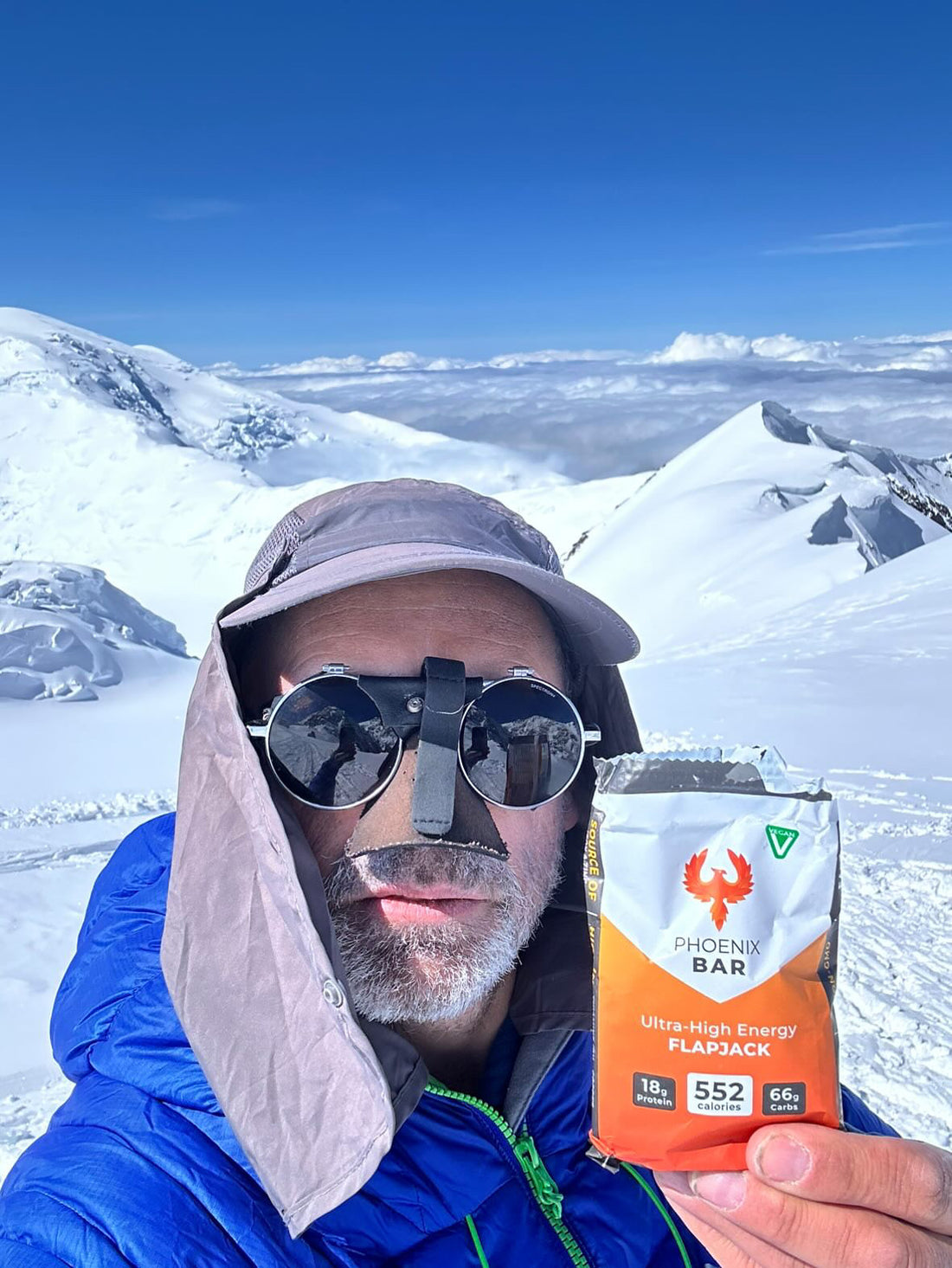
Big calories. Small bar.
Up to 557 calories in a compact, lightweight bar of only 120g, with up to 66g of carbs and 19g of protein. Eat it whole, break it into pieces over a few hours, or mix it with water or milk for porridge.
Easy to eat, easy to digest and not sickly sweet. Customers have eaten them at -45°C and through the heat of the Marathon des Sables, and they keep for up to 2 years, so they work on a mountain, on a night shift, or at home on days when eating enough feels hard.
- 557 calories in only 120g (529 to 557 by flavour)
- 4.6 calories per gram
- 66g carbs per bar (up to)
- 19g protein per bar (up to)
Declare withdrawal
Please fill out the following form to declare your withdrawal from the contract.

