
Easy Ways to Eat More Calories Without Bigger Meals
Quick answer: The easiest ways to eat more calories are to drink some of them, add fat to the food you already eat, and eat a little more often rather than forcing down bigger meals. None of these needs willpower or a larger plate. They work by removing the friction that makes eating enough hard, not by trying harder. For the foods underneath all of this, see calorie-dense foods.
The advice almost everyone gives, just eat more, is the least useful thing you can say to someone who already finds eating enough hard. The people who manage it never rely on willpower. They make the calories easier to get in: as a drink, added to food they were eating anyway, or kept within arm's reach.
Why is eating more calories so hard?
Because the usual approach asks the wrong thing of you. A bigger plate means more chewing, more time and more fullness, which is exactly what stops people halfway. Adding calories without adding bulk sidesteps all of that.
Here is the shift. Adding a tablespoon of olive oil and a handful of grated cheese to a meal you were already making adds around 250 calories and changes nothing about how much there is to get through. That is the whole idea behind every tactic below: more calories, same effort.
What are the easiest ways to eat more calories?
These are ordered roughly from easiest to hardest. You do not need all of them. One or two, done consistently, makes the difference.
Drink some of your calories
Liquids are the single easiest way to add calories, because they go down when food will not and you can sip them over time. A homemade shake of banana, oats, peanut butter and whole milk adds 400 to 600 calories with almost no effort to consume. A glass of whole milk alongside a meal adds about 130. See high calorie drinks and smoothies for recipes.
Add fat to the food you already eat
You do not need new meals, just richer versions of your usual ones. Fat is the lever because it adds the most calories for the least bulk. A tablespoon of olive oil is about 120 calories, a knob of butter around 110, 30g of grated cheese about 125, and a tablespoon of nut butter close to 95. Stir them into meals, spread them thickly, or drizzle them on at the end.
A quiet trick worth knowing: four heaped tablespoons of dried milk powder stirred into a pint of whole milk adds roughly 200 calories, and you can use that fortified milk all day in cereal, drinks, sauces and puddings without noticing it.
Eat a little more often, not more per sitting
If a big meal is hard, three smaller meals plus a couple of snacks are easier than three large plates. Two modest eating moments often feel more manageable than one proper meal, and they add up to the same total or more across the day.

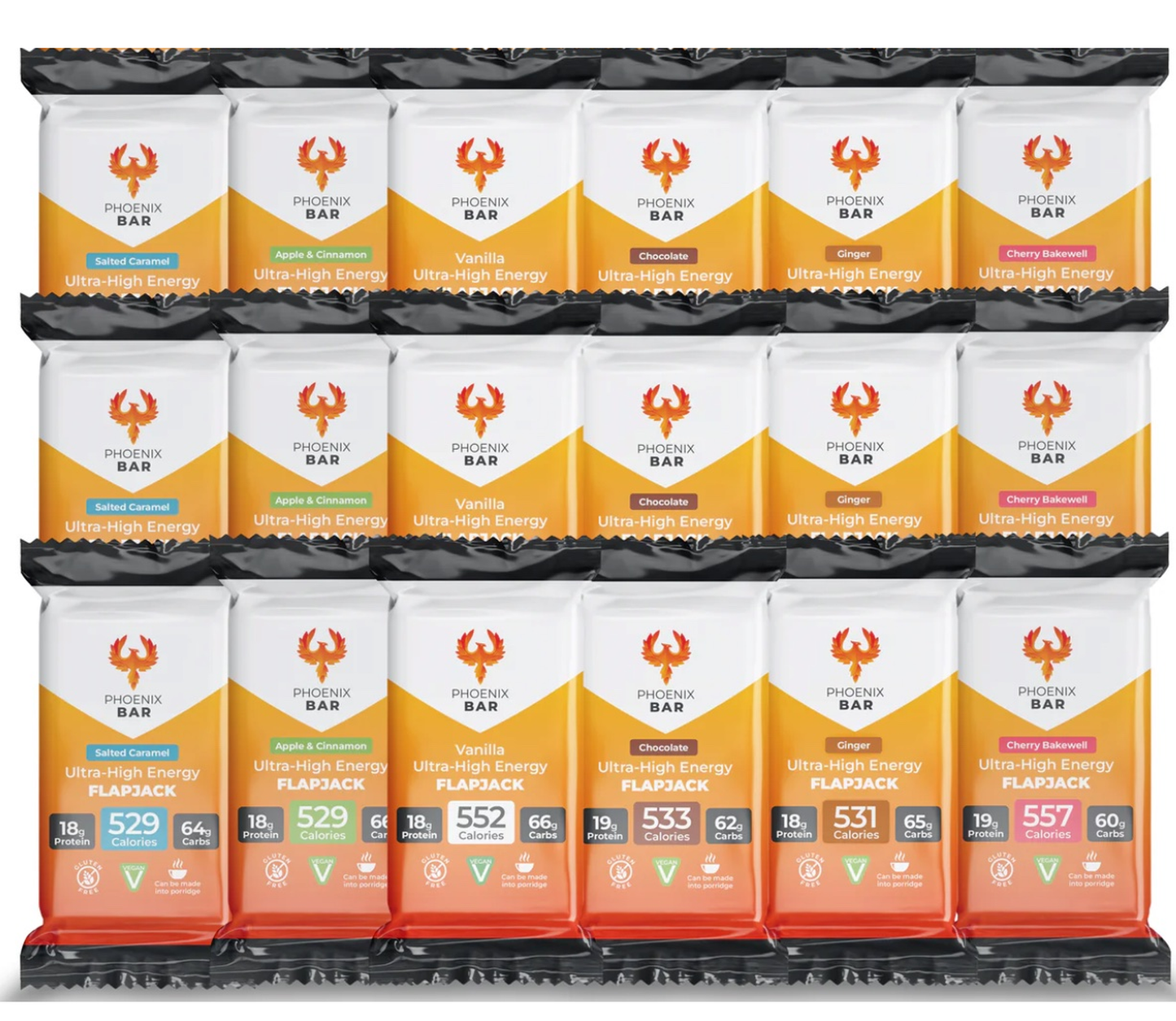
Phoenix Bars: Up to 557 Calories Per Bar
Highly compact, low-volume, calorie-dense bars. Soft, easy to eat whole or as a warm porridge. Vegan, gluten-free and contain up to 66g of carbohydrates, 19g of protein & 8 vitamins & minerals.
Keep dense food within reach
Most missed calories are missed because nothing was to hand at the right moment. Keep calorie-dense, no-prep food visible and portable: nuts, dried fruit, cheese, a flapjack or a bar. If you have to make something, you often will not. If it is already there, you will.
Stop filling up on low-calorie volume
This one is counterintuitive but high value. Drinking a lot of water, or starting with a big salad or low-calorie vegetables, fills the space before the calories arrive. If your aim is more calories, eat the dense part of the meal first while you have the room, and keep large volumes of low-calorie food to a minimum.
Prepare easy options in advance
Friction is the enemy, so remove it ahead of time. Batch cook calorie-dense meals and freeze them in portions, and keep grab-and-go options ready for the days you have no energy to make anything. For more on this, see high calorie snacks.
The easiest single thing you can do
If you take one thing from this page: keep a compact, no-prep, calorie-dense option to hand at all times, so a few hundred calories never depend on cooking or appetite.
This is exactly what the product is for. Each of our high calorie bars packs up to 557 calories into a 120g bar, with no preparation. It is vegan and gluten-free, and the same bar can be stirred into hot water or milk to make porridge. The idea behind our high calorie bars is maximum calories in the smallest, easiest format, which is the same principle running through every tactic above.
What if a full meal is already too much?
If you fill up fast, the priority shifts to getting more calories from a smaller volume rather than eating more often. That is its own approach, covered in more calories without eating more, and in what to eat when you fill up after a few bites. The short version: lean hardest on fat and on drinks, since both add the most for the least bulk.
Frequently asked questions
How can I eat more calories easily?
The easiest ways are to drink some of your calories, add fat to meals you already eat, and keep calorie-dense food within reach. A shake, a spoon of oil or nut butter, or a handful of nuts each adds 100 to 600 calories with very little effort and no larger plate.
What can I add to food to increase calories?
Add fat. A tablespoon of olive oil adds about 120 calories, butter around 110, 30g of cheese about 125, nut butter about 95 per tablespoon, and two tablespoons of cream about 135. Dried milk powder stirred into whole milk is another easy way to add calories invisibly.
How do I eat more when I am not hungry?
Eat smaller amounts more often, drink your calories, and keep the food easy and to hand. A milkshake or a compact bar goes down when a full plate will not, and two small eating moments are usually more manageable than one large meal.
How can I get more calories without eating more food?
Increase the calorie density rather than the volume. Cook with more fat, choose richer versions of what you already eat, and drink calorie-dense fluids instead of water. This is covered in detail in our guide to getting more calories without eating more.
Are liquid calories a good way to eat more?
Yes, for most people they are the easiest. Drinks bypass the chewing and fullness that make solid food hard, and you can sip them slowly. A homemade shake with milk, oats and nut butter can add 400 to 600 calories in one glass.
Related guides
For the foods to build on, see calorie-dense foods. For meals across the day, see high calorie meals. For liquid options, see high calorie drinks and smoothies. For the porridge method and how to eat a bar, see how to use Phoenix Bars.
Written by James Frost, Founder of Flaming Phoenix. James started Flaming Phoenix in 2024 and has spent the years since working out how to get the most calories into the least food, building and testing compact, calorie-dense recipes. He can be reached at jfrost@flaming-phoenix.co.uk. Last reviewed: June 2026.


Flaming Phoenix



Contact Us
Widerruf erklären
Füllen Sie das folgende Formular aus, um Ihre Widerrufserklärung abzugeben.

