
How to Eat 8,000 Calories a Day: The Real Challenge Is Volume, Not Willpower
Written by James, founder of Flaming Phoenix. Last updated June 2026.
Eating 8,000 calories a day is mostly a volume problem, not a willpower problem. You cannot get there on bulky, low-calorie food, because you fill up long before you hit the target. The answer is calorie-dense food, eating little and often, and drinking some of your calories. This is exactly how Tour de France riders and big-expedition athletes do it, and it is a level almost no one outside those worlds will ever need.
Most articles about 8,000 calories a day are written to make you raise an eyebrow at what professional cyclists eat. They list the menus and move on. They never answer the question that actually matters if you need to do this: how on earth do you physically get that much food in? When a Cycling Weekly journalist tried to eat a pro's intake for a single day, he managed 5,726 calories and still ended the day around 1,800 calories short. That is the real story of 8,000 calories, and this guide is about solving it. Griswold Care
Who actually needs 8,000 calories a day?
Very few people, and that is worth being honest about up front. This level of intake belongs to people with genuinely enormous energy expenditure. Grand Tour cyclists are the classic example: at the Tour de France, riders can burn up to 10,000 calories in a single day, and on a hard mountain stage their intake sits somewhere around 6,000 to 8,000 calories. Multi-day ultra-runners, big cold-weather and high-altitude expeditions, and the very largest, hardest-training strength athletes can approach these figures too. Even Michael Phelps in heavy training was reported to eat in the region of 8,000 to 10,000 calories a day. Senior Helpers + 2
If you are not in one of those categories, 8,000 calories a day is not a target to chase, and sustained intake at this level should be guided by a sports dietitian rather than copied from an article. For most people with high energy needs, our 5,000-calorie meal plan or 3,000-calorie meal plan is far closer to what the body actually demands.
Why is eating 8,000 calories so hard?
Because your stomach fills up long before your calorie target does. Eight thousand calories of normal, everyday food is an enormous physical volume, and you simply cannot keep eating once you are full, no matter how disciplined you are. This is the single thing every "what the pros eat" article skips over.
Even the professionals struggle with it. As one Tour team explained, it can be genuinely hard for riders to force food in after a stage, so the food has to look and taste good or they stop eating. The barrier is not motivation. It is capacity, appetite, and the sheer bulk of the food. Solve the volume problem and 8,000 calories becomes possible. Ignore it and you end up like that journalist, eating all day and still falling thousands of calories short. AgingCare.com
The four ways to actually hit 8,000 calories
Eat calorie-dense food, not bulky food. This is the whole game. Calorie density is calories per gram, and the higher it is, the more fuel you get before you feel full. Fats and oils, dense carbohydrates, nut butters, and calorie-dense bars do far more work per mouthful than bulky low-calorie food. Our guide to getting more calories without eating more food is built entirely around this principle, and calorie-dense foods lists the best options.
Eat little and often. Nobody hits 8,000 in three sittings. Pros eat almost constantly, on the bike and off it, in small frequent amounts that never overwhelm the gut. Spreading the load across the whole day is the only way the total adds up.
Drink some of your calories. Liquid calories slip in where solid food cannot. Smoothies, full-fat milk, and recovery drinks let you add hundreds of calories without filling your stomach the way a plate of food does, which is why pros take so much of their energy as drink. Our high-calorie drinks, smoothies and milkshakes guide has recipes for exactly this.
Stop wasting capacity on low-calorie volume. Large amounts of very bulky, low-calorie food fill you up while barely moving your total. When you are chasing 8,000, every bit of stomach space has to earn its place.

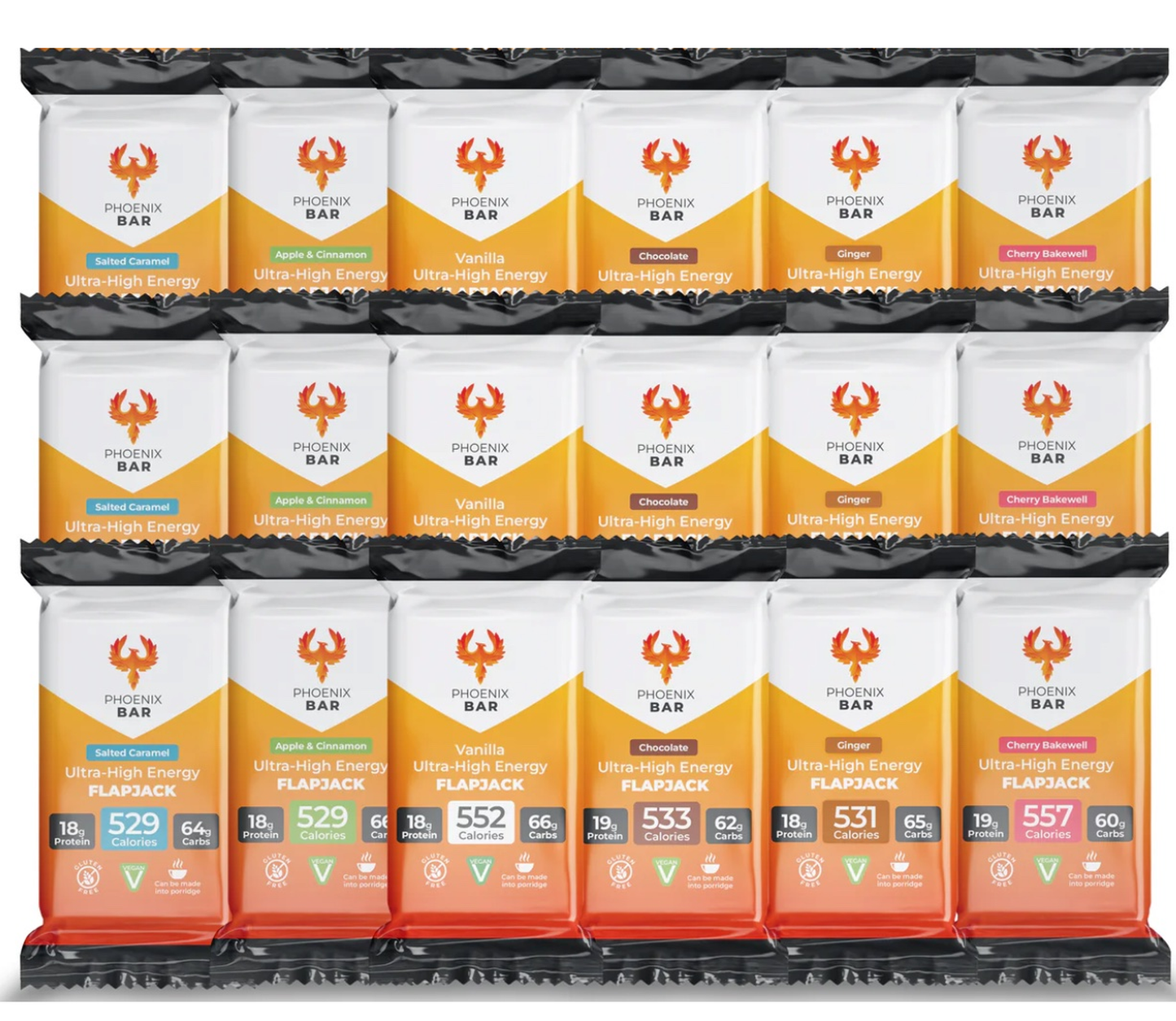
Phoenix Bars: Up to 557 Calories Per Bar
Soft, easy to eat whole or as a warm porridge. Low volume, two-year shelf life.
What 8,000 calories looks like in practice
The professional template is instructive. It starts with a big, carbohydrate-heavy breakfast, then a near-constant stream of compact, easily digestible fuel through the working hours, much of it as bars, gels and drinks, then a large recovery feed, a dense dinner, and snacks into the evening. Without eating these massive quantities, endurance athletes would face extreme weight loss and could not keep performing. Senior Safety Advice
Two themes run through it. Carbohydrate is prioritised, because that is what fuels endurance. And variety matters enormously, because teams deliberately vary colours, flavours and textures so riders do not get bored and stop eating. Boredom is a real enemy at these volumes. The food that keeps tasting good is the food that keeps getting eaten. AgingCare.com
Where calorie-dense food fits, and where Phoenix Bars come in
This is the brief our Phoenix Bars were built to: maximum calories in the smallest, easiest-to-eat package. Each 120g bar is calorie-dense real food, so it adds a serious chunk of your daily total without the bulk of a full meal, and it is easy to eat even when your appetite is fading late in a long day. They come in six flavours, Apple and Cinnamon, Cherry Bakewell, Chocolate, Vanilla, Salted Caramel and Ginger, which is precisely the variety that keeps you eating when boredom sets in, and they are vegan and gluten-free. On a long block, a bar can also be softened into a porridge or eaten alongside a drink to keep the calories flowing. You can see how endurance athletes use them on our how to use Phoenix Bars page, and read hundreds of verified reviews.
How endurance athletes and expeditions hit these numbers
For cyclists, the numbers are matched on the bike, taking in up to 120 grams of carbohydrate an hour from easily digestible bars, gels and drinks, then topping up hard off it. The same approach scales to multi-day ultras, where you fuel continuously rather than in big meals. Our ultra-endurance and expedition nutrition guide and long-distance cycling nutrition guide go deeper on this. Senior Helpers
Cold and altitude make the challenge harder still, because they push your energy burn up while suppressing your appetite, a brutal double bind where calorie density is the only realistic answer. That is why it sits at the heart of our polar expedition nutrition and high-altitude mountaineering nutrition guides.
How extreme mass-gainers approach it
The largest, hardest-training strength athletes face the same volume wall from the other direction: they are trying to hold or build a very big body and cannot eat enough bulky food to do it. Their solution is the same, lean on density and liquids and eat frequently, covered in our best high-calorie foods for bulking guide. As with endurance, 8,000 is only appropriate if your size and training genuinely demand it.
Do you really need 8,000 calories a day?
For the overwhelming majority of people, no, and chasing it without the expenditure to match would simply mean rapid, unwanted weight gain. Eight thousand calories is a number for the extremes of human endurance and size, not a general health or bulking goal. If your training or expedition genuinely demands intake anywhere near this level for an extended period, work with a sports dietitian who can tailor it safely to you. This guide explains how it is physically done, not a recommendation that you do it.
Frequently asked questions
Who eats 8,000 calories a day?
Mainly Grand Tour cyclists, multi-day ultra-endurance athletes, big cold-weather and high-altitude expeditions, and the very largest, hardest-training strength athletes. Tour de France riders can burn up to 10,000 calories a day, which is why their intake climbs this high.
Why is it so hard to eat 8,000 calories a day?
Because you fill up first. That many calories of normal food is an enormous physical volume, and even professionals struggle to force enough in. The fix is eating calorie-dense food, eating little and often, and drinking some of your calories.
How do Tour de France riders eat 8,000 calories?
They fuel almost constantly with compact, easily digestible bars, gels and drinks on the bike, take in large recovery feeds, and prioritise carbohydrate, with teams deliberately varying flavours and textures so riders do not get bored and stop eating.
What foods help you hit 8,000 calories a day?
Calorie-dense foods like fats and oils, dense carbohydrates, nut butters, calorie-dense bars such as a Phoenix Bar, and liquid calories like smoothies and full-fat milk that add energy without filling you up.
Should I eat 8,000 calories a day to bulk?
Almost certainly not. This level is only appropriate if your training or activity burns a comparable amount. For most people aiming to gain, a more moderate surplus is right, and sustained extreme intake should be guided by a professional.
Can you drink your way to 8,000 calories?
Drinks are a big part of how it is done, because liquid calories go in where solid food cannot. Smoothies, milk and recovery drinks let you add hundreds of calories without the fullness of a meal, which is why they are central to the approach.
Related guides
How to Get More Calories Without Eating More Food · Calorie-Dense Foods · 5,000-Calorie Meal Plan · 3,000-Calorie Meal Plan · High-Calorie Drinks, Smoothies and Milkshakes · Ultra-Endurance and Expedition Nutrition Guide
Chasing a big calorie target? See how Phoenix Bars help on the homepage.


Flaming Phoenix



Contact Us
Widerruf erklären
Füllen Sie das folgende Formular aus, um Ihre Widerrufserklärung abzugeben.

