
Bushcraft Food: Why the Calorie Ledger Never Balances on Foraging Alone
By James Frost, founder of Flaming Phoenix and designer of Phoenix Bars. I have spent over two years building calorie-dense field food for expedition teams, ultra athletes, and cold-weather use, sat down with the MOD's head of nutrition on ration design, and had my bars carried to the summit of Everest. Last reviewed June 2026.
The hardest part of feeding yourself in the wild is not finding food. It is that finding food usually costs you more calories than the food gives back. A day of real bushcraft, building shelter, processing firewood, hauling water, moving over rough ground, can burn 3,000 to 4,500 calories or more. A morning of foraging might return a few hundred, and most of what grows around you in Britain is closer to a salad than a meal. So the honest answer to "what do you eat doing bushcraft" is not a foraging list. It is this: plan around a calorie deficit, eat the densest food you can carry, and keep a sealed reserve you never touch unless the day goes wrong. The rest of this page is the accounting behind that sentence.
I find it useful to treat wilderness feeding as a ledger with two columns. On one side, the energy the day takes out of you. On the other, the energy you can actually put back. Bushcraft, more than almost any other outdoor pursuit, is the discipline of keeping that ledger from running too far into the red. Most guides only ever talk about the credit column, the wild food, and quietly ignore what it costs to earn it. That is the error that gets people cold, slow, and stupid by day three.
The debit column: what a day actually costs
Start with what you spend, because it is larger and more predictable than what you can find. Even before you do anything, your body spends its basal rate just keeping you alive. Add the work of bushcraft on top and the number climbs fast. A person carrying a moderate load over uneven ground burns several hundred calories an hour on the move alone, and shelter building, baton work, and digging are closer to manual labour than to a stroll. Across a full day, 3,000 to 4,500 calories is a realistic active figure, and a hard cold day can push higher.
Cold is the line item people forget. A small NOLS study found hikers in roughly minus nine to minus five degrees Celsius burned about a third more calories than the same effort in mild conditions, and your body spends extra energy on heat the moment you stop moving and start to shiver. So winter bushcraft does something cruel: it raises the debit column at the exact moment it empties the credit one. This is the same physiology that makes cold weather so punishing at altitude, which I cover on the high altitude nutrition guide, and it is why thinking in pure calorie density, not volume, matters so much. There is more on that principle on the calorie-dense foods guide.
The credit column: what the land actually pays out
Now the side everyone oversells. The single most important and least taught skill in survival foraging is net energy gain: not "is this edible," but "does eating this leave me better off than the effort of getting it." The UK bushcraft instructor Paul Kirtley makes this point bluntly, and so does every serious survival source: a handful of berries will not pay back the calories you spent walking a mile to reach them. Some classic "wild foods" actually run at a loss. Burdock and dandelion roots can take more energy to dig and prepare than they return. Nettles, greens, and most leafy forage are vitamins and water dressed up as a meal, not fuel.
The food that genuinely pays is narrow and seasonal: fatty nuts, starchy roots and tubers, oily fish, game, and carbohydrate-rich seeds. These exist, but they arrive in feast-and-famine windows. An autumn nut mast or a fish run can briefly put you in surplus. The long stretches between them, and almost the whole of a British winter, leave you with low-calorie scraps while your needs are at their peak. This is why "I will just live off the land" is the line that gets beginners into trouble. You can drink the landscape and graze it, but you very rarely bank a calorie profit from it. For the gentler reality of fuelling ordinary multi-day walking, where resupply exists and the stakes are lower, see the long-distance walking nutrition guide and the broader hiking and trekking nutrition guide.
The line item that balances the book
Here is the part of the ledger that armies worked out a century ago. In 1907 the US Army issued the first "iron ration": three small cakes, three one-ounce chocolate bars, and salt and pepper, sealed in a tin that weighed a pound and lived in the top tunic pocket. It had one rule. You did not open it for hunger, convenience, or a dull menu. You opened it only when normal food was gone and you were on your own. The sealed packet was a calorie reserve, deliberately set outside the daily ledger so it was always there when the day fell apart.
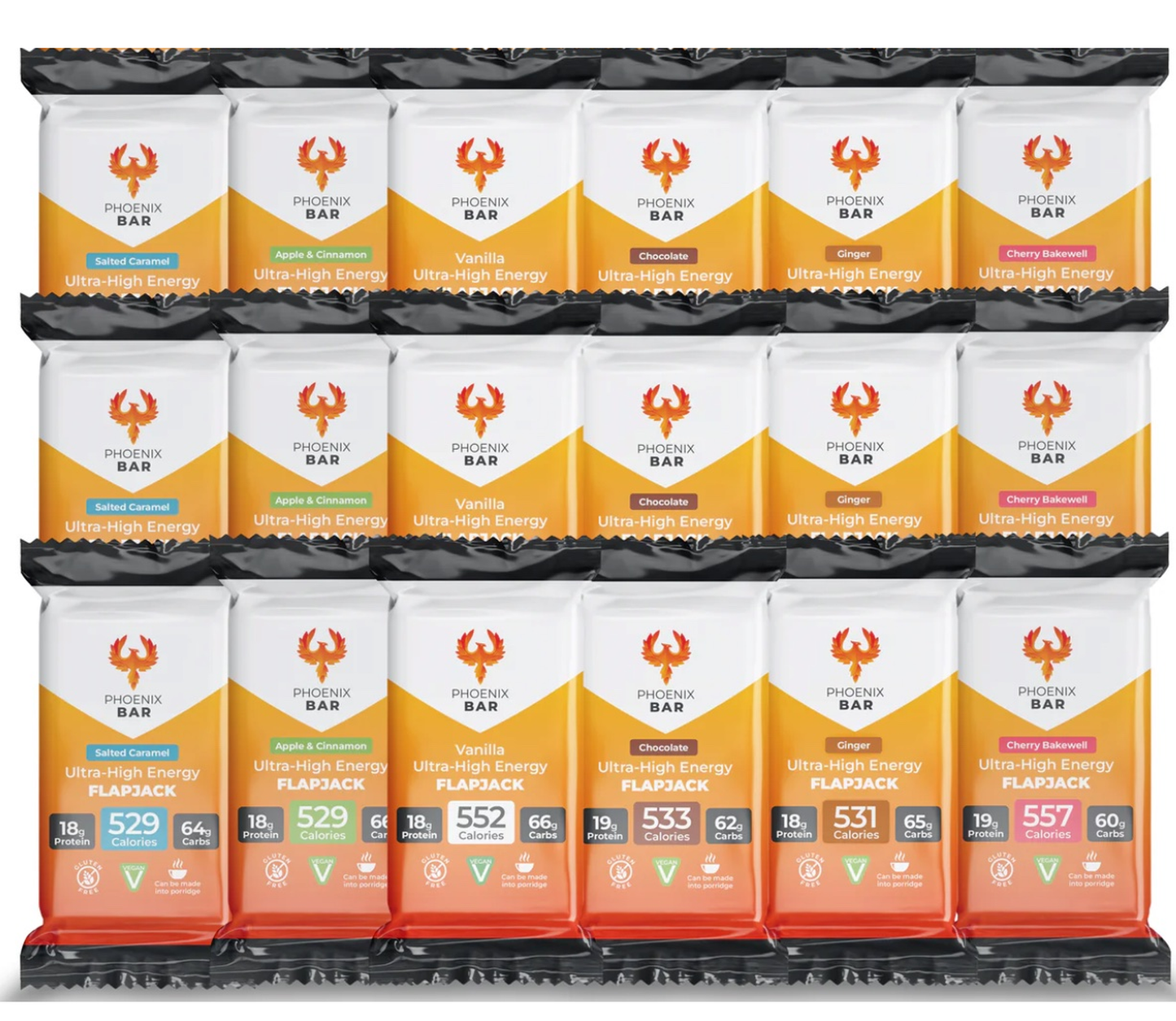
That idea outlived the tin. Modern hikers, climbers, and bushcrafters carry the same concept in a different wrapper: a small, dense, shelf-stable block of calories kept in reserve. That is exactly what I built Phoenix Bars to be. Each one is 120g and carries up to 557 calories, around 4.6 calories per gram, which is roughly double the density of the leafy forage that fills a stomach without paying its way. They are vegan and gluten-free, they keep for two years (the NATO standard for a field ration is a 24-month minimum, so this is genuinely ration-grade), and they take no fire to use. You can eat one cold and broken up in your hand on the move, or, if you do have a fire going, tip one into a mug and add hot water for a hot porridge, which is worth its weight in morale on a cold morning. There is a short guide to both methods on how to use Phoenix Bars.
I will be honest about what a bar is and is not, because pretending otherwise is how you lose trust. It is not a replacement for skills, and it is not dinner. Foraging, fire, and fieldcraft are the point of bushcraft and you should keep practising all of them. The bar is the line item that stops a bad day becoming a dangerous one: the reserve that keeps your decision-making sharp when the credit column has failed and you still have to walk out. Six flavours means it does not become the thing you dread eating either, which matters more than people expect when you are tired and cold: Apple and Cinnamon, Cherry Bakewell, Chocolate, Vanilla, Salted Caramel, and Ginger.
How I would actually pack the ledger
For a single overnight, carry your planned food as dense items and tuck one or two bars away as your untouchable reserve. The 12-bar Starter bundle covers a couple of short trips with reserve to spare. For a two to four day course or wild camp, where the gap between need and forage widens, I would build the daily ration around dense food and keep three to four bars sealed back, which is roughly what the 18-bar Essential bundle is sized for. For longer self-reliant trips, expedition prep, or group use, the 36-bar Complete box gives you a proper reserve and lets you rotate flavours. You can see the full range on the bundles page. The same reserve logic applies to other skills-led, low-resupply pursuits like caving, where a sealed pocket of calories earns its place for the same reason it did in 1907.

Phoenix Bars: Up to 557 Calories Per Bar
Soft, easy to eat whole or as a warm porridge. Low volume, two-year shelf life.
The questions I get asked on courses
Can you really not live off foraging in Britain? For short periods, with luck and the right season, you can take the edge off. As a calorie strategy across a multi-day trip, especially outside autumn, no. The plants that are easy to find are low in calories, and the ones worth real energy are seasonal, scattered, or costly to process. Treat forage as a supplement and morale, not as your fuel.
How many calories does a day of bushcraft burn? For an active adult, plan on 3,000 to 4,500 calories, and add roughly a third again in genuine cold once you account for shivering and heat loss. The exact figure depends on your size, your load, the terrain, and the temperature, but underfuelling by a thousand calories a day shows up fast as fatigue and poor judgement.
What is the best emergency food to carry? Something dense, shelf-stable, and edible with no preparation. The military settled on a sealed high-calorie block over a century ago and the logic has not changed. A 120g bar at up to 557 calories does the job in a jacket pocket.
Do I need to cook it? No. You can eat a Phoenix Bar cold, which is the whole point of a reserve ration. If you have a fire and want something hot, add boiling water to make porridge.
How long does it keep in a pack? Two years, so you can leave one sealed in your kit across a whole season of trips and trust it is still good when you finally need it.
Is it suitable for vegan or gluten-free diets? Yes, every flavour is both, which also makes it straightforward to carry for a mixed group.
I would rather you finished this page slightly less romantic about foraging and slightly more honest about the maths, because that honesty is what keeps people safe in the field. Learn the skills properly, respect the credit column for what it actually pays, and never walk in without the one line item that balances the book. If you want the deeper background on packing density for harder trips, the calorie-dense foods guide goes further, and the simplest first step is to keep a couple of bars from the Starter bundle sealed in your pack before the next one.


Flaming Phoenix



Contact Us
Soumettre une demande de rétractation
Veuillez remplir le formulaire suivant pour soumettre votre demande de rétractation.

