
High Calorie Lunch Ideas: How to Build a Quick, Compact One
Quick answer: A high calorie lunch is a midday meal built mostly from calorie-dense foods, so it delivers more calories from a smaller volume. Start with a starchy base, add a fat layer (olive oil, cheese, nut butter or avocado), then finish with a calorie-dense topping or side. Built this way, a normal-sized lunch can reach 700 to 1,000 calories without becoming a huge plate. For the underlying principle, see calorie-dense foods.
Lunch is the meal most people get least value from. It competes with work, it often has to travel, and a giant plate at midday leaves you heavy for the afternoon. The trick is not eating more food. It is choosing food that carries more calories per mouthful, so a normal-sized lunch quietly does more. Most of that comes down to one thing: fat.
What counts as a high calorie lunch?
A high calorie lunch usually means roughly 600 calories or more, often 700 to 1,000, compared with a typical lunch of around 400 to 600. There is no single correct number. What matters is calorie density: how many calories the food holds for its weight, so you get more from a sensible portion.
This is the part people miss. A shop meal deal of sandwich, crisps and a drink often lands around 700 to 900 calories anyway, but most of that is volume and very little is fat, so it fills you up before it adds up. A smaller lunch built around fat can carry the same calories in half the space.
How do you make a lunch higher in calories?
The reliable method is to layer it. Pick a base, add fat, add a topping, and let a drink carry a few hundred more. Fat is the lever, because it holds more than twice the calories of the same weight of carbohydrate or protein.
Step 1: choose a calorie-dense base
Start with bread, pasta, rice or potato rather than salad leaves. Two thick slices of sourdough are about 280 calories, a 75g dry portion of pasta about 265, and a medium baked potato around 215. The base sets your floor.
Step 2: add a fat layer, this is where the calories are
This single step usually adds the most. A tablespoon of olive oil is about 120 calories, a tablespoon of mayonnaise about 95, half an avocado roughly 150, 30g of cheddar around 125, and a tablespoon of peanut butter close to 95. Two tablespoons of olive oil is about 240 calories and takes up the space of an egg cup. That is the whole point.
Step 3: finish with a calorie-dense topping or side
Add nuts, seeds, hummus, pesto or dried fruit. A 30g handful of cashews is around 180 calories, two tablespoons of hummus about 90, a tablespoon of pesto roughly 90, and 30g of dried apricots about 70. These small additions stack up fast.
Step 4: add a drink that carries calories
Liquids are an easy way to add calories without taking up room on the plate. A glass of whole milk is about 130 calories, and a simple shake of banana, oats, peanut butter and milk can add 400 or more. For recipes, see high calorie drinks and smoothies.
What are some quick high calorie lunch ideas?
Here are six worked lunches, with the components and an approximate total. Adjust portions to suit your appetite.
- A loaded sourdough sandwich: two thick slices of sourdough, a tablespoon of mayonnaise, half an avocado, 30g of cheddar and a side handful of nuts. Around 800 calories.
- Olive oil and pesto pasta: a 75g dry portion of pasta with a tablespoon of olive oil, a tablespoon of pesto and 30g of grated cheese. Around 600 calories, and good cold the next day.
- A jacket potato with the works: a medium-large baked potato with a tablespoon of olive oil or a knob of butter, 40g of cheese and a couple of spoons of hummus. Around 650 calories.
- A creamy soup with a buttered roll: a mug of soup made with whole milk or a swirl of olive oil, plus a crusty roll with real butter. Around 600 calories, and easy on a cold day.
- A salad done properly: leaves and veg with half an avocado, a 30g handful of seeds or nuts, 30g of cheese or a scoop of chickpeas, and a proper olive oil dressing. Around 700 calories. Salad is only low calorie if you build it that way.
- A no-cook desk lunch: a wholemeal pitta with three spoons of hummus, a 30g handful of cashews, a small bag of dried apricots and a banana. Around 650 calories, no cooking, packs flat.
If you want lighter options for the morning instead, see high calorie breakfast ideas. When I swapped meal deals for a compact box like the last one, what surprised me most was how little space 650 calories needs once fat is doing the work.

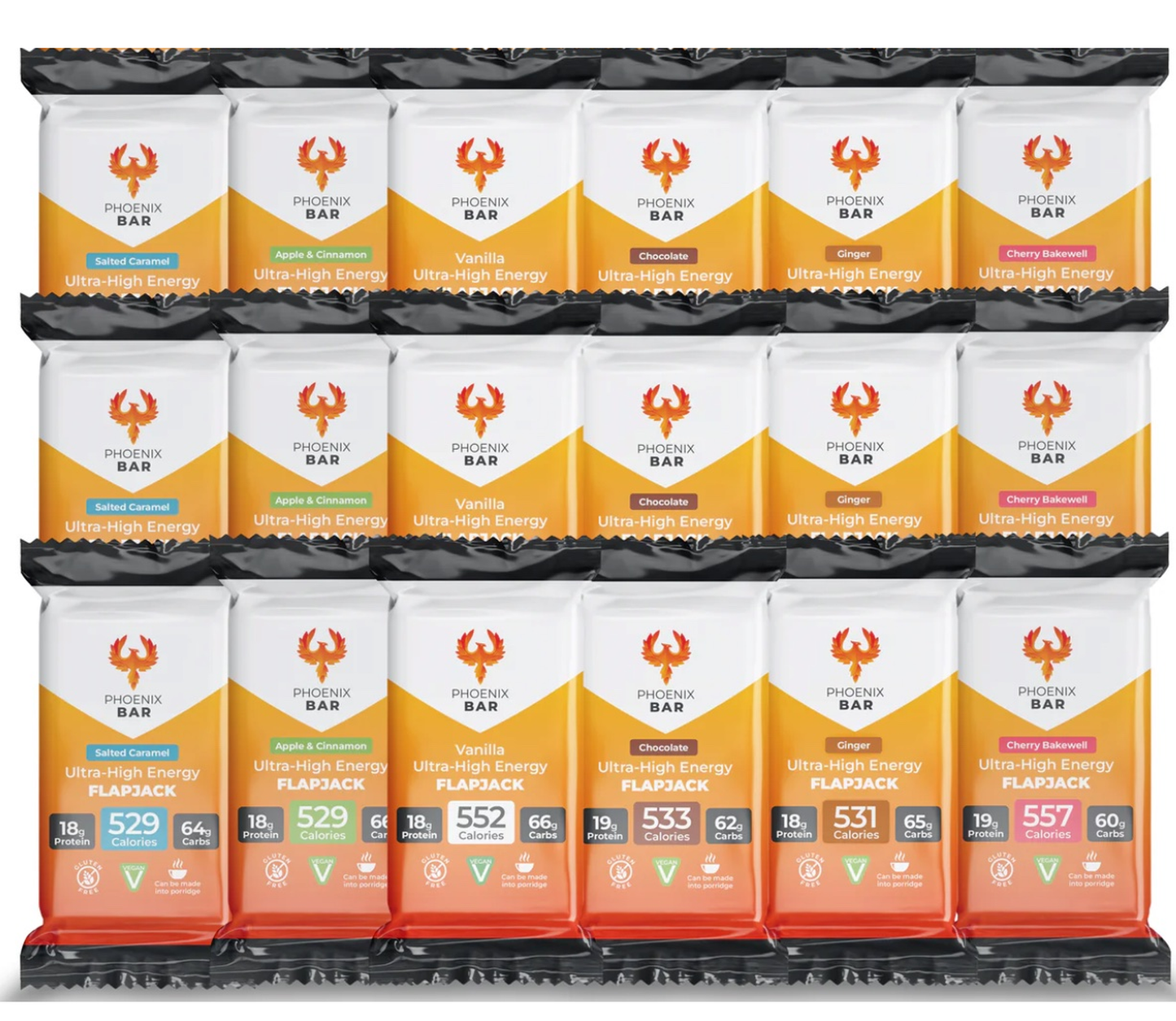
Phoenix Bars: Up to 557 Calories Per Bar
Highly compact, low-volume, calorie-dense bars. Soft, easy to eat whole or as a warm porridge. Vegan, gluten-free and contain up to 66g of carbohydrates, 19g of protein & 8 vitamins & minerals.
What can you eat for a high calorie lunch when you fill up fast?
If a full lunch is too much in one sitting, the fix is not to push through it. It is to make the calories smaller in volume and easier to get down. Choose dense-but-small foods, lean on liquids, and split lunch into two short sittings an hour apart rather than one big plate.
A few practical moves: drink part of your lunch, since a shake or a mug of soup goes down when a sandwich will not; front-load the fat, because a spoon of nut butter or a slice of cheese adds calories without bulk; and keep a compact option to hand for the days a meal feels like a mountain. For more on this, see what to eat when you fill up after a few bites.
This compact problem is exactly what we built the product around. Each of our high calorie bars packs up to 557 calories into a 120g bar, it is vegan and gluten-free, and the same bar can be stirred into hot water or milk to make porridge if you would rather eat it warm and soft. The whole idea behind our high calorie bars is maximum calories in the smallest, easiest format, which is the same thing a good lunch needs to do.
Will a high calorie lunch make you sluggish?
Not necessarily, and it depends more on what the lunch is made of than how many calories it holds. A massive plate of refined carbohydrate on its own is what tends to leave people feeling heavy in the afternoon. Balancing the volume helps: keep the portion sensible, build calories from fat and protein as well as starch, and drink some water alongside.
A compact, fat-led lunch is often easier on the afternoon than a large low-density one, simply because there is less food to sit through. Smaller in volume, similar in calories.
Frequently asked questions
What is a good high calorie lunch?
A good high calorie lunch combines a starchy base, a generous fat layer and a calorie-dense topping, landing around 600 to 1,000 calories. Examples include a loaded sandwich, olive oil pasta, or a jacket potato with cheese and avocado. The aim is more calories from a sensible volume of food.
How many calories should lunch be?
A typical lunch sits around 400 to 600 calories. A high calorie lunch usually means 600 or more, often 700 to 1,000. There is no single right number. It depends on your total daily intake and how hungry you are at midday.
How do I add calories to my lunch without making it bigger?
Add fat, because it carries more than twice the calories of the same weight of carbohydrate or protein. A tablespoon of olive oil, a spoon of nut butter, a slice of cheese or half an avocado each adds roughly 100 to 240 calories with very little extra volume.
What are high calorie lunch ideas for work?
Packable, no-cook options travel best: a loaded wrap or pitta with hummus and avocado, a pasta salad dressed in olive oil and pesto, oatcakes with nut butter, or a compact bar. Assemble at home, keep it in a lunchbox, and pair it with a calorie-dense drink.
What is a high calorie vegan lunch?
Plant foods can be very calorie-dense: olive oil, nut butters, avocado, hummus, tahini, nuts, seeds, coconut and dried fruit. A vegan high calorie lunch might be a tahini and roasted veg wrap, peanut noodles, or pasta with olive oil and toasted pine nuts, easily reaching 700 calories.
Are high calorie lunches unhealthy?
Not by definition. Calorie density describes how much energy a food holds for its weight, not its quality. Nuts, seeds, olive oil, avocado and wholegrains are all calorie-dense, and plenty of calorie-dense lunches are built from whole, minimally processed foods.
Related guides
For the morning, see high calorie breakfast ideas. For smaller bites, see high calorie snacks. For liquid options, see high calorie drinks and smoothies. For the porridge method and how to eat a bar, see how to use Phoenix Bars.
Written by James Frost, Founder of Flaming Phoenix. James started Flaming Phoenix in 2024 and has spent the years since working out how to get the most calories into the least food, building and testing compact, calorie-dense meals. He can be reached at jfrost@flaming-phoenix.co.uk. Last reviewed: June 2026.


Flaming Phoenix



Contact Us
Soumettre une demande de rétractation
Veuillez remplir le formulaire suivant pour soumettre votre demande de rétractation.

