
Drop Bags and Aid Stations: How to Pack for the Wrecked Version of You
By James Frost, founder of Flaming Phoenix. I make the kind of dense, no-fuss food that ends up in a lot of drop bags, and I have spent a long time talking to the ultra runners who pack them about what actually gets eaten out on the course and what comes home untouched. I am not a coach, and your race brief always overrides general advice, but this is the practical version. Last reviewed June 2026.
A drop bag is a bag of your own food and kit that the race transports to a designated point on the course, so you can resupply partway through without carrying everything from the start. An aid station is the staffed checkpoint where you refill water and take whatever the race provides. Used well, the two together let you run a long race almost as if you had a crew. The single principle that makes them work is this: you are not packing for the person standing in the kitchen the night before, fresh and clear-headed. You are packing for a stranger, the tired, queasy, cold, brain-fogged version of you who will reach that bag many hours and many miles from now. Almost every good drop bag decision, and every aid station mistake, comes back to whether you packed for present you or future you. Get that right and the rest is detail.
The mistake that sinks most drop bags
The classic error is packing what sounds good while you are fresh. You stand at the kitchen table feeling fine, and you fill the bag with the sweet gels and bars that taste great right now. Then you arrive at mile sixty in the dark, your stomach has turned, sweet has become repulsive, your hands are cold and clumsy, and your brain has stopped making decisions. None of what you packed appeals, and the one thing you would kill for, something savoury, warm, and easy, is not there. Future you is a different person with different needs, and the whole skill of packing is anticipating them: that sweet will likely sicken you, that you will be colder and slower than you think, that flavour fatigue is coming, and that you will want food you can look forward to, not just fuel. If you have ever wondered why your stomach quits halfway, the mechanism is on the mid-race nausea and appetite loss guide, and packing for it is half the cure.
What an aid station actually gives you, and what it does not
Aid stations vary, but most provide water, a sports drink, gels, fruit, boiled potatoes with salt, crisps, sweets, biscuits, and often soup and flat cola later on. Check the race's published aid station list before you pack, because it tells you what you can rely on and what you cannot. The thing to understand is that you should never depend on aid station food entirely. Tables get picked over by the time mid and back-of-pack runners arrive, the sports drink may be a brand that does not settle for you, and a stomach deep into an effort is fussy in ways it never is in training. So carry and stash your own food that you have trained on and know your gut tolerates, and treat the aid station spread as a bonus rather than a plan.
The other trap at aid stations is time. Minutes spent grazing and faffing add up to a startling amount over a long race, and the chair is where races quietly end. The fix is to arrive with a plan: in the few minutes before you reach a station, run the next section through your head so you know exactly what you need, then move through in a fixed sequence and leave. That said, the aid station is also where you catch up, because most people who blow up have simply got behind on calories without noticing, so do not leave under-fuelled in the name of speed. If it is hot, take the extra minute to cool down, because dropping your core temperature sends blood back to your gut and often brings your appetite back with it.
Building a drop bag that works
The cleanest way to pack is in layers, so every bag has the same dependable core and then whatever that specific point on the course demands. The base layer goes in every bag: your own nutrition for the next section plus a little spare, electrolyte capsules, a spare soft flask, a small blister and tape kit, wipes, a little anti-chafe, and any personal medication. The conditions layer is packed bag by bag for what you will actually meet there. Bags you will reach in the dark get a headtorch and spare batteries, warm layers, gloves, and heartier, warmer food. Later bags can hold a change of socks and a pair of shoes half a size up, since feet swell over distance, and poles for the climbs that always feel worse late on. Hot, exposed sections get sunscreen and a cooling option. The trick is to estimate your arrival time at each bag, including the slow-down that always happens, and pack for the weather you will hit then, not the weather at the start, because a course that is warm at midday can be bitter by night.
On top of those goes a small comfort layer, because morale is a real resource this far into a race. A clean dry top, a treat you will look forward to, even a daft note to yourself, all do more for future you than their weight suggests. Then handle the logistics so the bag actually works when you are wrecked: use a bright, waterproof dry bag so you can spot it among a hundred others, label it in big letters with your name, race number, and the aid station, and add inbound or outbound if the course passes the same point twice. Organise the inside into labelled freezer bags by section so a tired brain or a volunteer can find things fast, keep liquids in leak-proof containers, and never pack anything you genuinely cannot afford to lose, because drop bags usually come back but are never guaranteed.
The food that actually survives the day
Drop bag food has a harder job than training food, because it has to still be appetising and intact after a hot day in a tarpaulin field, and it has to appeal to a stomach that has turned. A few principles hold. Make it calorie-dense, so the weight and space in the bag buy energy rather than bulk, which is the same logic as the calorie-dense foods guide. Make sure it will not spoil or melt into a mess. Lean on real food rather than only gels, because by halfway the constant hit of concentrated sugar is exactly what turns a gut sour, a case made in full on the energy gel alternatives guide. Pack across sweet and savoury, with a couple of different things to look forward to, so flavour fatigue always has somewhere to turn. And front-load real calories into your earlier bags, while your stomach still works well, before the inevitable drift toward simpler fuel later on.
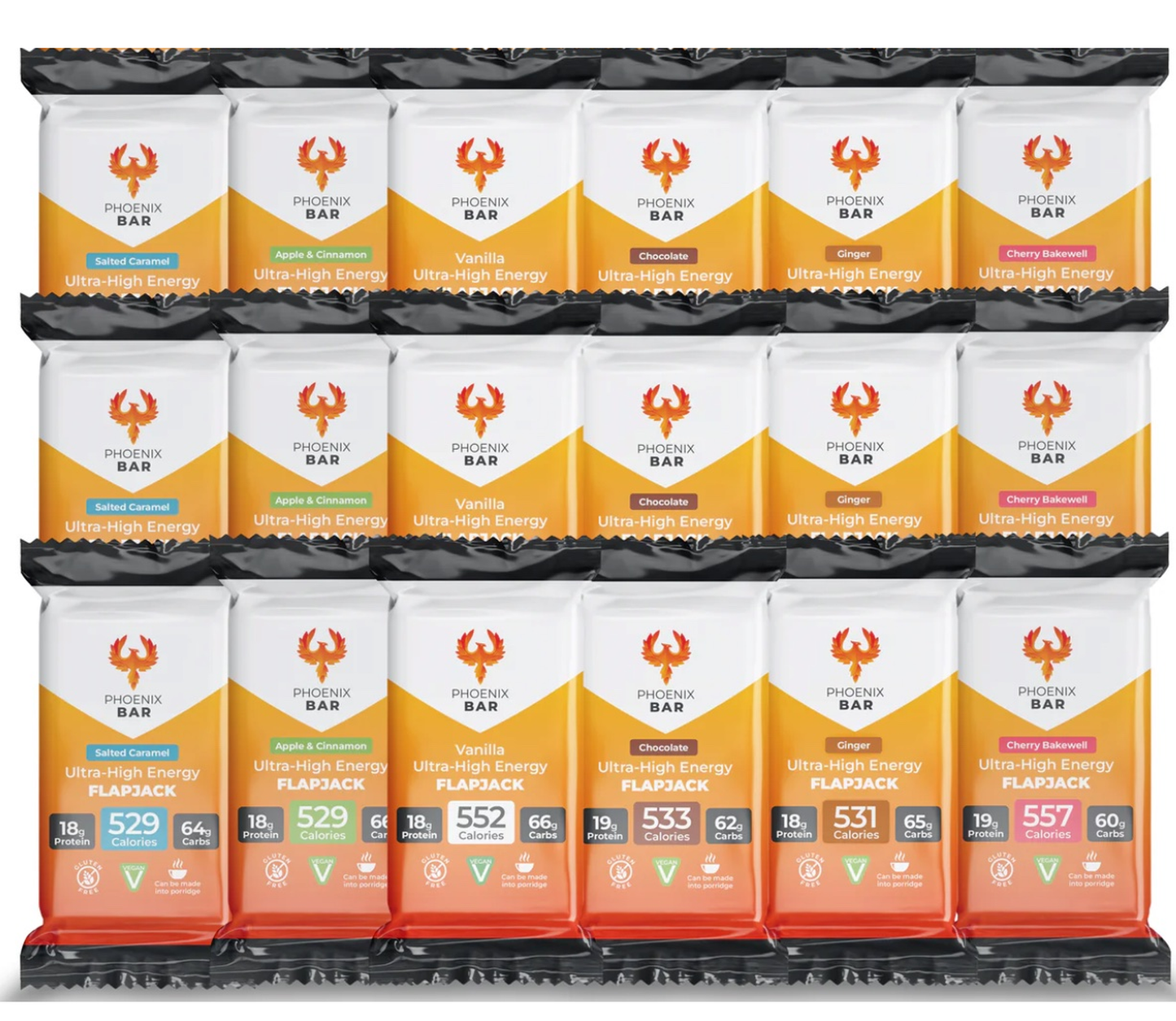
This is the job I built Phoenix Bars to do. Each one packs up to 557 calories into a compact bar of only 120g, so a drop bag full of them is a drop bag full of energy rather than air, and they are low-bulk enough to tuck several into a section without bloating the bag. They do not melt in the heat or turn to crumbs, and because they keep for two years, you can build your bags days ahead, reuse whatever you do not open across a whole season, and trust they are still good. They are real food in six flavours, which beats flavour fatigue and gives you something to actually want, and when you reach a night aid station with hot water, a bar stirred into a warm porridge becomes the soft, warm, morale-lifting food that future you will be desperate for, while still being eaten cold and broken up the rest of the time. There is a quick guide to both on how to use Phoenix Bars. They are not the whole bag, you still need your kit, fluids, and electrolytes, but they are the part of it most likely to get eaten. For stocking several bags or a season of races, the 36-bar Complete box spreads furthest, while the 18-bar Essential suits a single big race and the 12-bar Starter bundle lets you trial flavours in training first.

Phoenix Bars: Up to 557 Calories Per Bar
Soft, easy to eat whole or as a warm porridge. Low volume, two-year shelf life.
The aid station routine
Tie it together with a routine you can run on autopilot, because autopilot is all you will have late on. As you approach, picture the next section and decide what you need. At the station, refill your fluids first, restock your pockets with enough food to cover the gap to the next stop, then eat or drink something there and then. Deal with feet or chafe only if they actually need it, grab anything from your drop bag for the conditions ahead, and leave. Catch up on calories before you go, cool off if it is hot, and keep moving. The runners who finish are rarely the ones with the cleverest kit. They are the ones who never let a rough patch become a long sit-down, and who kept quietly feeding future you the whole way. How this fits into the wider fuelling picture is on the multi-day ultra running guide and the trail running guide, and if you fuel plant-based, your own bag matters even more, which is covered on the vegan endurance nutrition guide.
Common questions
What is a drop bag and how does it work? It is a bag of your own food and gear that the race transports to a designated aid station, so you can resupply partway round without carrying everything from the start. You hand it in before the race, and staff take it to the points the race director specifies.
What should I put in an ultramarathon drop bag? A dependable core in every bag (your own nutrition for the next section plus spare, electrolytes, a spare flask, a small blister and chafe kit), plus conditions-specific items for that point such as a headtorch and warm layers for night, a change of socks or shoes later on, and sunscreen for hot sections. Add a small morale item, and label everything clearly.
What food is best for a drop bag? Calorie-dense food that will not spoil or melt, leans on real food rather than only gels, and spans sweet and savoury so flavour fatigue has options. A 120g bar carrying up to 557 calories, that keeps for two years and can be eaten cold or made into warm porridge, fits the brief on every count.
Can I rely on aid station food alone? No. Tables get picked over, the sports drink may not suit your stomach, and a tired gut is fussy. Use the aid station as a bonus, and carry and stash food you have trained on and know you tolerate.
How long should I spend at an aid station? As little as you can while still doing the essentials. Arrive with a plan, move through in a fixed order, and avoid sitting down for long. The exception is nutrition: do not leave under-fuelled, because getting behind on calories is what ends most races, not the minute you saved.
Are Phoenix Bars good drop bag food? Yes. They are calorie-dense and low-bulk, they do not melt or spoil, they keep for two years so you can pack bags ahead and reuse them, they come in six flavours to beat flavour fatigue, and they work eaten cold or stirred into a warm porridge at a night aid station.
The whole game is anticipation. Pack the bag for the person who will open it, not the one filling it, and you will arrive at each point with exactly what tired, cold, sick-of-sweet future you actually wants. That is the difference between a drop bag that rescues your race and one that comes home full. If you want to keep going, the energy gel alternatives guide and the mid-race nausea guide pair naturally with this one, and a mixed-flavour Starter bundle is the simplest way to test what your stomach will still want at hour twelve.


Flaming Phoenix



Contact Us
Soumettre une demande de rétractation
Veuillez remplir le formulaire suivant pour soumettre votre demande de rétractation.

