
High Calorie Meals: What They Are and How to Build One
Quick answer: A high calorie meal is one built mostly from calorie-dense foods, so it delivers more calories from a smaller portion. The principle is the same at every meal: start with a calorie-dense base, build calories in with fat such as oil, butter, cheese or nut butter, then finish with a rich topping or a drink. Done this way, a normal-sized meal reaches 700 to 1,000 calories without becoming a huge plate. For the foods this is built on, see calorie-dense foods.
This page is the overview. It covers the one idea that runs through every high calorie meal, then points you to the right guide for each meal of the day, where the specifics live.
I have spent years working out the smallest, easiest way to get more calories into a meal, and across breakfast, lunch and dinner it always comes back to the same lever: fat, added during cooking or assembly, where it adds calories without adding bulk.
What makes a meal high in calories?
Calorie density. That is how many calories a food holds for its weight. A meal is high in calories not because there is more of it, but because what is in it is concentrated.
Fat is the reason. It holds more than twice the calories of the same weight of carbohydrate or protein, so a spoonful of oil, a slice of cheese or a dollop of nut butter changes the calorie total far more than another serving of vegetables would. This is why a small, rich meal can carry as many calories as a large, plain one.
How do you make any meal higher in calories?
Three moves cover almost every meal. The ingredients change by meal, but the method does not.
Start with a calorie-dense base. Bread, pasta, rice, potatoes or oats give you a solid floor to build on, rather than starting from salad leaves.
Build the calories in with fat. This is the big one. Cook in oil or butter, make the sauce a creamy or oily one, spread it thickly, or stir in nut butter. A tablespoon of olive oil is about 120 calories, 30g of cheese around 125, and two tablespoons of peanut butter about 190, none of which adds much bulk.
Finish with a rich topping or a drink. Nuts, seeds, cheese, a drizzle of oil, or a calorie-dense drink alongside top the meal up. A glass of whole milk adds about 130 calories on its own.
The specifics differ by meal, which is what the guides below are for.

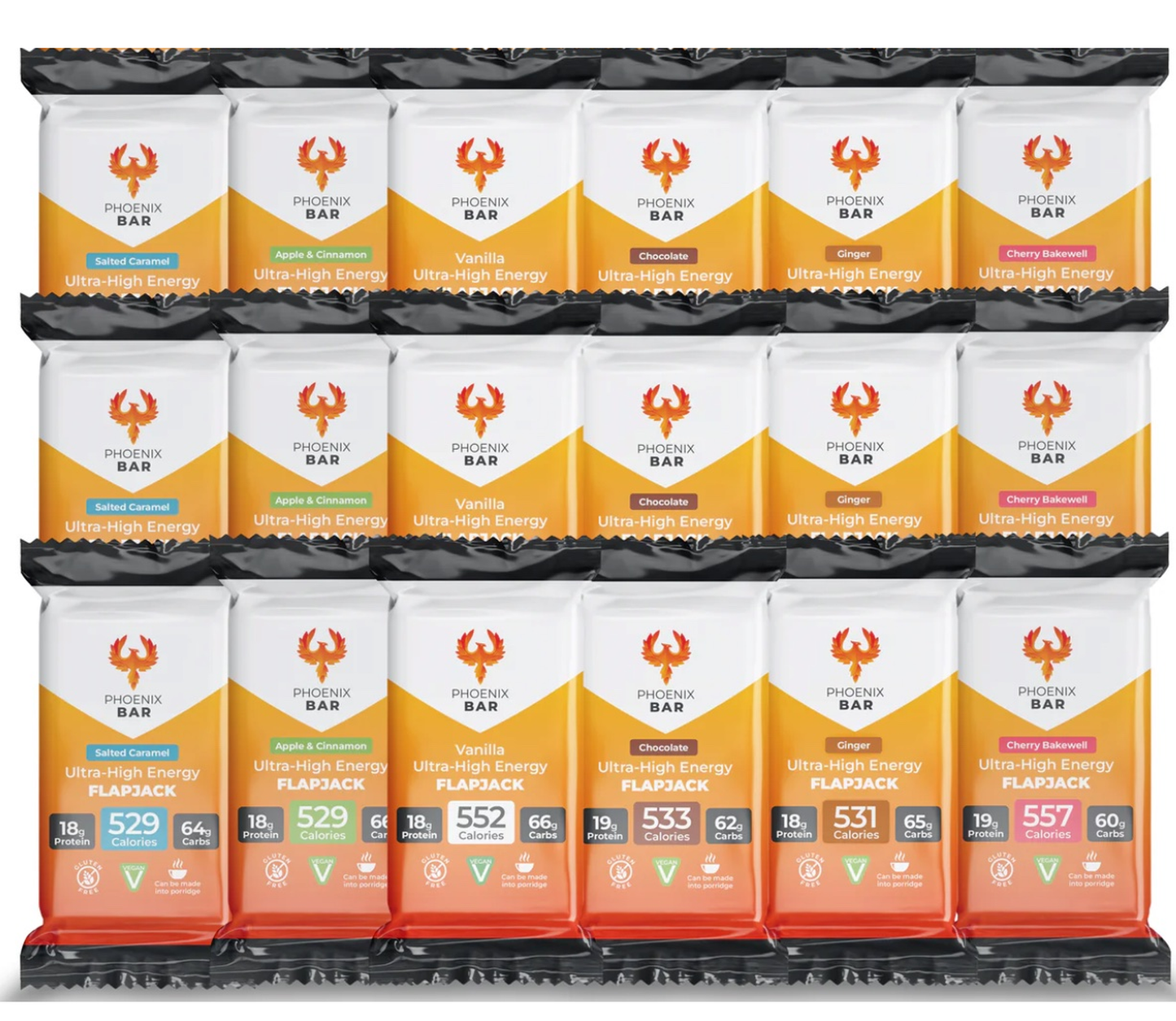
Phoenix Bars: Up to 557 Calories Per Bar
Highly compact, low-volume, calorie-dense bars. Soft, easy to eat whole or as a warm porridge. Vegan, gluten-free and contain up to 66g of carbohydrates, 19g of protein & 8 vitamins & minerals.
What does a high calorie day look like?
Here is how the meals fit together across a day, with a rough figure for each. Follow the links for the detailed version of each one.
Breakfast sets the tone, and it is easy to make dense with oats, whole milk and nut butter. A bowl of overnight oats lands around 650 calories. See high calorie breakfast ideas.
Lunch is the meal that has to travel, so it pays to make it compact. A loaded sandwich with avocado and cheese is around 800 calories. See high calorie lunch ideas.
A snack or two between meals does quiet, steady work. A yoghurt pot with granola and nuts is around 400 calories. See high calorie snacks.
Dinner is the easiest meal to add calories to, because you are cooking it and can build the fat in. A coconut chickpea curry with rice is around 850 calories. See high calorie dinner ideas.
Dessert is the simplest and most pleasant top-up, already built around fat and sugar. A rich pudding or a milkshake is around 500 calories. See high calorie desserts.
That comfortably passes 3,000 calories across the day without any meal being enormous. If you want a structured plan built around a daily figure, see the 3,000 calorie meal plan. For liquid calories at any point, see high calorie drinks and smoothies.
What if a full meal is too much?
If a full plate is too much, the answer across every meal is the same: make the calories smaller in volume rather than forcing down more food. A smaller portion of the densest part of the meal, a drink in place of a plate, or a compact option to hand all add calories without the bulk.
This is the harder version of the problem, and it has its own guide. See what to eat when you fill up after a few bites.
It is also the problem the product was built for. Each of our high calorie bars packs up to 557 calories into a 120g bar, it is vegan and gluten-free, and a bar can be stirred into hot water or milk to make porridge. The whole idea behind our high calorie bars is maximum calories in the smallest, easiest format, which is what every meal on this page is trying to do.
Are high calorie meals unhealthy?
Not by definition. Calorie density describes how much energy a meal holds for its weight, not its quality. Plenty of calorie-dense meals are built from whole foods: oats, nuts, nut butter, olive oil, full-fat dairy, eggs, beans and wholegrains.
A lot of advice online treats high calorie and unhealthy as the same thing and steers you towards lighter options. If your aim is the opposite, to take in more calories, then rich meals made from real ingredients are the straightforward way to do it.
Frequently asked questions
What is a high calorie meal?
A high calorie meal is one built mostly from calorie-dense foods, so it delivers a lot of calories from a normal-sized portion. It usually means roughly 700 calories or more for a main meal. The calories come mainly from fat: oil, butter, cheese, cream, nut butter, nuts and full-fat dairy.
How do I make my meals higher in calories?
Add fat. Cook in oil or butter, make sauces creamy, spread things thickly, stir in nut butter, and finish with cheese, nuts or a drizzle of oil. Each of these adds 100 to 200 calories with very little extra volume, so the portion stays the same size.
What are some high calorie meal ideas?
Overnight oats with peanut butter for breakfast, a loaded sandwich for lunch, a coconut curry or pasta bake for dinner, and a rich pudding for dessert. Each leans on a calorie-dense base plus added fat. The meal-by-meal guides on this page cover each in detail.
What are cheap high calorie meals?
The cheapest calorie-dense staples are oats, rice, pasta, potatoes, eggs, beans, lentils, peanut butter and whole milk. Build meals on these, add oil for extra calories, and batch cook to save time and money. A rice bowl with beans, cheese and olive oil is filling, cheap and calorie-dense.
How can I do high calorie meal prep?
Batch cook calorie-dense bases like rice, pasta and curries, then portion and freeze them. Keep quick add-ons to hand, such as cheese, nut butter, oil and nuts, so you can lift the calories of any reheated meal. Curries, stews and pasta bakes all freeze and reheat well.
What is a high calorie vegan meal?
Plant foods can be very calorie-dense: olive oil, coconut milk, nut butters, tahini, avocado, nuts, seeds and dried fruit. A vegan high calorie meal might be a coconut chickpea curry, peanut noodles, or pasta built on olive oil, each easily reaching 700 to 850 calories.
Related guides
For each meal in detail, see high calorie breakfast ideas, high calorie lunch ideas, high calorie dinner ideas and high calorie desserts. For the foods underneath it all, see calorie-dense foods. For the porridge method and how to eat a bar, see how to use Phoenix Bars.
Written by James Frost, Founder of Flaming Phoenix. James started Flaming Phoenix in 2024 and has spent the years since working out how to get the most calories into the least food, building and testing compact, calorie-dense meals. He can be reached at jfrost@flaming-phoenix.co.uk. Last reviewed: June 2026.


Flaming Phoenix



Contact Us
Soumettre une demande de rétractation
Veuillez remplir le formulaire suivant pour soumettre votre demande de rétractation.

